Image source: wikiart.org
Introduction
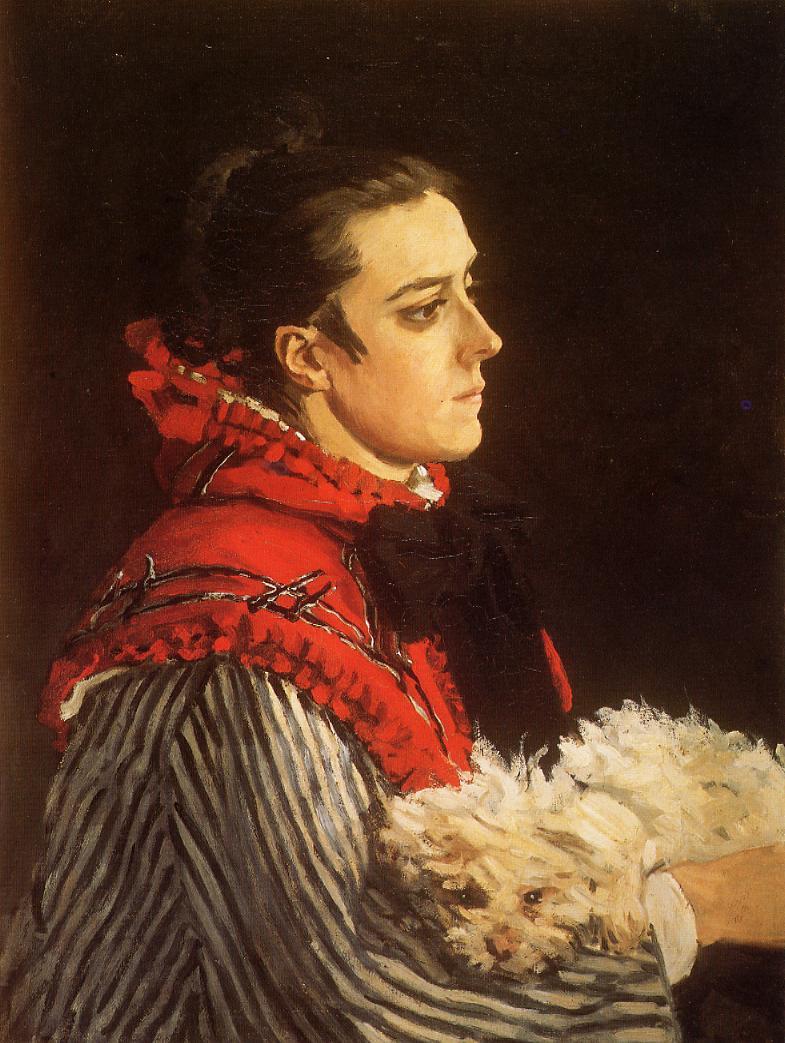
Claude Monet’s Camille with a Small Dog from 1866 is a fascinating early portrait that reveals how much sensitivity, confidence, and ambition the artist already possessed before Impressionism fully emerged as a movement. At first glance, the painting appears simple. A young woman is shown in profile against a dark background, dressed in a striped garment with vivid red accents, while a small white dog rests across her arms. Yet the longer one looks, the more complex the work becomes. This is not just a likeness of a woman with a pet. It is a study in personality, mood, texture, color contrast, and modern presence.
The subject is Camille Doncieux, Monet’s companion and later his wife, one of the most important figures in his early life and art. She appears here not as an idealized mythological figure or a grand historical heroine, but as a real modern woman. Even so, Monet gives her a dignity and gravity that make the portrait feel far larger than its modest premise. Her profile is composed and self contained, her expression serious, and her pose almost sculptural. The dog introduces softness and domestic warmth, but it does not dissolve the painting’s introspective intensity.
What makes this work especially compelling is the tension it holds between intimacy and formality. Monet clearly knew his sitter deeply, yet he did not reduce her to sentiment. He presents her with restraint, structure, and remarkable visual intelligence. The result is a portrait that feels both personal and poised, both immediate and carefully composed. It stands as an important example of how Monet could engage portraiture on his own terms, using light, color, and brushwork not simply to describe appearance, but to shape emotion and atmosphere.
The First Visual Impression
The painting makes a strong impression because of its clarity and focus. Monet places Camille against a dark, nearly empty background, allowing her figure to dominate the composition. There are no distracting details, no elaborate setting, and no decorative objects competing for attention. Everything serves the central figure. This creates a direct encounter between viewer and subject, even though Camille is not looking outward. Her profile turns away, but the painting still feels immediate because her presence is so clearly defined.
The use of profile is especially important. A frontal portrait might invite easy connection through eye contact, but Monet chooses a more reserved approach. Camille’s turned head gives her an air of inwardness. She seems thoughtful, distant, perhaps even unreachable. This choice gives the painting much of its emotional character. It encourages the viewer to study her outline, expression, and posture rather than searching for narrative clues in her gaze.
The contrast between the vivid reds in her clothing and the deep brown background immediately draws the eye. The red fabric around her shoulders and neck acts almost like a visual frame for her face. It creates warmth and urgency around the calm, pale tones of her skin. The small dog, rendered in soft whites and creams, provides another point of focus. Its fluffy coat breaks the darker and sharper forms of the costume, adding texture and tenderness.
The overall effect is both elegant and intense. Monet strips away anything unnecessary and lets color, silhouette, and expression do the work. This economy of means is one of the painting’s strengths. It feels concentrated, deliberate, and visually memorable.
Camille as Subject
Camille Doncieux appears throughout Monet’s early work, and she was clearly one of his most important models. In Camille with a Small Dog, however, she is not presented merely as a convenient sitter. She becomes the emotional center of the painting. Monet studies her with care, but also with a certain reserve. He does not sentimentalize her features or exaggerate her softness. Instead, he allows her seriousness to remain intact.
Her profile is strong and distinctive. The line of the forehead, nose, lips, and chin is sharply observed, and Monet pays close attention to the way light touches the face. The result is not ideal beauty in the academic sense, but character. Camille looks intelligent, self possessed, and quietly remote. There is even a hint of tension in her expression, as if her thoughts are elsewhere.
This seriousness matters because it separates the portrait from lighter genre scenes of fashionable women with pets. The small dog could easily have turned the picture into something charming and decorative, but Monet refuses that easy solution. Camille remains dominant. The dog is secondary, almost incidental, despite its visual softness. What lingers in the mind is her face, her stillness, and the emotional ambiguity of her pose.
Monet’s treatment of Camille also suggests the complexity of personal portraiture. When an artist paints someone close to him, the result can become overly affectionate or overly descriptive. Here Monet finds a balance. He shows familiarity through attention and intimacy through closeness, but he also maintains formal discipline. Camille is both a loved individual and a painted subject. That tension gives the portrait its lasting power.
Composition and Pose
The composition is one of the painting’s most refined achievements. Camille is placed in a half length view, turned strongly to the side, her body angled so that the striped sleeve and red shawl or collar create broad diagonal movements across the canvas. These diagonals keep the profile from feeling static. Even though the sitter is motionless, the composition has internal rhythm.
The head, positioned near the upper center of the work, becomes the obvious focal point. Monet supports this focus by surrounding the face with dark hair and intense red fabric. The pale skin stands out as a luminous center amid deeper tones. From there, the eye moves downward along the striped sleeve to the dog, whose pale fur echoes the brightness of the face while softening the sharper geometry of the clothing.
The profile pose also heightens the painting’s sculptural quality. Camille’s head appears almost carved out of light and shadow. The clean edge of her face against the dark background gives the figure a strong contour, making her presence feel solid and monumental. This is one reason the painting seems more formal than its subject matter might suggest. The pose lends dignity and a sense of permanence.
At the same time, Monet avoids stiffness. The arm holding the dog introduces a relaxed, natural note. The dog itself, loosely nestled in her arms, prevents the composition from becoming too severe. This interplay between structured pose and softer detail keeps the painting balanced. It is disciplined without being rigid, intimate without being casual.
Color and Contrast
Color is central to the success of Camille with a Small Dog. Monet builds the entire painting around a relatively limited palette, but he uses it with striking intelligence. The dominant dark background acts as a stage against which the reds, whites, flesh tones, and black hair become more vivid. Because the surrounding space is subdued, every color within the figure gains extra force.
The red fabric is the most arresting element. It is bold, energetic, and emotionally charged. Red brings heat to the composition, but Monet uses it carefully. It does not overwhelm the painting because it is balanced by darker browns, blacks, and grays. Around the face, it creates a halo of warmth that intensifies the sense of life. Around the shoulders, it adds weight and presence.
The striped garment introduces a cooler note. Its black and pale lines bring visual structure and prevent the work from becoming too dominated by red. These stripes also demonstrate Monet’s ability to handle patterned clothing without losing form. He does not paint the costume as a flat design. Instead, the stripes curve and shift with the body, helping describe volume and movement.
The dog’s cream and white fur offers another important contrast. Where the reds are bold and the stripes are linear, the dog is soft, irregular, and feathery. Its lighter tones echo the face and cuff, creating small visual bridges across the canvas. This helps unify the work.
Perhaps most impressive is Monet’s handling of the flesh. Camille’s skin is not a blank pale surface. It contains warmth, shadow, and subtle tonal variation. The face is built through sensitive transitions rather than hard outlines. Even in this relatively early portrait, Monet shows a sophisticated understanding of how color can model form and convey atmosphere at the same time.
Light, Shadow, and the Dark Background
The dark background is one of the painting’s most decisive choices. Rather than placing Camille in a detailed interior or outdoor setting, Monet isolates her in shadow. This has several effects. First, it sharpens the figure’s silhouette and emphasizes her profile. Second, it removes anecdotal distractions, making the portrait feel more concentrated and psychological. Third, it allows the light on her face, clothing, and dog to feel more dramatic.
The light does not flood the composition. It is controlled and selective. It touches the face most clearly, then moves across the red fabric, the striped sleeve, and the pale fur. This selective illumination creates hierarchy. We know exactly where to look and in what order. Monet guides the eye without obvious theatricality.
The background also contributes to mood. Because it is so empty and dark, Camille appears enclosed within her own world. The absence of environment turns the portrait inward. Instead of asking where she is, the viewer asks what she is thinking or feeling. This shift from place to presence gives the work much of its psychological depth.
At the same time, the darkness makes the painting feel timeless. Without a richly described setting, the portrait is less tied to a specific room or narrative moment. It exists as a concentrated encounter with a person, a costume, a pose, and a feeling. This helps explain why the painting still feels powerful today. Its simplicity gives it durability.
The Role of Fashion and Modern Identity
Monet was painting in a period when modern life and modern appearance were becoming increasingly important subjects for artists. Clothing in this portrait is not incidental. It is part of how Camille is defined. The red trim, the striped sleeve, and the carefully observed textures suggest both style and individuality. Monet understands that dress can shape perception, mood, and social identity.
Yet he does not paint fashion as mere surface display. The garments are striking, but they do not eclipse the person wearing them. Instead, they become part of the portrait’s expressive system. The stripes introduce order and pattern. The red introduces heat and intensity. Together they help construct Camille’s presence as modern, vivid, and memorable.
There is also an interesting tension between elegance and severity here. The costume is visually rich, but Camille’s expression remains restrained. This prevents the portrait from becoming frivolous. Monet seems interested not just in fashionable display, but in the contrast between outward appearance and inward life. Camille is beautifully dressed, yet emotionally opaque. That complexity gives the painting depth.
This attention to modern identity connects the work to broader changes in nineteenth century art. Painters were increasingly interested in contemporary people, contemporary clothes, and contemporary experience. In this portrait, Monet participates in that shift while still drawing on older traditions of formal portraiture. The result is a compelling blend of modern immediacy and classical restraint.
The Small Dog as a Pictorial and Emotional Device
The small dog is easy to overlook at first, but it plays an important role in the painting. Visually, it provides softness, lightness, and textural contrast. Emotionally, it introduces intimacy and domesticity. Symbolically, it complicates the portrait by placing a tender, familiar creature within an otherwise serious and composed image.
The dog’s fur is painted with looser, feathery strokes that differ from the firmer handling of Camille’s face and clothing. This creates a welcome variation in surface. It also gives Monet a chance to explore the play of light across soft texture. The pale fur catches illumination in a way that echoes the face, subtly linking sitter and animal.
Emotionally, the dog softens the portrait without sentimentalizing it. Camille does not cuddle it in an exaggerated way, nor does the dog seem staged for cuteness. Instead, it rests naturally within her arms. This gives the scene a sense of private life. We are not just seeing a posed sitter, but a person holding something familiar and comforting.
The dog also makes the portrait feel more modern and personal. Rather than relying on the grand props of traditional portraiture, Monet includes a companion animal. This choice humanizes the scene. It suggests affection, home life, and everyday presence. Yet because Camille remains so composed, the painting avoids becoming anecdotal. The dog enriches the portrait without reducing its gravity.
Brushwork and Painterly Confidence
Although Camille with a Small Dog predates Monet’s fully mature Impressionist style, it already shows his painterly confidence. The brushwork varies according to the needs of each passage. The face is handled with care and relative smoothness, while the clothing and fur allow for more visible, energetic strokes. This variation gives the painting life.
The red fabric is especially impressive in this respect. Monet uses brisk, active marks to suggest folds, trim, and texture without over explaining them. The result feels immediate and alive. The stripes in the sleeve are also confidently painted. They are not mechanically precise, but responsive to the form beneath them. This keeps the garment from looking stiff.
The dog’s fur is even freer. Here Monet lets the paint flicker and break, creating an impression of softness through broken touches rather than meticulous detail. This anticipates the way he would later use brushwork to capture fleeting effects of light and atmosphere.
What is striking is how Monet balances finish and freedom. He knows where precision is necessary, especially in the profile and facial structure, and where looseness will be more expressive. This balance allows the portrait to feel both controlled and alive. It is not an academic exercise, but neither is it careless. It shows a young painter testing how far painterly freedom can go within the framework of portraiture.
Psychological Mood and Emotional Ambiguity
One of the most memorable qualities of this painting is its mood. Camille does not smile. She does not perform charm for the viewer. Her expression is thoughtful, even solemn. Because she is shown in profile, we cannot fully read her emotions, and this partial withholding becomes part of the portrait’s power.
There is a quiet melancholy here, or at least a deep inwardness. The dark background, the absence of setting, and the stillness of the pose all contribute to this effect. Even the red, though vivid, does not make the work cheerful. Instead, it gives the portrait intensity. It feels like the warmth of feeling held under control.
This emotional ambiguity is one reason the painting stays interesting. It does not explain itself. It does not provide a simple story. We sense that Camille is present as a real person, but her inner world remains partly closed. That tension between visibility and mystery is one of the great strengths of portraiture, and Monet handles it beautifully here.
The dog, in contrast, offers a note of comfort and softness, but not enough to dissolve the painting’s seriousness. This balance is essential. If everything were solemn, the work might feel cold. If everything were tender, it might feel slight. Monet keeps both qualities in play. The result is a portrait that feels emotionally rich without being overdramatic.
An Early Monet and the Road Toward Impressionism
This painting is valuable not only as a portrait of Camille, but also as evidence of Monet’s artistic development in the mid 1860s. Viewers often associate Monet primarily with landscapes, gardens, water lilies, and shimmering outdoor light. Camille with a Small Dog reminds us that he was also deeply engaged with the figure and with portraiture in his early career.
The work reveals interests that would remain important throughout his life. One is the effect of light on color. Another is the tension between observed reality and painterly interpretation. Another is the challenge of capturing the fleeting quality of presence without losing structural coherence. Even though this portrait is much darker and more enclosed than his later Impressionist paintings, it already shows a mind thinking in painterly terms rather than purely descriptive ones.
It also demonstrates Monet’s independence. He was clearly aware of portrait traditions, yet he does not simply imitate academic models. The composition is formal, but the handling is fresh. The subject is modern. The paint has energy. The dark background may recall older portrait conventions, but the picture’s sensibility feels contemporary and personal.
Seen in this light, Camille with a Small Dog becomes an important bridge between traditional portraiture and the freer modern vision that Monet would later help define. It belongs to a formative period in which he was discovering how to unite structure, immediacy, and atmosphere.
Why the Painting Still Matters
What makes Camille with a Small Dog enduring is the combination of its simplicity and depth. The subject is not grand in the conventional sense. It is a portrait of a woman, in profile, holding a dog. Yet Monet transforms this quiet premise into something resonant through composition, color, mood, and touch.
The painting matters because it shows how much can be achieved without excess. There is no elaborate setting, no narrative complexity, and no symbolic overload. Instead, Monet trusts the expressive power of a face, a pose, a few strong colors, and the material presence of paint. That trust is rewarded. The painting feels concentrated and complete.
It also matters because it gives viewers a different Monet than the one they may expect. Here we see not the painter of dissolving sunlight across water, but a young artist capable of psychological nuance and formal seriousness. The portrait expands our understanding of his range.
Most of all, the painting matters because Camille herself remains compelling. Monet presents her not as a decorative accessory in his artistic life, but as a figure of presence and complexity. She is calm but not passive, elegant but not ornamental, close yet still mysterious. That balance is what makes the portrait memorable. It continues to invite slow looking, and it continues to reward it.
Conclusion
Camille with a Small Dog is one of Claude Monet’s most engaging early portraits because it combines intimacy, restraint, and painterly vitality in a remarkably assured way. Through the profile pose, dark background, vivid red accents, and delicate handling of flesh and fur, Monet creates a portrait that is both visually striking and emotionally subtle.
Camille Doncieux emerges here as far more than a model. She becomes a modern presence, observed with care and seriousness, surrounded by signs of fashion and domestic life but never reduced to them. The small dog adds softness, yet the portrait’s essential tone remains reflective and composed. Every formal element, from the limited palette to the controlled lighting, contributes to this effect.
The painting also deserves attention as an early statement of Monet’s artistic intelligence. Even before the rise of Impressionism, he was already thinking deeply about color, atmosphere, and the living surface of paint. This work shows him negotiating between portrait tradition and modern immediacy, between careful structure and expressive brushwork.
That is why the painting continues to resonate. It is beautiful, but not merely decorative. It is personal, but not sentimental. It is quiet, yet unforgettable. In Camille with a Small Dog, Monet proves that a restrained portrait can hold just as much emotional force and visual invention as a far grander subject.
