Image source: wikiart.org
Introduction
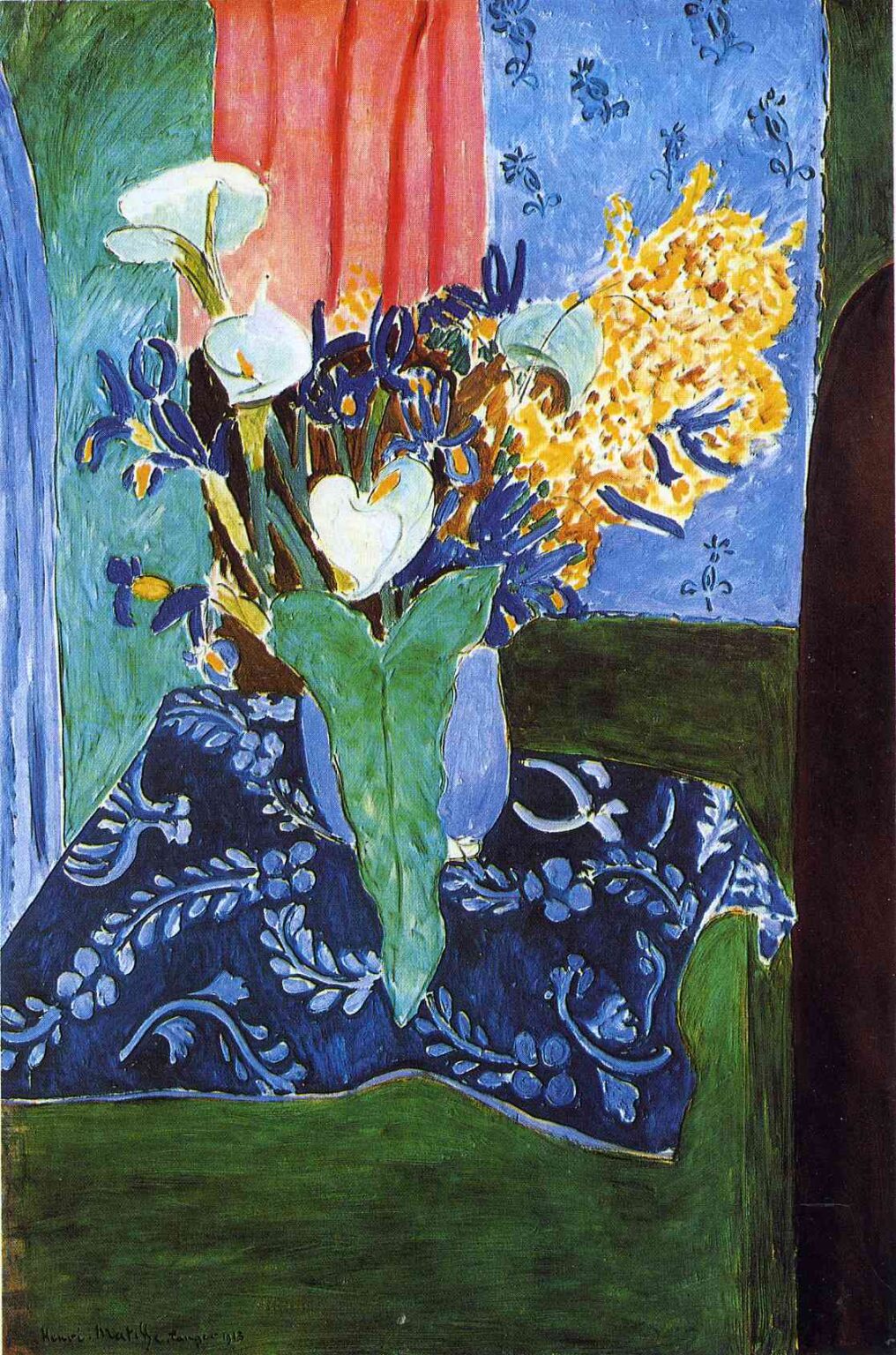
Henri Matisse’s “Calla Lilies, Irises and Mimosas” is a dazzling still life that turns a simple bouquet into a full orchestration of color, pattern, and rhythm. Painted in 1913, the work compresses the experience of an interior into a shallow stage where flowers, fabric, wallpaper, and curtains converse in bold tones. Rather than presenting a quiet, naturalistic study of blossoms, Matisse constructs a decorative world in which color builds form, contour clarifies structure, and ornament becomes a vehicle for pictorial meaning. The bouquet—calla lilies, blue irises, and a cloud of yellow mimosa—sits in a blue vase atop a patterned cloth; behind it rise a swath of pink curtain and a wall glazed in sky blue, each surface animated by small motifs. The effect is at once intimate and monumental, a domestic scene scaled to the intensity of a mural.
Historical Moment: Matisse in 1913
By 1913 Matisse had moved beyond the explosive Fauvism of the previous decade, but he had not relinquished its central lesson: color could carry the full weight of representation. The years around 1912–1913 were marked by his travels to the Mediterranean and North Africa and by his sustained fascination with textiles, ceramics, and Islamic ornament. He folded these interests into a deliberate investigation of how a painting could be both a window and a wall—an image of space and an assertive, decorative surface. “Calla Lilies, Irises and Mimosas” belongs to this transition. The colors are saturated but controlled; the drawing is bold but supple; and the space, though shallow, flickers between depth and flatness in a way that feels decisively modern.
First Impressions and Visual Walkthrough
At first glance the eye is seized by the bouquet’s triad of hues: the white trumpets of calla lilies, the ultramarine irises, and the burst of mimosa rendered as a loose, granular cloud of yellows and oranges. These shapes rise from a compact blue vase placed slightly off center, an asymmetry that energizes the canvas. The table is covered in a dark blue cloth strewn with pale botanical motifs, and the wall blooms with small, lighter ornaments. A coral-red curtain drops vertically near the center, bridging foreground and background while dividing the blue field into separate zones. Across the lower register, a rich green band signals the tabletop or the front edge of a bench. The painting assembles these parts like a stage set, each plane a piece of scenery with its own tempo and temperature.
Composition: Orchestrating Planes, Axes, and Drapery
Matisse organizes the picture through a play of intersecting axes. The upright thrust of the lilies, reinforced by the curtain’s vertical fall, meets the diagonals of the patterned cloth as it drapes off the table. The bouquet itself spreads fanlike: irises radiate outward in spiky, star-shaped rhythms; calla leaves push down in a bold, heart-shaped wedge; and the mimosa forms a feathery, oblique mass on the right. The vase acts as a fulcrum, lifting the eye into the bouquet while anchoring the composition to the table. The off-center placement avoids symmetry yet maintains equilibrium through the counterweight of the curtain. This orchestration of vectors keeps the viewer’s gaze moving, like a conductor shaping crescendos and pauses within a musical score.
Color as Structure and Emotion
Color is the painting’s architecture. The dominant blues—wallpaper, tablecloth, vase, and irises—create an expansive, cool atmosphere against which the warmth of the mimosa and curtain flares. White is used not merely to denote the calla blooms but to punctuate the composition with moments of unmodulated light, a strategy that makes the lilies appear luminous rather than shaded. Green functions as a mediator: the tabletop and large leaf knit the blues and warms together, preventing the composition from splitting into rival camps. Matisse treats each color as a flat, resilient field; where hues meet, a dark contour often intervenes, preventing the colors from muddling and ensuring that each remains legible. The mood is fresh and aerated, yet the tonal saturation gives the work a ceremonial gravity.
Pattern, Ornament, and the Decorative Ideal
Pattern is not garnish in this painting; it is a primary language. The tablecloth’s scrolling leaves and berries echo the botanical subject while also amplifying the flatness of the surface. The wallpaper’s miniature motifs, by contrast, recede psychologically even as they sit on the same plane, a paradox that produces a gentle shimmer of depth. The curtain—plain but textured—acts as a resting field amid these competing patterns. Matisse had long argued that painting should be both a window and a decorative object. Here, ornament binds the scene into a cohesive carpet of sensation. The viewer is invited to read across the surface as one would read the repeat of a textile, discovering correspondences between the real flowers and their stylized counterparts in the cloth.
Space, Flatness, and the Tension Between Depth and Surface
Although there is a suggestion of a room, the spatial cues are intentionally compressed. The edge of the table occurs not as a perspectival receding line but as a gently curving boundary between green and blue. The wall is a plane of color rather than a box receding into distance. The bouquet occupies a shallow pocket of space, pushed forward by the high horizon and the assertive patterns. This tension—objects that imply volume yet cling to the surface—constitutes the painting’s modernity. Matisse stages the centuries-old genre of still life as a conversation about painting itself: how to depict the world without surrendering the autonomy of the picture plane.
Flowers as Motifs and Meanings
Each flower type carries both visual and symbolic roles. Calla lilies, with their sculptural white spathes and golden throats, offer clear, simplified volumes that suit Matisse’s love of essential forms. Their whiteness provides luminous anchors amid saturated color. Irises introduce sharp, ruffled outlines and deep blues, a hue that Matisse associated with expansiveness and serenity. Mimosa, a Mediterranean and North African plant, arrives as a haze of tiny blooms—a perfect subject for a diffuse, flickering brushmark. Symbolically, callas have been linked to purity and ceremonial solemnity, irises to faith and royalty, and mimosa to sensitivity and spring’s return. Matisse leverages these associations only lightly, allowing their visual properties to do the primary work, but the trio together reads as a celebration of renewal and of the cultivated interior as a site where nature and artifice meet.
Brushwork, Contour, and the Hand of the Painter
The paint handling is deliberately varied. In the mimosa, small, broken touches accumulate into a tremulous mass that seems to shed pollen. The irises are built from quick, assertive strokes that describe petal edges with a calligrapher’s snap. The calla lilies are simplified into planes of white that show subtle modulations, a reminder that Matisse could evoke curvature with minimal means. Around all of this runs a firm contour, typically in dark blue or black, that locks forms into place without chilling their vitality. The tablecloth is brushed more evenly, its pattern reserved as lighter shapes within a darker field, a technique that makes it read as dyed cloth rather than modeled volume. Throughout, you sense an artist who paints not in search of texture for its own sake but in pursuit of a surface that vibrates with measured energy.
Influence of the Mediterranean and North Africa
The painting’s chromatic bouquet and love of ornament resonate with Matisse’s experiences in the Mediterranean basin and his stays in Morocco. The intense blues, the attraction to floral repeats, and the use of the curtain as both screen and zone of color all suggest an artist nourished by luminous southern light and by decorative traditions that privilege pattern over perspective. The mimosa, common along Mediterranean coasts, functions as both subject and cultural sign, gently embedding the work in a geography that had become central to Matisse’s imagination. Rather than transcribing exotic motifs, he translates their spirit into a French interior—a synthesis that would blossom fully in his later odalisque interiors.
Dialogue with Cubism and Post-Fauvist Evolution
In 1913, Cubism cast a long shadow over European painting, pushing artists to rethink form and space. Matisse’s response was not to fracture objects into planes but to clarify planes into objects. The flat zones of color, the gathered bouquet as a compact structural mass, and the deliberate denial of recession are his answer to Cubist analysis. He chooses synthesis over deconstruction. The patterned cloth is not a still-life prop alone; it is a means to state that painting is a fabric of ordered forces. The result is a picture that feels modern without borrowing the syntax of fracture, a work that insists on color and ornament as equal routes to abstraction.
The Role of the Tablecloth and Textiles
The tablecloth deserves special attention because it mediates between nature and artifice. Its stylized leaves echo the living leaves above it, but the repeat and the constrained palette make it clearly a human-made pattern. The cloth also performs a compositional task: its diagonal fall introduces depth without linear perspective, while its dark tonality steadies the higher-keyed hues of the bouquet and wall. Matisse often collected textiles and placed them at the heart of his pictorial world; here, the cloth supplies both a physical ground for the vase and a conceptual ground for the painting’s decorative logic. The viewer oscillates between reading the cloth as fabric and reading it as a field of abstract marks—an oscillation that animates the entire canvas.
The Vase, the Table, and the Architecture of Still Life
The blue vase is compact, almost architectural, with just enough modeling at its base and shoulders to suggest roundness. It is painted not as reflective glass but as a matte, opaque presence, a decision that keeps highlights from disrupting the painting’s overall unity of tone. The table’s front edge bends like a shallow wave, an elegant solution that both reveals the cloth’s thickness and prevents the composition from becoming rigid. Still life, for Matisse, is an architecture of relationships; vase, cloth, table, wall, and curtain are structural members in a load-bearing design whose weight is color.
Rhythm, Music, and the Sense of Movement
The bouquet generates visual rhythm through repetition and variation. Calla lilies repeat their white crescents at different heights; irises scatter a staccato of small spikes; mimosa thrums like a sustained chord. The wallpaper’s tiny motifs provide a soft ostinato, while the bold leaves at the bottom strike a slower beat that counterbalances the flutter above. Matisse frequently compared color harmonies to musical harmonies, and this painting exemplifies that analogy. The composition is not static; it sways gently, and the eye moves through it as through a melody that returns to certain notes while discovering new phrases.
Intimacy, Domesticity, and the Modern Interior
Although the painting is flamboyant, it remains fundamentally intimate. It takes place on a tabletop within arm’s reach, and the bouquet is arranged with the care of someone who lives among these objects. Modernity here is not an urban spectacle but a cultivated interior where the artist calibrates sensation through decor. The curtain evokes the presence of a window or doorway without narrating one, and the wall reads as both barrier and field of light. The domestic setting does not diminish the painting’s ambition; rather, it demonstrates how the modern interior, stocked with textiles and flowers, could become a laboratory for transforming perception.
What the Painting Teaches about Seeing
“Calla Lilies, Irises and Mimosas” trains the viewer to look for correspondences instead of illusions. It asks us to measure shapes against shapes, colors against colors, patterns against patterns. The bouquet ceases to be a mere subject and becomes a lens through which to understand pictorial order. We notice that the white of the lilies reappears in the printed motifs, that the blues form a continuous atmosphere from wall to vase to flower, and that the yellows of the mimosa ignite their surrounding blues by complementary contrast. This mode of seeing extends beyond the canvas, encouraging attentiveness to how interiors choreograph our daily visual experiences.
Legacy and Place in Matisse’s Oeuvre
Within Matisse’s broader production, this painting stands as a keystone of his mature still lifes. It condenses lessons from the Fauve years, anticipates the luxuriant interiors of the 1920s, and keeps company with the great decorative statements of his career. The work’s balance of clarity and exuberance makes it a touchstone for the artist’s belief that painting should offer both sensual pleasure and structural conviction. It is neither a sketch of immediate sensation nor an exercise in arid design; it is a fully realized object where pleasure and discipline coincide.
Conclusion
In “Calla Lilies, Irises and Mimosas,” Henri Matisse takes an arrangement of flowers and transforms it into a complete world. Every element—the bouquet, the vase, the cloth, the wall, the curtain—participates in a network of color harmonies and patterned echoes that hold the surface taut while allowing space to breathe. The painting is a manifesto of the decorative ideal not as ornament for ornament’s sake, but as a mode of thought that fuses seeing, feeling, and making into a singular experience. It confirms Matisse’s conviction that color is a robust structure and that beauty, rigorously organized, can still feel effortless. To stand before it is to occupy a room ordered by joy.