Image source: wikiart.org
Introduction
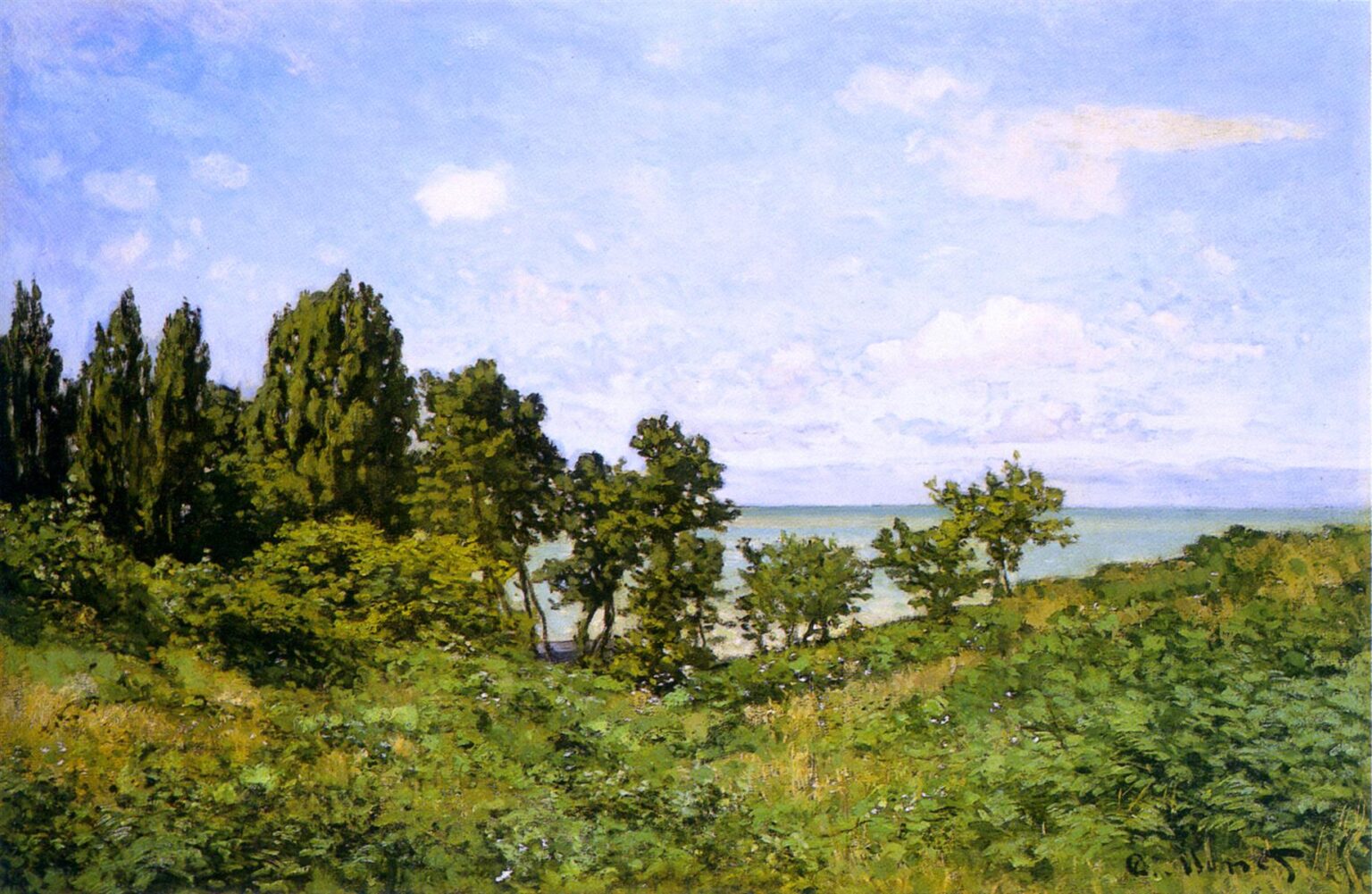
Claude Monet’s By the Sea from 1864 is a painting that reveals a great deal about the young artist before he became the defining figure of Impressionism. At first glance, the work may seem quiet and even modest. It does not present a dramatic storm, a theatrical human subject, or a carefully arranged narrative. Instead, it offers a stretch of coastal landscape filled with greenery, trees, open sky, and a calm band of water in the distance. Yet this apparent simplicity is exactly what makes the painting so compelling. Monet transforms an ordinary scene into an experience of atmosphere, light, and living sensation.
What makes this work especially interesting is that it belongs to an early stage in Monet’s career. Painted in 1864, it comes from a period when he was still forming the visual language that would later make him famous. In this painting, one can already sense many of the qualities that would define his mature work: a devotion to outdoor observation, a fascination with changing light, a rejection of rigid academic finish, and a desire to paint the world as it is felt in a passing moment. At the same time, the painting still carries traces of traditional landscape structure. This combination of freshness and structure gives the image its special energy.
The painting draws the viewer into nature without forcing a single dramatic focal point. The eye moves across the green foreground, pauses among the clustered trees, and then drifts outward toward the pale sea and luminous sky. Instead of guiding us through a story, Monet invites us to inhabit a place. The result is a painting that feels open, breathable, and immediate. It is less about spectacle than about perception. It asks us to notice how land meets water, how vegetation catches sunlight, and how a wide sky alters the emotional tone of the entire scene.
The First Impression of the Scene
The first impression created by By the Sea is one of freshness and spaciousness. The sky occupies a large portion of the composition, filling the upper half with pale blue, soft white clouds, and subtle tonal shifts. Below it, the trees and vegetation form a richly textured mass of green that stretches across the foreground and middle ground. Between these zones, the water appears as a light horizontal band, calm and restrained, separating earth from sky.
This arrangement produces a powerful visual rhythm. The heavy density of the land is balanced by the airiness of the sky. The foreground feels alive and tactile, filled with grasses, shrubs, and varied brushwork, while the distant water and clouds create an impression of openness and calm. Monet does not overload the picture with detail in a conventional sense. Instead, he builds vitality through painterly marks that suggest movement, growth, and changing light.
The scene feels natural rather than staged. There is no obvious human activity to dominate the image. Nature is not turned into a backdrop for a story. It is the subject itself. That choice is important, because it reflects a shift in nineteenth century painting away from historical or literary themes and toward direct visual experience. Monet presents the coast not as a symbolic setting but as a living environment.
Another striking aspect of the first impression is the sense of weather. The sky is bright but not harsh. The clouds are soft and dispersed. The sea seems quiet rather than turbulent. Everything suggests a mild day with clear air and gentle light. This weather creates a mood of repose, but not stillness in a dead sense. The leaves, grasses, and broken cloud forms imply subtle movement. The painting feels suspended in a real moment that could change at any time.
Composition and Spatial Structure
The composition of By the Sea is carefully balanced, even if it appears spontaneous. Monet places the densest group of trees toward the left side of the painting, creating a strong visual anchor. These tall, dark vertical forms rise sharply against the luminous sky and give the composition weight. From that left side, the land slopes and opens toward the right, allowing more air and distance to enter the image. This movement from density to openness gives the painting a natural flow.
The horizon line sits relatively low, which allows the sky to play a major role. That choice expands the sense of atmosphere and makes the landscape feel broad rather than enclosed. At the same time, Monet avoids an empty or monotonous foreground by filling it with layered vegetation. The lower part of the painting is alive with varied greens, yellows, and darker notes, which keep the eye engaged before it travels outward.
The middle ground functions as a transitional zone. The trees do not form an impenetrable wall. Instead, there are openings through which glimpses of light and water appear. These breaks are essential, because they keep the composition from becoming too heavy. They also create depth. The viewer senses space not through sharply drawn perspective lines but through overlapping forms, tonal recession, and intervals of visibility.
This way of constructing space is significant. Monet is less interested in precise topographical description than in visual sensation. Depth is felt rather than mathematically demonstrated. The landscape unfolds through color, light, and relative density. This approach helps the painting feel immediate and observed, as though the artist responded directly to what he saw outdoors rather than building the scene according to academic formulas.
The composition also avoids a single dominating center. Instead, it encourages wandering vision. The eye can move from the foreground plants to the clustered trunks, then toward the sea, and finally up into the sky. This kind of movement reflects how one actually experiences a landscape. One does not look at nature as if reading a diagram. One scans, pauses, and returns. Monet captures that visual freedom.
The Importance of Light
Light is one of the true subjects of By the Sea. Even though the painting contains trees, shrubs, sky, and water, these elements are unified by the way light touches them. Monet does not treat light as a neutral condition that merely reveals objects. He treats it as an active force that shapes the entire mood and structure of the image.
The sky is the clearest example. It is not a flat blue field but a shifting expanse of subtle tones. Pale blues, cool whites, and faint lavender or gray passages create a sense of atmospheric depth. The clouds are soft and dispersed, not rigidly outlined. They seem to float and dissolve, making the sky feel open and alive. This handling of the sky affects everything below it. The land appears sunlit but also moderated by passing cloud cover. There is brightness, but it is diffused rather than hard.
The greenery of the foreground is animated by variations of light. Some areas glow with yellow green highlights, while others sink into deeper olive and shadowed tones. This contrast gives the vegetation volume and movement. Instead of painting each plant in isolation, Monet lets light organize the masses. The viewer reads the forms through flickers of brightness and shadow.
The distant sea is especially important because it acts like a reflective strip of light within the composition. It is quieter than the foreground, but its pale color helps open the space and reinforce the airy mood. The water does not shout for attention. It breathes within the composition, offering visual rest after the density of the land.
This treatment of light points toward Monet’s later achievements. He would go on to make light one of the central concerns of modern painting, but even here in 1864, the impulse is already visible. He is not just representing a place. He is representing the experience of seeing that place under specific atmospheric conditions.
Color and the Poetry of Green
One of the most memorable features of By the Sea is its orchestration of green. Many painters would struggle to make so much greenery feel varied and alive, but Monet handles it with sensitivity. The painting is not simply green in a general sense. It is composed of many greens, each adjusted according to light, distance, density, and texture.
In the foreground alone, one can see yellow greens, blue greens, muted olives, deep forest tones, and touches of earthier brownish notes. These shifts prevent monotony and create the sensation of living vegetation. The plants do not merge into a single blanket of color. They pulse with difference. This chromatic richness is one of the ways Monet makes nature feel immediate.
The darker trees at the left create strong contrast against the sky, but even these are not painted as solid black masses. Within them are subtle variations of warm and cool darks. This complexity keeps the forms organic. They feel like foliage catching uneven light rather than simplified silhouettes.
The blues of the sky and sea are equally restrained. Monet avoids overstatement. The blue is pale, luminous, and open, which allows the greens to dominate without becoming oppressive. The relationship between blue and green is central to the painting’s harmony. The cool distance of the water and sky balances the warmth and density of the land.
There are also small touches of lighter color within the vegetation that suggest flowers, dry grasses, or brief glints of illumination. These accents enliven the lower half of the picture and keep the surface visually active. Monet’s color does not merely describe objects. It creates mood. Here that mood is one of growth, calm air, and summer brightness.
The painting shows that Monet understood color as a relational system. No hue exists alone. Every passage depends on its neighbor. The dark trees seem darker because the sky is so luminous. The foreground seems richer because the distant sea is so pale. This sensitivity to color relationships would become one of the defining strengths of his art.
Brushwork and Surface Energy
Although By the Sea is tranquil in mood, its surface is full of energy. Monet’s brushwork is varied and responsive, and this gives the painting a strong sense of life. The marks are not hidden beneath a polished academic finish. They remain visible enough to remind the viewer that the image has been built through quick observation and painterly decisions.
In the vegetation, the brushwork is especially animated. Short, broken touches suggest leaves, grasses, stems, and irregular growth without describing each element precisely. This method allows Monet to convey abundance without stiffness. Nature appears dense and complex, but never frozen.
The trees are handled with broader and darker strokes, which gives them structural force. Their trunks and foliage feel more anchored than the foreground plants, helping organize the picture spatially. Yet even here the paint retains a certain looseness. The forms are suggested rather than laboriously defined.
The sky is painted more softly, with smoother transitions and lighter touches. This contrast between the lively land and the airy sky is essential. It creates a difference in texture that supports the difference in subject. Dense organic matter below, open atmosphere above.
What is remarkable is that the painting feels coherent despite these varied handling methods. Monet adapts his brushwork to the needs of each part of the scene while maintaining overall unity. The visible strokes do not disrupt the illusion. Instead, they become part of the experience. They help the viewer feel the artist’s presence before nature.
This brushwork also reflects an important change in modern painting. Rather than concealing the act of painting, Monet allows the painted surface to remain active and perceptible. The result is not unfinished in a negative sense. It is alive. The surface itself participates in the image’s meaning, suggesting the fleeting, changing character of the world it depicts.
Nature as Experience Rather Than Background
In many earlier traditions, landscape often served as a setting for historical, mythological, or religious scenes. In By the Sea, nature does not play a secondary role. It is the entire focus. This matters because it changes how the viewer engages with the painting. There is no story to decode, no central human drama to dominate interpretation. Instead, the meaning emerges from direct encounter with place.
Monet’s landscape is not empty simply because it lacks prominent figures. It is full of presence. The plants, trees, sky, and sea generate their own drama through atmosphere, contrast, and spatial rhythm. The painting invites contemplation of how nature appears and feels in a specific moment.
This emphasis on direct experience was part of a broader transformation in nineteenth century art, but Monet brings unusual freshness to it. He does not make the coast grand or heroic in the older romantic sense. He makes it immediate. The viewer is placed at the edge of a living environment, surrounded by growth and looking outward toward open water.
That sense of lived experience is reinforced by the absence of rigid finish. The painting feels observed rather than manufactured. One can imagine the artist working outdoors, responding quickly to shifting light and weather. Whether every detail was completed entirely on site or not, the image preserves the feeling of plein air perception.
Nature here is also presented as unstable in the best sense. The clouds could change, the light could soften, the breeze could move through the shrubs. The scene is calm, but it is not static. This underlying changeability gives the painting its vitality. Monet is already interested in the transient condition of the world, not just its fixed forms.
The Painting in the Context of Monet’s Early Career
Because By the Sea dates from 1864, it belongs to a formative period in Monet’s development. He was still a young painter, but his commitment to direct observation was already becoming clear. In works from this era, one can see him testing how to reconcile solid composition with the immediacy of outdoor painting.
This painting still retains a readable structure that links it to earlier landscape traditions. The trees on the left anchor the composition, the middle ground opens toward the sea, and the sky provides atmospheric expansion. These are not accidental choices. They show that Monet understood how to build a balanced landscape.
At the same time, the work also reveals his growing independence from academic methods. The brushwork is freer, the emphasis on passing light is stronger, and the subject itself is relatively unpretentious. He is not seeking grandeur through historical narrative. He is seeking truth through perception.
This early date is important because it reminds us that Impressionism did not appear all at once in a finished form. Artists like Monet developed it gradually through experiments in seeing and painting. By the Sea captures that process beautifully. It is not yet the fully dissolved shimmer of some later Monet landscapes, but it clearly points in that direction.
The painting also reflects his interest in coastal subjects, which would remain important throughout his life. Shores, water, cliffs, rivers, and changing skies offered endless opportunities to study reflection, atmosphere, and shifting color. In this sense, the painting is both early and characteristic. It shows the young Monet discovering themes that would continue to sustain him.
Mood and Emotional Resonance
The emotional power of By the Sea lies in its restraint. It does not rely on dramatic contrasts or sentimental storytelling. Instead, it creates a mood of quiet alertness. The painting feels peaceful, but not sleepy. It feels fresh, open, and mentally clarifying.
Part of this mood comes from the balance between enclosure and openness. The foreground vegetation surrounds the viewer with density and life, while the distant sea and expansive sky offer release. This combination produces emotional richness. The landscape feels protective and liberating at the same time.
There is also a sense of solitude, though not loneliness. Because no prominent figures appear, the viewer encounters the scene directly, without mediation. This can create a feeling of intimacy. One is not watching someone else in nature. One is simply there, looking.
The light contributes to this emotional tone. It is bright but gentle, producing an atmosphere of calm attentiveness. The clouds soften the sky, preventing the scene from becoming too stark or dazzling. The entire painting seems to hover in a suspended moment of natural harmony.
Many viewers are drawn to Monet because he makes visual perception feel emotional without becoming theatrical. By the Sea is a fine example of that ability. It does not tell us what to feel in an obvious way. Instead, it creates conditions in which feeling arises naturally from color, light, and space.
Why This Painting Still Matters
By the Sea remains significant because it shows Monet at a point of emergence. It allows viewers to see the roots of his later achievements while also appreciating the painting on its own terms. This is not merely a historical document of an artist on the way to greatness. It is already a compelling landscape, full of sensitivity and conviction.
The painting matters because it demonstrates that modern vision can be found in ordinary subjects. Monet does not need a spectacular event to create beauty. He finds it in the meeting of shrubs, trees, sea, and sky. That democratic vision of nature helped change the direction of art. It suggested that what matters is not the grandeur of the subject but the intensity of perception brought to it.
It also matters because it remains deeply accessible. A viewer does not need specialized knowledge to respond to its freshness, balance, and atmosphere. At the same time, the painting rewards deeper study through its structure, color relationships, and place in Monet’s development. It works both immediately and historically.
Most of all, the painting still matters because it captures something timeless about being in the natural world. The sensation of looking through trees toward water beneath a bright sky is one that many people recognize. Monet takes that familiar experience and gives it lasting form without draining it of life. The scene remains open, changeable, and breathable.
Conclusion
Claude Monet’s By the Sea from 1864 is a remarkable early landscape that reveals the young artist’s extraordinary sensitivity to light, color, atmosphere, and natural rhythm. Its subject may appear simple, but the painting is rich in visual intelligence. Through a carefully balanced composition, nuanced greens, luminous sky, and lively brushwork, Monet turns a coastal view into an immersive experience of perception.
The work stands at an important point in his career. It still shows compositional clarity associated with earlier landscape traditions, yet it already moves toward the freer, more immediate language that would define Impressionism. The painting does not present nature as a backdrop or symbol. It presents nature as something directly seen and deeply felt.
What makes the image enduring is its combination of freshness and control. It feels spontaneous without being careless, atmospheric without being vague, and quiet without being dull. The viewer is invited to look slowly, to move through the surface, and to experience how land, water, and sky interact under a specific light.
In the end, By the Sea reminds us that Monet’s greatness did not begin with spectacle. It began with attention. This painting shows an artist learning how to trust the eye, how to honor the fleeting conditions of the world, and how to find poetry in a seemingly ordinary patch of coast. That is why the painting continues to resonate. It offers not only a view of nature, but a way of seeing.