Image source: wikiart.org
Introduction
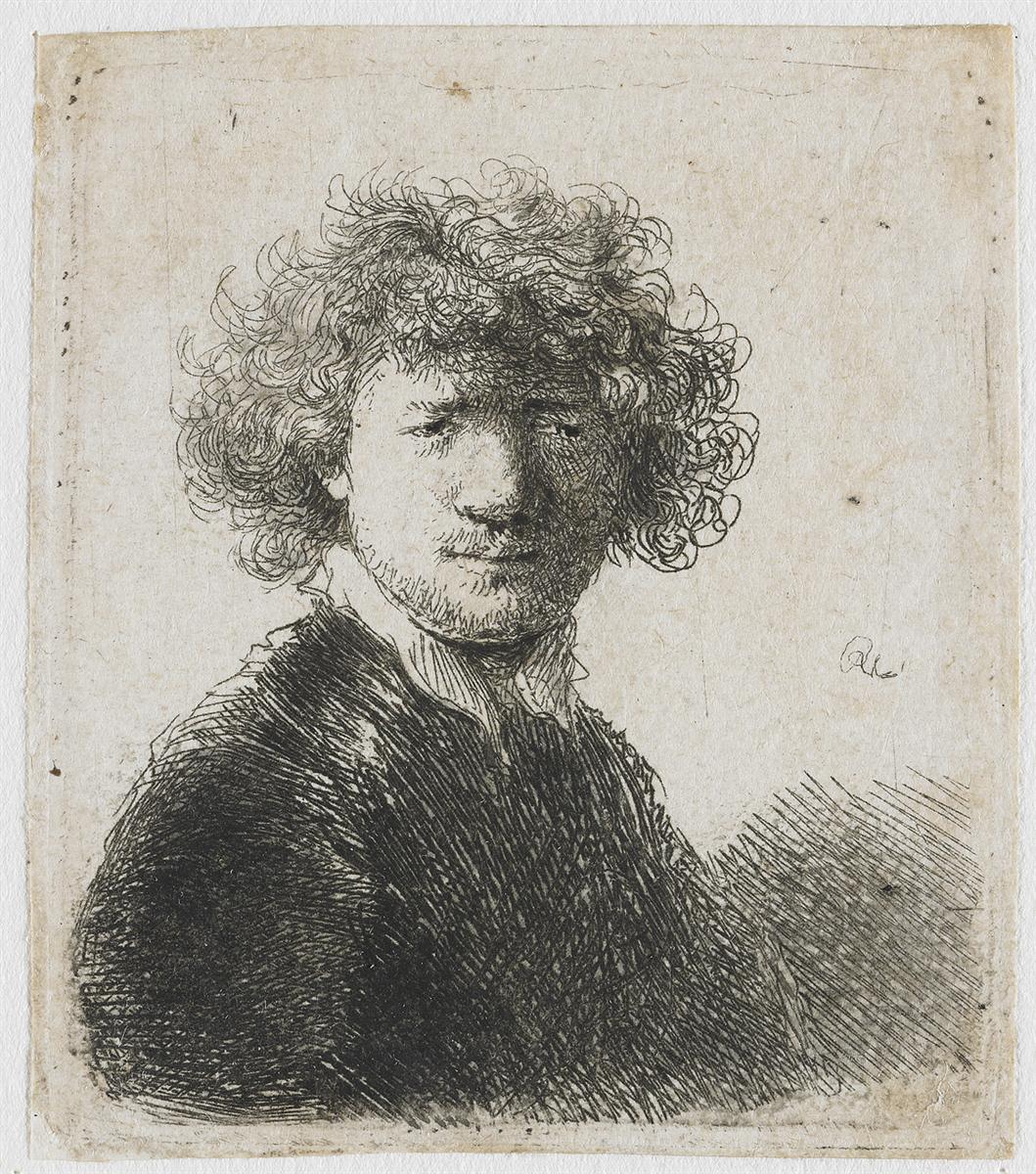
Rembrandt’s “Bust of an Old Man with a Flowing Beard, the Head Bowed Forward, the Left Shoulder Unshaded” (1630) is a compact etching that magnifies a private weather of mind. The subject appears close to the picture plane, head inclined, eyes lowered, beard cascading in soft waves that blur into the dark of his cloak. The title points our attention to a peculiar and purposeful decision: one shoulder is left unshaded. That single omission becomes the hinge of the composition. It is where light gathers, where air settles, and where the old man’s inwardness tips outward into the room. With an economy of means—black line and reserved paper—Rembrandt makes a small sheet feel like a chamber filled with breath.
Leiden, 1630: A Laboratory for Faces
The year 1630 places this print squarely within Rembrandt’s Leiden years, when he was refining a language of light, line, and character through small-scale experiments. Instead of commissioned portraits, he pursued tronies—studies of heads that explore temperament rather than identity. These were made for the open market, purchased by collectors who prized virtuoso etching and the insight of close looking. In this cluster of works, elders are frequent subjects: their faces accept light like fine topography; their beards supply a field for the calligraphy of line; their downturned gazes make viewers step softly. The old man here belongs to that family, a cousin to prints of seated scholars and bearded patriarchs from the same period.
Etching as Drawing That Breathes
Etching preserves the touch of the hand with unusual fidelity. A copperplate coated in wax takes the needle like paper takes a pen; the acid then bites the exposed metal, fixing gesture into groove. In this print, Rembrandt uses etched line as if it were breath itself—tight, shallow marks around the eyes, longer calligraphic loops through the beard, and deep cross-hatching where cloth turns away from the light. Each region receives its own mark-language: skin is worried by short strokes that maintain softness; hair is released into looping arabesques; the cloak becomes a knit of shadow. This variety of line is not ornamental; it is anatomical. It makes substance legible without describing every detail.
A Composition Built on Inclination
The figure is cropped at bust length, tilted slightly from the upper left toward the lower right. That diagonal does several jobs at once. It embodies the head’s bow—a gesture of reading, prayer, fatigue, or simple thought. It drives the eye from scalp to beard, allowing us to feel time running down the face like water. And it sets up a counter-movement: the unshaded left shoulder lifts, a pale buoy that keeps the composition from sinking entirely into shadow. Balanced between descent and float, the old man’s pose reads as a pause, an interval where gravity has his attention but not his surrender.
The Expressive Logic of the Unshaded Shoulder
The left shoulder—saved as light, hardly touched by line—does not simply “lack” shading. It performs the picture’s central work. By leaving this plane open, Rembrandt gives the old man a place to breathe. The pale shoulder pushes forward, meeting the viewer’s space, while the head recedes into shadow. The result is a spatial inversion: the nearest form is least described, and the most described form retreats. This contradiction animates the sheet. Light feels like an active participant, a thing that touches the body and reorders depth. The choice also clarifies the head’s inclination by supplying a white counterweight. Without that unshaded expanse, the composition would read as a uniform dusk.
Chiaroscuro as Thought
Light in this print is not theatrical; it is meditative. It glances across the bald crown in a thin crescent, slides down the knotted brow, flickers at the bridge of the nose, and disappears into the beard. Shadows thicken under the eyes and at the corner of the mouth, not as melodrama but as quiet grammar. It is a language that says: here is where the gaze rests; here is where time has laid its hand. The softest tones—those that model the brow and cheek—are not mechanical hatchings but strokes that respect the roundness of living flesh. Chiaroscuro becomes the way the mind reveals itself through the skin.
The Beard as a River of Time
Rembrandt treats the beard as a moving landscape. At the cheek, the curls are tight and shaded, showing the closeness of hair to skin; farther down, loops open to admit paper white, and the beard seems to brighten as if catching light from below. This transition from density to air is crucial. It keeps the lower half of the image from congealing into a block and gives the sheet a sense of exhalation. The beard is not mere iconographic shorthand for age; it is the visible record of time flowing and light gathering, a soft architecture that makes the head’s downward tilt feel both weighty and buoyant.
The Head: Plane, Furrow, and Mercy
The face is built from planes rather than hard outlines. A narrow highlight travels the ridge of the nose; small spots of white rest at the eyelids; a rounded tone cups the cheekbone. Lines do not carve the features; they graze them. This restraint avoids caricature and creates room for mercy. The old man’s brow is deeply scored, yet the marks maintain tenderness. The mouth is closed but not clenched; the eyes are lowered but not sealed. Rembrandt refuses to fix a single emotion. He offers a posture that can hold many—concentration, sorrow, fatigue, prayer, gratitude—and lets the viewer’s own experience inflect the reading.
Paper White as Air and Meaning
The untouched page is as important as the ink. White space on the right and above the head functions like the room’s air, a volume that receives the figure rather than frames it. Within the image, paper reappears as glints in the beard, as that signature unshaded shoulder, as a slight halo on the crown. Rembrandt’s discipline is evident here: he stops before explanation dulls the effect. What is not drawn speaks as eloquently as what is. The white is not emptiness; it is light withheld for use where it matters most.
The Signature as Whisper
A small monogram and date typically hover on Rembrandt’s early plates, placed where they will neither compete with nor abandon the image. In prints like this, the signature reads as a whisper inside the room, a discreet acknowledgment that the hand that watched so carefully is the one responsible for what we now see. It also introduces a secondary rhythm into the composition—a tiny dark note at the margin that keeps the upper field from going mute.
Printing Variants and the Atmosphere of Impressions
Etchings do not exist as a single, fixed image but as a family of impressions whose mood can shift with inking and wiping. A plate tone left on the copper can veil the background with a gray that softens the white of the shoulder and enriches shadows; a clean wipe makes the shoulder blaze and the beard glitter. Heavier inking darkens the eye sockets and cloak, deepening the sense of interiority; lighter inking emphasizes the air between curls and the glitter of the crown. These differences are not accidents. They are atmospheric choices that allow the same composition to register morning, afternoon, or clouded day without changing a line.
Kinship with Rembrandt’s Elders
Set alongside Rembrandt’s other etched elders from 1629–1631, this print shows a consistent ethics and evolving craft. In each, direct confrontation is rare; most figures look down or aside. Beards are not props but labors of line that absorb and return light. Backgrounds are minimal, granting space for thought. And always there is one focal decision around which everything turns—here the unshaded shoulder; in others, a slant of window light, a small book, or an anchored staff. This discipline of one decisive idea gives the small sheets their monumental calm.
Theological Undercurrents Without Emblem
While the print bears no explicit religious symbol, its posture and light resonate with a devotional tradition. Bowed heads, softened shadows, and white fields that read as grace are part of Rembrandt’s visual vocabulary. The old man may be a scholar, a patriarch, or simply an anonymous elder; in every case the image proposes that inwardness has its own luminosity. The unshaded shoulder, where light rests, can be read as the body’s welcome to that brightness. Without preaching, the etching conveys a theology of attention: light honors what it touches.
The Sound of the Plate
Look long and the image seems audible. The beard’s loops hum in a soft, continuous line; the cloak’s cross-hatching murmurs at a lower register; the tiny highlights ping like faint bells along the nose and eyelids. Even the unshaded shoulder has a sound—the quiet of breath. Rembrandt’s lines are rhythmic, and that rhythm subtly sets the viewer’s tempo. We linger where strokes thicken, accelerate where they open, and pause at the white shoulder before returning to the head. The print becomes a score for looking.
Materiality, Wear, and the Life of the Object
Sheets like this often arrive to us with signs of time—soft corners, foxing, a shadow of the plate mark pressing into the paper. Far from diminishing the effect, such patina can intensify the sense of presence. Rembrandt’s forms are built by firm value decisions rather than by fragile tricks, so they endure minor changes in condition. The image remains authoritative even as the paper ages, a testament to the solidity of choices made at the plate.
Lessons for Artists
This print is a quiet masterclass. Reserve the brightest area early; let it govern the rest. Model the head with small shifts of value rather than heavy contour. Define hair by the rhythm of line, not by individual strand. Keep accents tiny and decisive—inner eye, bridge highlight, lip edge—so the whole does not turn brittle. Separate materials by mark-language: skin with short strokes; hair with loops; cloth with knits of hatch. Above all, stop before finish extinguishes air. The unshaded shoulder shows that the most daring stroke can be the one you do not make.
Modernity of Restraint
The image feels contemporary because it trusts essentials. A head, a beard, one shoulder left bright: that is enough. There is no descriptive background to anchor date or place, no attribute to force allegory. The print aligns with later notions of reduction and negative space, demonstrating that a few elements, precisely tuned, can carry emotion more durably than crowded scenes. Its modernity lies not in novelty but in courage—the courage to let light and posture do the work.
Reception and Enduring Appeal
Collectors have long prized Rembrandt’s early elder heads for their intimacy and graphic invention. What keeps this sheet vivid is the way it treats attention as a form of care. The old man is not spectacular; he is present. The beard is not flamboyant; it is thoughtful. The unshaded shoulder is not a trick; it is an act of hospitality to light. That balance of modesty and mastery gives the image its lasting power. One does not tire of it because it refuses to exhaust its meanings; the print remains available to whatever quiet the viewer brings.
Conclusion
“Bust of an Old Man with a Flowing Beard, the Head Bowed Forward, the Left Shoulder Unshaded” condenses Rembrandt’s early brilliance into a single, memorable premise: illuminate precisely where the body invites light, and allow darkness to carry thought. The bowed head occupies a dusk of careful lines; the beard releases that dusk into brightness; the unshaded shoulder receives the day. Around these elements the white of the page becomes a room where silence is not emptiness but attention. In a handful of marks, the young Rembrandt shows how art can honor age without allegory, find drama in stillness, and make mercy visible in the way we draw.