Image source: wikiart.org
Introduction
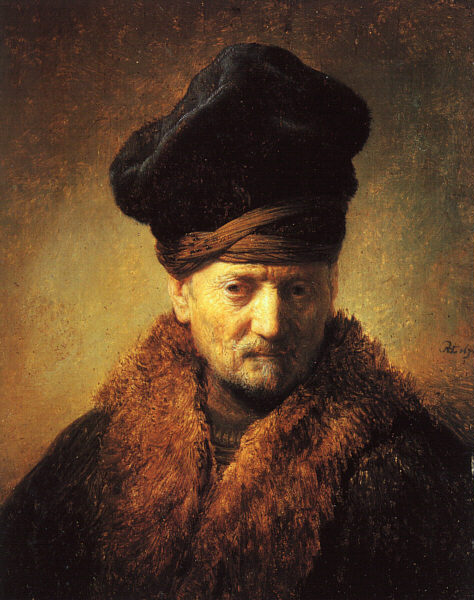
Rembrandt’s “Bust of an Old Man in a Fur Cap” (1630) is a compact drama of light and age. Painted during his final Leiden years, the work presents a weathered face set beneath an oversized fur cap and wrapped in a thick pelt collar. The background is a warm, granular field that seems to hold the figure in a cone of glow. Nothing in the image is incidental: the height of the cap, the dense seam of the fur, the downward cast of the eyes, and the carefully rationed highlights across brow, cheek, and nose collaborate to produce an authority that belies the painting’s modest scale. It is not a society portrait but a tronie—a study of character—through which Rembrandt tests how light can dignify an ordinary head and how painterly texture can stand in for the textures of a life.
The Leiden Moment And The Freedom Of The Tronie
In 1630 Rembrandt was still working in Leiden, forging the vocabulary that would soon make his Amsterdam career. The tronie format gave him freedom from patron demands. He could choose costumes for their tactile and optical possibilities, search for expressions that interested him, and place the sitter in a neutral space where light becomes protagonist. “Bust of an Old Man in a Fur Cap” is quintessential Leiden Rembrandt: an intimate head, severe chiaroscuro, a near-monochrome harmony pushed warm by earth colors, and brushwork that is both exact and exploratory. The result is a laboratory piece that never feels experimental because the artist’s decisions are so sure.
Composition That Builds Monumentality
The composition is simple: head and shoulders, three-quarter view, calm background. Yet Rembrandt builds monumentality from this economy. The cap forms a dark, swelling mass that anchors the upper half of the painting and frames the brow like a velvet architecture. Beneath it the face takes on the shape of a subdued triangle, the eyes set low and inward, the mouth relaxed but compressed into experience. The broad fur collar creates a second triangle that points upward, meeting the face at the chin and sending a current of warmth back toward the eyes. These large, legible shapes—the cap, the face, the collar—read at a distance and hold the picture together; within them, delicate shifts of value and hue create life.
Light As Moral Atmosphere
Rembrandt’s light is never merely optical. Here it functions like moral atmosphere, a calm illumination that respects the sitter. It falls diagonally from the left, catching the ridge of the cap, skimming the forehead, pooling at the cheekbone, and settling into the beard and fur. Highlights are rationed to just a handful of places: a glint at the brow, a tapering stroke along the nose, a tender flare at the cheek, a damp sheen in the lower lip, and micro-sparks along the links of a chain that half vanishes into shadow. These choices place the viewer’s attention exactly where character lives—at the junction of bone, skin, and thought—without wasting light on spectacle. Shadow is equally eloquent. It wraps the eye sockets, softens the jaw, and allows the mouth to withhold as much as it reveals, so that the face seems to think rather than pose.
The Face As A Record Of Time
The old man’s features read like finely engraved weather. Crow’s feet branch lightly from the outer corners of the eyes; the lower lids puff and then recede into half-tone; nasolabial folds descend but stop short of caricature; a sparse, grizzled beard gathers under the lip. Rembrandt avoids the grotesque distortions that many contemporaries applied to “old-man heads.” Instead he calibrates his marks to keep the person intact. The left brow lifts slightly higher than the right, producing a mild asymmetry that prevents mask-like stiffness. The mouth sits in a poised neutrality, neither bitter nor amused, the lips just loose enough to breathe. These small deviations from symmetry give the head its authority: a life has been lived here and is still being lived.
The Fur Cap And Collar As Instruments Of Tone
Costume in this painting is chosen for tone, not rank. The fur cap’s broad mass swallows light and throws the forehead into relief. Rembrandt renders its pelt with draggy, loaded strokes, letting clotted pigment stand for dense, oily hair. A russet band wraps the cap, providing a warm counternote that echoes in the sitter’s cheeks. The collar behaves differently: it flares with short, brisk touches that catch light like frost at the tips of grass. These two furs—the heavy, nocturnal cap and the lively, sparkling collar—bookend the face and set its temperature. Against their darks and warms, the flesh appears luminous but never polished.
Pigment, Surface, And The Tactile Truth Of Oil
This is a painting that asks to be read by the eye and almost by the fingers. Rembrandt scumbles thin ochres and umbers across an absorbent ground to build the granular backdrop, then layers more saturated paint into the face so it glows from within. He drops impasto accents at points of highest reflection—the brow ridge, the nose tip, the cheek’s crest—so that the surface itself contributes to the illusion of light. The metal chain at the neck is not meticulously described; a few thick, flicked strokes suggest its weight and glint. Such material candor—letting paint look like paint—creates tactile truth. Flesh breathes because the paint handling is alive; fur feels matted because the brush drags like fingers across pelt.
Chiaroscuro That Protects Dignity
The drama of dark and light is carefully moderated. Rather than blast the head from darkness, Rembrandt allows shadow to remain porous. We glimpse the ear as a warm peninsula in half-tone; we sense the neck turning into the collar; we follow the cap’s contours without losing them to black. This moderated chiaroscuro protects the sitter’s dignity. He is not a prop emerging from a theatrical void but a person occupying air. The background’s warm, breathing brown participates in this respect. It holds the figure the way a room’s light holds someone you love, securing presence without exposing him cruelly.
Psychology In The Angle Of The Eyes
Two elements account for much of the portrait’s psychological power: the lowered gaze and the slight inward turn of the head. The eyes do not meet ours; they meet thought. This refusal to perform intensifies the sensation of interiority. The downward look also presses the brow into a quiet arc, making the cap’s mass feel protective rather than assertive. The inward turn sets a rhythm: cap leaning right, face turning left, collar pushing up. The intersecting angles conjure energy without motion and produce the feeling that the man has just shifted to consider something said. It is portraiture as listening.
The Chain, The Garment, And The Question Of Status
A small chain peeks from the fur, hinting at object but not identity. Rembrandt withholds heraldry, initials, and setting. The choice is consistent with the tronie tradition and with his ethic of attention: what matters is the head and the human inside it. The garment reads as warm and serviceable, not ostentatious. If the chain suggests means or office, it does so politely. The sitter could be a merchant, a scholar, a guild elder, or simply a model dressed for tonal play. The absence of fixed status allows the painting to operate as a mirror for any viewer: the face remains particular, but its dignity is common.
Kinship With The Etched Old Men Of 1630
Across 1630 Rembrandt produced etched heads of old men—eyes downcast, beards flowing, foreheads bright with thought. This painting is the oil counterpart to that graphic exploration. The etched lines that hatch beard and brow become, in oil, vibrating strokes of pigment; plate tone in the etchings becomes the warm aura of the painted background; the tiny highlights on copper become the minute impasto glints here. Seeing the bodies of work together reveals Rembrandt’s method: he studies a subject across media until he learns its emotional physics. Old age, for him, is not a theme of decline but of illuminated endurance.
The Viewer’s Distance And The Contract Of Respect
Rembrandt positions us at conversational distance. We are close enough to read pores and brushwork, yet the sitter’s lowered gaze keeps us from transgressing. That negotiated closeness is a hallmark of his best heads: the viewer is invited to attend, not to interrogate. The contract feels modern. It models a way of looking that is curious without being acquisitive, intimate without being invasive.
Color Harmony And The Weight Of Warmth
The palette rests in a spectrum of warms—burnt sienna, raw umber, amber, and a breath of red lake—anchored by the cap’s cool, almost black mass. The ground is not neutral; it carries a golden undertone that mingles with the flesh, creating a sensation of gentle heat. Cool notes are sparingly placed: a whisper along the jaw’s shadow, a faint gray in the eye whites, a cooled brown lacing the cap’s deepest hollows. The harmony conjures late-afternoon light on weathered wood and leather, the kind of light that renders textures honest. Warmth here is not sentiment; it is a color strategy that enfolds the sitter.
Why The Painting Feels Larger Than It Is
Viewers often describe this small canvas as “monumental.” The sensation arises from three sources. First, the large, simple masses give the head architectural gravity. Second, the slow, coherent light allows the eye to travel without friction, as if across a sculpture. Third, the ethical poise of the sitter—his inward gaze, his uninsistent presence—expands the painting’s moral scale. Monumentality is not a matter of size; it is the measure of how generously an image accommodates human attention. This painting accommodates it with ease.
A Study Of Age That Avoids Sentimentality
Rembrandt never sentimentalizes age. He refuses both flattering erasure and theatrical misery. The skin is irregular because life makes skin irregular; the eyes are moist because eyes are; the mouth rests because speech is not always necessary. In a culture that often made “old-man heads” into comic or moralizing types, this refusal is revolutionary. The painting proposes that age deserves the same luminous scrutiny as youth and that the truth of a face is more moving than any allegory we might hang upon it.
Enduring Relevance And The Humanist Core
The portrait’s endurance stems from its humanist core. It does not tell us who the sitter was, what he owned, or what he did. It tells us what he is like to behold under patient light. That act—beholding another person without agenda—is the engine of the painting’s continuing life. In museums today, viewers still fall silent before this head because it offers what we continue to seek: a chance to look at someone with care and to be looked after by the gentle order of light.
Conclusion
“Bust of an Old Man in a Fur Cap” distills the capabilities of Rembrandt’s early style into a single, resonant image. Chiaroscuro builds character rather than spectacle; texture stands in for lived time; color warms without flattering; composition renders a small head monumental. The fur cap and collar create a theater of tone around a face that thinks in silence. The painting belongs to the tronie tradition, yet it transcends typology to become an encounter with a particular human presence. In 1630, before fame and large commissions transformed his practice, Rembrandt already understood the deepest premise of his art: that light, honestly observed, can confer dignity on anyone it touches.