Image source: wikiart.org
Introduction
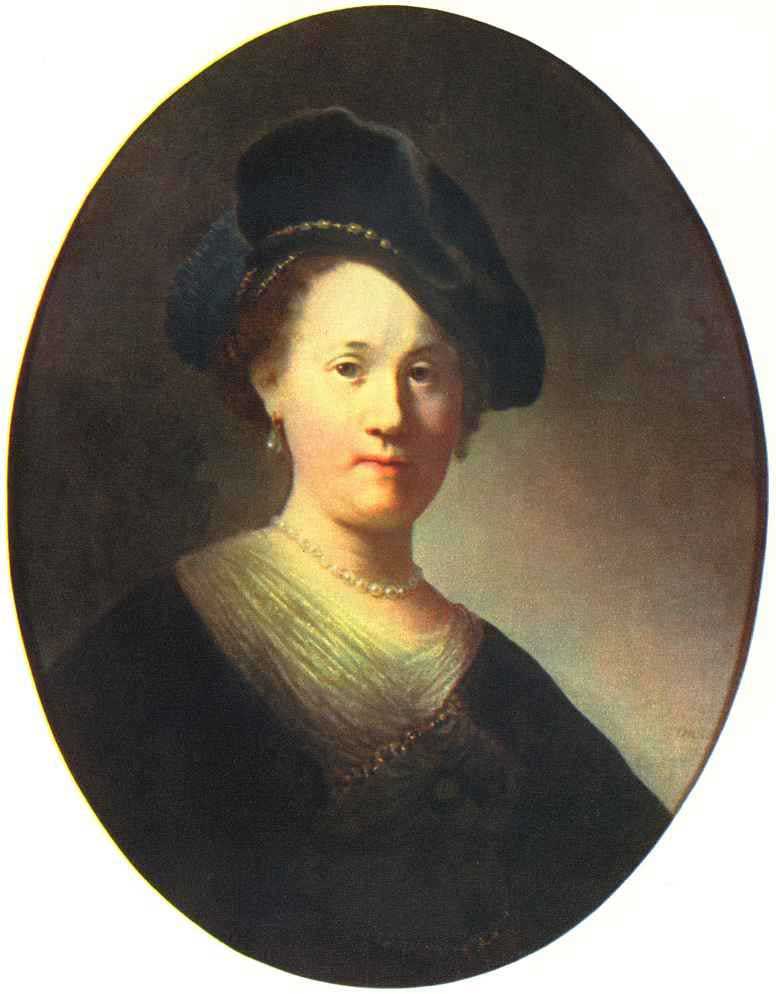
Rembrandt’s “Bust of a Young Woman in a Cap” (1632) is a concentrated study of poise. The sitter appears head-and-shoulders within an oval field, her face lifted to the light, a dark cap softening the silhouette, and a gentle chain of pearls repeating the curve of her throat. A gauzy fichu crosses the bodice, catching small glints that echo the fine beading at the neckline. The background is a hushed, breathable atmosphere rather than a room, allowing the viewer to attend to nothing but presence. Made during Rembrandt’s first Amsterdam year, the picture displays how decisively he could marry bourgeois restraint with a living, modern clarity.
The Oval As An Instrument Of Intimacy
The oval governs the entire experience of the portrait. By removing corners and straight edges, the format extinguishes any sense of architectural box and replaces it with a chamber of air. The eye is coached into circling rather than scanning, returning again and again to the lit face at the center. Rembrandt strengthens this effect by letting the ground bloom slightly behind the head, creating a soft “window” that keeps the silhouette legible without outlining it. The oval also encourages the sitter’s calm; nothing in the field pushes against her. She seems to float, poised between stillness and breath.
Amsterdam, 1632: Restraint And Confidence
In 1632 Rembrandt had just transplanted his Leiden virtuosity to Amsterdam’s wealthier, more civic-minded clientele. These patrons preferred portraits that signaled seriousness—dark dress, clean linen, modest jewelry—yet also broadcast prosperity through craftsmanship and light. This painting meets those expectations exactly. The cap and sober garment keep the rhetoric quiet; pearls and fine gauze introduce luxury without ostentation; the painter’s real bravura lies in modeling skin and fabric so persuasively that understatement itself becomes the most eloquent status symbol.
A Composition Built From Curves
At a glance the portrait reads as a constellation of interlocking arcs: the oval of the frame; the band of the cap; the curve of cheek and jaw; the double strings of pearls; the crescent of the fichu as it crosses the chest. These echoed shapes create a choreography of softness, every curve reinforcing the next. Rembrandt places the head slightly off the vertical axis and turns it marginally toward us, adding a faint diagonal to the arrangement so the likeness feels alive rather than diagrammed. The shoulders descend gently into shadow; the lower field darkens to anchor the buoyant upper half.
Light That Learns The Face
Light enters from the upper left and behaves like a careful reader. It rests with its largest, calmest note on the forehead, then moves down to the brow ridge and the bridge of the nose, softening at the cheeks and blooming faintly at the lips. A tiny highlight in each eye preserves moisture and attentiveness. The far cheek receives a tender reflected light that prevents the nose from dividing the face into hard halves. On the throat and pearls the light quickens, scattering into minute points that sparkle without crowding. By contrast, the cap and bodice absorb illumination, deepening into browns and blacks that make the face glow more warmly.
The Cap: Mass, Edge, And Character
The cap is not mere decoration; it sets the portrait’s mood. Its dark velvet mass provides a canopy that calms the head and moderates the background glow. Rembrandt varies the cap’s edge—lost where soft hair lifts against light, found where the cap overlaps shadow—so that the silhouette breathes. A narrow braid or jeweled band rides along the front, catching tiny flecks of brightness that rhyme with the necklace. The cap’s quiet weight also contributes to characterization: this is not an airy, flirtatious headdress but a choice for gravity and composure.
Dress, Fichu, And The Morality Of Ornament
Dutch taste in the 1630s favored sobriety tempered by refined detail. Rembrandt translates that code into paint with scrupulous tact. The bodice is an enveloping field of near-black that strongly supports the face, while a filigreed trim around the neckline flashes just enough to declare fine workmanship. Over this, a translucent fichu is laid with thin, pearly strokes that catch the light in a controlled shimmer. The pearls at the throat repeat the effect but with even greater economy: not every bead must gleam; a few well-placed sparks convince the eye and keep the necklace modest. Ornament here is obedient to character rather than a performance in its own right.
The Face And Its Unforced Psychology
What holds the viewer is the sitter’s expression: attentive, lucid, and untouched by either theatrical smile or formal severity. Rembrandt balances features with micro-asymmetries—the mouth softens slightly to one side; one eyelid lifts a fraction more than the other—details that convert anatomical truth into personality. Skin is modeled through tempered temperature shifts: warmer notes at cheek and chin; cooler half-tones under the jaw and at the temple; a whisper of violet in the shadow below the lower lip. These transitions deny cosmetic smoothness and maintain the sensation of living circulation beneath the surface.
The Background As Breathable Space
The ground appears neutral, yet its workmanship is active. Rembrandt shapes it with delicate scumbles and feathered strokes that grade from lighter left to darker right, tracking the direction of illumination and helping the forms turn. There is no architectural description, no curtain or column; the background keeps its promise to remain air. In a portrait devoted to character, such discretion is not an absence but a positive ethic. It assures the sitter’s presence will not be borrowed from props.
The Grammar Of Edges
Edges are where Rembrandt’s intelligence is easiest to see. Around the lit cheek and hair the contour dissolves, admitting air between sitter and field. At the shadowed jaw the contour firms, providing structure. Across the fichu the painter alternates crisp and soft boundary lines so the textile seems to advance and retreat with the chest’s curve. On the pearls, edges are momentary—a speck of light with no contour at all. This variety of edge quality prevents the portrait from ever flattening; it keeps the likeness spatial and tactile.
Brushwork And Material Imagination
Rembrandt adapts touch to matter with unobtrusive virtuosity. The face is built with fused, small strokes that suppress the mark of the brush while maintaining a palpable epidermal vibration. The cap bears broader, velvety handling that suggests pile without enumerating it. The fichu is described with thin, milky strokes and quick lifted highlights; the effect is a convincing transparency that still respects the underlying dark. Along the trim at the neckline, tiny, raised touches capture actual light, turning paint itself into jewelry. The control is total, yet nothing feels labored.
Palette And Temperature Harmony
The chromatic strategy is disciplined. Warm creams, peaches, and delicate pinks model the flesh; a family of umbers, deep blues, and softened blacks shapes the garment and cap; pearly grays describe the gauze; the background assembles low-chroma browns and gray-greens. What makes this limited palette sing is its temperature counterpoint: cool notes stabilize the warm face; a cool reflection beneath the jaw prevents the head from floating; cooler glints within the pearls balance the cap’s dark warmth. The result is a harmony that reads calm instead of muted, luxurious without extravagance.
The Necklace: A Silent Metronome
The two strands of pearls perform a compositional and psychological task. They time the movement of the eye from face to garment and back again, and they offer a second, quieter locus of brightness that keeps attention circulating within the oval. Their scale is modest, enforcing the picture’s ethic of contained wealth, yet their precise, intermittent sparkle signals the painter’s pleasure in observable fact. The necklace is a metronome of light that measures the portrait’s tempo.
The Sitter’s Social World
Even without explicit emblems, the painting communicates class and values familiar to Amsterdam viewers. The clean cap, pearls, and neat fichu suggest a household of means; the absence of extravagant lace or ostentatious brocade signals adherence to civic ideals of moderation. The direct gaze and controlled presentation convey self-possession. In this way the portrait participates in a broader cultural rhetoric: it is a modest declaration that prosperity and virtue can coexist, expressed through linen, light, and a calm face.
The Role Of Scale And Distance
The portrait is scaled for domestic nearness. At about head-and-bust size within an oval, it invites viewing at conversational distance rather than gallery remove. This intimacy intensifies Rembrandt’s soft modeling and makes the tiny highlights in eyes and pearls feel like discoveries rather than announcements. The painting offers no spectacle for the far viewer; it rewards the near one with the pleasures of close looking—breathing edges, humane color, and the delicate psychology of a frank encounter.
A Guide For Slow Looking
Begin at the forehead where the largest, quietest light pools. Let your gaze slide down the nose to the small glint on the upper lip and the cooler shadow beneath the lower one; notice how these tiny modulations keep the mouth natural. Move to the eye at left, where a pin point of light makes the iris wet; then cross to the other eye and feel the slight difference in lid height that animates the gaze. Travel outward to the cap’s braid and count—not numerically but rhythmically—the bright flicks that declare the beadwork. Drop to the pearls and follow their broken trail across the throat, sensing how some disappear into half-tone. Finally walk the scalloped edge of the gauze as it arcs across the chest, advancing where light strikes and retreating where the form turns. Step back, and the parts recompose into an unforced presence.
Comparison With Related Early Portraits
Placed beside Rembrandt’s other 1632 oval “busts,” this work shares an ethic of elegant economy. Like “Bust of a Young Woman,” it trusts the union of soft air, sober costume, and living light to achieve dignity. Compared with the more opulent portraits of the same year—gorgets gleaming, gold chains flashing—this picture whispers rather than declaims. Its distinction rests not in pageantry but in calibration: every decision answers to the face.
Why The Painting Feels Contemporary
Modern portraiture—from magazine covers to studio photography—often relies on the same devices Rembrandt perfected here: a neutral, graded background; a centered, softly lit face; limited but expressive accessories; tonal authority instead of decorative noise. The portrait thus reads as strikingly current. Its message—that interior poise can be radiated with minimal means—remains persuasive to contemporary eyes, which are saturated with spectacle and hungry for sincerity.
The Humanity Of Restraint
Perhaps the painting’s deepest lesson is that restraint can be a form of generosity. By refusing overstatement, Rembrandt clears room for the sitter’s interiority to arrive. No single passage demands applause, yet everywhere there is care: the tempered warmth in the cheeks, the breath at the contour, the honest heaviness of dark cloth, the respectful staccato of pearl highlights. The result is a portrait that seems to exhale, welcoming the viewer into quiet conversation across centuries.
Conclusion
“Bust of a Young Woman in a Cap” is small in ambition only if ambition is measured by noise. Within its oval, Rembrandt assembles an entire ethics of looking: attention without intrusion, elegance without vanity, light without spectacle. The cap confers gravity; the pearls and trim give sparkle in measured doses; the gauze carries the light like a whisper; and the face, calmly modeled, becomes the core of meaning. In Amsterdam’s year 1632—an era of civic confidence and private industry—such a portrait was both ideal and accurate. It remains so today, a tender proof that the simplest means, in the right hands, can summon the richest presence.
