Image source: wikiart.org
Introduction
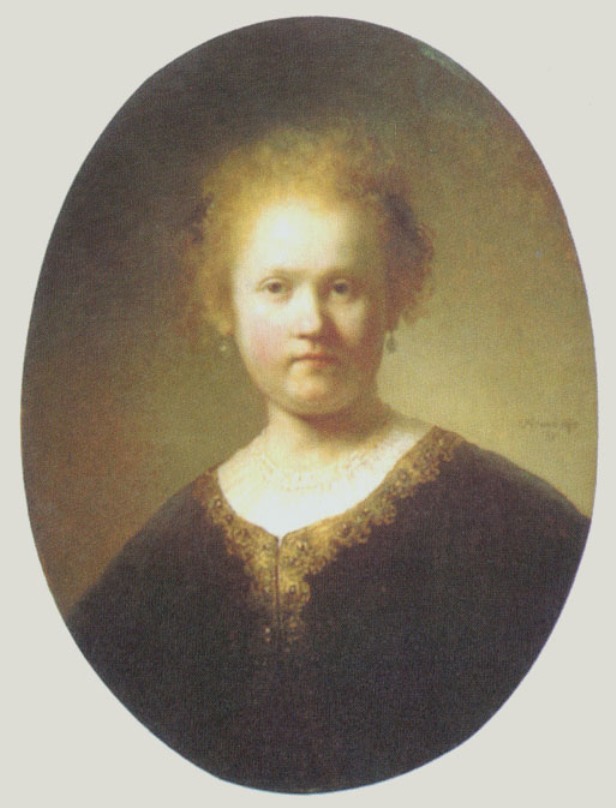
Rembrandt’s “Bust of a Young Woman” (1632) is a small, oval portrait that radiates a quiet glow, the kind of glow that arrives when light discovers a face and pauses there as if to listen. The sitter is presented head-and-shoulders against a soft atmospheric ground. Her hair catches the light like pale flame; her cheeks bloom with a delicate warmth; a modest necklace rings the throat; and the dark garment—trimmed with fine golden embroidery that traces the neckline—absorbs the surrounding space so the features can speak. Painted at the moment Rembrandt was establishing himself in Amsterdam, this picture shows how a young master could convert restraint into authority. Nothing in it shouts; everything works together to make a simple truth persuasive: here is a living person, present and thoughtful, meeting our gaze.
An Oval That Feels Like Air
The oval format is not a mere frame; it is an active part of the composition. Rembrandt lays the head into the oval the way one might set a gem into a bezel, allowing the curve to guide how the light wraps around the skull. The shape suppresses corners and therefore any sense of hard architecture; the sitter seems to inhabit a chamber of air rather than a room with measurable walls. The curve also encourages the viewer’s eye to circulate, returning again and again to the center where the face rests. The oval’s pale halo behind the hair completes a “window of attention,” a soft spotlight that clarifies without isolating.
The First Year In Amsterdam
The date 1632 belongs to Rembrandt’s early Amsterdam surge. After his Leiden years, dense with studies and small histories, he arrived in the city and quickly became the portraitist of choice for patrons who favored sober elegance. In that context, “Bust of a Young Woman” fits perfectly: economical in scale, formally modest, yet charged with the psychological freshness that set Rembrandt apart from his peers. He accepts civic taste—dark clothing, neat linen, restrained jewelry—and then animates it with a tender, searching light.
Composition That Balances Warmth And Gravity
The portrait is built from a clear, stable geometry. The head forms the apex of a gentle triangle whose base is the embroidered neckline and small necklace. The shoulders slope evenly to either side, creating a platform that steadies the composition. The gaze centers just off the vertical axis, so the likeness feels alert rather than diagrammed. The garment darkens into the lower oval, anchoring the figure and deepening the sense of proximity. With very few moves, Rembrandt balances warmth above with gravity below, making the face feel buoyant and the body assured.
Light As Portraitist
Rembrandt’s light arrives from the left and behaves like an attentive companion. It blooms at the forehead, softens across the cheek, highlights the tip of the nose and the moist lower lip, and then relaxes along the necklace and golden trim before being swallowed by the dress. Because he avoids loud contrasts, the face reads as a sequence of gentle turns rather than as a map of edges. The most exquisite passage may be the ear and temple, where thin stipples and faint half-tones let the translucency of skin and the thinness of hair register at once. Light does not interrogate; it understands.
The Language Of Edges
Edges in this portrait have their own grammar. Around the lit hair, the boundary is feathered and breathable, letting air enter the curls. On the shadow side of the face the contour sharpens slightly, securing the head’s volume against the background. At the neckline and along the embroidery, Rembrandt alternates crisp and softened edges so the golden trim appears to shimmer and retreat with the curvature of the chest. This orchestration of edges is part of how he builds credibility without pedantry; we feel the head in space without ever counting strokes.
The Face And Its Unforced Psychology
The young woman meets us with an expression that is composed yet curious. The corners of the mouth hold neither a practiced smile nor a pout; they rest in a natural equilibrium that suggests awareness rather than performance. The eyes are luminous but not glossy, each with a minute highlight placed to imply moisture and depth. The skin carries faint temperature shifts—warmer at the cheeks and chin, cooler under the jaw, a subtle coolness near the temples—that prevent cosmetic smoothness and keep the face living. There is no caricature and no flattering exaggeration; there is a calm willingness to see.
Hair As Light’s Partner
The hair is painted to collaborate with illumination. Thin strokes and lifted touches catch highlights along the crown, while softer scumbles indicate the flare of fine, frizzy strands at the edge of the halo. The color retains a warm golden cast that knits it to the embroidery below, making a vertical rhyme of gold at head and chest. Because the hair’s brightest notes sit against a slightly lighter background, the silhouette remains gentle; the head does not pop out like a cutout but emerges as if from air.
Necklace And Embroidery: Ornaments That Obey
Rembrandt offers the smallest instruments of luxury—a modest necklace and a border of gold stitching—and then subordinates them to the face. The necklace’s tiny highlights are placed sparingly; a few beads gleam while others recede into half-tone, a rhythm that feels like breathing rather than like a tally of pearls. The embroidery along the neckline is indicated by raised, broken touches that flash where the light meets thread and disappear where the garment rounds away. These passages teach us what the material is without stealing the scene.
The Dress As Depth And Anchor
The dark garment is more than absence. It is a field of deep color that grounds the composition and clarifies the head. Rembrandt builds it with layered glazes and broad, velvety strokes that absorb light. A handful of softer highlights along the right shoulder and sleeve suggest pile or fine wool without enumerating texture. Because the garment is tonally quiet, the face and golden trim seem to brighten spontaneously. The painting’s mood depends on this restraint; it is elegance defined by how much one can afford to leave dark.
The Background As Atmosphere
The ground behind the figure is a warm, slightly varied field that behaves like breathable air. Near the crown of the head, it lightens gently, supporting the face the way a cloud supports a bright moon. Farther out, it deepens to a mellow brown, preventing the oval from feeling flat. A few barely visible swirls of brushwork stir the surface so it never reads as dead plaster. In portraits of this period, such backgrounds were more than a convention; they were a moral statement that character should stand free of distracting rhetoric.
Touch And The Ethics Of Paint
Every material receives its own handling. The face merges strokes into fused transitions so that the illusion of skin is never broken by bravura. The embroidery bears tiny, lifted touches that sparkle under raking light; here the painter allows himself a hint of flourish. The garment is laid with broader, quieter movements; the background receives soft scumbles. This varied touch keeps attention honest: where life is delicate the brush is discreet, where ornament is superficial the brush shows itself briefly and then gives way.
Color And Temperature Harmony
The palette is disciplined yet ample in feeling. Warm creams, ochres, and tender pinks build the flesh; cooler gray half-tones stabilize those warmths; the garment descends into near-blacks with hints of umber and green; the trim glows with tempered gold; the background carries muted browns and olive-tinged grays. The success of the picture lies in the temperature counterpoint: a cool soft shadow under the chin allows the warm cheek to bloom; the cool glints within the necklace balance the golden trim; a slightly cooler highlight on the shoulder connects the garment to the cooler half-tones in the face. Nothing is arbitrary; color and temperature cooperate to preserve calm.
The Portrait’s Social Code
Seventeenth-century Dutch portraiture communicated class and values through dress and pose rather than flamboyant emblems. This sitter’s modest jewelry, sober garment, and clean presentation align with a culture that prized diligence and restraint. At the same time, the soft halo and direct gaze confer individual presence. The image suggests a young woman from a respectable household who engages the world with intelligence and poise. The painting participates in civic norms while refusing to reduce the sitter to type.
Oval Versus Rectangle: A Deliberate Choice
Why choose an oval? Beyond fashion and intimacy, the oval brings the viewer closer. It denies the outward thrust of corners, focuses attention, and eliminates the temptation to add furniture or drapery. It is an efficient shape for a likeness intended to hang in a domestic interior, where proximity and tenderness matter more than spectacle. The oval also encourages the painter to shape the background like atmosphere instead of architecture, which suits Rembrandt’s preference for building presence with light alone.
A Conversation With Contemporary Portraits
Compared with the polished symmetries of a Mierevelt or the sparkle of Frans Hals, this portrait is quieter. It offers less in the way of decorative bravura and more in the way of human equilibrium. Rembrandt does not chase virtuoso pleating or compete with lace; he makes the face the event. The embroidery is content to echo the hair; the necklace agrees to play a secondary melody. This clarity reflects a principle that runs through his early Amsterdam work: when everything is subordinate to the lighted face, the painting remains young.
The Viewer’s Distance
The picture is scaled to be encountered at roughly conversational distance. Standing a step or two away, one feels the warmth of the face and the pleasing weight of the garment; step closer and the soft cross-hatching and minute lifts of paint in the trim become visible pleasures. The painting rewards both proximities. It is not a hall portrait meant to impress from afar; it is a home portrait that thrives on nearness, a presence neatly matched to the oval’s embrace.
A Guide For Slow Looking
Begin at the center of the forehead, where the largest, calmest light sits. Let your gaze travel down the bridge of the nose to the small highlight on the upper lip, then to the delicate cool shadow under the lower lip. Drift sideways to the shadowed cheek and watch how the tone deepens near the ear and lightens again along the jaw. Move up to the hairline and follow the tiny flickers where individual strands catch light against the halo. Trace the necklace bead by bead, noticing how not every bead is lit; the rhythm is more musical than mathematical. Finally, walk the eye along the gold embroidery from shoulder to sternum to shoulder, feeling how the brush lifts where light strikes and settles where it does not. Step back and the portrait recomposes itself into a steady, calm presence.
The Humanity Of Restraint
What may be most moving about “Bust of a Young Woman” is how much it achieves with so little. No ornate background, no grand gesture, no aggressive virtuosity—only the essential elements tuned with care. The portrait’s power lies in the painter’s refusal to overstate. Restraint becomes a form of respect: respect for the sitter’s modesty, for the viewer’s intelligence, and for the medium’s ability to imply more than it declares. In that ethic of understatement the painting feels remarkably modern.
Legacy And Afterlife
Small ovals like this became cherished household pictures in the Dutch Republic, circulated among families and connoisseurs who valued the intimacy of a head seen well. They also served Rembrandt as workshops for light, edge, and character—lessons he would bring to larger commissions. The success here foreshadows the humane clarity of his later portraits: the belief that the deepest luxury in painting is not gold or lace but the truthful meeting of light and face.
Conclusion
“Bust of a Young Woman” distills Rembrandt’s early Amsterdam promise into a single, luminous oval. The painter unites a modest costume and minimal ornament with a searching, respectful light to produce a likeness that feels both civic and personal. The face is clarified rather than dramatized; the background is air, not architecture; the golden trim and necklace obey the portrait’s inner hierarchy. Nearly four centuries later, the young woman still speaks in the same quiet register: composed, attentive, and fully present.