Image source: wikiart.org
Introduction
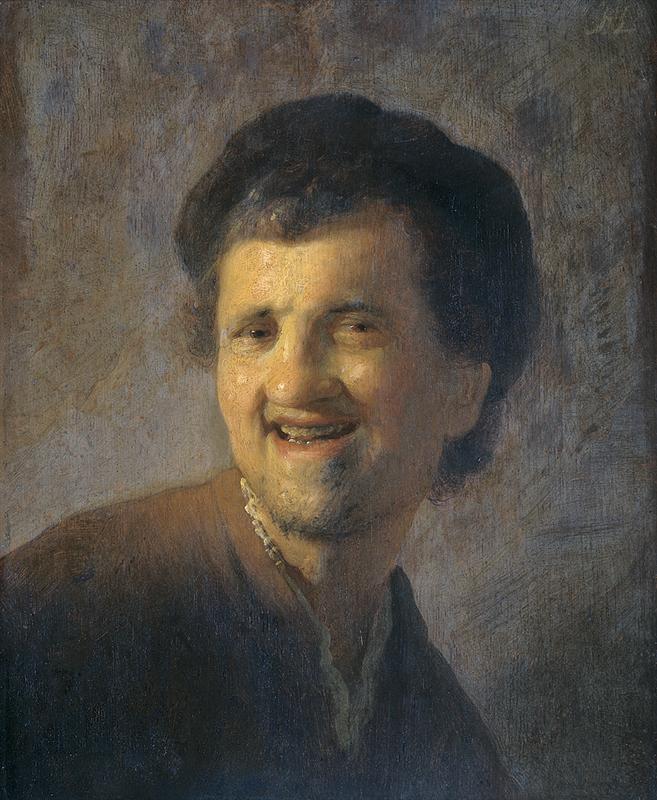
Rembrandt’s “Bust of a Laughing Young Man” (1630) sparkles with the rarest commodity in seventeenth-century portraiture: spontaneous joy. Painted during the artist’s Leiden years, this half-length tronie captures a young man who has just broken into laughter, his mouth open, teeth uneven, eyes crinkled with delight, and cheeks flushed by light. The head turns slightly over the shoulder as if someone has said something irresistible offstage. The background is a simple, brushed field of warm gray, yet the figure radiates like a lantern. In a period when painted faces often wore composure like armor, Rembrandt dares to record a passing burst of feeling and to make it monumental without pomp. The result is a compact masterclass in how light, touch, and timing convert an ordinary expression into a durable image of humanity.
The Tronie Tradition And Rembrandt’s Experiment
The canvas belongs to the Dutch tradition of the tronie, a study of a head or character type rather than a commissioned portrait. Tronies allowed painters to experiment with gesture, costume, and physiognomy without the constraints of likeness. Rembrandt pushes the format toward psychological immediacy. The sitter is anonymous not because he is generic but because the painting’s subject is the experience of laughter itself. Freed from the demands of elite patronage, the artist conducts a laboratory of emotion. He studies the way a mouth opens when mirth overtakes manners, the way eyelids narrow, the way light multiplies across moist skin, and the way joy bends the neck and loosens the shoulders. The tronie becomes a theatre of observation, and the audience is the viewer who recognizes the sensation in their own body.
Composition That Feels Like a Turn of the Head
The composition is disarmingly simple: a three-quarter head turned toward the viewer’s left, shoulders cropped low, and a neutral ground. Yet movement thrums through the frame. The figure’s shoulders angle one way, the chin tilts another, and the eyes cut diagonally toward the unseen source of humor. This gentle torque gives the painting its rhythm. Nothing sits flat. The sweep from dark cap to illuminated cheek, down to the open mouth, and back along the jaw is a circular path that keeps the gaze in play. Rembrandt avoids any symmetry that would freeze the expression. Everything is slightly off-balance, as laughter is—a fleeting disruption of composure that refreshes the order of the face.
Light As a Physical Sensation
Light does more here than model form; it transmits a physical sensation of warmth and life. It strikes the forehead and nose with pearly highlights, stipples the cheek with tiny points of moisture, and glides across the upper lip before pooling in the shadow of the opened mouth. The ear, half submerged in half-tone, glows like thin porcelain. The young man’s teeth, not cosmetically arranged, catch just enough light to charm rather than gleam. This distribution of light tells a story about presence: the laughter has increased circulation, moistened the eyes, flushed the skin, and quickened breath. In Rembrandt’s hands, illumination is anatomy.
The Brushwork of Breath and Flesh
The artist’s brushwork is frank and varied. Thin, brisk strokes articulate the stubble along the jaw and the soft edges of the cap. Broader, oil-rich sweeps form the collar and shoulders, their economy preventing distraction from the face. On the cheeks and nose, Rembrandt stitches tiny dabs and scumbles into a living surface; the paint becomes skin, slightly uneven, catching pinpricks of light. These tactile decisions matter for laughter, which is not a line drawing but a fluttering of micro-expressions across flesh. The painting feels breathed into being because the brush understands how breath changes the surface of a face.
Psychology Without Polishing
Rembrandt refuses to tidy the moment into decorum. The mouth’s irregular teeth, the slight crease at the chin, the glistening at the lower eyelids, and the asymmetry in the cheeks all testify to unedited observation. The expression is not a theatrical grin; one hears the chuckle inside it. The young man’s eyes, narrowed yet bright, focus on something or someone beyond the edge of the canvas. That directed attention gives the laughter its cause and prevents it from reading as empty display. We are watching a real exchange, the second after a joke lands or a friend’s gesture surprises. By declining to perfect the features, Rembrandt honors the truth of the moment.
The Warm Gray World Around Him
The ground is a warm, brushed gray that subtly swirls behind the head. Its neutrality is strategic. It sets off the amber and rose notes of the skin while keeping the entire effect intimate, domestic, unposed. If Rembrandt had staged the figure against a rich interior or a dramatic landscape, the laughter would feel precariously theatrical. Instead the background withdraws, like a friend stepping back to let the good story be told. The slightly visible brush tracks in the ground echo the energy of the head, a muted visual laughter that ripples behind the figure.
Costume, Cap, and the Ethics of Simplicity
The young man wears a plain brown garment and a soft, dark cap whose edges dissolve into shadow. There is no jewelry, no heraldic detail, no explicit class signifiers. The choice keeps the emphasis on expression and allows viewers across centuries to identify with him. The cap’s dark mass also acts as a compositional foil, setting off the lit face the way a theatre’s proscenium frames a stage. Simplicity becomes an ethical stance: to treat joy as sufficient subject without the scaffolding of status.
Color Temperature and the Music of Warmth
The palette is restrained yet musical. Warm ochres and pinks command the face, cooled gently by gray-blue shadows at the jaw and eye sockets. Small sparks of higher value—a wet fleck at the corner of the mouth, a tip of light on the nose, a glancing sheen on the forehead—play like grace notes. The cap’s deepened, cool darkness and the garment’s brown under-chord stabilize the lyricism of the flesh tones. The color harmony feels like late afternoon light on friendly faces: honest, flattering without flattery.
Laughter in Seventeenth-Century Context
Seventeenth-century portraiture often prized gravity, prudence, and self-command. Smiles appear, but open laughter is rare because it risks reading as impropriety, folly, or loss of control. Rembrandt engages that cultural tension and reverses it. He shows laughter as intelligence at play—a quick wit manifesting in muscle and light. The young man does not appear silly; he appears vivid. In elevating a spontaneous expression within the dignified craft of oil painting, Rembrandt asserts that truth of feeling is itself a noble subject. The tronie becomes a defense of the human capacity to delight.
The Moment Caught Between Sounds
The painting traps time between the sound that triggered the laugh and the sound that will be the laugh’s fullest release. We are at the inhale, the point where the mouth opens and the chest rises. That temporal delicacy explains the portrait’s magnetism; it feels like something is about to happen and yet already has. Laughter is contagious partly because of this contagious breath. The viewer finds their own face primed to mirror the expression, a small social miracle conjured by paint.
Kinship With Rembrandt’s Early Self-Portraits and Studies
Around 1630 Rembrandt made numerous etched and painted self-portraits in which he rehearsed expressions—frowning, astonished, open-mouthed. “Bust of a Laughing Young Man” speaks the same language but displaces it onto another model. The set of the jaw, the slightly mischievous eyes, and the lively handling of highlights recall those exercises in facial drama. The painting thus belongs to a broader project: a mapping of the face’s topography under emotional weather. Where the etched heads chatter with line, this canvas hums with color and touch.
The Viewer’s Position and the Game of Distance
We stand close to the figure, at conversational distance. The shoulders angle toward us; the head turns as if we are the ones who caused the laugh. This proximity is crucial. The painting does not show someone laughing at a spectacle somewhere else; it shows someone laughing with us. The implied reciprocity makes the picture socially alive. Encounter becomes participation. The viewer is not an inert observer but a reluctant conspirator in the joke.
Rembrandt’s Humanism in a Smile
The humanity of the image lies in its refusal to hierarchize emotions. Rembrandt grants to laughter—often trivialized—the same depth of attention he gives to grief in later works. He understands that joy is not superficial but reveals character: ease with self, openness to others, a readiness to be moved. The painting thereby anticipates a modern sensibility that values authenticity over posture. In a century of ceremonial faces, a laughing one becomes a small revolution.
The Material World Responds to Joy
Look at how matter behaves under the pressure of the smile. The collar loosens, the cap shifts, strands of hair lift, and the skin gathers into temporary folds that will relax in a moment. Rembrandt notes these physical consequences not to analyze joy out of existence but to convince the eye that joy is real. The world around the face registers the event. Even the ground’s brushmarks seem to whirl faintly in agreement. Paint joins the celebration.
Likeness Versus Truth
Because the picture is a tronie, likeness to a particular individual is secondary. Yet the face feels absolutely specific. Rembrandt achieves this paradox by prioritizing micro-truths over macro-idealization. The left eye narrows slightly more than the right; the nostrils flare asymmetrically; the tooth line arcs irregularly; the cheeks swell unequally as muscles engage. It is precisely these small unrepeatable facts that make us trust the image. The painting does not impersonate a generalized “laughing youth”; it witnesses one person laughing once, and we sense that the next moment would look a little different.
The Ethics of Looking at Joy
There is a responsibility in witnessing someone’s unguarded moment. Rembrandt seems to anticipate that ethics by giving the figure enough autonomy to resist our consumption. The eyes, though sparkling, are not pleading for approval; the laugh is not performed for a patron. The young man remains partly in shadow, partly turned away, and wrapped in the warmth of his own amusement. We are welcome to enjoy the moment, but we do not own it. The painting models a way of looking that is participatory and respectful.
Endurance of an Instant
Why does a fleeting expression endure for centuries? Because Rembrandt treats it not as novelty but as the distilled essence of shared life. The canvas holds warmth the way a hearth holds coals after flame. We return to it and feel again the easy heat of an encounter without calculation. In a world where images are often engineered to produce laughter cheaply, this picture offers laughter honestly, with the patience of oil and the gravity of close looking. That sincerity is why it survives fashion.
Technical Subtleties That Sustain the Illusion
Several subtleties sustain the portrait’s freshness. The highlight on the lower lip is placed a fraction off center, preventing symmetry from stiffening the mouth. The eyes carry pinpoint reflections of the same value as the highest light on the nose, knitting the features into one luminous system. The cool shadow under the jaw is thin enough to let a warmer underlayer breathe, so the flesh never dies into gray. The collar’s broken edge is painted with a dry brush that lets the ground peek through, a meager texture that nudges the head forward. Each small decision adds oxygen to the scene.
Conclusion
“Bust of a Laughing Young Man” is an early Rembrandt at his most daring: serious about pleasure, disciplined about spontaneity, and exacting about the mechanics of feeling. The painting transforms a moment of casual laughter into an enduring encounter shaped by light, touch, and human warmth. It participates in the tronie tradition while expanding its emotional range; it honors the body’s way of recording joy; it lets the viewer become part of the joke without sacrificing the sitter’s dignity. In the end, the canvas offers a proposition about painting itself: that the most lasting images are often those that catch us off guard, when we are most ourselves.