Image source: wikiart.org
Introduction to Brother Pedro Machado by Francisco de Zurbaran
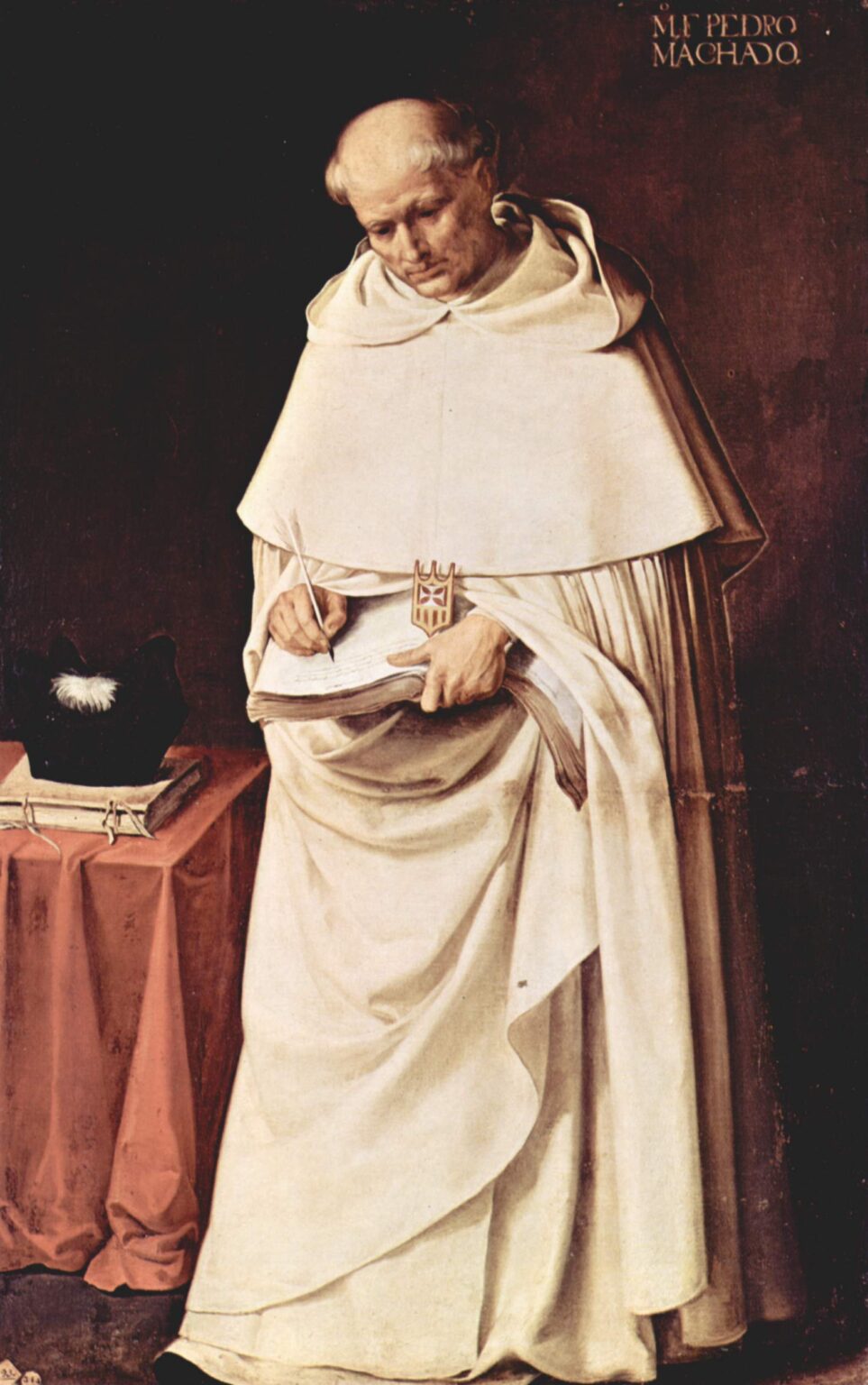
Francisco de Zurbaran’s painting “Brother Pedro Machado,” completed in 1633, is a quiet yet compelling portrait of a learned monk immersed in the act of writing. The figure stands alone against a dark background, wrapped in a monumental white habit that falls in heavy folds to the floor. His head bends gently over a large book that he holds like a portable desk, and a quill pen rests between his fingers. To his left a small table covered with a red cloth supports two closed volumes and a black hat with a white tuft of fur. The name “Fray Pedro Machado” appears in gold letters in the upper corner, identifying the sitter and affirming his importance within the community.
At first glance the painting seems simple. There is no elaborate setting, no narrative action, no crowd of secondary figures. Yet the longer one looks, the richer and more layered the work becomes. “Brother Pedro Machado” is not just a likeness of a specific monk. It is a meditation on study, humility and the quiet heroism of the cloister. Through Zurbaran’s careful handling of light, fabric and gesture, the figure becomes a living embodiment of monastic wisdom and devotion.
Historical and Religious Context of the Painting
To understand the significance of this portrait, it helps to situate it in the world of seventeenth century Spain. Zurbaran worked primarily in Seville, a major port city that prospered from trade with the Americas and that also housed numerous monasteries and convents. Religious orders were among his most important patrons. They commissioned altarpieces, narrative cycles of saints and portraits of their most distinguished members. These images decorated cloisters, chapter rooms and libraries, inspiring the community and preserving the memory of revered brothers.
Brother Pedro Machado was a member of the Mercedarian order, recognizable by the small badge with a cross and stripes that hangs from his belt. The Mercedarians, founded in the thirteenth century, were originally dedicated to the redemption of Christian captives. By Zurbaran’s time they were also known for theological study and preaching. A learned friar who wrote or copied important works would have been a figure of some standing in the community.
The Counter Reformation spirit shaped the values expressed in such portraits. The Catholic Church encouraged images that demonstrated the virtues of obedience, poverty, chastity and intellectual seriousness. Instead of focusing on aristocratic display, Zurbaran’s monastic portraits highlight spiritual qualities. The plain background, the absence of luxurious objects and the emphasis on books and writing all point toward a life dedicated to study in the service of faith.
Portraiture and Monastic Identity
Unlike many secular portraits of the period that stress lineage and worldly status, “Brother Pedro Machado” presents a different type of identity. The monk is not surrounded by emblems of wealth. He wears the common habit of his order, identical to what any of his brothers might wear. Yet within this shared uniformity, Zurbaran brings out the individuality of his sitter.
The face of Brother Pedro is calm, slightly introspective. His thinning hair and rounded features suggest a middle aged man who has spent many years within the walls of the monastery. His eyes are directed downward, focused on the text he is writing rather than on the viewer. This averted gaze reinforces a sense of modesty. He is not posing for admiration but is caught in the midst of his daily task.
At the same time, there is dignity and authority in his posture. He stands upright, shoulders relaxed yet firm. The large book balanced on his arm indicates the weight of knowledge he carries. The quill in his hand symbolizes his role as writer or chronicler of the order’s history and teachings. Through gesture and bearing Zurbaran reveals a personality that is gentle yet intellectually engaged, humble yet quietly confident.
Composition and Spatial Arrangement
The composition of the painting is deceptively straightforward. Brother Pedro occupies most of the vertical space, slightly off center to the right. His white figure stands out against a deep brown background that fades into darkness toward the top and sides. This stark contrast focuses attention on him and gives his presence a sculptural solidity.
On the left, the small table covered with a warm red cloth introduces a balancing element. Its triangular shape and draped folds echo the angles and curves of the habit, tying the two halves of the composition together. The books and hat on the table act as secondary focal points that lead the eye back toward the central figure. The subtle diagonal between the quill, the book he holds and the volumes on the table creates a visual path that reinforces the theme of study.
The emptiness of the surrounding space is important. There is no window, landscape or architectural frame. The viewer encounters Brother Pedro in an almost abstract environment that isolates his spiritual vocation from worldly distractions. The narrow strip of ground at the bottom anchors him in reality, but the overall effect is one of suspended stillness, as if time has slowed around the absorbed monk.
The White Habit and Drapery
Zurbaran was famous for his ability to paint white fabric. In “Brother Pedro Machado,” the Mercedarian habit becomes a visual protagonist in its own right. The cloak and tunic form a cascade of creamy tones, from cool near grays in shadow to almost glowing highlights where the light strikes most strongly. The folds are carefully constructed, revealing the underlying structure of the body while also suggesting the heavy, coarse nature of the cloth.
The large cape drapes over the shoulders in a wide triangle, its straight lower edge emphasizing the stability of the figure. Beneath it, the tunic falls in long, gently curving folds that gather around the knees and cascade to the floor. Subtle variations in color and shadow mark the areas where the cloth creases or overlaps. The habit feels weighty and real, as if one could reach out and touch it.
This attention to drapery is not merely technical display. The habit symbolizes the vows and identity of the monk. Its enveloping presence suggests that Brother Pedro’s entire being is wrapped in his religious commitment. The whiteness evokes purity and the simplicity of a life stripped of unnecessary decoration. By devoting so much painterly energy to the garment, Zurbaran underscores its spiritual significance.
Light, Shadow and the Quiet Drama of the Scene
Light in this painting is soft but directional. It appears to fall from the upper left, illuminating the monk’s face, shoulders and the front of his habit while leaving the background and parts of the robe in gentle shadow. This controlled lighting creates a quiet drama. The head and hands, essential carriers of expression and action, are highlighted just enough to draw attention to the act of writing.
The play of light and shadow across the habit enhances the sense of three dimensional form. It also contributes to the contemplative mood. The illuminated areas suggest moments of understanding or inspiration, while the shadows hint at the hidden depths of the monk’s interior life. The dark background functions like silence around a spoken word, giving emphasis to the illuminated figure.
On the table, the red cloth catches patches of light, revealing its texture and folds. The black hat absorbs light almost completely, creating a dense, velvety presence that contrasts with the shining white of the habit. The books show worn edges and slightly yellowed pages, their surfaces catching just enough light to signal their importance without competing with the central figure.
The Table, Books and Hat as Symbols
The objects on the table may at first seem like simple accessories, but they carry symbolic weight. The stack of books emphasizes Brother Pedro’s scholarly role. Their bindings are plain, tied with cords, indicating that the knowledge they contain is not for show but for serious study. The top book serves as a platform for the hat, linking intellectual life and ecclesiastical office.
The hat itself, likely a biretta or some related clerical headgear, is black with a white tuft or lining that stands out against its dark bulk. It signifies Pedro’s status as a religious professional, possibly with teaching or administrative responsibilities. By placing it on the table rather than on his head, Zurbaran suggests that in the moment of writing the monk is less concerned with outward rank than with the content of his work. His attention is turned inward and downward, not outward toward honors.
Together, these objects form a still life that echoes the themes of the larger portrait. Books, hat and cloth all point to a life of disciplined labor in the service of the Church. Their restrained colors and simple shapes harmonize with the austerity of the composition, reinforcing the idea that sanctity can be expressed through ordinary tools used with dedication.
The Act of Writing and Intellectual Devotion
The central action in the painting is the act of writing. Brother Pedro supports a massive volume in his left hand, its pages slightly curled with use. With his right hand he guides the quill across the page. Although the script is too small to read, Zurbaran carefully indicates lines of text, suggesting that the monk is engaged in sustained, meaningful work rather than a token gesture.
Writing in the monastic context of the seventeenth century was a significant spiritual practice. It might involve copying important texts, composing sermons, recording the history of the community or commenting on theological issues. The slow, deliberate movement of pen on parchment mirrored the gradual internalization of sacred truths. By focusing on this moment, Zurbaran portrays intellectual labor as a form of prayer.
The slight downward tilt of Pedro’s head indicates concentration. His lips are closed, and his brow is relaxed rather than furrowed. This calm expression suggests that the writing task, while serious, is carried out in an atmosphere of interior peace. The viewer senses a harmony between mind and heart, between the words on the page and the monk’s own spiritual life.
Psychological Presence and Character
One of the most impressive aspects of the painting is the psychological presence of Brother Pedro Machado. Though he does not look directly at the viewer, his inner life feels accessible. His features are modeled with tenderness, avoiding both idealization and harshness. The slight rounding of cheeks, the soft lines around the eyes and the gentle set of the mouth convey a person who has grown into maturity through years of disciplined living.
There is no trace of pride or self display. Instead the portrait radiates humility. The monk seems almost unaware of being observed, absorbed in his task. Yet his posture and expression also communicate quiet self possession. He knows his work matters. He is not seeking acclaim, but he carries out his responsibilities with steady seriousness.
This combination of modesty and quiet strength would have been deeply appealing in a monastic setting. The painting offered a model of how a religious man could integrate intellect and devotion, action and contemplation. In contemplating Brother Pedro, monks and visitors could see an idealized version of the life they themselves were called to live.
Zurbaran’s Style and Spanish Baroque Portraiture
“Brother Pedro Machado” belongs to a distinctive strand of Spanish Baroque portraiture that focuses on religious figures rather than nobility. Zurbaran’s approach differs from flamboyant court portraits of contemporary artists. Instead of elaborate costumes and luxurious settings, he emphasizes restraint and clarity. His use of a dark background, strong light and sculptural white drapery aligns with the aesthetic of his altarpieces and monastic scenes.
Technically, the painting showcases Zurbaran’s mastery of oil paint in rendering different textures: the heavy cloth of the habit, the smoothness of the book’s pages, the soft sheen of the red tablecloth, the velvety black of the hat. Yet he avoids unnecessary detail. Everything serves the central theme. This economy of means contributes to the painting’s serene authority.
Within his oeuvre, this portrait connects to other images of monks and saints who appear in isolated, contemplative poses. Zurbaran repeatedly explored the tension between the visible and the invisible, the material and the spiritual. “Brother Pedro Machado” captures this tension in the most quietly human terms. It is not an ecstatic vision or a martyrdom scene, but a recognition that holiness can also appear in the simple act of writing a book.
Legacy and Modern Reception
Today, “Brother Pedro Machado” is appreciated both for its artistic quality and for the insight it offers into early modern religious culture. Modern viewers, even those outside the monastic tradition, often find the figure’s concentration and humility deeply moving. In an age of distraction, the image of someone totally absorbed in a meaningful task carries a special resonance.
Art historians see the painting as a high point in Zurbaran’s portrait work, exemplifying his ability to infuse static poses with inner life. The balance between realism and idealization, the subtle play of light and the harmonious composition all contribute to its lasting appeal. It stands as a visual document of the intellectual life of Spanish monasteries and of the respect accorded to scholars within them.
For many, the painting also raises broader questions about the value of study, memory and written tradition. The quiet monk preserved in oil on canvas continues to write, in a sense, across the centuries, reminding viewers of the enduring impact of those who dedicate themselves to thought and prayer.
Conclusion
Francisco de Zurbaran’s “Brother Pedro Machado,” painted in 1633, is far more than a simple likeness of a Mercedarian friar. It is a rich meditation on vocation, learning and humility. Through careful composition, luminous handling of the white habit, and concentrated depiction of the act of writing, Zurbaran transforms a solitary monk into a symbol of the contemplative intellectual life.
The dark background and sparsely furnished space focus attention on the figure whose inner world is suggested by his downcast eyes and absorbed expression. The books and hat on the table deepen the narrative, linking scholarship with religious office. In this restrained yet powerful painting, the artist shows that sanctity can be found not only in moments of dramatic sacrifice, but also in the patient, daily work of putting words on a page.
“Brother Pedro Machado” continues to speak to contemporary viewers about the dignity of study, the beauty of simplicity and the possibility of finding meaning in tasks that might appear ordinary. Through Zurbaran’s skillful brush, the quiet monk becomes an enduring presence, inviting us into a slower, more thoughtful way of seeing.