Image source: wikiart.org
Introduction to “Brother Juniper and the Beggar” by Bartolomé Esteban Murillo
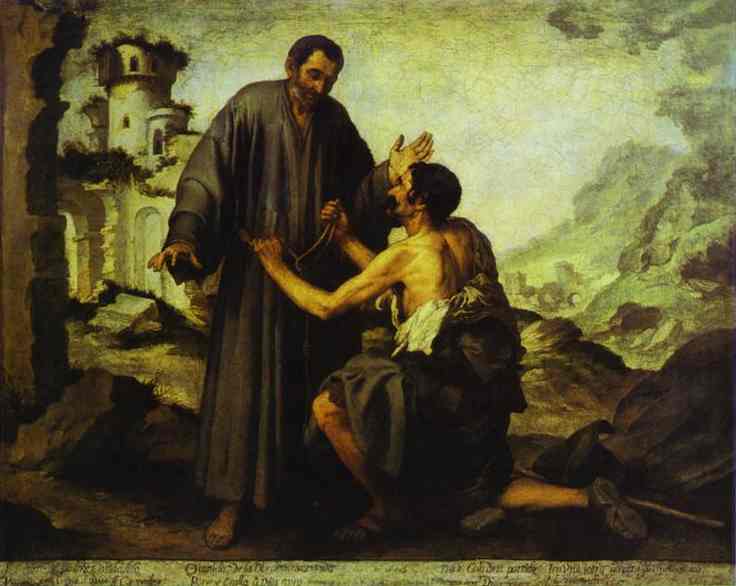
“Brother Juniper and the Beggar,” painted in 1646 by Bartolomé Esteban Murillo, is one of the most moving images of charity in Spanish Baroque art. The painting shows a simple exchange between a Franciscan friar and a destitute man. Brother Juniper stands at the left in a long grey habit, while a half naked beggar kneels before him, clutching the cord of the friar’s robe. The background is a rugged, desolate landscape with ruined buildings and distant hills under a cloudy sky.
At first glance the scene appears modest and almost quiet, but Murillo uses subtle gestures, expressive faces, and a carefully balanced composition to turn this meeting into a profound meditation on generosity, humility, and the Franciscan ideal of radical poverty. The work belongs to a series of canvases celebrating Franciscan saints and blessed figures that Murillo produced for the Franciscan convent of Seville. Among them, this painting stands out for its intense human focus and its compassionate treatment of the poor.
The Story of Brother Juniper
To understand the depth of Murillo’s painting it helps to know who Brother Juniper was. Juniper was one of the earliest companions of Saint Francis of Assisi. Medieval accounts describe him as a man of extreme simplicity and almost childlike charity. He was famous for giving away his clothes and possessions to the poor without hesitation. In one well known story, he cut off the bells from the altar cloth to give them to a beggar, and in another he gave away part of a pig that had been donated to the friars, convinced that the owner would be pleased to see charity shown in his name.
Murillo’s painting draws on this tradition of extravagant generosity. Brother Juniper appears as the embodiment of Franciscan ideals: a man who sees Christ in the poor and responds immediately, without calculation. The kneeling beggar represents the suffering Christ in disguise. Their meeting becomes a visual parable about how holiness is expressed not by grand gestures but by simple acts of mercy.
Composition and Spatial Arrangement
Murillo constructs the composition with great clarity. The two figures dominate the foreground, slightly off center to the left, forming a diagonal relationship that runs from Juniper’s lowered face down to the beggar’s bent knees. This diagonal guides the viewer’s eye through the exchange between the two men.
Brother Juniper stands upright, his body forming a vertical line that stabilizes the scene. His robe falls in heavy folds almost to the ground, giving him a sense of solidity and calm. The beggar, by contrast, kneels on one leg and leans forward with extended arms. His body twists, creating a dynamic curve that contrasts with the stable figure of the friar. The tension between these two postures highlights the drama of giving and receiving.
The background is divided into two zones. On the left, remnants of ruined architecture rise behind Juniper. On the right, the landscape opens into rocky hills and a cloudy sky. This division reinforces the meeting of two worlds: the world of abandoned or broken human structures and the wider world of nature and divine providence. Brother Juniper stands near the ruins, as if leaving behind worldly security. The beggar, closer to the rugged path, embodies exposure and vulnerability.
The Encounter Between Juniper and the Beggar
The heart of the painting is the moment of encounter. Brother Juniper looks down at the beggar with a gentle, slightly sorrowful expression. His right hand is extended in a gesture that suggests both blessing and readiness to give. With his left hand he holds his robe loosely, as if about to offer it or already in the process of doing so.
The beggar kneels with an intensity that is almost desperate. His body is gaunt and muscular, his shoulder bare, his clothing torn. He grasps the cord around Juniper’s waist, not in a violent way but as someone clinging to hope. His face is turned up toward the friar, mouth slightly open. The gesture of his hands implies both pleading and gratitude, as if he is already overwhelmed by the kindness being shown to him.
Murillo captures a delicate balance here. The beggar is not presented as a passive victim, and Brother Juniper is not a distant benefactor. Instead, the two are caught in a relationship of mutual recognition. Juniper leans slightly forward, entering the beggar’s space. The beggar reaches upward, entering Juniper’s. Their bodies form a small, intimate circle within the wider landscape. This intimacy conveys the idea that true charity is not merely giving things but meeting another person face to face.
Light, Color, and Texture
Murillo’s use of light and color supports the emotional tone of the painting. The overall palette is warm but muted, dominated by earthy browns, greys, and soft golds. The sky is cloudy yet luminous, casting a diffuse light over the figures. There are no harsh contrasts or dramatic spotlight effects. Instead, a gentle illumination bathes both men, suggesting that the entire scene takes place under the quiet gaze of God.
Brother Juniper’s robe is a muted grey that picks up subtle reflections from the warm earth and sky. The folds of fabric are painted with soft transitions of light and shadow, giving the impression of coarse but comfortable material. The beggar’s skin, by contrast, is painted in warmer tones, with visible highlights on the shoulders, arms, and legs. These touches of light emphasize his physical vulnerability and draw attention to the exposed areas of his body.
The ruins and rocks in the background are rendered with looser brushwork, which keeps them from competing with the central figures. Their rough textures echo the roughness of the beggar’s life and the hardship of the environment. Yet the landscape is not entirely bleak. Hints of greenery and a softly lit horizon introduce a note of hope and renewal.
Emotional and Psychological Depth
One of Murillo’s great strengths is his ability to convey psychological depth without exaggeration. In “Brother Juniper and the Beggar” he achieves this through subtle facial expressions and restrained gestures.
Brother Juniper’s face conveys compassion more than pity. His eyes are slightly downcast, and his mouth forms a soft, understanding line. He seems genuinely moved by the beggar’s plight, yet there is no sense of condescension. His expression suggests that he sees the beggar as a brother, not as an object of charity. This attitude is central to Franciscan spirituality, which emphasizes identifying with the poor rather than simply helping them from above.
The beggar’s expression is more intense. There is a mixture of desperation, relief, and perhaps disbelief in his eyes. His open mouth may indicate that he is speaking or thanking Juniper, but it may also suggest that he is overwhelmed, caught between fear and hope. Murillo does not idealize the beggar; he remains gaunt, dirty, and visibly marked by hardship. Yet the painter gives him dignity by focusing on his emotional life rather than on his suffering alone.
Together, these expressions create a powerful sense of empathy. Viewers are invited to feel with both men: with Juniper, whose heart is moved to give, and with the beggar, who experiences both need and gratitude.
Ruins and Landscape as Symbols
The architectural ruins in the background are more than decorative. They carry symbolic weight. Rendered in pale, crumbling stone, they suggest the fragility of human achievements and the passage of time. Overgrown with vegetation, they hint at how worldly glory fades, while nature and grace continue.
Placed behind Brother Juniper, the ruins imply that he has turned away from the security of established structures. As a Franciscan, he has renounced wealth, property, and social status. His true security lies not in buildings or institutions but in trust in God and solidarity with the poor.
The rugged landscape to the right, with its rocky slopes and cloudy sky, reflects the harsh reality of poverty. It may also allude to the wilderness where Christ was tempted and where saints often sought solitude. For the beggar, it is the environment of daily struggle. For the viewer, it becomes a metaphor for the spiritual deserts in which acts of charity create oases of grace.
Murillo’s Franciscan Cycle and Counter Reformation Context
In 1646 Murillo was working on a series of paintings for the Franciscan convent in Seville, each depicting a different episode from the lives of Franciscan saints and blessed figures. These works served both decorative and didactic purposes. They adorned the convent and at the same time taught friars and visitors about the ideals of their order: poverty, humility, charity, and missionary zeal.
“Brother Juniper and the Beggar” fits perfectly within this program. Unlike paintings that show dramatic miracles or heavenly apparitions, this canvas focuses on a simple act of giving. In the climate of the Catholic Counter Reformation, such images were meant to inspire concrete imitation. Viewers were encouraged not only to admire distant saints but to practice mercy in their own lives.
Murillo’s gentle realism made him one of the most beloved painters of his time. His religious works avoid both cold formality and excessive drama. Instead, they present saints as approachable figures whose virtues can be imitated. In this painting, Brother Juniper appears almost like an ordinary man in a long robe, yet his actions reveal extraordinary love.
Spiritual Themes of Poverty and Generosity
The central spiritual themes of the painting are voluntary poverty and generous love. Brother Juniper has chosen to live with little in order to be free to give. His long, plain robe and bare feet testify to this choice. The beggar’s rags reveal involuntary poverty, the result of social and economic forces. By bringing these two forms of poverty together, Murillo suggests that voluntary renunciation can meet and heal forced deprivation.
The act of giving is depicted as mutual. Juniper gives material help, but he also receives something intangible from the beggar: the opportunity to serve Christ in the poor, the grace that comes from self giving. The kneeling man, meanwhile, receives not only goods but also recognition and dignity. He is looked at, spoken to, and touched with respect.
The rope belt that the beggar grasps carries symbolic meaning as well. For Franciscans, the rope with three knots represents the vows of poverty, chastity, and obedience. When the beggar clings to this cord, he is literally holding on to the ideals of the order. The gesture implies that he is seeking more than alms; he is seeking spiritual support and perhaps a share in the freedom that the vows represent.
Relevance for Modern Viewers
Although painted in the seventeenth century, “Brother Juniper and the Beggar” speaks powerfully to contemporary concerns about inequality, homelessness, and social responsibility. The image challenges viewers to consider how they look at people in need. Do they see them as burdens, as problems to be solved, or as brothers and sisters worthy of respect and personal encounter?
Murillo’s painting also invites reflection on simplicity of life. Brother Juniper’s ability to give so freely stems from his lack of attachment to possessions. In a consumer culture that often equates happiness with accumulation, this Franciscan example can feel both challenging and liberating. The painting suggests that real wealth is found in relationships and acts of love rather than in objects or status.
Finally, the work encourages a more personal approach to charity. Instead of anonymous giving from a distance, Murillo shows a face to face meeting. The saint’s compassion is expressed not only through his hands but also through his attentive gaze. For modern viewers, this can inspire efforts to combine structural solutions to poverty with personal engagement and solidarity.
Conclusion
“Brother Juniper and the Beggar” by Bartolomé Esteban Murillo is far more than a historical illustration of a Franciscan legend. It is a timeless meditation on compassion, humility, and the dignity of the poor. Through a simple yet powerful composition, warm but restrained color, and nuanced psychological insight, Murillo turns an act of giving into a revelation of divine love at work in human hearts.
The painting invites viewers to step into the space between the two figures, to feel the tension between need and generosity, and to ask how they themselves might respond to the beggars of their own time. In the gentle face of Brother Juniper and the pleading eyes of the kneeling man, Murillo shows how holiness can appear in the most ordinary of encounters. The ruined buildings and rough landscape remind us that worldly structures may crumble, but acts of mercy endure.
Seen in its original Franciscan context or in a museum today, “Brother Juniper and the Beggar” continues to speak with quiet force. It calls us to a deeper understanding of poverty, not simply as lack but as a place where God’s love can be revealed through human kindness.