Image source: wikiart.org
Introduction
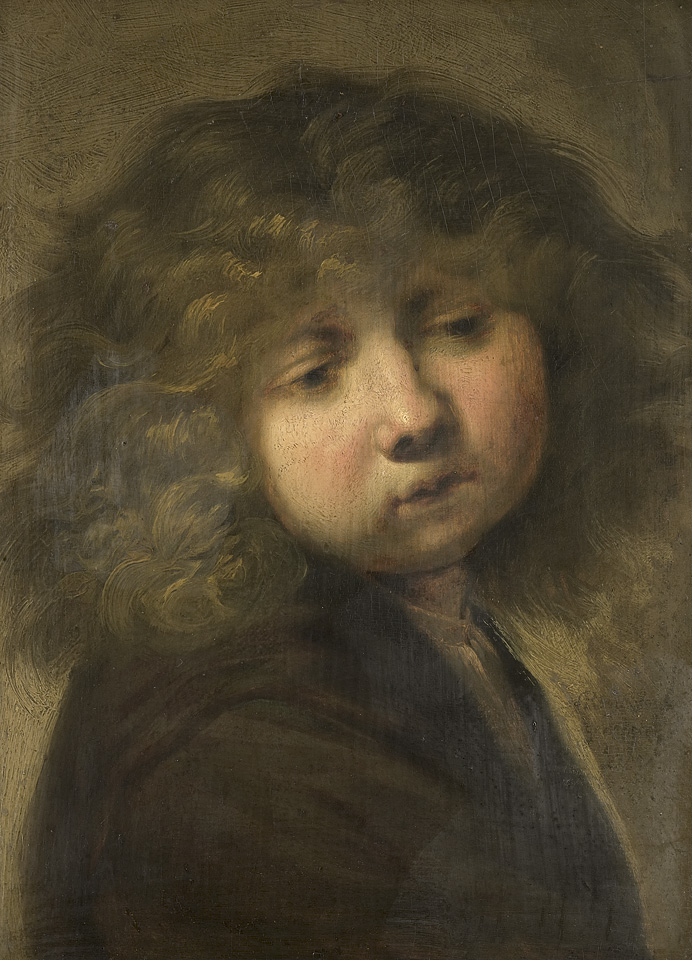
“Boys Cup” (1643) is a small, tender portrait that captures Rembrandt’s rare ability to make quiet feeling visible. The painting presents the head and shoulders of a young boy turning gently over his left shoulder, mouth softened, eyes lowered as if he has just turned away from something that both interests and unsettles him. The background is an atmospheric brown-gold field, rubbed and brushed in broad arcs, against which the boy’s fair curls glow like a halo of ordinary sunlight. There is no narrative prop, no inscription, no elaborate costume; the drama is contained in a living face that has not yet learned how to hide what it feels. In place of spectacle, Rembrandt offers us a study of youth as a state of porousness—open to light, to touch, to the thought of being seen.
The Subject and the Poise of a Turning Head
Rembrandt often found revelation in the moment a head turns. Here the boy has pivoted his body away from us but kept his attention hovering near the viewer’s plane. That pivot organizes the entire composition. The left shoulder advances toward the picture edge, the right recedes, and the neck twists in a gentle spiral that the painter echoes with long, circling brushstrokes in the background. The boy’s gaze is not direct; it falls downward and slightly outward, a line of sight that feels like modesty rather than evasion. The mouth is in the act of relaxing, the lower lip thickened by a highlight that reads as breath. The overall poise is one of listening—youth caught at the instant when it registers the presence of another.
Composition and the Architecture of Quiet
Nothing in the picture competes with the face. The figure fills the vertical format from top to bottom, and the head is placed just above center, so the hair can billow while the torso anchors the lower field. Rembrandt resists the temptation to sharpen a contour where the cheek meets the background; instead he lets edges “breathe,” merging paint layers so the head seems to grow out of the enveloping air. The background itself is structured with large, circular sweeps—a low relief that not only animates the surface but also mirrors the soft motion of the curls. This circular architecture contains the turning head as a shell contains a pearl.
Light and Color as Emotional Weather
The chromatic key is warm and humane. Browns and olive-blacks fill the ground and coat, while the flesh is built from creamy lead white warmed with ochre and pricked with tiny notes of rose at cheek, nose, and lip. Light arrives from the left, sliding across the cheekbone and pooling in the lower eyelid before dissolving into more neutral halftones around the mouth and jaw. The hair catches scattered sparks—small, brisk accents that read like sun on ringlets. Importantly, the light is not theatrical; it is domestic, the sort of glow that comes through a window or bounces off a pale wall. Because it never blares, the smallest highlights become eloquent. A tiny flare at the inner corner of the eye, a narrow edge along the nostril, a softened glint at the lip—these micro-events turn paint into feeling.
Brushwork and the Sensation of Living Skin
Rembrandt models the face with a tempo that changes from zone to zone. Across the cheek and nose, strokes are short and responsive, laid wet into wet so transitions keep a living softness. Around the eyes, he switches to almost stippled touches to retain moisture without gloss. The hair, by contrast, is a playground of freer marks—long, elastic swirls alternated with crisp, lifted strokes that leave tiny ridges catching real light. The garment is blocked with broad, darker scumbles; it must be felt as weight, not read as pattern. This orchestration of speeds makes a surface that breathes like a body: quick at the edges of thought, slower where flesh settles.
The Hair as Halo and Habitat
Few painters render children’s hair as persuasively as Rembrandt. In “Boys Cup,” the curls function as both portrait detail and mood. They form a soft aureole around the head, lightened at the left where illumination pours across and deepened at the right where the turning motion gathers shadow. The painter does not describe every strand; he constructs a “weather” of hair from which small accents emerge. That method suits the picture’s psychology. The child is not a doll with arranged ringlets; he is a person inhabiting a halo of untamed softness that seems to belong to his age as much as to his body.
Costume, Background, and the Refusal of Distraction
The clothing is deliberately indistinct: a dark brown coat, perhaps with a collar that melts into hair, and the faintest suggestion of a white shirt at the throat. Rembrandt suppresses any emblem or trim that would turn the portrait into a social document. The same restraint governs the background. It is not a wall, not a landscape, not a drapery—only an atmosphere. The neutrality lifts the sitter out of circumstance and into presence. The boy could belong to any house, any class; what matters here is the common currency of youth—skin unweathered by labor, hair still learning to settle, a gaze not yet trained to perform.
The Psychology of Youth
The face is a small geography of feelings that arrive and depart too quickly to name. The downward gaze registers shyness, but the head’s openness signals curiosity. The mouth has the softness of someone thinking about what to say. The boy does not court the viewer; he allows the viewer to be near. In this balance we glimpse Rembrandt’s gift for psychological truth. He refuses sentimentality—no rosy props, no over-sugared grin—and instead records the ambiguity that makes youth recognizable: alert but unarmored, present yet still forming.
A Study in Empathy
Many portraits of children in the seventeenth century are essentially portraits of fathers’ fortunes: satin suits, miniature adult poses, symbols of education or inheritance. “Boys Cup” discards that vocabulary and substitutes empathy. Rembrandt paints the child at his own scale—not a small adult, but a person with proportionally larger eyes, softer bone transitions, and a still-growing skull. He does this without caricature. The child is particular, not typified. This approach anticipates later portraits of children that honor individuality over social display.
Technique, Layers, and the Breath of the Ground
Under the topmost paint one senses a warm ground, possibly a brownish imprimatura, that seeps through in the darker passages and contributes to the painting’s inner glow. Rembrandt builds the flesh with semi-opaque layers that he partially “tiles,” leaving tiny interstices where the ground colors lighten or deepen the overpaint. This method keeps the skin luminous without slickness. In the background, he scumbles a darker, cooler mixture, then drags a nearly dry brush in circular arcs, creating a lively tooth. Those arcs, subtly visible, are not merely decorative; they generate a slow vortex that visually supports the head’s turn.
The Mouth and the Question of Voice
The mouth in this portrait is unforgettable. The upper lip is scarcely darker than surrounding flesh, a choice that diminishes sharp edges and makes the mouth quieter. The lower lip carries a soft highlight at its center and a slightly cooler shadow beneath, which supplies volume without hardness. The corners relax downward rather than clamp, so that the entire expression hovers between concentration and openness. It is a mouth that could break into speech or silence with equal plausibility, which is to say it belongs to a child who has not yet learned to choose a persona.
The Eyes and the Ethics of Looking
Rembrandt paints the eyes with humility. There is no showy glint; instead he sets a calm light along the lower lids and lets the pupils remain in soft midtone. This makes the gaze feel interior. We are not being examined; we are being allowed to witness someone’s private seeing. That ethics of looking is part of the artist’s larger practice: invite intimacy without theft. The viewer’s role is to keep company, not to consume.
A Possible Workshop Context and What That Means
Rembrandt’s studio in the 1640s was a hive of learning. Pupils absorbed his handling of light and his psychological realism, and he, in turn, sometimes corrected or finished their efforts. Works of children’s heads exist in this orbit—some autograph, some touched by the master. Whether every square inch of “Boys Cup” is Rembrandt’s hand or whether a pupil blocked the garment matters less than the work’s integrity as an image. Everything essential—the orchestration of tone around the face, the dignity of the gaze, the hair’s truthful weather—speaks Rembrandt’s language fluently.
The Condition of the Surface and the Poetry of Age
The panel or canvas (depending on variant) shows faint abrasions and age-typical craquelure, and in places the varnish has likely mellowed into a golden veil. These material facts contribute to the painting’s mood rather than diminish it. Age has made the background more atmospheric, the lights warmer, the hair more cloud-like. Rembrandt knew that his colors were not meant to stay raw; time would knit them together. In a portrait of youth, that paradox—time softening the image of what is young—adds a poignant echo.
Comparisons Within Rembrandt’s Portraiture
If we compare “Boys Cup” with Rembrandt’s portraits of adults from the same year, a pattern emerges. In adult likenesses he often uses sharper tonal breaks and more assertive costume to articulate role and rank. Here he softens everything. The edges blur at transitions; the palette stays within a narrow, humane range; the pose is without posture. The painting belongs to the intimate family of Rembrandt heads where psychology is not announced but discovered: beggars, scholars in reverie, his own late self-portraits. The boy shares their inwardness while maintaining the lightness particular to childhood.
The Viewer’s Place and the Invitation to Care
The viewer stands close—close enough to count brushstrokes, close enough to sense breath. That proximity is an ethical invitation. The painting asks for the kind of attention we would give to a child who has turned to us with a question. It also implies responsibility. To look with care is to acknowledge the other’s vulnerability. Rembrandt does not preach this lesson; he stages it in the very texture of paint. The softness of edges and the restraint of light teach the eye to behave gently.
Why the Picture Still Moves Us
In an age saturated with perfected images of youth, this small portrait remains startlingly modern. It refuses the polish of advertisement and offers, instead, the strangeness of a real child suspended between gestures. The dignity it confers is not the dignity of social ambition but of regard: to be carefully seen, with one’s unfinishedness intact. That is why the image travels so easily across centuries. It does not require knowledge of Dutch history or studio practice to understand; it requires the willingness to look slowly until paint becomes a person.
Conclusion
“Boys Cup” crystallizes Rembrandt’s belief that likeness is a moral act. By limiting costume, dissolving background into atmosphere, and concentrating all resources on the turning head, he creates a portrait where youth’s inner weather is legible without being pinned down. The warm light, the pliant brushwork, the almost audible hush around the mouth and eyes—these choices make the painting less about a particular boy and more about the condition of being young. It invites the viewer into an exchange governed by tact and empathy, demonstrating how much—and how little—an artist needs to reveal to make a human presence convincing. In its quiet way, this small picture stands with the great portraits of the Dutch Golden Age, reminding us that tenderness is one of art’s most durable powers.