Image source: wikiart.org
First Impressions: A Child of Color and Contour
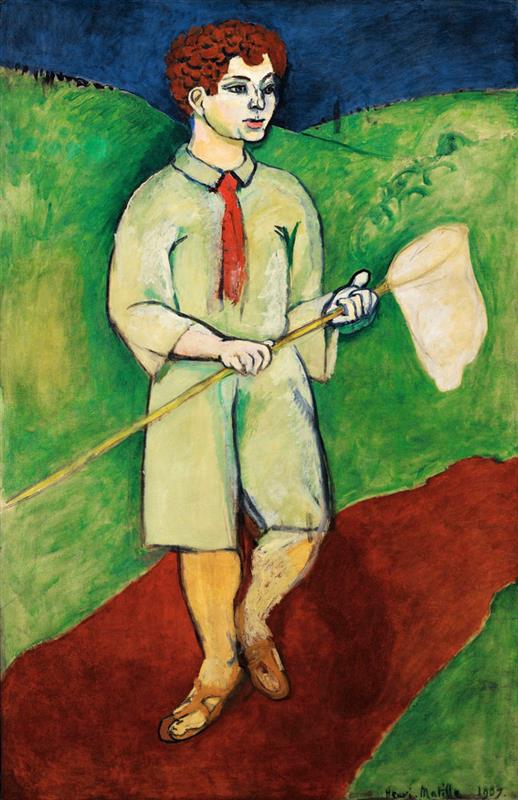
“Boy with Butterfly Net” (1907) greets the viewer with the poised stillness of a full-length portrait and the breezy immediacy of a landscape study. A red-haired child strides along a rust-colored path that cuts diagonally through swells of green. He holds a long pole with a pale net that glows like a small flag against the terrain. The sky is a concentrated blue, and black contours press around the figure and major shapes, giving the scene the emphatic clarity of a poster while retaining the tactile softness of oil paint. The painting feels both theatrical and candid, a moment staged by color.
Subject and Setting: A Modern Pastoral
Matisse chooses a simple, almost archetypal motif: a boy outdoors with a net, ready to chase butterflies. The figure is dressed in a pale smock and shorts, yellow stockings, soft shoes, and a red tie that shoots a hot vertical down the center of the body. The countryside rolls behind him in simplified, buoyant mounds, free of specific topography yet unmistakably Mediterranean in light and hue. Landscape and figure mutually define each other—the boy’s pale outfit reads cooler and brighter because it is set against saturated greens and blues; the hills feel fuller because the body’s outline anchors their curves.
Vertical Format and Staging
The elongated vertical canvas enhances the sense of a solitary walker moving through open ground. Matisse places the boy slightly left of center and allows the sweeping red path to thrust upward from the right foreground, then bend under the figure’s step. This path is not merely scenery; it is a compositional engine. Its diagonal energizes the calm horizontals of the far ridge and sky, while its warm tone counterbalances the cool expanse of the boy’s clothes. The long net follows a secondary diagonal from lower left to upper right, crossing the body obliquely and echoing the direction of the stride. Together, path and pole create a triangulated scaffolding that locks the figure into the field without stiffness.
Color Orchestration: Fauvism Matured
The painting is a master class in limited yet resonant color relationships. Matisse pits three dominant families against one another—green, blue, and red/orange—and lets them sing in carefully separated masses. The hillside is a chorus of greens that range from acid lime to sap green to deep bottle tones; they are smoothed into broad planes rather than broken into pointillist flicker. The sky is a dense, enamel-like blue that recedes as a cool lid over the scene. Into this cool framework Matisse drops the accents that carry the drama: the boy’s red tie and hair, the ruddy path, and the slight blushes in the face and knees. The whiteness of the net reads not as empty space but as an energized pause, a luminous zone where the surrounding colors can resonate.
Black Contour and Cloisonné Echoes
Unlike the riotous Fauve canvases from 1905, this 1907 work uses firm black lines to lock forms. The device recalls cloisonnism—the decorative outlining of Gauguin and the Nabis—and it serves multiple functions. It keeps the pale smock from dissolving into the green, it strengthens the silhouette against the blue sky, and it bestows a poster-like legibility that suits the innocence of the theme. Matisse never lets the contour become brittle; it thickens and thins, breathing with the turns of the body and the curve of the hills. The line is not merely an edge; it is a rhythm.
Brushwork: Quiet Energy in the Paint
The paint handling is more even than in Matisse’s explosive summer of 1905, yet the surface still bears the vitality of the brush. In the greens of the hillside, strokes are laid with a soft drag that leaves a feathery, grassy feel. In the sky, broader, flatter applications allow the blue to sit as a stable plane. The boy’s hair is dabbed in small curls of red and sienna that catch light, and the path is filled with longer, directional strokes that echo the gait. The net is brushed thinly so that the ground color peeks through—an apt visual metaphor for a tool meant to hold air.
Anatomy of a Pose
The boy’s stance is a study in relaxed readiness. One foot is forward on the path, the weight set on the back leg; the torso is open toward the viewer while the head turns slightly to the left, eyes following something just off frame. The hands clasp the pole in an uncomplicated grip—a child’s confident hold rather than a trained worker’s grasp. Proportions are simplified: the limbs lengthen slightly, the hands are broad, the facial features are reduced to expressive essentials. Matisse aims not for pedantic accuracy but for the body’s readable presence in space, an emblem of youth poised between looking and leaping.
The Red Tie: A Compositional Keystone
That narrow streak of red down the boy’s chest does subtle heavy lifting. Chromatically, it is the warmest, most saturated note in the painting; compositionally, it anchors the torso within the large cool mass of the smock and sets up a vertical that counters the diagonals of pole and path. Psychologically, it adds a touch of self-consciousness—this is not a ragged urchin but a child dressed with a flash of style. The tie also converses with the red path, forging a warm circuit across the canvas and preventing the cooler blues and greens from dominating the mood.
The Path as Narrative and Design
The red path is both story and structure. Story-wise, it tells us where the boy has come from and where he is headed—forward into the green, angled toward the unseen. Design-wise, its color is crucial. Because red is complementary to green, the path pops without recourse to sharp edge or fussy texture; it also recedes diagonally, creating a strong sense of depth in a composition otherwise built by stacked planes. Matisse uses the path’s changing width to suggest distance, widening it near the bottom edge and tapering as it slides under the figure.
Landscape as Simplified Theater
Matisse resists descriptive detail in the hills. Instead, he treats the ground like pliable scenery, swelling and dipping in broad arabesques that cradle the figure. Small notches and darker patches indicate bushes and distant tree forms, but these are hints, not inventories. This simplification does not make the world generic; it makes the painting universal, transferring the specificity of place into the specificity of color relationships and compositional balance. The countryside becomes an ideal stage for childhood.
The Net: Metaphor and Motif
The butterfly net is a literal tool, but it also functions as a symbol. It evokes pursuit and capture, yet it is made to hold the most fragile quarry—creatures of air and color. For a painter committed to seizing fleeting sensations of light, the net becomes a wry emblem of the artistic act. The net’s whiteness and airy thinness resonate with the idea that what is sought is elusive, almost immaterial. Its diagonal also creates a path for the eye, drawing us from the boy’s hands to the landscape he is about to traverse.
Psychology and Expression
Despite the painting’s decorative clarity, the child is not a mere cutout. The slightly tilted head, attentive eyes, and calm mouth suggest concentration without strain. There is purpose but no urgency; curiosity rather than conquest. This psychological poise harmonizes with the painting’s overall structure, where bold color masses are kept in balance by measured contour. The inner world and outer design mirror each other.
1907: A Turning Point in Matisse’s Method
Placed within Matisse’s timeline, “Boy with Butterfly Net” signals a period of consolidation after the Fauve blaze. He simplifies drawing and amplifies the constructive role of contour. Color remains vivid, but it is organized into broader fields with fewer clashes and more tonal hierarchy. Compared with the jittering mosaic touches of his 1905 landscapes, this canvas shows a steadier wrist and a search for clarity. It belongs to the same family as portraits like “The Madras,” “Portrait of Marguerite,” and the second “Young Sailor,” where figuration is assertive and design is kept spare.
Dialogues With Precedents and Peers
The black outline that corrals shapes nods to Gauguin’s cloisonné approach and the decorative flatness admired by the Nabis and by Matisse himself in Islamic textiles and Japanese prints. Yet the painting remains unmistakably Matissean in the way color is allowed to breathe within those lines. In 1907 Paris, radical experiments were arriving from all sides—most famously the shattering geometries of Picasso’s “Les Demoiselles d’Avignon.” Matisse’s response here is different: rather than fracture the figure, he clarifies it; rather than disrupt space, he calms it. His radicalism is one of audacity in simplicity.
Material Presence and Edge Play
Look closely at the edges where smock meets sky or path meets grass. Matisse often lets a sliver of underpaint or a soft halo remain, creating small cushions of vibration between complementary hues. This slight trembling at borders prevents the painting from feeling mechanically flat. The net’s circular mouth is drawn with a thin contour that fades in places, allowing the background greens to seep through like light through gauze. Such passages give the work a tactile quietness, a sense that the world and the figure exchange air.
Light Without Modeling
Conventional portraiture builds volume with light and shadow; Matisse builds it with temperature and placement. The boy’s body has minimal chiaroscuro. Instead, cooler whites tint toward blue on shadowed planes and toward yellow on lit planes, accomplishing the sense of roundness with color shifts rather than tonal gradations. The landscape behaves similarly: darker greens compress into hollows; brighter yellow-green bulges forward as if warmed by the sun. Light is not something painted on top; it is something generated by the meeting of hues.
The Child as Emblem of Freedom
Matisse often sought subjects that embodied an untroubled vital energy—bathers, dancers, and children. The boy here is a messenger of that ideal. His open shirt, soft shoes, and easy stride proclaim an unarmored relation to the world. The butterfly net, in this reading, becomes a symbol of playful inquiry rather than conquest. The painting does not describe a particular afternoon; it proposes a state of being where perception and movement are unforced and joyful.
Modern Decorative Vision
Calling the work “decorative” is not to diminish it; for Matisse, decoration names a profound integration of surface and structure. The red path’s curve, the net’s diagonal, the black contours, the simplified hills, and the large color plates all conspire to produce a clear, pleasurable order. That order is not an escape from reality but a way to distill it. The painting offers an image of life arranged to maximize clarity and delight, which for Matisse is precisely the ethical task of art.
Reading the Painting Today
Contemporary viewers may find in “Boy with Butterfly Net” a refreshing confidence that a few strong decisions—bold color masses, a stable design, an unguarded subject—can carry a picture. In a visual culture crowded with detail, the work’s spareness reads as generosity. It leaves space for the viewer’s own memories of summer grass, of hunting butterflies, of being on the cusp of action. The painting is not nostalgia; it is an invitation to attention.
Legacy and Foreshadowing
The controlled harmony achieved here forecasts later Matisse—those interiors where windows frame seas of blue, those odalisques where patterned fabrics carry the weight of description, and eventually the paper cut-outs where color and contour become the entire language. The figure with a net is also a sly self-portrait in method: the artist, like the child, uses a light, open tool to snare the quick, fluttering realities of sensation. He does not trap them brutally; he gathers them with a mesh fine enough to hold color and air together.