Image source: wikiart.org
Introduction to “Boy with a Dog”
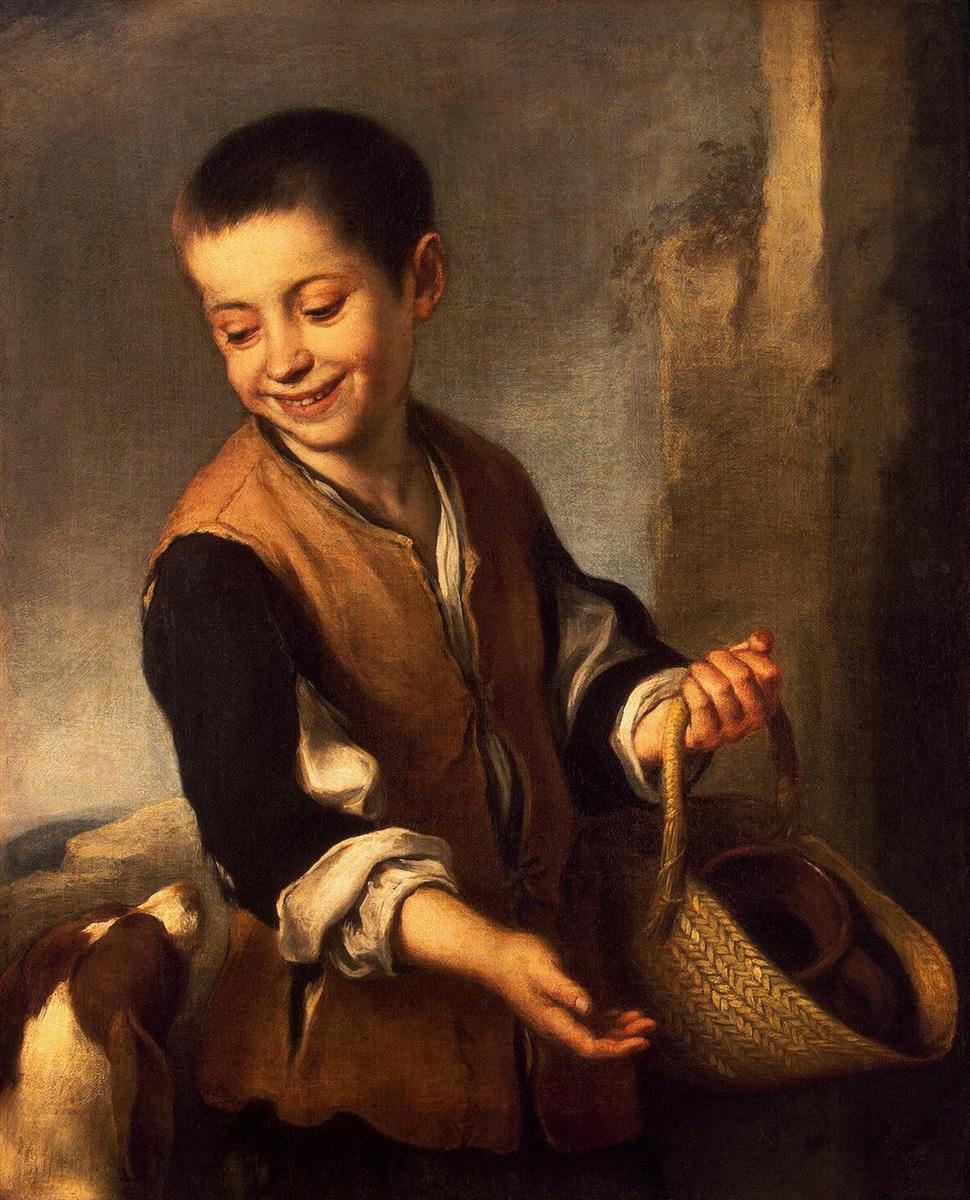
“Boy with a Dog,” painted by Bartolome Esteban Murillo around 1650, is one of the most charming and revealing examples of the artist’s genre scenes from Seville. Instead of saints or nobles, Murillo presents a young street boy, smiling as he turns toward a small dog that eagerly noses at his side. The boy carries a straw basket with earthenware pots, perhaps on the way to deliver food or water. The encounter is simple, yet the painting is filled with warmth, humor, and quiet social observation.
In seventeenth century Spain, images of poor children were often used to illustrate moral lessons or to stir compassion. Murillo’s treatment is distinctive because he avoids cynicism and sentimentality. “Boy with a Dog” celebrates childhood resilience and affection even in the midst of poverty, transforming an ordinary moment into a timeless study of joy and companionship.
Composition and Focus on the Child
Murillo builds the composition around the boy’s figure, placed slightly off center toward the left. The child’s body forms a soft S curve, shoulders turned toward the viewer while his head tilts down and to the left, following his gaze toward the dog. This gentle twist adds a sense of liveliness and spontaneity, as if we have caught him mid gesture.
The boy’s right hand holds the handle of a woven basket that hangs at his side. Inside the basket sit one or two clay pots whose rounded shapes echo the curve of the basket and the boy’s bent arm. His left hand is extended, palm up, in a relaxed but inviting gesture. It might be offering a crust of bread or simply responding to the dog’s presence, but the open palm reinforces the mood of generosity.
The dog, positioned low at the left edge of the canvas, is partly cropped by the frame. We see mainly its head and neck, turned toward the boy with expectant attention. By not revealing the whole animal, Murillo emphasizes the relationship rather than the dog as a separate subject. Our eye moves in a loop from the boy’s smiling face down to his open hand, then to the dog’s muzzle, and back up again.
The background is minimal: a rough wall suggested by broad strokes and a neutral tone. A vertical stone or plaster pillar on the right hints at a doorway or corner of a building. This simplicity prevents distraction and keeps our attention firmly on the pair.
Light, Color, and Atmosphere
Murillo’s control of light gives the painting its warmth and intimacy. A soft illumination falls from the left, bathing the boy’s face, neck, and hands in a gentle glow. Highlights catch on his cheekbones, the bridge of his nose, and the edges of his lips, modeling the features without harsh contrasts. The same light strikes the dog’s head and the wicker basket, tying these elements together.
The color palette is dominated by warm earth tones. The boy’s vest is a tawny brown, worn and slightly frayed at the edges. Beneath it, a dark sleeve and a white shirt create strong yet harmonious contrasts. The basket’s straw yellow and the reddish clay of the pots echo the tones of his clothing, while the background shifts between ochre and muted gray. The dog’s brown and white fur blends naturally into this harmony.
Rather than dramatic tenebrism, Murillo opts for a softer gradation from light to dark. The shadows are deep but never flat; they preserve a sense of air around the figure. This approach suits the gentle subject matter, creating an atmosphere that feels calm and humane.
The Boy’s Expression and Body Language
The emotional center of “Boy with a Dog” lies in the boy’s expression. He smiles downward, eyes half closed, with an expression that combines amusement, affection, and a hint of shyness. This is not the loud laughter of a caricature but the quiet smile of a child who is momentarily at ease.
His posture reinforces this mood. There is no tension in his shoulders; his free hand hangs with open fingers, suggesting ease rather than work or worry. Even the way he grasps the basket handle feels light, as though the pots are not a heavy burden. Murillo manages to communicate both the boy’s poverty and his contentment without contradiction.
The slightly flushed cheeks, the hint of missing teeth, and the short, roughly cut hair all contribute to the sense of a real child rather than an idealized model. Murillo likely drew on direct observation of Seville’s street children, whose presence in the city was a familiar sight amid chronic economic hardship. Yet he portrays this boy not as an object of pity but as an individual with personality and dignity.
The Dog and the Theme of Companionship
The dog, though only partly visible, plays a crucial role in the painting. Its head is raised toward the boy, ears relaxed, nose approaching the child’s open hand. The interaction suggests trust and mutual affection. We can almost imagine the wagging tail just outside the frame.
Dogs in seventeenth century art often symbolize loyalty and friendship. In this context, the animal may also hint at the boy’s emotional life: even if he lacks family protection, he is not entirely alone. The dog stands for a bond that cuts across social status. Both are modest creatures on the fringes of society, yet together they form a little community of two.
Murillo captures the intimacy of this relationship without exaggeration. There is no theatrical embrace or staged trick. The boy simply smiles at the dog, as any child might when sharing a crumb or a playful moment. That understated naturalism is part of what makes the painting so engaging.
Social Context: Poverty and Street Life in Seville
Behind the cheerful scene lies a broader social reality. In Murillo’s Seville, poverty was widespread due to economic decline, plague, and the concentration of wealth in the hands of a few. Orphaned and homeless children were common in the streets, surviving through small jobs, begging, or petty trade. Religious charities and confraternities attempted to care for them, and artists often depicted these children to draw attention to their plight.
Murillo became particularly known for his images of poor children, including works such as “The Young Beggar,” “Children Eating Grapes and Melon,” and “Two Boys Eating Fruit.” “Boy with a Dog” fits within this series. However, unlike some of his more overtly poverty focused scenes, this painting downplays signs of deprivation. The boy’s clothes are worn but not ragged; there are no obvious sores or dirt, and the setting does not emphasize squalor.
This choice may reflect the intended audience. Such paintings were often collected by middle class patrons and foreign visitors who found in them both exotic local color and moral themes. Murillo gave them an image that was honest enough to acknowledge poverty but softened by light, humor, and tenderness, making it easier to sympathize without discomfort.
Murillo’s Technique and Painterly Skill
“Boy with a Dog” also showcases Murillo’s technical strengths. His brushwork varies subtly across the canvas. The boy’s face and hands receive careful, blended strokes that create smooth transitions of tone and texture. This delicate modeling brings the flesh to life. In contrast, the background wall and the dog’s fur are painted more loosely, with visible strokes that suggest texture without precise detail.
The wicker basket is particularly well observed. Murillo indicates the braided pattern with economical diagonal strokes, allowing the viewer’s eye to reconstruct the weave. The clay pots, partly obscured inside the basket, are suggested by curved lines and warm highlights rather than fully drawn shapes. This balance between precision and suggestion gives the painting vitality.
Murillo’s handling of costume is also notable. The folds of the vest and shirt are indicated through shifts in value rather than crisp outlines. The rolled cuffs of the shirt show his understanding of how cloth bunches and catches the light. These subtleties contribute to the sense that the child is truly moving within his clothing, not simply posing in stiff fabric.
Symbolism of the Basket and Pots
The basket and pots provide more than decorative interest. They offer clues to the boy’s daily life and carry symbolic associations. The pots may contain food, water, or wine, suggesting he is a messenger or helper running household errands. In a broader sense, earthenware containers often symbolize modest domestic work and the fragility of human existence, shaped from clay and easily broken.
The open hand that the boy extends toward the dog may indicate sharing. Perhaps he is about to offer the animal a small treat from the basket, or maybe he has already done so and is now enjoying the dog’s gratitude. Either way, the gesture implies generosity, an important Christian virtue. For seventeenth century viewers, the painting could thus be read as an image of charity and kindness, virtues especially associated with children in spiritual literature.
At the same time, the sturdy basket and durable pots speak of resilience. Although poor, the boy is engaged in useful work, integrated into a network of tasks and relationships. Murillo suggests that dignity can be found in simple labor and that such work can coexist with moments of play and affection.
Comparison with Murillo’s Other Child Studies
“Boy with a Dog” can be fruitfully compared with Murillo’s other genre scenes featuring children. In “The Young Beggar,” a ragged boy picks lice from his clothing while scraps of fruit and a loaf of bread lie on the floor beside him. That painting emphasizes hardship and neglect, using sharp chiaroscuro to underline the boy’s vulnerability.
In contrast, “Boy with a Dog” presents a more hopeful vision. The child is cleaner, better clothed, and engaged with a friendly animal. The light is warmer, and the mood more cheerful. Nevertheless, both works share a deep empathy for youth at the margins of society. Murillo does not treat his subjects as exotic curiosities but as individuals with inner lives.
The artist’s repeated focus on children suggests his interest in exploring early human character: openness, mischief, generosity, and resilience. For many patrons, such images also carried moral messages about innocence and the duty of charity. In this painting, the boy’s smile and the dog’s trust remind viewers of the small joys that can exist even in humble circumstances.
Emotional Impact and Contemporary Relevance
For modern audiences, “Boy with a Dog” remains immediately accessible. The relationship between child and dog is timeless, and the expression of mutual delight transcends cultural boundaries. Viewers often respond to the painting with a sense of warmth and nostalgia, recalling their own experiences of childhood pets or simple pleasures.
At the same time, the work gently invites reflection on social inequality. The boy’s clothing and setting indicate that he is not a child of privilege. His happiness does not erase the reality of his circumstances, but it shows that dignity and affection are possible even for those who have little. In a world where many children still live in precarious conditions, the painting’s message retains its force.
The painting also speaks to the value of noticing small, everyday moments. Murillo could have chosen to depict grand historical or religious scenes, yet here he finds meaning in the brief exchange of a glance between a boy and his dog. This focus encourages viewers to see beauty and significance in their own ordinary encounters.
Conclusion
“Boy with a Dog” is a luminous example of Bartolome Esteban Murillo’s ability to combine social observation, emotional depth, and painterly skill. Through careful composition, warm light, and nuanced characterization, he transforms a simple scene into a rich study of childhood, companionship, and quiet generosity. The boy’s smile, the dog’s attentive posture, and the modest basket of pots all work together to create an image that is at once specific to seventeenth century Seville and universally resonant.
In this painting, Murillo offers more than a charming genre scene. He invites us to acknowledge the humanity of poor children, to appreciate the bonds between humans and animals, and to recognize the grace that can be found in ordinary acts of kindness. “Boy with a Dog” continues to captivate viewers because it captures a moment of pure, unselfconscious joy, reminding us of the enduring power of simple affection in a complex world.