Image source: wikiart.org
Historical Context And Why This Still Life Matters
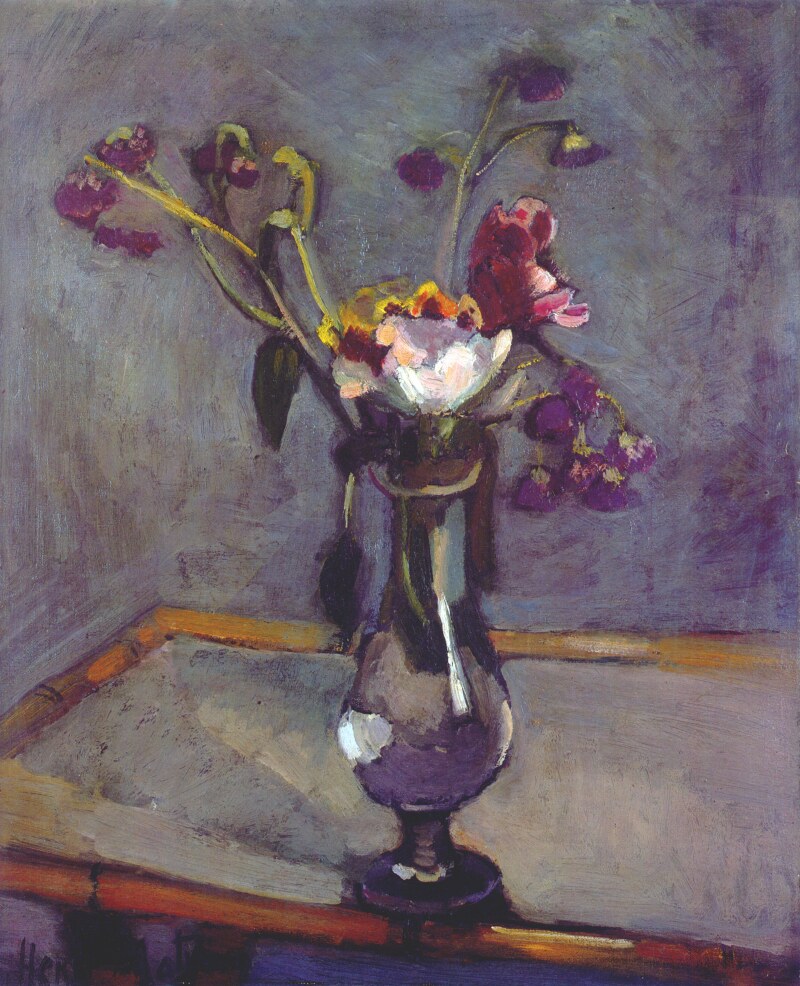
Henri Matisse painted “Bouquet on a Bamboo Table” in 1903, at a hinge point between his rigorous academic formation and the color-forward language that would soon explode into Fauvism. Throughout 1902–1904 he used still life as a laboratory, because a tabletop stripped of narrative obligations allowed him to test how color, value, touch, and edge alone could carry meaning. This canvas captures him before the blaze of 1905, working in a restrained, violet-gray key and discovering how a few well–tuned temperatures could replace heavy chiaroscuro. The subject is modest—a glassy, dark vase holding a handful of flowers on a bamboo-edged table against a cool wall—yet the painting reads as a complete world. It demonstrates Matisse’s emerging conviction that a picture should be a harmonious arrangement on a flat plane long before it is a literal transcription of things.
First Impressions: A Quiet Room With A Centered Vessel
The first sensation is of calm. A dark, reflective vase sits slightly forward of the center, planted on a pale tabletop whose bamboo frame forms a warm rectangle inside the picture. From the vase, lank stems arc outward and upward, each head described with a handful of assertive strokes: a white bloom edged with pink and yellow, a deeper red flower turned in profile, and loose purple clusters that droop like punctuation marks. The wall behind is a single, breathing field of lilac-gray. Nothing in the composition competes with the stillness of the vase; everything else exists to make the central form inevitable.
Composition As A Stable Column Within A Framed Plane
Matisse builds the rectangle like a carpenter. The bamboo edge—two warm rails along the lower and left sides—creates an inner frame that steadies the composition and provides scale. The vase becomes a vertical column set against this measured geometry; its ovoid belly and narrow neck echo the rounded blossoms above, making a rhythm of ellipses up the centerline. Stems reach to the left and right just enough to touch the field, preventing the design from collapsing into symmetry. A triangular wedge of tabletop at lower right pushes gently toward the viewer, keeping the space shallow but believable. The entire structure reads instantly: column, frame, and air.
Color Architecture: A Violet Climate With Warm Accents
The palette is unusually hushed for Matisse, but it is anything but neutral. The wall is a high–value lilac mixed from blue, red, and a generous lead white; the tabletop is a slightly warmer gray with violet cools pooling into shadow; the bamboo moulding strikes rich ochre notes that act as a bass against the cool field. The vase, though “black” at a glance, is in fact a composite of deep violet, bottle green, and cool brown that never settles into dead neutral. The bouquet supplies the painting’s chromatic spark: a white rose broken by pink and lemon impasto, a crimson bloom turning toward shadow, and purples pitched to match the climate of the wall. Because Matisse avoids absolute black and pure gray, every passage leans warm or cool. Temperature becomes the engine of form.
Light As Climate, Not Spotlight
Illumination appears to come from a soft, ambient studio light rather than a single theatrical source. The wall lacks hard cast shadows; the tabletop’s value shifts are broad and persuasive; and the vase’s highlights are crisp but not blinding. On the white flower, Matisse paints daylight as a sequence of temperatures—cool whites where petals face the wall, faint yellows where they catch warmth from the bamboo, mauves where neighboring color reflects. The bouquet reads luminous without a single pure white; the illusion of brightness comes from adjacency, not from extremity. This is precisely the method that will let Matisse, a few years later, build blazes of color that still feel calm.
Drawing Through Adjacency Rather Than Outline
Edges are authored by contact. The lip of the vase exists because a cool highlight sits against a darker oval; the bamboo rail announces itself by a meeting of ochre and violet; a petal serration is a quick pale stroke laid against a plum shadow. Where linear accents do appear—a dark seam around the vase’s ring, a contour on a stem—they are calligraphic and immediately reabsorbed into neighboring tones. The painting never resembles a drawing colored in; instead, form precipitates from relationships, and the whole surface reads as one living skin.
Brushwork And The Physics Of Materials
Touch changes with substance. The wall is scumbled thinly so the canvas grain catches, imitating plaster and letting air circulate. The tabletop is brushed in long, level strokes that create a placid plane. The vase is handled with tackier, shorter marks so its glassy body seems to resist the brush, and highlights are laid as compact, opaque notes that sit “on” the surface like reflections. In the flowers the paint fattens into creamy touches; whites and pinks are applied with visible ridges, and the purple clusters are dabbed quickly, their forms implied by little constellations of color. This orchestration of speeds—slow for the wall, steady for the table, quick for blossoms—creates a pulse you can feel in your eyes.
The Bamboo Table: Warm Geometry That Holds The Scene
The bamboo edging is more than furniture detail. Its warm ochre sets the room’s temperature and keeps the cool violet field from drifting. Because the rail forms an interior rectangle, it repeats the canvas’s outer frame, creating a quiet rhyme between picture and object. Corners are suggested rather than measured; the bamboo’s gleaming facets are made with two or three strokes each. Presenting this crafted, worldly material alongside flowers and glass is classic Matisse: he likes the conversation between natural form, made object, and painted surface.
The Bouquet: Small Theatre Of Complementary Dialogues
Look closely at the cluster of blossoms and you can read Matisse’s color logic. The white rose is not “white” but an ensemble of chilled grays and warmed creams, edged with lemon where it turns to the bamboo. The nearby crimson flower sets a warm complement against the cool wall; it darkens toward violet in recess, echoing the vase’s chromatic darks. The purple pom-poms extend that cool family, but as high-chroma accents. Even the downturned flowers are purposeful: their droop introduces gravity and time into an otherwise still arrangement. Nothing is picturesque; everything is relational.
Space Compressed Into A Decorative Field
Depth here is plausible yet deliberately modest. The tabletop’s triangle advances; the bamboo rails recede; the vase sits convincingly on the surface; and yet the background presses forward like a color field. This compression is central to Matisse’s developing ideal: a painting must be a satisfying pattern on a plane at the same time that it describes space. By holding the wall close and simplifying the table’s recession, he lets color carry more of the structural work without surrendering to illusionism.
Rhythm, Balance, And The Viewer’s Route
The canvas teaches a gentle path. Most viewers enter through the bright white blossom at center, pivot to the crimson head at right, drift along the line of purples to the left edge, and then slide down the long stems to the vase before resting on the cool highlights that assert its volume. From there the warm bamboo pulls the eye along the bottom edge and back up to the bouquet. At each stop small correspondences click into place: a lavender in the wall echoed in a petal’s shadow, a lemon streak echoed in a bamboo highlight, a dark green note repeated in the vase. The painting becomes a loop rather than a diagram.
Dialogues With Predecessors And Peers
“Bouquet on a Bamboo Table” listens to Chardin’s dignity of common things, to Manet’s authority of flatness, and to Cézanne’s constructive method of building form from abutting patches rather than blended tones. It also nods to Japonisme: the bamboo edging reads like a conscious reference to East Asian craft, while the asymmetric bouquet and empty background echo Japanese prints’ use of negative space. Yet Matisse’s temperament is distinct. Where Cézanne is analytic and pressurized, Matisse is harmonizing; where Manet courts high-contrast bravura, Matisse prefers a sustained, lyrical key that can absorb saturated accents without shock.
Materiality And Period Pigments
The harmony likely rests on a practical 1903 palette. Lead white and perhaps a touch of zinc white supply the pale passages and keep the wall breathable. Ultramarine and cobalt blues, mixed with madder lake and white, generate the lilac field; small additions of earth ochres warm the tabletop. The bamboo’s glowing note comes from yellow ochre and raw sienna lifted with white. Alizarin or madder supplies the reds; chrome or cadmium yellow sparks the lemon edges; viridian or terre verte tempers the vase’s darks. Darks are deepened with blues and madder rather than killed with raw black, which is why even the deepest passages feel chromatic.
The Ethics Of Omission
Matisse refuses the temptation to describe everything. There is no explicit wallpaper pattern, no mapped reflections on the vase’s far side, no painstaking crosshatching to carve petals. Instead, he leaves out anything that does not serve the whole. Omission protects harmony and lets the viewer’s memory complete the scene. Because the canvas is economical, it remains readable from across a room and rewarding at close range—a balance Matisse would guard throughout his career.
How To Look Slowly And Profitably
Stand back far enough to receive the scaffold: purple wall, pale table framed by bamboo, dark vase, flaring bouquet. Let those four actors stabilize. Then move in. Watch edges appear where temperatures change—violet into ochre at the bamboo, cool gray into deep plum along the vase. Track the brushwork’s change of speed between wall, table, glass, and flower. Notice how the white blossom holds its brightness without resorting to pure white, and how the vase’s “black” is full of color. Step back again and allow the painting to resolve in one breath as a calm, lilac climate punctuated by measured warmth. That near–far rhythm mirrors the painter’s own process of tuning relations until the whole reads at once.
Why “Bouquet on a Bamboo Table” Endures
This small canvas endures because it shows an artist discovering durable truths. It proves that restrained color can carry a picture when relations are exact; that edges authored by adjacency make a surface feel unified; that a world can be built from four or five planes without feeling thin; and that modest things—a bamboo moulding, a glass vase, a half-dozen blossoms—can become emblems of poise. The painting anticipates the coloristic daring to come, but it is complete on its own terms: a quiet arrangement that breathes, remembers light, and turns economy into grace.