Image source: wikiart.org
Historical Context And Why This Still Life Matters
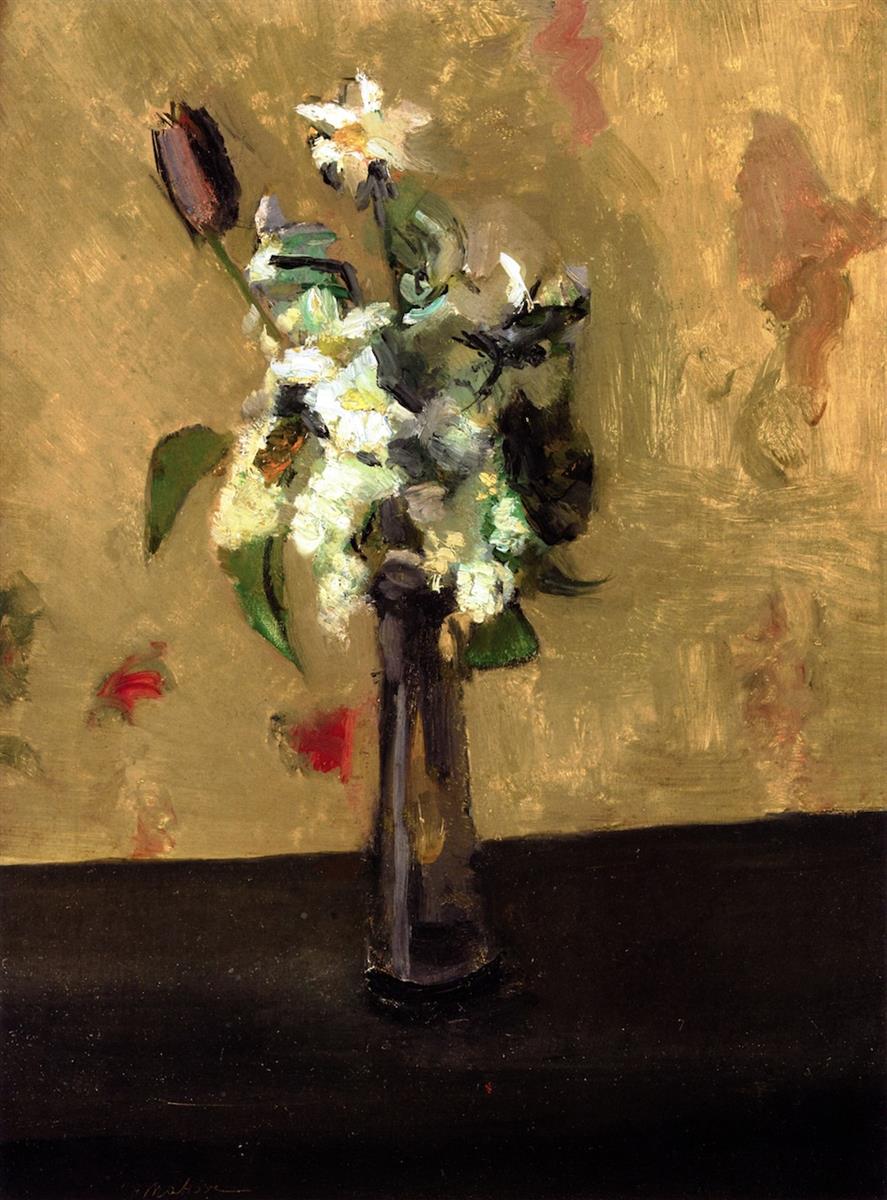
Painted in 1902, “Bouquet of Flowers in a Crystal Vase” captures Henri Matisse at a pivotal moment, just before the riotous color of Fauvism became his trademark. In the previous two years he had tested how color, plane, and brushwork could replace academic finish in landscapes, portraits, and interiors. Still life served as his most controlled laboratory. Flowers do not demand likeness the way portrait sitters do, and a tabletop offers a stage where light, material, and composition can be tuned without narrative distractions. In this canvas Matisse preserves recognizability—a narrow vase, a small bouquet, a table and wall—yet he lets color relations, surface texture, and omissions do the heavy lifting. The picture becomes a disciplined rehearsal for the high-key harmonies that would follow, while honoring a lineage that runs from Chardin to Manet and Cézanne.
First Impressions: A Flame Of White Blossoms On A Dark Stage
At first glance the bouquet reads like a flame rising from a dark hearth. The bottom band of the painting is an expanse of near-black tabletop, dense and calm. From its center a slim crystal vase ascends, painted with just enough opaque and translucent notes to register glass. Above it a cluster of white blossoms bursts outward, their petals struck by cool and warm lights. The entire arrangement sits against a yellow–olive wall whose scumbled surface carries murmurs of red and brown, suggesting worn wallpaper or a decorative plaster. No extraneous objects intrude. The composition feels stripped to essentials: base, vessel, bloom, atmosphere.
Composition As A Study In Vertical Balance
The rectangle is engineered with striking simplicity. A broad, horizontal field of dark paint bases the picture and stabilizes everything above. The vase is centered but not rigidly so, shifting a fraction to the left to accommodate the flowers’ outward tilt. That faint off-center pull prevents symmetry from turning static. The bouquet’s silhouette rises as an irregular triangle whose apex leans slightly right, countered by a deep, dark tulip form that juts left near the top. The wall behind contains no straight architectural edges—only soft, brushed divisions—so the single strong vertical of the vase becomes the composition’s spine. This interplay of one clear axis against fields and soft diagonals keeps the still life poised.
The Table As Structural Bass Note
Matisse devotes almost a third of the canvas to the tabletop, an uncompromising plane of near-black. Rather than receding with perspective lines, it presents itself as a flat, weighty band that presses the arrangement toward the viewer. The decision is both structural and psychological. Dark value concentrates energy and throws the light bouquet into relief; flatness emphasizes the painting’s surface as a designed field before it is a window. The table acts like the low register in music, a steady bass over which the brighter notes can sing.
Color Architecture: Warm Ground, Cool Bloom, Living Darks
The palette is spare and tuned. The wall is a yellow-olive that warms toward ochre in rubbed passages; scarlet and rust strokes bloom and fade at the periphery, never fully forming motifs. The table’s “black” is not dead; it is built from deep greens, umbers, and violets that read as color rather than hole. The bouquet takes a cooler register: creamy whites touched with blue-gray, mint, and the faintest pink, surrounded by green leaves that swing from sap to bottle-green. A single very dark bud, nearly maroon, becomes an anchor note near the top left. Because there are no true neutrals, each area leans warm or cool. Those temperature tilts, rather than heavy chiaroscuro, create form and bind background to subject.
Light Without Theatrical Shadow
Illumination in the painting is ambient and gentle, like afternoon light filtering through a room rather than a spot lamp. The bouquet’s volume appears through small shifts in temperature: petals warm where they turn toward the wall’s golden light and cool toward gray-blue where they recede. The vase carries quick, vertical glints that declare its curvature without counting reflections. The tabletop absorbs light and gives back a faint, oily sheen; it is less a mirror than a dense field. By avoiding sharp cast shadows, Matisse keeps the picture unified and invites the eye to linger in color transitions rather than in dramatic contrasts.
Painting Glass With Economy
The crystal vase is a lesson in omission. Instead of a lace of highlights, Matisse uses a few slender vertical streaks, a soft ellipse at the base, and a slightly cooler interior column to suggest thickness and transparency. The surrounding dark helps tremendously; glass comes to life not by drawing the thing itself but by orchestrating what lies behind it. A warmer stroke slips behind the stem bundle; a dark seam breaks across the foot; two pale accents catch along the lip. With a handful of marks the eye accepts crystal, proof that conviction in painting often travels by relation rather than description.
From Petal To Paint: Brushwork As Botany
Across the flowers Matisse varies touch to suit material. Petals are struck with short, creamy dabs that carry a low impasto; those ridges actually grab light, turning physical gloss into optical bloom. Leaves are laid with longer, elastic strokes that bend and taper like plant forms. The dark tulip-shaped bud at upper left is pressed in a single dense gesture, its surface slightly matte so that it reads as weight rather than glare. In the wall, paint is scumbled and rubbed—some patches nearly dry-brushed—so that the ground color breathes through and the entire plane vibrates lightly. That array of touches assigns a “speed” to each substance: quick for petals, supple for leaves, slow for wall, steady for tabletop.
Drawing By Adjacency Rather Than Outline
Edges in the painting arise where color abuts color. The bouquet’s contour is the meeting of pale petal and warm wall; the vase’s profile appears where gray-violet glass collides with the black table and olive ground; the leaves’ serrations are intimated by a darker note pressed against a lighter one. Linear drawing—where present at all—serves merely to emphasize a fold or stem. This method keeps the surface unified. The viewer never feels that a charcoal scaffold sits beneath the paint; forms seem to precipitate from the surrounding color climate.
Space Compressed Into A Decorative Field
Although we sense a tabletop and a wall, depth is intentionally shallow. The table reads as a plank; the wall is an active plane rather than a recessing room; the bouquet sits tightly against it, almost fused with the surface. This compression is part of Matisse’s maturing decorative ideal: a painting should first be a balanced arrangement on a flat field, and only second a window onto things. In practice, the compression helps the whites blaze. Without much atmospheric distance to swallow their light, the flowers project forcefully toward the viewer.
The Background Wall As Atmospheric Partner
The warm wall is not neutral backdrop; it is an actor. Its rubbed ochres, ghosted reds, and half-seen shapes suggest wallpaper or the painter’s earlier adjustments. Those soft events weave through the space between stems and petals, aerating the bouquet. Crucially, the wall’s warmth reflects back into the whites, giving them form without shadow. Sometimes a still-life background recedes into polite blankness; here it lends the painting its indoor weather, a kind of luminous hush.
The Tabletop’s Near-Black As Modern Color
Nineteenth-century academies often treated black as the absence of color. Matisse instead uses a living near-black that intensifies its neighbors. The deep band below heightens the bouquet’s whites and greens; it also echoes faintly in the vase’s core, binding vessel to support. The modernity lies in treating dark as hue, not as void. This choice foreshadows the active blacks of his later interiors, where dark arabesques and table planes make colors flare rather than sink.
Silence, Scale, And The Mood Of Restraint
Everything about the still life is measured. The bouquet is modest, not extravagant; the vase is slender, not elaborate; the table carries no cloth or extra props. That restraint allows the painting to communicate through harmonies rather than anecdotes. The mood is quiet and domestic, yet not sentimental. The presence of the bouquet is earned by weight and light, not by symbolism. In the midst of early twentieth-century Paris, with its bustle and noise, such a well-tuned silence constitutes its own modern statement.
Dialogues With Tradition And With The Avant-Garde
The canvas speaks fluently with predecessors while pointing forward. From Chardin and Manet it inherits the dignity of ordinary objects and the authority of a dark base against a light subject. From Cézanne it borrows constructive brushwork and a preference for abutting planes over blended modeling. From the Nabis and Gauguin it takes the right to simplify, to let a wall be a color field and a vase be a set of decisive notes. Yet the temperament—harmonizing, steady, luminous—is unmistakably Matisse’s. He declines allegory and theatrics in favor of balance.
Materiality And Period Pigments
The picture’s chord likely rests on pigments typical of 1902: lead white massed into petals and scumbled over the wall; cobalt and ultramarine tipped into the bouquet’s cools; chrome or cadmium yellow softened with ochres for the ground; viridian and earth greens moderated for leaves; alizarin or madder for the scattered reds; and earth umbers anchoring the table’s near-black. Paint width varies: lean, semi-transparent washes in the wall admit the canvas’s tooth; thicker body-color in petals and vase catches real light. The material play between absorbent scumbles and glossy impasto enriches the sensation of indoor light.
The Bouquet As Temporary Light
Flowers have long served painters as metaphors of time. Matisse sidesteps overt vanitas symbols—no skulls, snuffed candles, or clocks—and instead lets the bouquet’s very substance carry the theme. The whites are made of paint that will never wilt; yet the brushwork preserves the feel of quickness, of petals caught mid-opening. The dark bud at left functions as a counter-time, a note of potential not yet spent. By translating bloom into tuned color and touch, the painting turns ephemera into lasting harmony.
How To Look Slowly
Begin by letting the big relations settle: dark table, slim central vase, light bouquet against warm wall. Notice how your eye rises and falls with the triangular silhouette of the flowers, then steadies along the table’s horizon. Move closer and follow edges where colors meet—petal into wall, vase into table, leaf into air. Attend to the varying “speeds” of brushwork: quick dabs that become blossoms, supple pulls that become leaves, rubbed passages that become atmosphere. Step back again until the picture reasserts itself as a single chord. That near-far rhythm echoes the painter’s own process of adjusting patches until the whole breathes.
Relationship To Matisse’s Early Still Lifes
Compared with the saturated carpets and cobalt bowls of 1901, this canvas is quieter in chroma but identical in method. The table is a decisive plane; black behaves as a living color; edges are authored by adjacency; and omitted detail protects the harmony. Where the 1901 still lifes rehearse complementary fireworks, “Bouquet of Flowers in a Crystal Vase” explores how a limited key—warm ground, cool light, active dark—can yield calm intensity. It is a companion lesson that sets up the audacity of the Fauvist years by mastering restraint.
Why This Painting Endures
The work endures because it reveals how little is required to build a complete world when relations are true. A flat band of dark supports a clear vertical; a handful of warm and cool notes precipitate a bouquet; a scumbled wall becomes indoor air. The painting is both a tribute to everyday beauty and a manifesto for modern pictorial thinking: color carries form; omission clarifies; the surface remains sovereign. Long after the real flowers would have faded, Matisse’s constructed bloom still glows, its whites alive with room light, its greens fresh against a golden hush.
