Image source: wikiart.org
Introduction
Claude Monet’s Boatyard near Honfleur from 1864 offers a fascinating look at the young artist before the fully mature language of Impressionism had taken shape. At first glance, the painting may seem quieter and more restrained than the luminous garden scenes, water lily panels, and dazzling riverscapes that later made Monet world famous. Yet this early coastal work is deeply revealing. It shows an artist already attentive to changing weather, atmospheric softness, natural light, and the poetry of ordinary places. Instead of choosing a grand historical subject or an idealized landscape, Monet turns toward a working shoreline. He paints a place shaped by labor, erosion, sea wind, and practical human use. In doing so, he transforms an unpretentious corner of Normandy into a compelling meditation on texture, mood, and place.
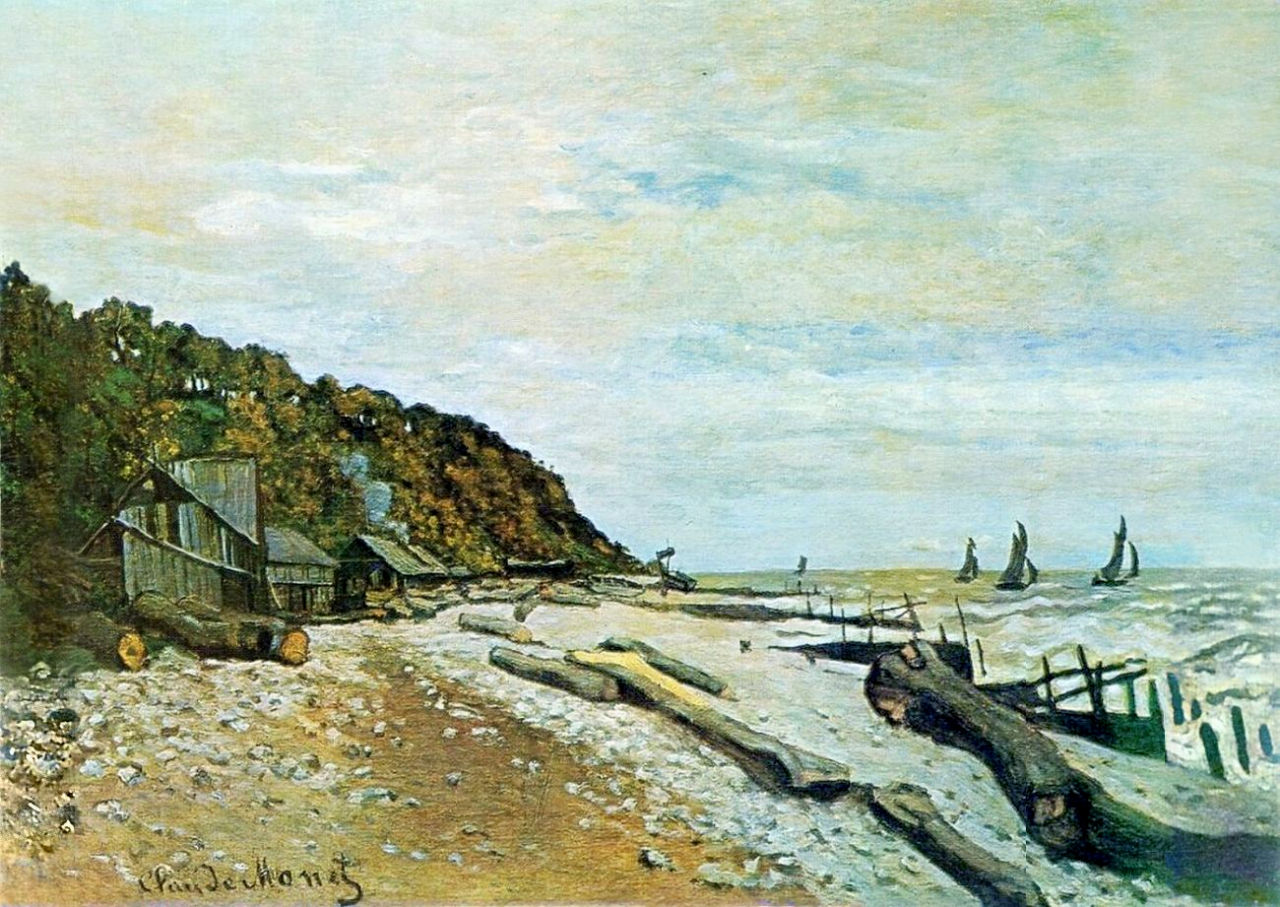
The painting presents a modest stretch of coast near Honfleur, with rough ground, timber, small wooden structures, broken fencing, and boats visible on the water beyond. A sloping bank of trees rises on the left, while the sea opens across the right side of the composition. There is no theatrical centerpiece and no dramatic figure commanding attention. Instead, the visual experience grows through observation. The eye moves from stones and driftwood in the foreground to the boathouse and shoreline in the middle distance, and then outward toward the pale water and distant sails. This gradual unfolding is one of the painting’s great strengths. Monet does not force a narrative. He invites the viewer to inhabit the place.
What makes Boatyard near Honfleur so rewarding is the way it balances realism and sensitivity. The site feels tangible, weathered, and specific, but it is also filtered through an artistic temperament strongly drawn to atmospheric unity. The painting does not merely record a boatyard. It turns the boatyard into an experience of light, coastal air, and muted color harmony. Even in this relatively early work, Monet shows that he is less interested in static description than in how a place feels at a certain moment of day and under a certain sky.
Claude Monet in 1864
To understand the painting fully, it helps to place it within Monet’s early development. In 1864, Monet was still a young painter searching for direction, recognition, and financial stability. He had not yet become the central figure associated with Impressionism in the public imagination. At this stage of his career, he was absorbing lessons from landscape painting, marine painting, outdoor observation, and contemporary realism. Normandy played an important role in that formation. Coastal towns such as Honfleur offered him the chance to study skies, water, boats, tides, and changing weather, all of which would remain crucial throughout his life.
This was a period when Monet was learning how to translate direct visual experience into paint. He had a strong interest in painting from nature, and he was especially alert to the way atmosphere could unify a scene. While some earlier landscape traditions treated nature as a stage for myth or sentiment, Monet increasingly treated nature as the subject itself. In a work like Boatyard near Honfleur, that shift is already visible. The site is not idealized into a pastoral fantasy. It remains stubbornly real, even a little rough. Yet Monet sees beauty in that very roughness.
The painting also belongs to a moment before Monet’s palette became consistently brighter and more broken into flickering strokes of color. Here, his touch is still connected to older habits of structure and tonal organization. The forms are more anchored. The earth feels solid. The sky, though luminous, does not yet dissolve entirely into pure optical vibration. This makes the work especially interesting because it stands between traditions. It carries traces of realism, naturalism, and plein air observation, while also foreshadowing the more fluid and light centered vision that would define his later achievement.
The Setting and Its Coastal Character
Honfleur and its surrounding coastline offered Monet an ideal environment for study. This region of Normandy combines maritime life with shifting weather, pale skies, working harbors, and rugged stretches of shore. In Boatyard near Honfleur, Monet does not show a polished port or a picturesque tourist view. He chooses a practical edge of the coast where boats are built, stored, or repaired. The place is irregular and worn. Logs lie across the beach. Fences appear broken or half swallowed by the shoreline. Small buildings sit close to the bank, exposed to the elements. The coast is presented not as scenery alone, but as a lived environment shaped by human effort and the constant pressure of sea and wind.
This choice matters. Monet reveals an early attraction to subjects that might once have seemed too ordinary for ambitious painting. The boatyard is not glamorous. It is useful. Yet that usefulness gives the image its truth. We sense the history of work embedded in the timber, the scraped beach, and the fragile structures. The painting feels grounded in local life, even without showing laborers directly. Human presence is implied everywhere through objects and construction. The site is inhabited through traces.
The sea itself reinforces this realism. The water is not calm and decorative. It has movement and force. The waves come in under a pale sky, and the dark sails in the distance punctuate the horizon with a rhythm that keeps the composition alive. The coast feels active even in relative stillness. Nothing is frozen. The tide, the wind, and the weather all seem to be in motion, and the shoreline appears temporarily held together against that motion. This tension between stability and change is one of the painting’s most evocative qualities.
Composition and Spatial Movement
The composition of Boatyard near Honfleur is carefully constructed, even though it feels natural and unforced. Monet organizes the scene through a diagonal movement that begins in the left foreground and leads the viewer toward the open water on the right. The beach itself acts as a broad pathway for the eye, while the logs and fencing create secondary directional lines. These elements guide vision without seeming artificial. Their placement feels like part of the observed reality of the site.
The cluster of buildings on the left provides a dense anchor. Their vertical and angled forms contrast with the horizontal stretch of shore and sea. Behind them, the tree covered slope rises in a dark mass, giving the left side of the painting visual weight. This prevents the composition from dissolving into emptiness. From that darker concentration, the eye moves outward and rightward into increasing openness. The beach widens, the horizon becomes more evident, and the sky occupies a large area of the canvas. This expansion creates a strong sensation of breathing space.
The foreground is especially important. Monet fills it with stones, driftwood, and uneven ground, establishing a tactile entry point into the scene. Rather than placing the viewer at a distant observational remove, he brings us close to the material reality of the shore. We do not simply look at the coast. We feel positioned on it. The rough beach gives the painting physical immediacy.
At the same time, the distant sails keep the composition from becoming too enclosed or heavy. They introduce a note of elegance and distance, balancing the rustic density of the foreground and middle ground. Their slim, dark shapes rise against the lighter sea and sky, creating a gentle rhythmic pattern near the horizon. The result is a composition that feels both stable and fluid, structured and atmospheric.
Color and Tonal Harmony
One of the most striking aspects of the painting is its restrained palette. This is not the Monet of blazing poppies or shimmering summer gardens. The color range here is earthier, cooler, and quieter. Browns, ochres, grays, muted greens, pale blues, and off whites dominate the scene. The chromatic modesty suits the subject perfectly. A coastal boatyard under diffuse light would lose much of its truth if translated into overly saturated color. Monet instead chooses harmony over spectacle.
The left side of the painting is built from darker, denser tones. The hillside trees contain deep greens, browns, and shadowed blacks, giving the land mass presence and gravity. The structures near the shore are painted in subdued grays and browns, their wooden surfaces blending into the environment rather than standing apart from it. This tonal integration helps unify the scene.
As the eye moves rightward, the palette lightens. The beach becomes paler, with chalky whites and sandy creams mixed into the earth. The water and sky open into delicate blues and grayed greens. Monet does not separate these zones sharply. Instead, he allows them to echo one another. The sky reflects the sea, and the beach picks up light from both. This creates a continuous atmospheric field across the composition.
The painting’s most subtle achievement may be the way Monet finds beauty in dirty or weathered color. The whites are not pure white. The greens are not lush spring greens. The browns are mixed with gray and ochre. Everything feels touched by salt air, light cloud, and coastal wear. That soft desaturation gives the work emotional credibility. The scene feels inhabited by real weather rather than decorative artifice.
Light and Atmosphere
Even at this early stage, Monet’s deep sensitivity to atmosphere is unmistakable. The painting is not driven by dramatic sunshine or theatrical contrast. Instead, it is shaped by diffuse, filtered light. The sky is pale and expansive, with thin clouds stretching across it in soft transitions. The illumination is gentle and somewhat cool, giving the entire scene a mood of quiet observation. This is one of the defining features of Monet’s art across decades: his belief that light is not merely an accessory to form but the condition through which form is perceived.
In Boatyard near Honfleur, light softens edges and links different parts of the scene together. The shoreline, the buildings, the water, and the sky all seem suspended within the same atmospheric veil. There are shadows, but they are not harsh. There is movement in the sea, but it does not shatter the tonal unity. The result is a world held together by air.
This atmospheric coherence is especially important because the subject could easily have become fragmentary. A boatyard contains many irregular elements: beams, stones, fences, structures, water, and vegetation. Monet prevents the scene from breaking apart by letting the light knit it together. Everything belongs to the same moment. The painting is not an inventory of objects. It is a perception of a place under specific conditions.
There is also something emotionally expressive about this weather. The pale sky and muted surf create a sense of stillness tinged with motion. We feel that the coast is alive, but not bustling. The mood is reflective rather than energetic. This helps explain why the painting holds attention so well. It is neither empty nor overly eventful. It occupies a middle register of experience where quiet observation becomes powerful.
Brushwork and Surface
Monet’s brushwork in this painting is revealing because it stands at an early point in his evolution. The handling is freer than tightly academic finish, yet more contained than the fully broken, flickering touch of later Impressionism. Forms are visible and coherent, but they are not rigidly polished. The texture of the paint contributes to the sensation of place.
In the foreground, the brushwork creates the roughness of stones and sand. Small touches of light and dark suggest the uneven surface of the beach without requiring exact detail for every pebble. This is an important aspect of Monet’s method. He does not paint by outlining every object. He paints by building visual truth through relationships of tone, color, and texture. The logs in the foreground are rendered with enough solidity to register as heavy timber, yet their surfaces remain painterly.
The hillside vegetation is handled with a denser, more varied touch. The foliage is not botanically precise, but it conveys mass, depth, and irregular growth. The sky, by contrast, is painted with softer, more horizontal transitions, reinforcing its openness. The sea occupies a middle position, with strokes that suggest movement and light without turning the water into a rigid pattern.
This balance between description and painterliness is one of the work’s central pleasures. The surface remains active. We are aware that this is paint on canvas, arranged by an observing hand. Yet the marks never become self conscious. They remain in service of the scene. This is one reason the painting feels fresh. Monet is already learning how to preserve immediacy without sacrificing coherence.
The Poetry of the Ordinary
A major strength of Boatyard near Honfleur lies in its treatment of ordinary subject matter. The painting does not depend on rare spectacle, ideal beauty, or dramatic human action. It finds meaning in weathered boards, pebbled ground, broken structures, and a practical shoreline. This choice reflects a broader nineteenth century transformation in painting, when artists increasingly recognized that modern life and everyday places could be worthy of serious artistic attention.
Monet’s approach, however, is not simply documentary. He does not paint the boatyard as a neutral factual record. He reveals its poetic dimension. The logs scattered along the beach become powerful compositional forms. The fencing near the water reads almost like a calligraphic pattern against the surf. The distant boats introduce a sense of journey and open space. The pale sky expands the emotional tone of the scene. Through these relationships, the ordinary becomes resonant.
This ability to discover beauty in the uncelebrated would remain vital throughout Monet’s career. Whether painting haystacks, train stations, poplar trees, or riverbanks, he repeatedly demonstrated that artistic intensity does not depend on prestigious subject matter. What matters is perception. In Boatyard near Honfleur, the boatyard becomes moving because Monet sees it fully. He notices its textures, its tonal subtleties, its shifting weather, and its balance between human use and natural force.
The painting also carries a quiet dignity. Nothing is sentimentalized, yet nothing is degraded. The structures are humble, but they are painted with seriousness. The shoreline is rough, but it is not treated as bleak. The result is respectful attention. Monet suggests that even a utilitarian corner of the coast can hold visual richness and emotional depth if the painter is attentive enough to find it.
Nature and Human Presence
Although there are no prominent figures in the scene, human presence is everywhere implied. The buildings, the logs, the boatyard setting, the fencing, and the distant sails all point to labor and maritime life. Yet nature remains dominant in a subtle way. The sea, sky, and vegetated slope frame and exceed the human structures. The boatyard appears provisional beside the forces of weather and time.
This tension is beautifully handled. Monet does not present humanity as master of the landscape, nor does he erase human traces in favor of untouched wilderness. Instead, he shows a practical coexistence. People have shaped this section of coast, but only temporarily and imperfectly. Fences break down. Timber lies exposed. Buildings appear vulnerable to salt, wind, and erosion. The sea continues its restless movement regardless of human activity.
That relationship between human use and natural process gives the painting philosophical depth. It reminds us that landscapes are often shared territories where labor, habitation, decay, and elemental change overlap. The boatyard is not separate from nature. It is embedded within it. The logs come from trees, the structures weather under the same sky, and the boats depend on the sea that also threatens them.
Monet’s sensitivity to this balance prevents the painting from becoming merely picturesque. A picturesque treatment might smooth away roughness and turn the coast into a decorative scene. Here, roughness remains essential. The site is beautiful precisely because it is worn, active, and exposed. The painting acknowledges fragility without turning it into melodrama.
Place in Monet’s Artistic Development
As an early work, Boatyard near Honfleur is especially valuable because it reveals Monet in transition. We can already see several qualities that would become central to his mature art: a fascination with atmosphere, a commitment to modern and unidealized subject matter, an interest in coastal and aquatic environments, and a desire to paint what light does to a scene rather than merely what objects are. At the same time, the painting still retains a stronger sense of tonal construction and object definition than many of his later canvases.
This makes the work important not only as an individual image, but also as evidence of growth. It shows Monet learning how to balance solidity with sensation. He has not yet abandoned structure for pure optical play. Instead, he is building toward a method in which structure will increasingly emerge from color and light themselves. In this sense, the painting stands at a formative threshold.
The connection to Normandy is also significant for Monet’s career as a whole. The region’s skies, coasts, and maritime settings gave him ideal subjects for observing transient visual effects. Honfleur in particular belonged to a larger network of places that nourished landscape innovation in nineteenth century France. For Monet, these coastal studies were not side projects. They were part of the artistic training ground from which later breakthroughs emerged.
Looking at Boatyard near Honfleur today, one can feel both the youth of the artist and the seriousness of his ambition. The painting does not yet announce the full revolution of Impressionism, but it contains its seeds. The attention to atmosphere, the respect for ordinary visual experience, and the refusal of academic grandiosity all point forward.
Conclusion
Boatyard near Honfleur is a deeply rewarding early Monet because it combines realism, atmosphere, and quiet emotional intelligence. The painting takes a modest working shoreline and turns it into a rich visual experience. Through careful composition, muted color harmony, textured brushwork, and sensitive light, Monet reveals the poetry of a practical coastal place. The scene feels observed rather than invented, yet it also feels shaped by a distinctly artistic consciousness that understands how weather, space, and material surfaces can create mood.
What makes the painting memorable is its honesty. It does not rely on spectacle. It does not idealize the coast or dramatize it beyond recognition. Instead, it trusts the expressive power of careful looking. The rough beach, the scattered logs, the weathered structures, and the distant sails all become part of a single atmospheric whole. This unity is the painting’s true achievement. Even in 1864, Monet was already discovering that the deepest beauty in landscape often lies not in grandeur, but in fleeting relationships of light, air, earth, and water.
Seen within the arc of Monet’s career, the work becomes even more compelling. It allows us to witness the formation of one of modern art’s most influential painters at a moment when observation and experimentation were beginning to merge into something distinct. The later master of shimmering surfaces and radiant color is not fully present yet, but he is clearly emerging. In that sense, Boatyard near Honfleur is more than an early coastal scene. It is a record of artistic becoming.