Image source: wikiart.org
Introduction
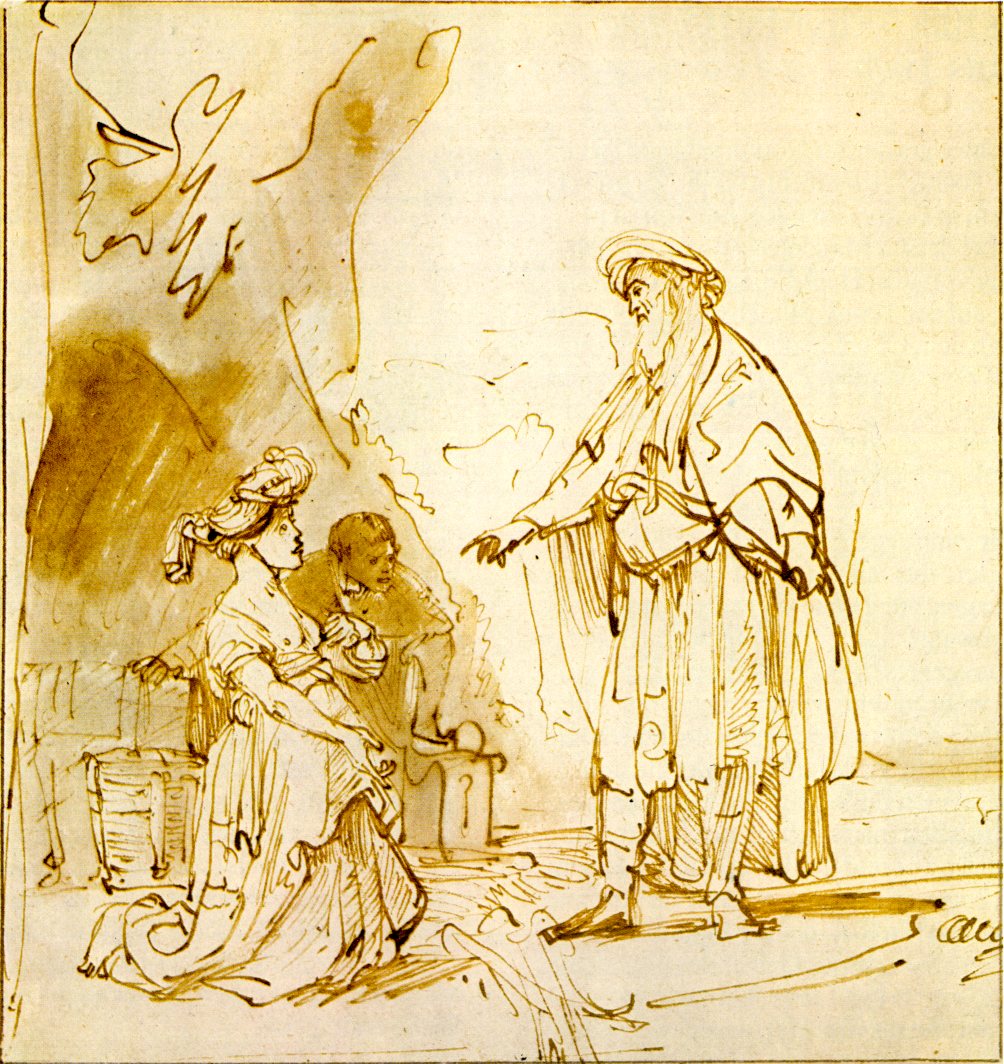
Rembrandt’s drawing “Boas und Ruth” (1640) distills a well-known biblical encounter into an intimate conversation rendered in a few eloquent lines. On a sheet animated by warm brown ink and washes, the artist sets Ruth kneeling at left, Boaz standing at right, and a witness—often identified as a servant or kinsman—observing from behind. Nothing is overworked: rocks and foliage are suggested with swift arabesques; garments fall in a handful of verticals; the ground is a field of quick strokes. Yet from this economy emerges a complete world of gesture, speech, character, and moral choice. The drawing shows Rembrandt at his most incisive: using the lightest of means to stage one of Scripture’s most humane scenes.
The Story and Why It Matters
The Book of Ruth tells of a Moabite widow who follows her Israelite mother-in-law Naomi to Bethlehem, pledging loyalty and survival together. In the fields of Boaz, a prosperous relative of Naomi’s late husband, Ruth gleans leftover grain. Boaz treats her with uncommon kindness; later, by the laws of levirate obligation and redemption, he marries Ruth, securing Naomi’s line and, by biblical genealogy, becoming an ancestor of David. Artists have long seized on two pivotal moments: Ruth gleaning in the fields and Ruth at the threshing floor. Rembrandt chooses neither spectacle nor scandal. He opts for a conversational interval that feels like the hinge of the narrative: Boaz’s recognition and Ruth’s petition, spoken with respect on both sides. The scene becomes a study in how generosity and modesty build covenant.
Composition as Morality
The arrangement is simple and eloquent. Ruth kneels in the left foreground, face turned upward; Boaz occupies the right side, upright and slightly forward; the third figure leans between them as witness and chorus. The diagonals created by Ruth’s gaze and Boaz’s outstretched hand meet at a soft triangle of attention that describes both a space and an ethic: the powerful man addresses the vulnerable woman not from above but across, at a conversational distance. The open ground between them is important. It is not an empty gap; it is a stage for speech and consent. Rembrandt avoids crowding; he keeps the figures near but not touching, emphasizing the respect that governs their exchange.
Gesture as Language
Rembrandt writes in gestures that do the work of paragraphs. Ruth’s body folds into a kneel, not abject but composed. One hand gathers her mantle; the other rests lightly on her lap, as if pausing between words. Her head tilts with a mixture of hope and attentiveness. Boaz’s right hand extends palm-down in a steadying motion—part blessing, part reassurance, part legal acknowledgment. His left hand tucks into his mantle, a sign of considered judgment rather than sudden passion. The witness’s posture—bent slightly forward, arms gathered in—mirrors our own curiosity. In these three bodies the psychological triangle is complete: appeal, response, observation.
Line, Wash, and the Art of Abbreviation
The sheet exemplifies Rembrandt’s mastery of abbreviated drawing. With a reed or quill pen he sketches decisive contours, then breathes tone into select areas with warm brown wash. The wash pools behind Ruth to set her in shallow relief; a soft cloud of tone rises behind Boaz’s head like an accidental nimbus; a few shaded bars suggest the shadowed interior of a rural shelter or the edge of a threshing floor. The rest is plain paper, shimmering as air. Rembrandt’s confidence shows in the way he leaves vast areas unarticulated. He trusts the viewer to complete the forms and to supply the hum of landscape from the slightest cues.
Light and Space Without Chiaroscuro
Because the medium is ink and wash, light is created less by contrast than by placement. Rembrandt situates the figures within a field of pale tone and reserves the brightest paper for the band of ground between Ruth and Boaz. That bright band becomes the moral stage of the drawing—the place where promises are made. The small cluster of darker washes at left behind Ruth serves another function: it pushes her forward and makes her kneeling figure legible against the white. Boaz’s robe, defined by long verticals, reads clearly against an uncolored field, giving his standing form a calm monumental presence. Without theatrical shadows the scene breathes; intimacy replaces drama.
Costumes and the Imagination of the East
Rembrandt clothes his biblical figures in “oriental” garments—turbans, layered mantles, tassels—that he loved to use for their sculptural clarity and historical flavor. Ruth’s headwrap ties into a knotted flourish; Boaz’s turban forms a soft wheel above his long beard; both wear a cascade of drapery that Rembrandt marks with a handful of vertical lines. The costumes are not ethnographic; they are credible stage dress designed to confer timeless dignity. In Rembrandt’s hands, such attire prevents the story from shrinking into Dutch genre; it remains a tale from a distant age implanted with present humanity.
Character in a Few Strokes
Ruth’s face may be little more than an angled nose, a small eye, and a line of mouth, yet it holds a world of feeling. Her posture supplies the rest. We sense prudence, resolve, and a touch of relief as she finds herself seen by a just man. Boaz’s features are similarly spare, but the long beard and measured hand feel like emblems of experience. He is not a youth smitten; he is a man who knows the legal and moral dimensions of what is asked. That maturity is central to the story’s appeal, and Rembrandt captures it without speech scrolls or props.
The Ethics of Distance
The distance between the figures deserves emphasis. In some treatments of the subject, Boaz looms or Ruth crumples; Rembrandt refuses such imbalances. The step between them is the step of choice. Ruth could rise and walk away; Boaz could withdraw his hand. The drawing honors that freedom. It transforms a narrative of providence into a study of consent, where kindness is not paternalism but recognition. In this, the sheet feels surprisingly modern while remaining faithful to the ancient text.
The Witness and the Public Dimension
The smaller figure behind Ruth complicates the intimacy of the scene. He indents the background with a face and shoulder, reminding us that this story is not purely private. Boaz’s decision will have public consequences—legal redemption, social integration, the securing of land for Naomi’s lineage. Having a witness also changes the tone of the exchange: nothing clandestine occurs; honor is preserved in the daylight of community. Rembrandt, who loved the texture of civic life in Amsterdam, understands that law, charity, and household ties are braided; the witness in the drawing quietly holds those strands.
The Ground as Threshold
Rembrandt’s quickly brushed ground underlines the sense of threshold. Strokes sweep from lower left to right, as though a few bundles of straw lay scattered on the floor. Ruth’s robe pools into that ground; Boaz’s bare toes—captured with a tiny flick—tread it gently. The space feels like the edge of the threshing floor or a courtyard—neither open field nor sealed chamber. Narratively, the threshold is apt: Ruth and Naomi stand at the edge of destitution and future; Boaz steps to the edge of obligation and favor. The drawing stages that edge without heavy symbolism.
The Pace of the Line and the Tempo of the Scene
Even the speed of the marks corresponds to the scene’s tempo. Where conversation happens—faces, hands, the air between them—Rembrandt draws attentively, with care for proportion. Where setting suffices, he accelerates: brisk diagonals for ground, a lazy wash for the background mass, summary indications for objects at left that might be grain jars or seats. The viewer feels time loosening for the words, tightening for the periphery. In this way the drawing makes us attend to speech and gesture, not décor.
Relationship to Rembrandt’s Painted Old Testament Scenes
The drawing speaks to Rembrandt’s larger practice of humanizing Old Testament episodes. In paintings like “Bathsheba,” “Jacob Blessing Joseph’s Sons,” or “David and Abigail,” he takes scriptural moments of high consequence and renders them domestically: rooms, low platforms, textiles, hands that work or bless. “Boas und Ruth” fits this approach. It is quiet, tactile, unafraid of pauses. The drama is ethical rather than spectacular. By choosing drawing rather than oil, Rembrandt underscores the inwardness of the story. Ink suits speech; paint suits flesh; here words matter most.
A Study That Feels Complete
Whether this sheet is a compositional study for a lost painting or an independent drawing, it functions with the completeness of a small stage piece. Every necessary actor is present; the arc of action is clear; the setting breathes but does not intrude. Rembrandt sometimes used such drawings to solve where hands should fall or how drapery should lead the eye; here those problems are resolved with startling economy. The artist knew when to stop: one more wash would cloud the air; one more fold would fuss the robe. The confidence of cessation gives the sheet its vibrancy.
Theology Without Emphasis
The Book of Ruth is cherished for its gentle theology—steadfast love (hesed), redemption within law, the grafting of a foreigner into Israel’s story, and the quiet ways providence works through ordinary kindness. Rembrandt’s drawing honors those themes without iconography: no hovering angels, no sacred inscriptions. Instead, the theology is enacted in the dignity of the figures. Ruth kneels not as a penitent before a god but as a courageous woman before a just kinsman. Boaz’s outstretched hand mediates law and mercy—his gesture is both juridical and tender. The scene teaches by example rather than emblem.
The Viewer’s Role and the Space of Empathy
The viewer stands close, roughly at the witness’s distance. We can practically hear Ruth’s breath and the rustle of Boaz’s mantle. The sheet invites us to take sides, but it also asks that we occupy the space between: to be the community that ratifies kindness. Many of Rembrandt’s drawings cultivate this empathic nearness; he positions us so that we feel responsible for the scene’s truth. Here, the minimal marks intensify that responsibility. Because so much is left implied, we must complete the picture with the best of our attention.
Material Time and the Beauty of the Sheet
Over centuries the paper’s tone has warmed, and the iron-gall ink has mellowed into russet. These changes serve the subject: the sheet looks like a late afternoon, the hour when fields quiet and threshing floors hum. The accidental blooms and faint edges of the wash read like dust and cloud. Rembrandt’s materials thus collaborate with time, increasing the sense that we look at an old story preserved in a living leaf.
Comparisons with Other Depictions of Ruth
Ruth has often been shown as an emblem of labor or sensual modesty. Northern painters especially favored the gleaning scene, filling fields with staffage and moralizing captions. Rembrandt simplifies. He doesn’t moralize with mottoes; he dramatizes with human attention. Compared to more didactic images, this sheet is humane and open-ended. It asks not what lesson we can extract from Ruth but what sort of community might welcome her. The difference explains why Rembrandt’s biblical drawings remain compelling even to viewers outside the traditions that birthed them.
The Rhythm of Repetition in Rembrandt’s Practice
Scholars note that Rembrandt repeatedly returned to certain stories—Susanna, Joseph, David—probing them in multiple drawings and prints. The Book of Ruth recurs less often, which makes this sheet especially precious. It bears the feel of a first idea struck clean. The spontaneity is not carelessness; it is fluency. By 1640 Rembrandt’s hand knew how to let a story speak through a few lines, and his mind knew where the moral center lay: in Boaz’s hand and Ruth’s gaze.
From Drawing to Life
One of the pleasures of studying Rembrandt’s drawings is recognizing his constant looking at the world around him. Street figures in cloaks, women with bundles, old men with beards—these everyday models supply poses for biblical actors. Ruth’s kneel could be a Dutch housewife adjusting a basket; Boaz’s hand could be a merchant’s gesture of measured generosity. The sacred narrative and the artist’s daily city life share a common vocabulary of bodies under gravity. “Boas und Ruth” feels true because it borrows truth from the ordinary.
Conclusion
“Boas und Ruth” is a quiet masterpiece of narrative drawing. With a handful of ink lines and washes, Rembrandt creates a space where justice and kindness are negotiated through human attention. Ruth’s poise, Boaz’s measured response, and the witness’s presence produce a triangle of ethical drama more compelling than any spectacle. The sheet honors the story’s themes—loyalty, redemption, the hospitality of a people—not by piling up symbols but by letting bodies and hands speak. It is a vision of how communities are made: by acts of recognition enacted at conversational distance. In its restraint, the drawing reveals Rembrandt’s deepest gift—the ability to make feeling and law visible with almost nothing.