Image source: wikiart.org
Historical Context And Why This Still Life Matters
Painted in 1901, “Blue Pitcher” sits at the inflection point when Henri Matisse was shifting from academic tonal modeling toward a pictorial language built from color relations, simplified planes, and purposeful omission. After years of rigorous training in Paris, he was looking closely at Cézanne’s constructive brushwork, at the Nabis’ decorative flatness, and at Gauguin’s non-local color. Still life offered the perfect laboratory. Without the social obligations of portraiture or the unpredictability of plein air, Matisse could stage an experiment, recalibrate it, and discover how far color alone could carry form, space, and mood. “Blue Pitcher” records that discovery with candor and force.
First Impressions: A Table That Holds Light
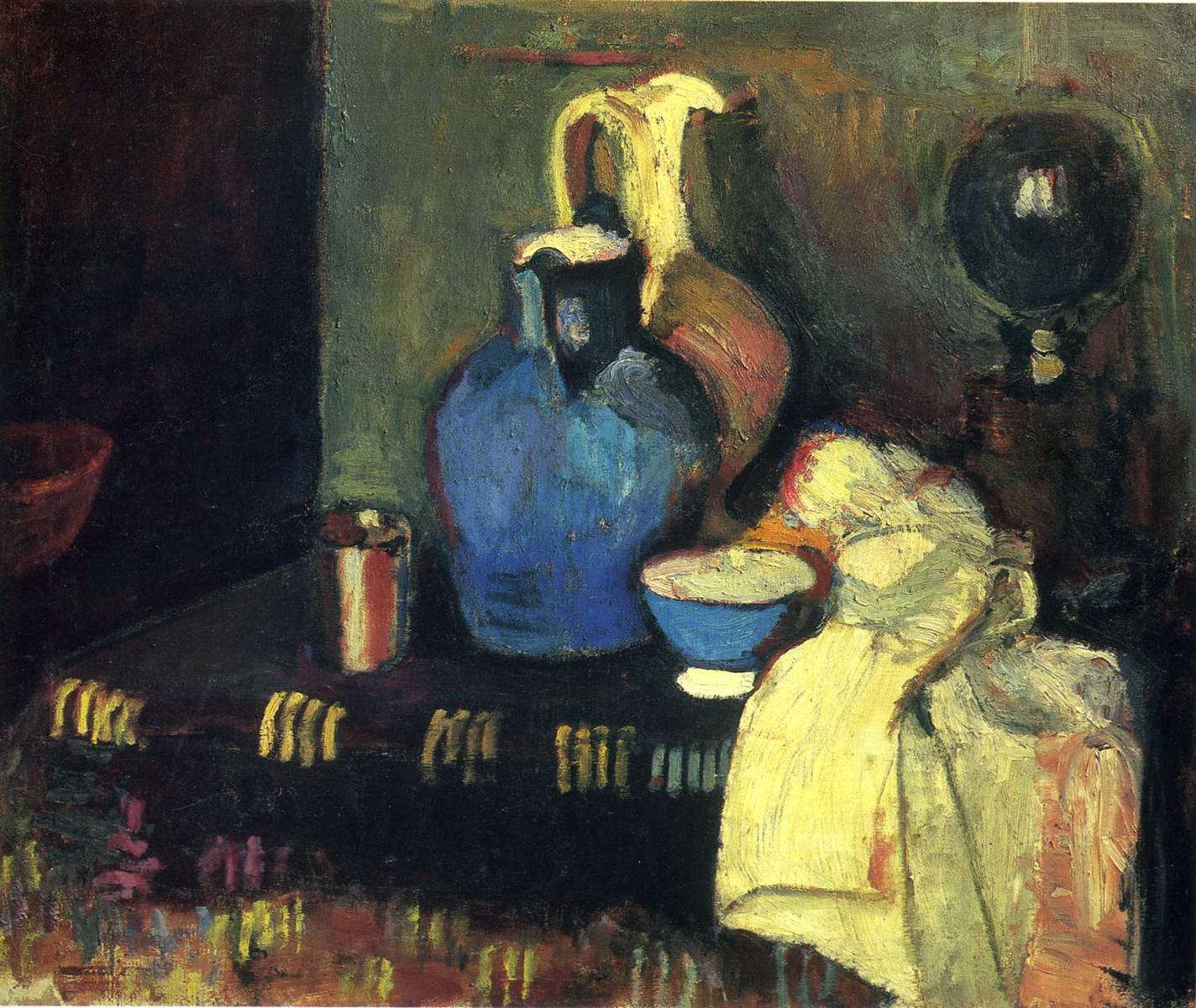
A dark tabletop cuts across the lower half of the canvas, its edge tilted just enough to declare a stage. At center left a monumental blue jug anchors the group; behind and above it a tall, pale pitcher rises like a column; to the right, a blue bowl nestles into a cascade of folded linen whose creamy weight spills to the edge. A small metal cylinder, a shadowed sphere on the wall, and a shallow bowl at far left complete the cast. The background is not an itemized wall but an atmosphere of greens, umbers, and aubergines. Bright, staccato lines—fringe or decorative stitching—march along the table’s front and echo as reflections below. The ensemble is sober yet charged, a domestic ritual taken in one breath.
The Subject And Its Silent Ritual
The objects imply a morning or washing routine: vessels for water, a bowl, cloth, a cup. Nothing is sentimentalized. Matisse refuses anecdote and gives the ceremony dignity through scale and placement. The blue jug is not merely described; it presides. The folded linen is not costume; it is substance, the heaviest light in the picture. The painting treats ordinary implements the way Dutch masters honored pewter and loaf, only here the eloquence comes from color structure rather than minute finish.
Composition And Framing As Architecture
The rectangle is engineered with a few decisive moves. Masses step rhythmically from left to right—jug, cylinder, bowl, cloth—held in check by the tall pale pitcher that rises like a buttress behind the jug. The spherical wall object on the right sets a counter-curve, preventing the composition from slumping to the left. The tabletop’s front edge is a long, dark bracket that steadies the lighter objects above it; the fringe marks become a frieze that both ornaments and measures the space. Cropping is deliberate: the white pitcher is clipped; the linen tumbles out of frame. These cuts heighten immediacy and keep the still life from behaving like a display case.
Color Architecture: Blue As Anchor, Warmth As Counterweight
Color is the true scaffolding. The jug’s saturated cobalt—modulated into slate in its shadows and electric at its edges—acts as the key around which the entire chord is tuned. Against it Matisse sets a suite of warms: the ochre and cream of the tall pitcher, the buttery linen, the orange-brown ground peeking through the darks, and the redder notes in the background. Between these poles he lays cool greens and near-blacks that do not deaden but intensify neighboring hues. Nothing is neutral; even the “grays” lean warm or cool to maintain tension. The blue bowl repeats the jug’s hue in a smaller register, keeping the chord coherent. The effect is structural rather than descriptive: the picture holds because the colors interlock.
Light Without Theatrical Shadow
Illumination is unified and ambient. There is no spotlight carving deep cast shadows or isolating showy highlights. Instead, light is a steady presence that softens edges and reveals surfaces through temperature shifts. The jug’s left flank cools; its shoulder warms where surrounding color reflects; the linen gathers creamy impasto in its folds and cools where planes turn away. The dark range underneath the tabletop is not a void; it breathes with reflected yellows from the fringe, a gentle reminder that darkness here concentrates energy rather than extinguishes it.
Brushwork And The Truth Of Materials
The paint handling assigns a distinct “speed” to each material. On glazed ceramics—jug and bowl—Matisse lays broader, confident strokes whose slight ridges catch light, producing the feel of curved, reflective skin. On the linen he builds short, viscous strokes, dragging and lifting the brush so the surface fattens and the weave of the canvas participates in the cloth’s weight. The tabletop receives flatter, lateral pulls, appropriate to a polished plane. In the background he scumbles thin layers, letting underpainting breathe through to create a velvety atmosphere. Facture is never hidden; it is part of the description.
Drawing By Abutment Rather Than Outline
Edges in “Blue Pitcher” are authored where colors meet. The jug’s contour is the collision of cobalt and umber; the bowl’s rim appears where pale cream rests against a darker interior; the cloth’s edges are made by a sudden flip from warm to cool rather than by a hard line. Where a linear mark does occur—on the cup’s verticals, at the pitcher’s lip—it is brief and absorbed into neighboring color. This method preserves the unity of the surface and lets color do double duty as structure and light.
Space Compressed Into A Decorative Field
The picture acknowledges depth—the tabletop recedes, the wall object sits behind, the tall pitcher overlaps the jug—but recession is restrained. The table tilts up slightly; the backdrop flattens into a tapestry of tones; the frieze of fringe along the table’s edge accentuates the surface. Matisse wants the still life to read instantly as a designed pattern before it is experienced as a window. This compression clears away descriptive clutter and keeps harmony sovereign.
Rhythm, Repetition, And The Fringe Motif
At the table’s lip small strokes of lemon yellow form a rhythmic band. They read as tassels, stitches, or the glints of woven trim. Echoed faintly in the reflected strip below, they create a syncopated line that holds the lower register together and ties darks to lights. The device is modest yet decisive: a bright percussive rhythm set against the slower masses above. It is also a hint of the decorative clarity that will soon dominate Matisse’s interiors.
The Blue Pitcher As Chromatic Hub
Why does the jug dominate so peacefully? Its blue gathers the room. Cool reflections from the wall temper its shadow; warm echoes from the cloth and pitcher test its edges; the tiny blue bowl repeats its hue in a higher pitch; even the black sphere on the wall reflects a ghost of cobalt. The jug is not only an object in space; it is a meeting place where neighboring colors announce themselves and harmonize. That function—object as chromatic hub—will recur in Matisse’s work whenever a single form must anchor an entire field.
Linen As Light Made Solid
The cloth at right is the brightest mass in the composition, but it behaves as volume, not glare. Matisse thickens paint on its crests and pulls it thin where planes turn, making the cloth catch real light like a low relief. Subtle infusions of gray-green and violet keep it from chalking out. In structural terms the linen counterbalances the jug: blue weight on the left, light weight on the right. Psychologically it brings human labor into the scene—the feel of a hand on fabric, of a towel folded and used—without resorting to narrative.
Dialogues With Tradition
The painting converses with Chardin in its respect for domestic objects and in its quiet gravity. It borrows from Cézanne the principle of building form with abutting color planes and the tilted tabletop that denies strict perspective. Gauguin and the Nabis are audible in the simplified silhouettes and the refusal of literal texture for decorative unity. Van Gogh echoes in the directional energy of brushwork, especially across the cloth and the dark background. Yet the temperament is Matisse’s: measured, harmonizing, neither feverish nor aloof. The goal is to balance forces so the eye rests and returns.
Materiality, Pigments, And The Skin Of The Surface
Turn-of-the-century pigments make the chord possible. Cobalt or ultramarine blues saturate the jug and bowl; earth reds and umbers warm the background; cadmium and lead whites modulate the cloth and pitcher; yellow lakes or cadmium yellow light up the fringe. Matisse alternates lean scumbles with fatter, body-color strokes so that some areas absorb light while others return it. The surface holds together as a single skin, never degenerating into patches of separate finish.
Light, Reflection, And The Quiet Drama Of Edges
Look into the shoulder of the jug and the rim of the bowl. Small, cool flares suggest windows outside the frame; thin warmer notes along the jug’s edge hint at light reflecting off the cloth. These reflected colors are not fussy details; they are structural, binding near and far. The quiet drama of the still life lives at these edges, where the identities of objects mingle without confusion.
The Psychological Tone: Poise Without Sentiment
Despite its richness, the painting is emotionally restrained. There is no abundance of fruit or vanitas symbolism; no knife glints with threat. The mood is one of poise. Objects have the scale of work and use, not display. That restraint lets the color speak without competition. The viewer senses care—the human measure of arranging and cleaning—and, through Matisse’s edits, a kind of ethics: say what the picture needs; do not overstate; keep the chord true.
Relation To Matisse’s Other Still Lifes of 1900–1901
“Blue Pitcher” stands beside “Still Life with Chocolate Pot,” “Dishes on a Table,” and related interiors from the same period. All share a compressed space; a table that tilts toward the viewer; black used as an active color; and a reliance on tuned complements to establish form. What distinguishes “Blue Pitcher” is its concentrated palette and its monumental central object. Where the chocolate-pot picture glows with oranges and reds, this canvas builds its harmony around the gravitational pull of blue, discovering how a single dominant hue can organize an entire room.
How To Look Slowly
Begin by letting the main chord settle: cobalt jug, pale pitcher, cream cloth, dark table. Then approach the edges where forms meet and notice how color alone makes contour. Attend to the different speeds of brush—the slide across glaze, the tacky pressure in cloth folds, the soft breathing of the background. Track the yellow tassels across the table and their echo below; see how they fasten the surface. Finally, step back until the still life reasserts itself as a single, legible balance. In moving near and far you follow the painter’s own rhythm of adjusting and confirming.
Why This Painting Endures
“Blue Pitcher” endures because it transforms a simple arrangement into a compact demonstration of modern pictorial thinking. It proves that color can shoulder structure, that omission can clarify, and that a painting may be both decorative and true to observed fact. The jug, bowl, cloth, and table are not merely recorded; they are built from relationships that the eye recognizes as convincing. This is Matisse on the threshold of invention, finding a grammar—blue against warm, edge by adjacency, depth held to the surface—that will sustain the audacities of the next decade.