Image source: wikiart.org
Historical Context And Why This Rural Scene Matters
Henri Matisse painted “Blasted Oak, Bohain” in 1903, a year perched between the muted tonal investigations of his late-1890s training and the blazing chromatic declarations that would soon define Fauvism. The subject is Bohain-en-Vermandois in northern France, close to where Matisse grew up. Returning to Picardy gave him a laboratory that was both personal and austere: flat fields, hedgerows, and huge windswept trees offered big forms and clear silhouettes, perfectly suited to his search for structural simplification. In this canvas he tests how far a landscape can be reduced to large, interlocking planes of value while remaining alive with air and meaning. The “blasted” oak—its crown torn, its limbs gnarled—becomes a portrait of endurance, and the picture announces the principles that will guide his next breakthroughs: emphasis on relationships over detail, on planar patterning over anecdote, and on a surface that remains, always, the primary stage.
First Impressions: A Monumental Tree And A Path Of Light
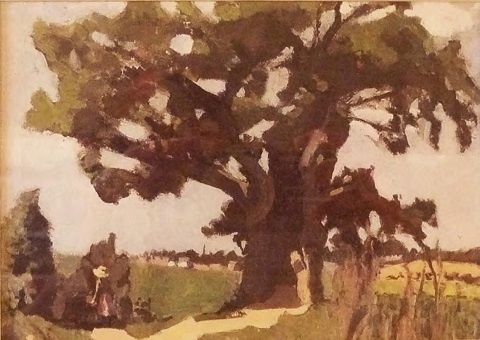
At first glance, the painting reads as a single, monumental mass of oak dominating the middle ground, its branches fanning outward like a dark, weather-bent canopy. Sunlit countryside spreads to either side, with a pale ribbon of path curving toward the trunk and then disappearing behind it. Low structures and a cluster of verticals at the left suggest cottages or garden edges, while to the right a band of tilled field or stubble glows with a warm yellow note. The sky is a milky, high key, nearly paper-white in places, against which the oak’s silhouette punches forward. Everything is compressed to essentials, inviting the eye to feel the brawn of the trunk before noticing the small human figure tucked near the left base—a scale cue that deepens the oak’s monumentality.
Composition As A Tree-Centered Armature
The rectangle is engineered around a cruciform tree. The trunk rises near the center, slightly right of middle, then explodes laterally in boughs that almost touch the frame. The path enters from the lower edge and bends toward the trunk like a soft S-curve, a visual invitation that pulls the viewer into the scene. The horizon sits low, granting the oak a majority share of the picture height, yet it remains firmly grounded by the flat Picard fields. Matisse organizes space with just three belts: foreground path and grasses, middle ground tree and figures, far ground fields and low buildings under a big sky. Because these bands are stated with broad, simplified shapes, the composition feels both monumental and easy to read.
Value Architecture And The Power Of Silhouette
Color here is subordinate to value. The oak is a composite of deep browns and olive-blacks that read almost as one continuous silhouette against the light sky. Mid-value fields stage that silhouette, preventing it from collapsing into mere darkness. The path is the highest value on the ground—a pale, almost chalky band—so it acts as a light conduit through the painting. Small mid-dark uprights at the left balance the trunk and keep the picture from tipping. The value plan is legible at twenty paces, which is why the scene holds together even though the brushwork is free and details are withheld.
Color As Weather Rather Than Ornament
Although restrained, the palette is not neutral. Warm earths—ochres, burnt siennas, and umbers—dominate the fields and lower trunk, while cooler olive and charcoal notes infiltrate the canopy’s interior, suggesting shadowed foliage. The sky is a high, cool white that leans faintly blue toward the upper edge and warms toward the horizon. This low-chroma chord evokes a breezy, sun-bleached day in northern light. Because there are almost no dead grays or blacks, every passage leans warm or cool, and those temperature tilts—not theatrical contrasts—supply the sense of depth.
Brushwork And The Feel Of Living Matter
Matisse builds the oak with brisk, faceted touches that stack into brawny planes. The trunk’s verticals are laid in broader, tacky swathes that catch real light and feel like bark. The canopy is a net of shorter, angled strokes that interlock without counting leaves. The fields are swept with longer, flatter pulls, registering their horizontality and calm. The path’s pale paint is scumbled thinly so the texture of the ground shows through, a tactile rhyme for dusted earth. This orchestration of speeds—quick in leaves, dense in trunk, even in fields—turns the surface into a pulse that the eye reads as weather and time.
Drawing Through Adjacency Rather Than Outline
Edges arise where tones meet. The oak is “drawn” by the confrontation of its dark mass with the milky sky; the path’s lip exists because a pale stroke abuts a mid-earth; the distant sheds appear as low rectangles created by tiny value shifts along the horizon. When a line does appear—a flick of branch, a fence mark—it is calligraphic and immediately reabsorbed into neighboring paint. The picture never feels like a colored drawing; it feels like a world condensed from tuned patches.
Space Compressed Into A Decorative Field
Depth is plausible yet moderated. The path and diminishing figure confirm recession; the horizon and village marks set distance; but the surface never dissolves into a tunnel. The oak’s canopy presses forward like a patterned screen, reminding us that this is a constructed image. That compression enforces Matisse’s decorative ideal: the painting must first be a balanced arrangement on a flat plane, then a window onto air. Because surface order is protected, the big shapes read instantly at any viewing distance.
The Human Figure And The Ethics Of Scale
Near the left foot of the oak, Matisse tucks a small figure—possibly a peasant or walker—wearing a light hat. The person’s diminutive scale is intentional. It calibrates the immense bulk of the tree while preserving the mood of solitude and rural quiet. The figure is a rhythm note rather than a story; a few strokes suffice to suggest stance and motion. With this single human metric, the oak becomes not just large but venerable, a local monument that predates and outlasts its passersby.
The “Blasted” Oak As Emblem
The title directs attention to damage: a lightning-struck crown, torn boughs, or old wounds. Matisse does not paint the catastrophe; he paints its aftermath as form. Broken limbs become jagged diagonals that energize the canopy; scars register as abrupt value changes on the trunk. The tree’s injuries turn into pictorial advantages, creating negative shapes where sky pierces foliage and adding character to the silhouette. Symbolically, the blasted oak reads as resilience. In an era when Matisse’s own art was shedding academic armor and weathering critical storms, the subject quietly mirrors an artist’s stubborn growth.
Dialogues With Tradition And Peers
“Blasted Oak, Bohain” listens to Corot’s economy and to the Barbizon painters’ forest interiors, where subdued chords carry mood. It nods to Cézanne in the constructive, planar handling of foliage and trunk. It anticipates the Fauves—Matisse included—in the courage to simplify large shapes and let silhouette and ground do the heavy lifting. Yet the temperament is distinctly his: harmonizing rather than rugged, serene rather than sentimental, modern without severing roots from landscape tradition.
Materiality And Likely Pigments
The low-chroma harmony suggests a palette of earth pigments: yellow and red ochres, raw and burnt umbers for trunk and soil; a touch of ivory or bone black moderated with ultramarine to cool the darkest passages; viridian or terre verte tempered with ochre for olive foliage; lead white massed into the sky and scumbled into the path. Paint alternates between lean, absorbent layers in the sky and path and thicker body color in the tree. Those material decisions are not incidental: they make the oak physically denser than the air around it and let the lightest passages breathe.
Rhythm, Balance, And The Viewer’s Route
The painting teaches a simple, satisfying journey. The eye enters at the bright path in the foreground, curves naturally toward the trunk, climbs the boughs into the canopy’s lattice, and then escapes through perforations of sky. From there it lands on the far horizon before returning along the field’s edge to the path. On each loop small correspondences click: a warm field note echoing in the trunk, a cool sky wedge repeated in a canopy gap, a vertical in the village answering the tree’s axis. This cyclical route creates the calm that defines the picture.
Omission As Clarity
Matisse withholds many particulars. There is no counted leafage, no botanical fidelity, no mapped texture of bark, no narrative in the figure. He rejects descriptive temptation in favor of structural truth. The omissions make the canvas legible from across a room and durable to memory. Viewers supply their own experiences of wind, shade, and rural path, which keeps the picture alive long after a more detailed account would have exhausted itself.
How To Look Slowly And Profitably
Stand back far enough to receive the three-band architecture: pale sky, giant oak, flat fields and path. Let the silhouette fix itself in your mind. Step closer and trace how edges form by adjacency—the tree’s dark shoulder against light, the path’s chalk against earth, the village’s rectangles along the horizon. Watch the brushwork slow and speed as it switches from trunk to leaf to field. Notice how temperature shifts, not dramatic shadows, make volume turn. Step back again and feel the path invite you in while the oak holds you in its shade. That near–far oscillation reproduces the painter’s own process of tuning until the whole reads at once.
Relationship To Matisse’s 1903–1905 Development
A year after this canvas, Matisse would raise the chromatic volume in Collioure and Paris, orchestrating saturated complements into the Fauvist blaze. What “Blasted Oak, Bohain” contributes is the armature that allowed that blaze to hold: big, simple shapes; value plans you can grasp instantly; edges authored by contact; and a willingness to let a motif be emblematic rather than anecdotal. When color later intensifies, those very structures will keep his wildest paintings serene.
Why “Blasted Oak, Bohain” Endures
The painting endures because it compresses a universal experience—shade, path, landmark tree—into a lucid, memorable design. It shows that strength of form does not require shrill color; that atmosphere can be built from modest earths; and that a single silhouette, tuned carefully against open light, can carry both place and feeling. In front of this oak, you sense weather, time, and stature. In front of this canvas, you witness Matisse securing the structural calm that would steady his coming revolutions.