Image source: wikiart.org
Introduction to Birth of the Virgin by Francisco de Zurbaran
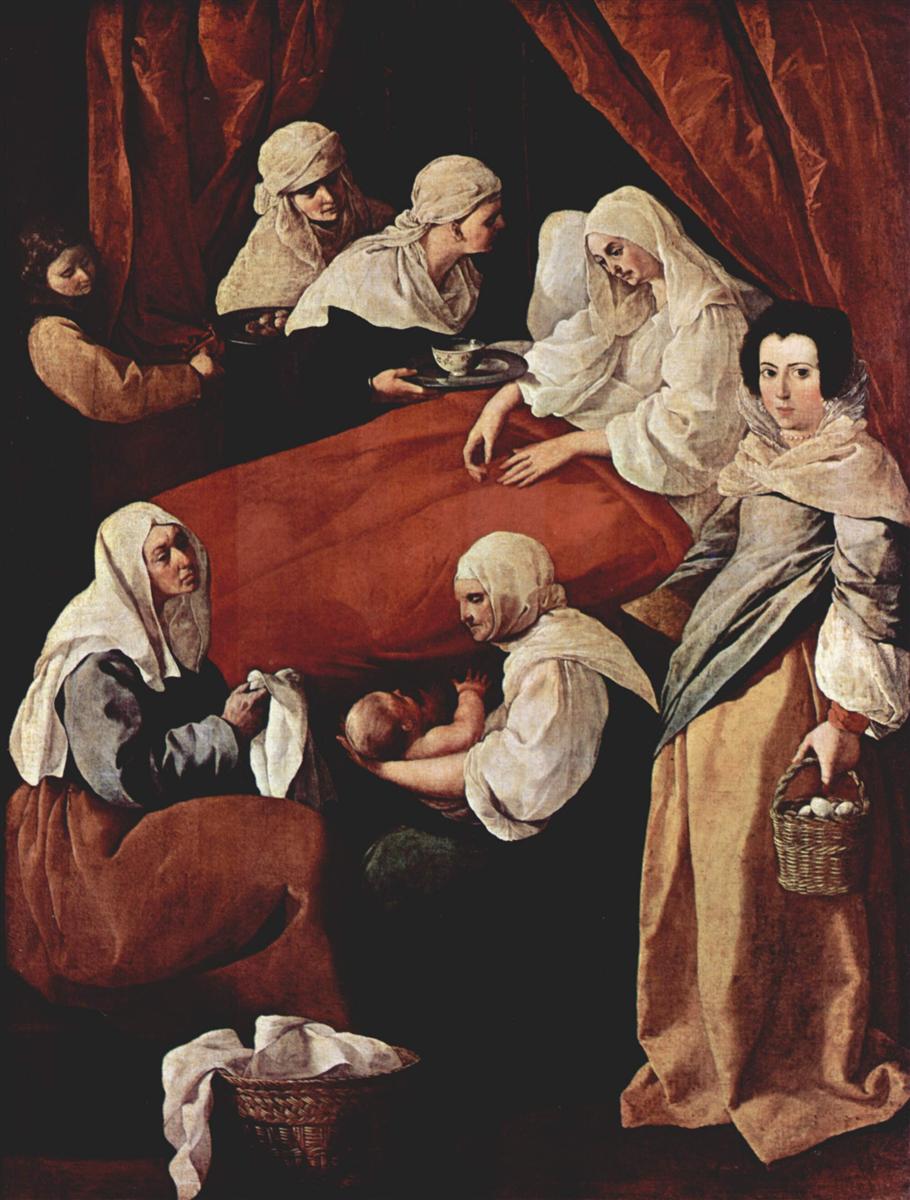
“Birth of the Virgin,” painted in 1629 by Francisco de Zurbaran, transforms a familiar sacred subject into an intimate domestic scene filled with quiet drama. Instead of a spectacular miracle or celestial apparition, Zurbaran offers a moment from everyday life. A group of women gather around a large bed covered with a deep red cloth. At the center, Saint Anne rests after giving birth. Nearby, other women tend to the newborn Virgin Mary, bathing and drying her tiny body. The entire composition is wrapped in crimson drapery, which functions as both theatrical curtain and protective canopy, enclosing the event in a warm shell of fabric and shadow.
This painting reveals how Zurbaran adapted the themes of the Counter Reformation to the visual language of Spanish Baroque art. The artist avoids obvious supernatural effects. Instead he focuses on gesture, light, and texture to convey the sacred importance of this birth. The result is a painting that feels at once humble and monumental, domestic and liturgical. For viewers in seventeenth century Spain, the scene would have echoed the reality of childbirth while also elevating it to the level of sacred history. For viewers today, “Birth of the Virgin” remains a striking meditation on motherhood, community, and the mystery of new life.
Historical and Religious Context
The birth of the Virgin Mary was not described in the canonical Gospels but in later devotional texts. By the time Zurbaran painted this work, the story of Mary’s miraculous birth to the elderly couple Joachim and Anne was widely accepted in Catholic tradition. The scene offered artists the opportunity to show a holy event in a domestic setting. After the Council of Trent, religious painting in Spain was expected to be clear, emotionally engaging, and respectful of doctrine. Zurbaran’s painting fulfills those requirements while drawing heavily on the realism of daily life.
In early seventeenth century Spain, devout viewers would see in this scene a model for Christian families. The Virgin’s birth prefigures the Incarnation, so her arrival is charged with spiritual significance. Yet Zurbaran sets the event in a room that looks like a contemporary Spanish interior, with woven baskets, folded linens, and ceramic bowls arranged around the figures. This bridging of sacred history and present reality allowed believers to feel closer to the mysteries they contemplated. The painting thus serves not just as an illustration of a story but as a visual tool for meditation on purity, grace, and the sanctity of ordinary domestic duties.
Composition and Spatial Structure
Zurbaran constructs the composition as a contained, almost stage like space. The red drapery that descends from above functions as a curtain pulled back to reveal the main action. It frames the bed and the figures around it, while the dark background behind the curtain recedes into shadow and mystery. The arrangement of figures forms a broad triangle, with the bed and the reclining Saint Anne forming the upper center and the group of women and the infant at the lower center.
The eye moves diagonally across the painting. On the right, a young woman stands almost full length, close to the picture plane, holding a basket of eggs and looking straight out toward the viewer. She acts as a threshold figure, bridging our space and the interior of the scene. From her, the gaze moves inward to the sitting woman who bathes the baby, then up to Saint Anne on the bed, and finally to the cluster of attendants at the top left. The composition thus guides the viewer into the heart of the event, leading from the ordinary act of carrying provisions to the miraculous newborn child.
There is a strong contrast between vertical and horizontal lines. The central bed with its heavy cover creates a stable horizontal plane, while the standing figure to the right and the vertical folds of the curtain provide an upright counterpoint. This interplay generates a calm yet dynamic structure. Nothing feels chaotic. Every figure seems carefully placed to contribute to a subtle rhythm of glances and gestures that tie the group together.
The Figures and Their Interactions
Each woman in the painting has a distinct role, yet together they form a cohesive community. Saint Anne lies propped up on the bed, dressed in white garments that echo the linen worn by the attendants. Her expression is serene and slightly withdrawn, as if she is still recovering from the effort of childbirth while contemplating the significance of her child. One hand rests on the red cover, bridging her body and the world of the newborn.
At the foot of the bed, two women focus on the infant Mary. One holds the child on her lap, cradling the tiny body with both arms. The baby turns slightly toward the viewer, a reminder that this ordinary newborn will become the Mother of Christ. Another woman kneels nearby, holding cloths ready to dry and wrap the infant. Their concentration is tender and practical. There is no exaggerated emotion, only the attentive care that accompanies any newborn’s first moments.
On the left, figures emerge from the shadows. A woman leans forward carrying a tray with a cup and small bowl, likely restorative food or drink for Saint Anne. Another attendant stands beside her, partly obscured by the red curtain. At the far left a child or young servant holds the curtain aside, literally opening the scene. This role mirrors the standing woman on the right, so that both edges of the painting form a gateway through which viewers enter the sacred space.
The young woman on the right side deserves special attention. Unlike the others, she meets the viewer’s gaze directly. Her dark hair and uncovered head contrast with the white veils of the older women. She carries a basket filled with what appears to be eggs, symbolically associated with birth, nourishment, and potential life. Her presence has often been read as a bridge between the holy event and the everyday world of the viewer. She might also represent a younger Mary, or simply an idealized contemporary woman invited to witness the miracle.
Light, Color, and Textural Detail
Zurbaran’s mastery of light and color gives “Birth of the Virgin” its powerful atmosphere. A warm, focused light strikes the figures from the left, illuminating the white veils, sleeves, and linens with gentle brightness. These areas of white stand out sharply against the deep reds and browns of the surrounding fabrics. The color harmony is carefully controlled. Rich earth tones dominate the lower garments, while the upper part of the scene glows with soft whites and warm flesh tones.
The massive red curtain and bedcover are particularly important. Their breadth and saturated color create a sense of warmth and enclosure, almost like the interior of a womb. The red also carries associations with both physical blood and spiritual love, linking the bodily reality of labor to the spiritual significance of Mary’s birth. The folds of the curtain are painted with a sculptural solidity that contrasts with the delicate transparency of the veils.
Zurbaran devotes special attention to tactile details. The rough weave of the baskets, the soft folds of linen, the polished surface of the ceramic bowl, and the smooth skin of the baby all appear carefully observed. These tangible qualities ground the scene in physical reality. They also celebrate the material world as a vessel for divine grace. In the context of Spanish Baroque spirituality, such loving attention to humble objects was a way to honor the presence of God in daily life.
Domestic Realism and Sacred Meaning
One of the most striking aspects of “Birth of the Virgin” is its blending of realism and symbolism. At first glance, the scene could be a typical seventeenth century Spanish birth chamber. Women carry baskets, wash linen, bring food, and assist the mother. There are no angels hovering overhead, no golden halos or shafts of heavenly light. Yet the painting is filled with subtle signs that this event is far from ordinary.
The number and arrangement of women suggest a community united around a moment of great significance. Their gestures are calm and purposeful, as if they understand they are participating in a sacred drama. The newborn baby, while tiny and vulnerable, is central to the composition. Even the basket of eggs carried by the standing woman may be read as more than simple provisions. Eggs evoke the idea of new life and foreshadow Mary’s role in bringing Christ into the world.
By embedding these symbolic meanings within an everyday setting, Zurbaran invites viewers to reflect on the holiness of ordinary human experiences, especially those connected to motherhood and care. The painting shows that divine grace operates through simple acts of service. The midwives, servants, and relatives surrounding the bed all contribute to the safe arrival of the child, just as everyday believers support the life of faith in their communities.
Zurbaran’s Style and Artistic Influences
Francisco de Zurbaran is often associated with starkly lit solitary saints and monks, yet in “Birth of the Virgin” he demonstrates his ability to orchestrate a complex multi figure scene. The painting still bears the marks of his characteristic style. There is a strong emphasis on volume, with figures modeled by light and shadow rather than linear outlines. The drapery is heavy and sculptural, reminiscent of carved stone statues.
The dramatic contrast between light and shadow connects Zurbaran to the larger Baroque tradition and to the influence of Caravaggio and his followers. However, the tone of this painting is quieter than much Italian Baroque art. Instead of intense emotion or sudden movement, we find steady concentration and meditative calm. Zurbaran applies tenebrism to create intimacy rather than shock. The darkness at the edges of the scene feels protective rather than threatening, as if it wraps the figures in privacy.
At the same time, the arrangement of figures and the monumental treatment of everyday fabrics show the influence of classical composition. There is balance and clarity, even within the complexity of overlapping bodies and drapery. Zurbaran gives each figure enough space to register individually while ensuring that none distracts from the central focus on the baby and the resting mother.
Emotional Atmosphere and Human Experience
The emotional tone of “Birth of the Virgin” is one of quiet joy and gentle fatigue. There are no overt signs of ecstasy or dramatic mourning. Instead, Zurbaran captures the mood that often accompanies childbirth after the initial crisis has passed. The women are attentive but not frantic. Saint Anne looks tired but peaceful. The baby is calm in the arms of the attendant.
This restraint makes the painting feel deeply human. Many viewers, then and now, can recognize the tenderness of the scene from their own experience of family life. The shared labor of women, the presence of practical objects, and the subdued expressions all contribute to an atmosphere of solidarity and care. By avoiding theatrical excess, Zurbaran achieves a different kind of emotional power, rooted in recognition and empathy.
At the same time, there is an undercurrent of awe. The way the light dwells on the baby, the careful choreography of gazes and hands, and the enclosing red curtain all hint that something extraordinary is happening here. The painting shows that the most important miracles often unfold quietly, in spaces where love and service are offered without fanfare.
Theological and Symbolic Dimensions
Beyond its realism, “Birth of the Virgin” carries rich theological significance. In Christian belief, Mary is conceived without original sin, prepared from the beginning to be the Mother of God. Her birth therefore marks the first visible step in the unfolding of salvation history. Zurbaran does not illustrate doctrinal concepts directly, but he suggests them through visual choices.
The whiteness of the garments around Saint Anne and the baby can be read as an emblem of purity and grace. The careful handling of textiles evokes both swaddling cloths and altar linens, linking the domestic scene to the liturgy. The red curtain has echoes of the curtain of the Temple that would later be torn at Christ’s death, hinting that this birth ultimately leads to the Passion and Resurrection.
The concentration of women in the scene also carries meaning. They represent the hidden, often unrecorded labor that sustains the sacred story. While theological texts often focus on male figures, Zurbaran shows the indispensable role of women in nurturing the life through which divine plans are realized. The painting thus honors both Mary’s unique vocation and the everyday vocations of ordinary women.
Legacy and Modern Appreciation
“Birth of the Virgin” remains one of Zurbaran’s most compelling narrative works. For art historians, it provides insight into the development of Spanish Baroque painting, especially the way artists navigated the demands of religious orthodoxy while pursuing realism and emotional depth. The painting stands at an interesting crossroads between monumental altar painting and genre scene, between sacred history and domestic observation.
For contemporary viewers, the work has a freshness that transcends its historical context. The focus on maternal care, communal support, and the tender vulnerability of a newborn continues to resonate. The painting invites reflection on the value of caregiving roles that are often overlooked. It also encourages a meditation on beginnings, on how small and fragile events can carry immense future significance.
In museums and reproductions, “Birth of the Virgin” often surprises viewers who expect religious art to rely heavily on overt supernatural motifs. Instead, Zurbaran offers a theology of daily life, in which sanctity is woven into the fabric of routine tasks and quiet cooperation. This aspect makes the painting especially relevant for a modern audience seeking spiritual meaning within ordinary existence.
Conclusion The Miracle Within the Everyday
“Birth of the Virgin” by Francisco de Zurbaran is a masterful fusion of domestic realism and sacred symbolism. Through careful composition, controlled color, and nuanced light, the artist turns a familiar birth room into a space of profound mystery. The figures move with calm purpose, their tasks rooted in real experience, yet their actions are framed by a sense of reverence that marks this event as unique.
By avoiding obvious spectacle, Zurbaran emphasizes the miracle hidden within ordinary life. The newborn Mary is small, almost fragile, but every element of the painting points to her future role in the history of salvation. The red curtain, the luminous linens, the attentive community of women, and the thoughtful gaze of the figure who meets the viewer all contribute to a deeply human and deeply spiritual atmosphere.
The painting remains a powerful reminder that great transformations often begin in quiet rooms, among people engaged in simple acts of care. Through “Birth of the Virgin,” Zurbaran invites viewers to recognize how sacred meaning can reside in the humblest tasks, and how the divine can be present in the first cry of a child, the warmth of shared labor, and the soft rustle of linen in a darkened room.