Image source: wikiart.org
Encountering a War Goddess in Human Scale
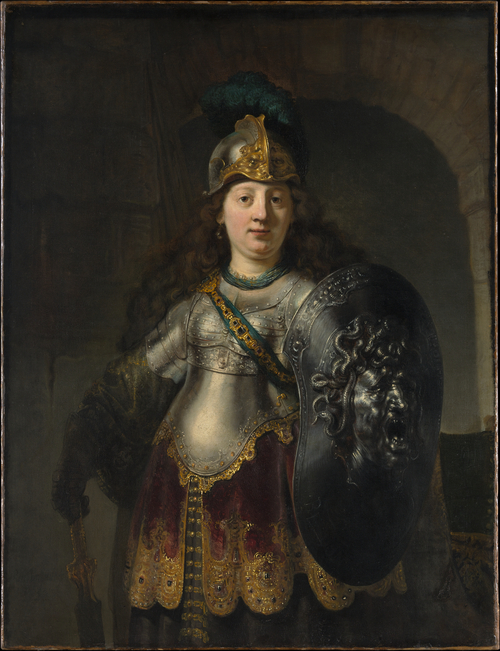
Rembrandt’s “Bellona” greets the viewer with the poise of a commander and the candor of a portrait. The Roman goddess of war stands three-quarter length before a shadowed architectural arch, her gaze forward, her weight calmly grounded. A bright plume crowns her helmet; a richly worked cuirass glints across her torso; a velvet tunic trimmed with gold cascades over the hips; and, at the right, an oval shield embossed with a screaming Medusa turns toward us like a second face. The figure fills the vertical field with a restrained grandeur, not by adopting an impossible stance or a tempestuous sky, but by bringing divine symbolism to human scale. The divine title remains intact, yet the person inside the armor is readable, vulnerable, and alert. The painting achieves its authority through a fusion of icon and individual, of classicizing decorum and Rembrandt’s acute attention to living presence.
A Composition Organized Around Equipment and Eyes
The composition pivots on a double axis: the eyes and the shield. The goddess’s face is placed just off center, at the height where a viewer’s own eyes might meet it. Light travels from the left, describing the cool curves of the helmet and the clear planes of the face before dropping into the plate-ridges of the breastplate and the hammered forms of the shield. The shield’s convex oval projects into the foreground, displacing space and pulling us into the painting’s physicality. Its Medusan relief, mouth agape and hair writhing, becomes a counter-portrait: volatile, metallic, and mythic, opposed to the calm, flesh-toned head above. The dialogue between living face and metal face structures the picture, turning the goddess into a mediator between human interiority and the terrifying instruments of war.
Light, Chiaroscuro, and the Intimacy of Metal
Rembrandt’s early-1630s light is theatrical yet disciplined. It rakes the helmet’s brow and feathered crest, skims across the cheek and mouth, then splays in fragments across the armor and gilded trim. The highlights on steel are not anonymous flashes; they are mapped, describing dents, rivets, and the slight undulation of burnished plates. The velvet skirt receives a lower-intensity glow that registers the nap of the fabric and the depth of its crimson. Light, in this painting, is a narrator with two voices: a cool prose that names metal precisely and a warm lyric that dignifies skin and cloth. In the penumbra at left, the goddess’s left arm and the hilt of her sword shelter in a recess that keeps the composition from flattening. The chiaroscuro is not a moralistic dark-versus-light scheme; it is a spatial and tactile intelligence that allows different substances to speak.
Armor as Architecture of Character
Bellona’s armor is both costume and architecture. The breastplate fits like a façade with a central ridge; its scalloped lower edge is banded with lace-like gold that softens the mechanical structure and integrates it with the velvet below. The gorget rises to guard the throat, suggesting vigilance at a vulnerable point. A green sash studded with gilt devices cuts diagonally across the torso, adding a ceremonial line that stabilizes the posture. These components do more than assert rank; they articulate the body’s potential energies: the chest’s expansion for breath, the shoulders’ rotation for command, the throat’s channel for voice. Rembrandt renders armor not as a fetish of military glamour but as a wearable architecture through which the body’s authority is expressed.
The Medusa Shield as Counter-Gaze
The most striking emblem is the shield with Medusa’s head. It is no small badge but a sculpted disc whose relief bulges outward into our space. The face’s mouth is open in an eternal cry; serpentine strands radiate like writhing rays; the pupils are drilled points of darkness. By giving the shield such presence, Rembrandt imports the classical idea of the aegis—the protective, petrifying emblem associated with Athena—into the Roman war goddess’s kit. The contrast is deliberate: the living goddess meets us with composure, while the shield confronts us with horror. The combined effect is not merely to terrify but to warn. War requires the ability to wield fear without succumbing to it. The painting, therefore, stages an ethics of looking: the viewer can meet Bellona’s eyes, but to stare at the shield is to risk being swallowed by its scream.
A Face That Refuses Allegorical Abstraction
Unlike many allegorical figures, this Bellona possesses a specific physiognomy. The soft oval of the cheeks, the sturdy nose, the small, compressed mouth, and the steady pupils anchored in light are observed rather than invented. The long auburn hair escaping beneath the helmet further anchors the figure in a tangible world. The goddess’s expression is sober, even practical. She is not raging or preening; she has arrived prepared. Rembrandt thereby humanizes the myth without trivializing it: the goddess is a person who has accepted the responsibilities of her emblem, not a pageant queen costumed as Mars’s consort. This refusal of abstraction deepens the painting’s gravity; policy and passion rest inside a mortal visage.
Color as Ceremony and Restraint
The palette is disciplined but ceremonial. Cool silvers of steel dominate the upper field, cooled further by the green sash and the peacock-toned plume, while the lower register burns with maroon velvet and mustard-gold embroidery. Flesh notes—peach and pink modulated with greyed half-tones—mediate between these poles. Rembrandt applies color not to decorate but to conduct the eye. The sash’s green diagonally ties face to sword arm; the gold scallops along the hem echo the helmet’s edging; the deep reds pool weight near the bottom to tether the figure’s mass. The coloristic effect is a quiet pageantry: enough spectacle to honor the subject’s divine office, enough restraint to keep attention on presence.
Textures That Speak in Distinct Voices
Each material has its own voice. The helmet’s polished crown speaks in smooth, well-defined reflections that bend over curvature; the feathers at the crest speak in soft, linear whispers; the breastplate’s micro-scratches and dents speak in short, interrupted highlights; the velvet skirt speaks in a saturated, absorbent hush. The shield roars. Its embossed lines catch light in sharp flares, pushing the relief forward in syncopated beats. The difference among these voices yields a polyphony of craft that animates the static pose. Rembrandt coordinates textures so that the painting reads like a score—legato on fabric, staccato on metal, sostenuto in flesh.
The Setting as a Stage of Authority
The figure stands before an architectural arch that fades into shadow. The arch functions like a proscenium: it frames the protagonist and intimates a civic or sacred space beyond. Its masonry, however, is only faintly described, keeping the setting open to multiple readings. Is this a palace corridor, a fortress entry, a triumphal gateway, or an imagined Roman interior? The ambiguity serves the painting’s dual allegiance to allegory and portraiture. Bellona is at once a universal figure of martial resolve and a specific person depicted in a studio. The arch’s curve echoes the shield’s oval, producing a formal kinship between human authority and built structure.
Gesture, Stance, and the Vocabulary of Control
Bellona’s stance communicates a learned control. The weight is distributed evenly with a slight cant to the right; the sword arm hangs relaxed but ready; the shield arm is lifted to present the embossed emblem without strain. The head is held level, neither challenged nor bowed. This vocabulary of control distinguishes the goddess from typical baroque battle imagery, where bodies twist violently and drapery flails. Here, command is steady. Rembrandt suggests that authority in war is not constant frenzy but the capacity to keep one’s center when pictorial weather turns tumultuous.
The Early Amsterdam Period and the Rhetoric of Splendor
Painted in 1633, this work belongs to Rembrandt’s early Amsterdam years, when he explored the rhetoric of splendor: polished armor, rich textiles, and historical or mythological roles animated by living models. Yet even at his most sumptuous, Rembrandt avoids sterile display. The splendor is in service to a human drama. The metal’s polish is not vanity but an index of preparedness; the embroidery is an honorific border to resolve; the plume is a badge of office rather than mere flourish. The painter’s fascination with costume becomes a route to psychology: by staging the weight and instrumentality of dress, he gives the wearer’s inner life something credible to press against.
The Possibility of a Known Model and the Play of Identity
The face has the weight of a real person and has often prompted speculation that a specific model posed for the goddess. Whether or not the identity is recoverable, the painting plays with this doubleness: a named goddess animated by a contemporary face. The effect is deliberately destabilizing in the best sense. Viewers can read Bellona as both symbol and someone. Rembrandt seems to suggest that allegory draws its power not from abstract perfection but from the credibility of a lived countenance. Myth enters history through the doorway of a face.
The Ethics and Politics of War in Paint
Although the picture contains the instruments of violence, it is neither a call to bloodshed nor a satire. It reads as a sober portrait of the idea of war: terrifying power harnessed by a steady mind. The Medusa shield frightens; the sword threatens; yet the composure of the goddess proposes that victory depends on discipline more than rage. In a commercial republic where civic militias and international conflicts shaped daily news, such an image would resonate as a meditation on readiness and restraint. Rembrandt’s art refuses cartoon heroism; it dwells on the moral weight of arms in human hands.
The Dialogue Between Craft and Symbol
Craft and symbol constantly negotiate. The painted metal is convincing not simply as virtuosity but as proof that the goddess’s claims are materially grounded. Conversely, the symbols clarify the craft: the artist’s ability to paint the Medusan relief magnifies the sense of peril the goddess contains. This reciprocity keeps the painting alive to two forms of truth, the truth of how things look and the truth of what things mean. In Rembrandt’s studio, craft is never neutral; it moves ideas across the threshold from myth to experience.
Edge Control and the Breathing Perimeter
Rembrandt modulates edges to create atmosphere. The plume feathers break into the surrounding air with soft, frayed edges; the helmet rim tightens against the forehead where light meets shadow; the shield’s perimeter sharpens at its gleaming right flank and relaxes as it sinks toward lower shadow. These shifts keep the figure breathing inside the space rather than pasted in front of it. The perimeter becomes dynamic, a living boundary through which light and air circulate. This contributes to the sensation that Bellona occupies our space and could step forward if she chose.
Human Beauty and the Refusal of Flattery
The goddess’s face is beautiful without being idealized. The skin is modeled with honest transitions; the mouth is small but firm; the eyes are modestly set beneath the helmet’s brow. No coyness or theatrically arched brows advertise the role. Instead, beauty arises from clarity and poise. Rembrandt’s refusal of flattery grants the painting its unusual freshness: the viewer trusts the face because it has not been polished into a generalized emblem. The divine role is not a mask that erases individuality; it is a title the individual wears with composure.
The Shield’s Relief as a Miniature Sculpture in Paint
The Medusan head is a painting that behaves like sculpture. Rembrandt uses high-valued highlights to simulate the way light slides across bronze or steel. He reserves the brightest spots for serpentine locks and for the ridges around nostrils and lips, then dives into pocketed shadows that read as recesses in metal. The relief is not a flat drawing with shading; it is a modeled object conjured by light logic. This feat of illusionism supplies the painting with a palpable object that seems to occupy space independently of the goddess, intensifying the sense that she wields a real artifact with mythic charge.
The Emotional Temperature and the Sound of the Room
Although the subject is war, the emotional temperature is cool. There is little dust or heat in the air; no battle rages in the background; no flag snaps. The silence is thick, like the moment in a hall before a judgment is delivered or an oath is sworn. We hear the soft clink of articulated plates if the goddess shifts, the low rasp of a scabbard if the sword moves, the whisper of feathers if the head turns. By refusing noise, Rembrandt sharpens psychological audibility. We attend to intention, not spectacle.
The Viewer’s Position Inside the Field of Authority
The painting places the viewer close, almost within arm’s reach of the shield. This proximity makes the exchange personal: we stand not as distant spectators of a parade but as interlocutors summoned to account. The eye-level encounter with Bellona asks what we are prepared to face, what we are prepared to defend, and whether we can hold a steady center before the Medusan specter of fear. The shield’s convexity threatens to breach the boundary between picture and room, transforming our viewing into a minor test of courage.
Why the Painting Still Feels Contemporary
Modern viewers recognize in this Bellona a familiar conflict between power and personhood. Public roles often armor individuals, yet the human face remains the place where seriousness is anchored. The painting understands this dual condition. It speaks to the necessity of protective surfaces—uniforms, titles, procedures—without losing sight of the mind that must animate them ethically. In a world where images of militancy often slide into propaganda or parody, Rembrandt’s work offers a tonic clarity: strength without swagger, symbolism without hollowness.
A Final Synthesis of Splendor and Conscience
“Bellona” ultimately synthesizes splendor and conscience. The splendor is undeniable—polished steel, embroidered velvet, and carved relief—but its purpose is to serve a conscience made visible in the face and stance. The goddess’s readiness is not theatrical; it is moral. She bears the instruments of fear but refuses to be governed by them. Rembrandt’s alchemy is to lodge this idea inside paint, to make the surface’s glitter and the subject’s gravity inseparable. The result is a portrait of power that keeps its humanity intact, which is perhaps the most difficult victory that art, or governance, can deliver.