Image source: wikiart.org
Introduction
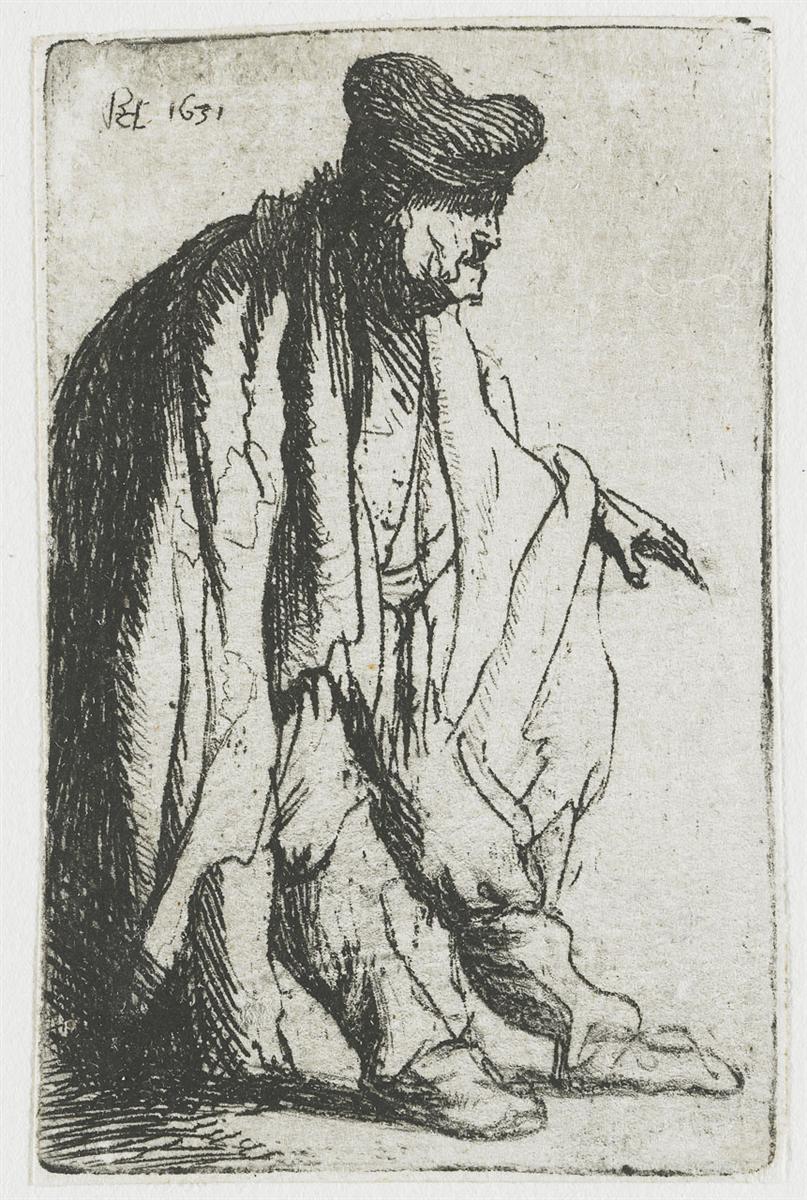
Rembrandt’s “Beggar with his left hand extended” (1631) is a small but piercing etching that distills the artist’s early mastery of empathy, gesture, and line. The composition presents a single figure pressed against the left edge of the plate, cloaked in heavy, tattered garments, knees bent, and head bowed beneath a wrapped cap. The left hand unfurls toward the void at the right, its bony fingers just beginning to open, while the right arm and most of the torso retreat into shadow. Though modest in scale, the print has the gravity of a monument. It is not a picturesque vignette of poverty but a study in how a single human movement can carry history, fatigue, and hope all at once.
Dating, Signature, and the Moment in Rembrandt’s Career
The upper left bears Rembrandt’s early monogram and the date 1631, a year that caps his first phase in Leiden and overlaps with his relocation to Amsterdam. In these years Rembrandt explored two intertwined pursuits: grand narrative ambitions in paint and a relentless cycle of etched and drawn studies after ordinary people. The beggar series belongs to the latter track and functions as a laboratory where Rembrandt converts lived observation into a potent graphic shorthand. The 1631 date matters technically as well. By this time he controlled the etching needle with supreme confidence, allowing a few assertive strokes to stand for entire planes, and he used plate tone—the film of ink left on the copper during printing—to thicken atmosphere without laboring over cross-hatching. This print exemplifies those advances.
Composition and the Architecture of Asymmetry
The figure is stacked vertically along the left margin, a choice that does more than conserve space. By loading mass to one side, Rembrandt sets up a counterweight with the open, nearly empty right half of the plate. That emptiness is not neutral; it is the world to which the beggar appeals. The diagonals of the garment’s folds—dropping from shoulder to knee—drive the eye downward; the triangular notch made by the bent right leg halts the descent; and the jutting left arm re-directs us into the blank field. The design reads like a wave advancing and pulling back, a visual echo of the hesitant movement of asking. The heavy, parallel hatchings anchoring the cloak at far left act like a tonal buttress, keeping the figure from toppling and, metaphorically, from falling completely out of the social frame.
Gesture as Narrative
Rembrandt builds the print’s narrative out of anatomy rather than props. The knees flex as if joints ache; the heels angle inward, compromising balance; the neck bows not in shame but to target attention on the extended hand. That left hand is everything. It is not dramatically splayed; the fingers are hooked and tentative, implying a ritual the beggar has performed too often to dramatize. The hand’s extension into the plate’s brightest, most open area transforms paper into encounter—between the figure and an unseen passerby, and between the print and the viewer who occupies that space. We are not spectators; we are the addressed.
The Language of Line
The sheet’s authority comes from how Rembrandt manipulates inked line to describe weight and texture. The cloak’s left edge is a dense wall of vertical hatches, some bitten deeply, others lightly grazed to create a shag of darkness. The interior folds are articulated with long, slightly arcing strokes that crumple and flare like fabric worn thin by years of weather. Around the cap, Rembrandt switches to tight, circular hatchings, a different grain for a different material. The face is rendered with mere notches—the socket, nose ridge, and a hook of shadow beneath the lower lip—yet we register age, concentration, and a guarded dignity. Where lesser artists would elaborate, Rembrandt subtracts, trusting viewers to read the energy contained in a few sculptural marks.
Space, Ground, and Plate Tone
The impression likely carried a veil of plate tone, especially along the upper left where the monogram floats on a slightly smoky field. That retained film of ink is crucial: it makes the left half feel heavier and closer, while the right half—wiped cleaner—opens like chilly air. A handful of shallow horizontal strokes beneath the feet suffice to secure the figure to ground without insisting on a specific locale. The result is a paradox: the beggar feels absolutely present and yet unmoored from setting, which universalizes his condition. He is this person and every person who has had to ask.
Clothing as Biography
Rembrandt turns clothing into biography without resorting to caricature. The cloak’s depleted hem, indicated by frayed, broken lines near the ankles, reads as long use and repeated mending. The sandals slip at the toes, the strap barely suggested—a sign of precarious footing. The cap, wrapped high and tight, keeps heat at the crown but throws the face into shadow. Each garment is described not as fashionable costume but as a system of survival. These details build respect rather than pity. The beggar has organized what little he has to keep going.
The Ethics of Depicting Poverty
Seventeenth-century audiences would have recognized beggars as part of urban life, objects of both charity and suspicion. Rembrandt neither sanitizes nor mocks. His ethics are embedded in formal choices: he avoids grotesque exaggeration, calibrates the gesture to humility rather than performance, and grants the figure a private interiority by withholding a frontal, pleading stare. The dignity is real. The bowed head conveys focus, not abjection; the extended hand is also a measured point, as if the beggar is indicating where to place a coin rather than begging for the viewer’s pity. In Rembrandt’s hands, the act of asking becomes an act of relation.
Comparison Within the Beggar Series
Placed beside Rembrandt’s other beggar studies from 1630–1631—the couples huddled against banks, the men on crutches, the mothers with children—this sheet stands out for its solo, near-architectural presence. Many earlier prints isolate figures in profile; here the three-quarter turn folds the body into space and gives the cloak the mass of a column. The left-hand extension introduces a modern, almost cinematic framing device: an off-screen interlocutor whose response we will never see. That device recurs in Rembrandt’s later biblical prints, where unseen sources of power or compassion energize a scene without appearing in it.
A Theater of Edges
Edges do a remarkable amount of work. The thick black band at far left is not only garment—it’s curtain, wall, and moral boundary. The frayed silhouette of the cloak against blank paper at right is softer, allowing the eye to slide outward toward the offered hand. The mapping of pressure along these edges—heavy to light—becomes the mapping of emotion—burden to appeal. Rembrandt orchestrates the viewer’s proprioception: you feel the print’s left side carrying weight in your own shoulders, then feel yourself tilt rightward toward the open hand.
The Face as Site of Restraint
Rembrandt keeps the head small relative to the body, its features pared to essentials. The eyebrow ridge is a single slanted stroke that casts the eye into shade; the nose is a crisp contour with one sharp notch; the mouth is a short, hooked incision. This restraint keeps the figure from becoming a sentimental mask. It also shifts attention from expression to posture. Rembrandt suggests that truth resides not in mimed facial emotion but in how the whole body arranges itself in the world.
Time, Repetition, and Habit
The print captures not a first begging but a thousandth. You feel the rehearsed economy in the bend of the knees and the angle of the wrist. There is no theatrical flourish because spectacle rarely works; habit does. This sense of habitual gesture deepens the pathos. The extended hand contains memory—of days succeeded and failed—and that memory is stored in ligaments and bones, not in narrative detail. When viewers recognize this, the scene ceases to be an episode and becomes a condition.
Technical Intelligence: Bite, Burr, and Selective Detail
The etched lines display varied bite depths, suggesting Rembrandt guided the copper through multiple acid baths or managed stop-out varnish to differentially protect strokes. Deep-bitten lines define the silhouette of the cloak; lighter bites articulate interior folds. Occasional granular edges hint at the earliest nicks of burr, though this plate does not depend on drypoint’s fuzziness. The technical intelligence is all in the selectivity: Rembrandt chooses to develop the left fringe of the garment to near-absurd density while allowing the right half to remain skeletal. That imbalance is expressive, and it keeps the print fresh after countless viewings.
The Viewer’s Position and the Psychology of Address
Because the figure looks downward and the hand extends outward, the viewer falls naturally into the role of passerby. But Rembrandt spikes the psychology. The beggar’s height within the frame means we meet him almost eye level rather than looking down. The solicitation is thus leveled; charity becomes conversation rather than condescension. The viewer must decide what to do with the offered space: ignore it, fill it with a coin, or fill it with attention. The print turns seeing into a moral test.
Parallels with Rembrandt’s Sacred Imagery
The gravity of the pose faintly echoes saints and prophets in Rembrandt’s early biblical scenes—a standing figure whose internal drama projects outward through a single, expressive hand. Without collapsing distinctions, one can feel a humanist continuity: the same visual grammar that conveys sacred address conveys social address. In both, meaning radiates from a hand extended into space, a hand that asks for response. This continuity explains why Rembrandt’s beggar studies resonate beyond their documentary value; they participate in a larger inquiry into how bodies communicate invisible urgencies.
Scale, Intimacy, and Collecting
Small prints like this were meant to be held close, studied by candle or window light, shared among connoisseurs and students. Their intimacy is part of their ethical force: they ask for close looking, and close looking is a form of care. In the seventeenth century, such sheets circulated in albums where the beggar’s presence sat among scholars, soldiers, and saints, denying any hierarchy of worthiness in the realm of the image. That democratic impulse is one of Rembrandt’s quiet legacies.
The Sound of the Image
Though silent, the print seems to carry sound: the soft scrape of worn sandals, the whisper of layered cloth, the almost inaudible click as fingers part. Rembrandt achieves this by leaving zones of paper untouched—negative space that behaves like pause—and by letting certain lines trail off mid-curve, like a phrase that fades rather than stops. The result is a rhythm you can feel as you scan from left density to right openness. Even the monogram and date, tucked at the top, read like a small intake of breath before the gesture begins.
Looking Today
For contemporary viewers, “Beggar with his left hand extended” remains disarming because it refuses the pose of reportage while delivering truth. The image does not claim to solve poverty or explain it; instead, it honors encounter. In a culture saturated with images, the print’s economy is tonic: no rhetoric, no distraction, just a human being organizing his body to communicate need with dignity. The more one returns to it, the more the drawing teaches about attention—how to give it, how to embody it, and how to turn it into action.
Conclusion
This 1631 etching embodies Rembrandt’s early genius for transforming line into life. Through asymmetrical composition, disciplined restraint, and the eloquence of a single extended hand, he renders poverty without spectacle and dignity without pretense. The figure leans forward from a wall of darkness into a field of possibility, and the viewer inhabits that field. The print is small, but its space is the size of a conscience. In the brief distance between the beggar’s fingertips and the edge of the plate, Rembrandt leaves room for response—and for us.
