Image source: wikiart.org
Introduction
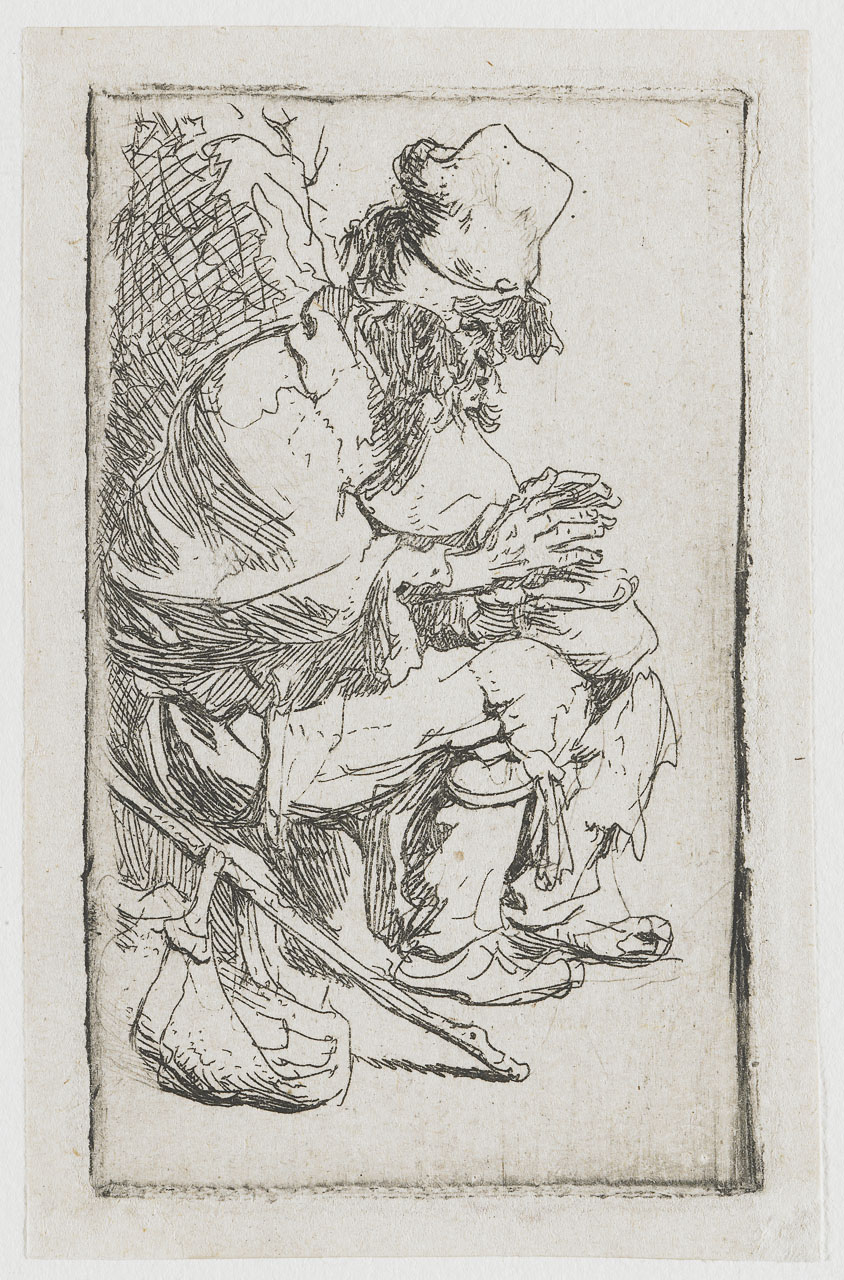
Rembrandt’s “Beggar Seated Warming His Hands at a Chafing Dish” from 1630 compresses winter, need, and human ingenuity into a small burst of etched line. The figure crouches close to the ground, knees drawn up, shoulders hunched, cap slouched over his brow. Both hands extend toward a low brazier outside the frame’s center, fingers splayed to catch the thin ribbon of heat. Everything surrounding the body—the blank paper, the boxy border scratched into the copper—behaves like cold air. Instead of staging a crowded street or a picturesque doorway, Rembrandt lets a single act carry the whole picture: the practical salvation of warmth. With almost nothing but needle marks, he makes temperature visible.
Historical Context
The date places the print in Rembrandt’s Leiden years, when he was in his early twenties and systematically expanding the expressive range of etching. Small plates of beggars, old men, and anonymous walkers circulated widely in the Dutch Republic, appealing to collectors who prized virtuoso drawing and scenes of everyday life. Rembrandt entered this market with a set of images that were neither satirical nor sentimental. His beggar series of 1629–1630—walking with a wooden leg, conversing with a companion, leaning on a staff, sitting in an elbow chair, and, here, warming chilled hands—forms a compact manifesto: ordinary human adjustments to weather and age are worthy of the most careful looking. The sheet belongs to this humane program and is among the most interior of the group. Street bustle drops away; only the cold remains, and the answer to it.
Etching as Thinking in Line
Etching translates drawing directly into copper. A wax ground coats the plate; the artist scratches through it with a needle; acid bites the exposed metal to create grooves that hold ink. Because the tool meets little resistance, the line preserves the hand’s speed and pressure. In this print Rembrandt exploits that responsiveness. The beggar’s cap is formed by soft, rounded strokes that feel like thick cloth. The beard is a bristle of quick, jagged marks. Sleeves and knees are built from long, parallel hatchings that sag with gravity. The staff—slanted across the lower left, terminating in a small pouch—reads as a single, decisive contour, an instrument as necessary as the brazier’s heat. The variety of marks is not decoration; it is information. Each family of strokes corresponds to a texture, a temperature, a weight.
Composition and the Architecture of Heat
The composition packs the figure into the left half of the plate, leaving a pale field to the right—a breath of air into which heat might drift. A rectangular border scratched inside the margins frames the action like a small stage. The beggar sits in profile, creating a forward-leaning triangle whose apex is the cluster of hands. The staff echoes that diagonal; the bag hung from it forms a counterweight, a visual ballast that keeps the body from tipping. Behind the figure, a quick lattice of hatching suggests a hedge or rough wall, but it functions primarily as a dark panel that pushes the silhouette forward. Everything points toward the hands, the locus of heat and meaning.
Gesture as Narrative
The hands are the story. Fingers spread, palms cupped, wrists close, the gesture is specific enough to feel learned. This is not a dramatic supplication; it is practiced technique. The thumb joints are bent just so; the nearer palm angles to catch warmth across its breadth; the farther hand hovers a little higher, as if testing the air. Rembrandt uses only broken contours and short strokes to build these forms, but their conviction is irresistible. It is the difference between drawing “hands” and drawing this person’s hands in this exact moment. The entire print lives in that fidelity.
The Chafing Dish and the Physics of Warmth
The brazier itself is understated—little more than a shallow round with a lip—yet it commands the image by inference. Because etching creates darkness but leaves light as untouched paper, heat is figured by white: the clear space between hands and dish, the small halo reserved around the vessel, the untouched field into which the hands extend. The beggar’s body, woven from dark lines, becomes a receiver of light; the chafing dish, scarcely drawn, becomes a producer of it. This inversion—heat as white, body as dark—gives the picture a physical truth that painting would struggle to achieve without color.
Clothing as the Ledger of Use
Rembrandt records poverty not through caricature but through the grammar of wear. The coat falls in heavy tiers whose edges curl like torn paper; the sleeves thread with small ragged apertures; the patched knees thicken with cross-hatching at points of strain. Even the sole of the nearer shoe flattens and widens on the ground, a sign of long walking in thin leather. The satchel or bundle hanging from the staff receives a few vigorous loops and is left partly open, a small pouch of the man’s world. These details do not moralize; they accumulate. Clothing becomes a ledger of encounters with weather, work, and time.
Paper White as Breathable Air
Much of the plate is simply paper. That reserve is essential to the sensation of cold and to the clarity of the gesture. The white on the right is not blankness; it is air. It allows the eye to feel the distance between the man and the imaginary fire and to register the tremble of heat that the etching cannot draw but can imply. Within the coat and cap, Rembrandt repeatedly lets blank paper peek through, creating the sparkle of frost or the flicker of firelight without illustrating either. The sheet breathes because he knows when to stop.
Light as Ethics
Rembrandt’s light is never only optical. Here it functions as an ethic: a way of honoring what the subject is doing. Rather than aim a dramatic beam across the figure, he allows a modest, even illumination that reads as clouded day—a setting where warmth is precious. The brightest zones are the untouched paper of the air and the backs of the hands; the darkest are the folds of cloth near the body’s core. This distribution suggests both temperature and care: the hands receive gentleness; the body shelters what heat it can; the world around remains cool but not cruel. The print’s morality lies in its attention.
The Psychology of Posture
Crouching compresses the torso, and the figure’s bent spine, tucked chin, and drawn-up knees communicate both need and focus. Yet there is no pathos-soaked collapse. The feet are planted; the elbows are set; the wrists maintain the fine control required to hover close to heat without touching. The man is not passive; he is skilled. Rembrandt’s beggar prints consistently emphasize this kind of knowledge: how to distribute weight on a peg leg, how to lean into a staff, how to build a conversation out of posture, and here, how to harvest warmth from a small fire. Such knowledge is a form of dignity.
Kinship with the Beggar Suite
“Beggar Seated Warming His Hands at a Chafing Dish” converses with Rembrandt’s other etchings of 1629–1630. In the walking figures, motion is the protagonist; in the seated beggar with an elbow chair, rest becomes drama; in the pair of conversing beggars, social exchange governs the design. This sheet isolates a different human necessity—heat—and distills it to essentials. The brazier is cousin to the staffs and crutches in the other prints: an enabling device. Together, the suite articulates a worldview in which survival is a set of small inventions, each worth drawing with care.
The Line as Temperature
Study the drawing long enough and line begins to feel thermodynamic. Quick, close hatchings near the torso read as retained warmth; long open strokes at the knees and hem feel cooler; the sparer, more delicate lines around the hands suggest the watchful slowness of fingers in cold air. Even the cross-hatched panel behind the figure seems to radiate backwardness—a dark that emphasizes the forward, heat-seeking thrust of the body. This is not symbolism; it is physical empathy, achieved with nothing more than variations of stroke.
Printing Variants and Atmospheric Choices
Impressions of Rembrandt’s plates often differ. A plate tone left on the surface can lay a gray veil over the white field, turning the day wintry; a brisk wipe yields a sparkling clarity, as if the air were brittle with cold sun. Heavy inking enriches the coat’s folds and makes the figure feel denser; lighter inking allows the beard, cap, and hands to hum with brightness. Such variability is not incidental. It means the image can register many weathers while preserving the central choreography of hands to heat.
The Ethics of Looking
Beggars in seventeenth-century art frequently appear as comic types or moral warnings. Rembrandt sidesteps those tendencies by declining to furnish a stage for judgment. No passerby offers alms; no signage designates a tavern or brothel; no caption moralizes. The image neither exploits nor pleads. It simply asks the viewer to attend to a person’s skillful management of cold. This stance—neither satirical nor sentimental—feels strikingly modern and accounts for the print’s persistent power.
Lessons for Draftsmen and Painters
Artists reading the sheet can extract practical lessons. Reserve paper for light; let white perform what paint would have to describe. Differentiate materials with stroke language: long, directional hatches for heavy cloth; quick, jagged marks for hair; steady contours for wood. Stage gesture by building a compositional triangle whose apex is the action—in this case, the hands and heat—and align diagonals to reinforce it. Use a small dark panel to propel a silhouette forward without drawing a full background. Above all, stop early. Suggestion here is stronger than completion.
Comparisons to Painted Interiors
In roughly the same period, Rembrandt painted intimate interiors lit by windows, where light became the protagonist and humans leaned into its beam. The beggar etching takes that idea outdoors or into a nameless threshold and substitutes fire for daylight. Both modes share a conviction that illumination—literal and metaphorical—makes human interiority visible. The etching’s extreme economy forces that conviction into its purest form: a small source of heat, a body arranged to receive it, and a world reduced to the minimum needed for that exchange.
The Sound of the Scene
The print is silent, yet it invites the ear. One can almost hear the papery crackle of coals, the soft rasp of cloth as the beggar shifts, the faint tap of staff on ground, the quick intake of breath as warmth reaches the skin. Rembrandt encourages this synesthetic reading by treating line as sound: tight hatchings murmur, long strokes whisper, firm contours strike. The image occupies that delicate space where the senses blend under the pressure of attention.
Modernity and Minimalism
“Beggar Seated Warming His Hands at a Chafing Dish” feels contemporary because it embraces minimal means and trusts viewers to complete the scene. The blank field is not a deficiency; it is deliberate modern restraint. The image asserts that the heart of representation lies in the relation between a human act and the surrounding air. Later artists who worked with the fewest possible marks to capture a decisive gesture would find in prints like this an early ally.
Why the Image Endures
The etching endures because it is exact about something universal: the small salvations by which life proceeds. No one is immune to cold; no one fails to recognize the reflex of hands extended to warmth. Rembrandt anchors that reflex in truth—posture, angle, the dance of fingers—and allows it to stand without commentary. The longer one looks, the more the act gathers meaning: resourcefulness, patience, a brief reprieve from hardship, a moment of privacy in a public world.
Conclusion
In a rectangle small enough to be held in one hand, Rembrandt stages a complete human drama. A man crouches; a brazier glows; air shines in blank reserve; line tightens and loosens in sympathy with texture and temperature. The picture neither flatters nor accuses. It pays attention. That attentiveness—focused, modest, and exact—is the artwork’s moral center and the source of its beauty. The beggar warms his hands, and we, warmed by recognition, understand anew how art can honor the common acts by which people stay alive.