Image source: wikiart.org
Introduction
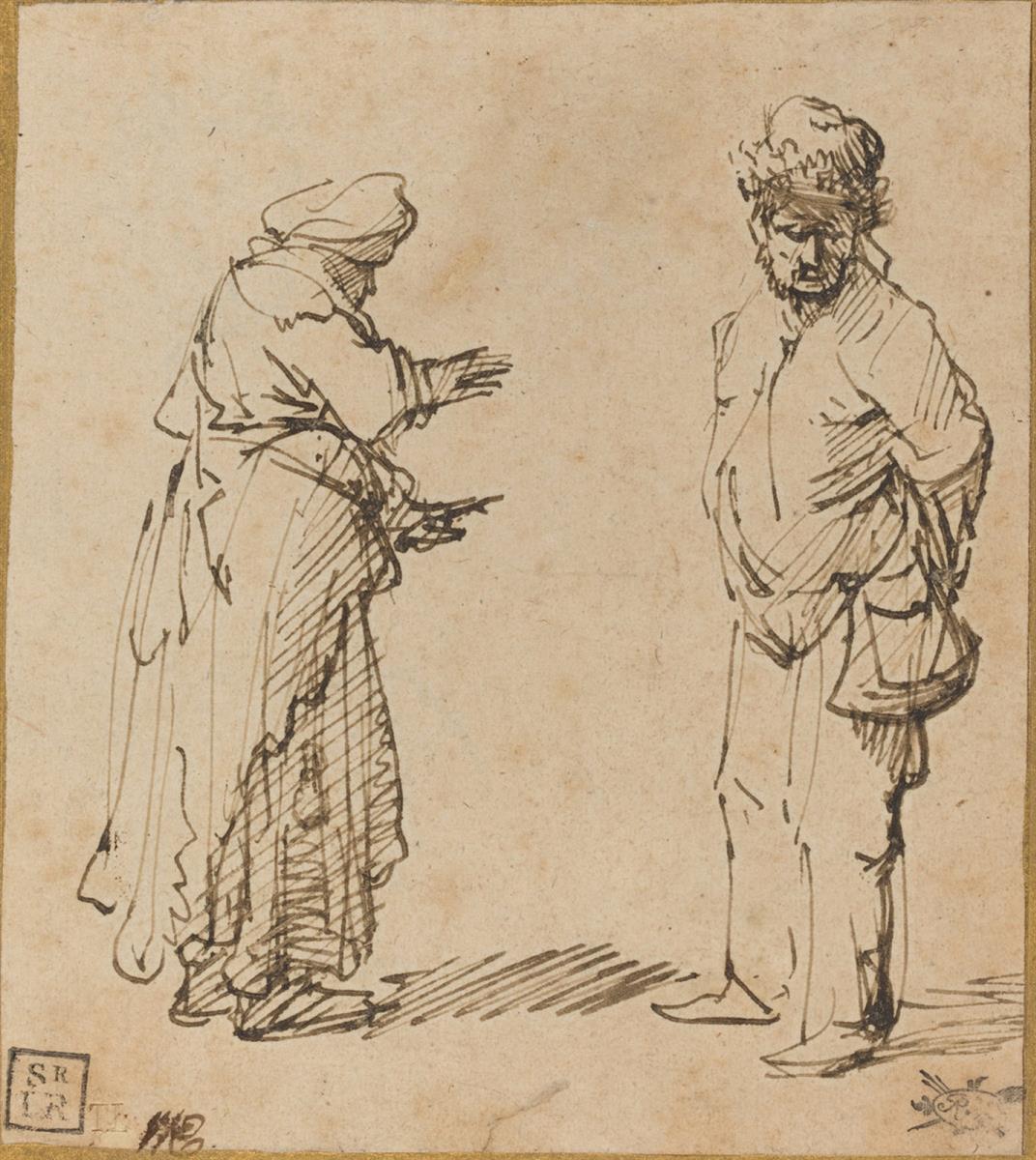
Rembrandt’s “Beggar Man and Woman” from 1631 is a small drawing that feels extraordinarily large in human presence. Executed with brisk, decisive strokes, the sheet captures two impoverished figures mid-exchange, the woman reaching outward while the man stands with his weight pitched to one hip, one hand tucked behind his back, the other hanging beside a worn satchel. Nothing in the background distracts us. There is no city, no doorway, no narrative furniture. The drama is entirely in the lines—their direction, their speed, their pressure—and in the space that opens between two people negotiating dignity on the edge of survival. It is an image of poverty, yes, but more profoundly it is a study of attention: how one person addresses another and how a watching artist makes that private moment legible.
A Moment In Rembrandt’s Early Development
The date situates the drawing just as Rembrandt was consolidating his reputation between Leiden and Amsterdam. In the late 1620s and early 1630s he pursued two parallel tracks: ambitious biblical and historical scenes and a tireless series of studies after everyday models. The beggar sheets belong to the latter. They were not “genre” images in the modern sense so much as laboratories for empathy and invention. By analyzing bodies that existed outside the flattering circuits of portraiture—the destitute, the elderly, the maimed—Rembrandt refined a visual language capable of conveying weight, fatigue, and weathered resilience with minimal means. “Beggar Man and Woman” crystallizes this approach, transforming two quick notations into a full emotional field.
Composition Built From Conversation
The drawing’s architecture is startlingly simple: two figures placed apart within a wide, empty rectangle. Yet that spareness is strategic. Rembrandt sets the woman at the left, turned three-quarters away from us, shoulders hunched and arms extended as if she is explaining, pleading, or counting. The man occupies the right edge, viewed frontally but with the head bowed and turned, his gaze falling toward her hands rather than toward us. Between the two, the blank paper becomes charged air, the zone of speech and response. The asymmetry of their placement creates a slow diagonal that begins at the woman’s feet, runs through her outstretched hands, catches the man’s turned head, and resolves in the tilt of his cap. Composition becomes rhetoric: each line and angle argues for the seriousness of the exchange.
The Expressive Power Of Line
Rembrandt uses pen and brown ink with astonishing economy. The woman’s robe is a web of long, sloping hatchings that suggest both volume and wear. Her right forearm is briskly doubled with parallel strokes, a shorthand for movement. The man’s coat and breeches are resolved with fewer marks, but each contour pinches or swells to imply cloth shifting across a bony frame. Notice the different velocities. Around the woman’s back the lines are layered and deliberate, a slow build that reads as heaviness; at her cuffs and hands the marks are quick and flicked, the graphic equivalent of speech. The man’s trousers are bounded by slim, steady contours that make him feel more static, as if he is deciding whether to accept or refuse. Line, in other words, is character.
Gesture As Psychology
Although faces are barely described, the sheet is psychologically precise because the gestures are precise. The woman’s upper body leans forward, her palms turned up in a universal sign of request. She does not grovel; the posture is earnest rather than abject. The man’s stance is defensive but not hostile. With one hand behind his back and one leg forward, he presents a narrow profile to the negotiation, neither quite closing off nor opening up. The slight bend in his neck softens the pose into attentiveness. These subtleties explain why Rembrandt’s beggar studies never read as caricature. He observes the grammar of real bodies under social pressure, and he trusts those postures to carry meaning.
Texture, Clothing, And The Reality Of Poverty
The man’s fur cap is rendered with a prickly fuzz that separates it from the smoother, flatter tones of his coat. The satchel at his hip is small and drooping, defined by a few curving lines and a triangle of shadow. The woman’s garments fall in heavy, faceted folds, some stitched with short cross-hatches to indicate patches or seams. Rembrandt is not inventorying poverty for spectacle; he is showing how materials hang on bodies when resources are scarce. The fur cap keeps warmth at the crown while the shoulders remain exposed to weather; shoes appear thin and loose, the soles turning up slightly at the toes. Such attention to how things are used—and overused—is part of the sheet’s truthfulness.
Light Without Modeling
In many of his paintings and etchings Rembrandt creates theatrical lighting with dark grounds and bright faces. Here, light is not imposed from a single source but emerges from the page itself. White paper becomes skin, highlight, pause. A few short bars of shadow beneath the figures ground them, but there is no cast shadow arcing across the field. That restraint has two effects. First, it keeps the mood open and observational rather than melodramatic. Second, it shifts our focus from light to line, from glow to gesture. The luminosity is conceptual: clarity of action rather than optical dazzle.
The Ethics Of Looking
Drawing beggars could be a moral minefield in the seventeenth century as in ours. Rembrandt’s approach avoids both sentimentality and mockery. He neither cleans up his subjects for aesthetic consumption nor inflates their misery. Instead he treats them with the same formal curiosity he extends to scholars, saints, or soldiers. The woman’s face is a few strokes within the shadow of her headscarf; the man’s beard is a quick, rough mass. By withholding overdefinition, Rembrandt refuses to cast them as types and allows them to remain people encountered in passing. The space between artist and subjects is, like the space between the two beggars, a space of respect.
The Role Of Empty Space
The large blank field is not a lack; it is a structural element. It amplifies the quiet, making the exchange legible from a distance. It also functions as time. Because there is nothing else to read, our eye returns to the woman’s palms, then to the man’s turned head, then out again to the white around them. The rhythm is steady and dignified. Had Rembrandt filled the sheet with architecture or landscape, the urgency of the figures would dissipate. The emptiness declares that this moment matters.
Comparison With Rembrandt’s Other Beggar Studies
Throughout 1630–1631 Rembrandt drew and etched numerous studies of the poor—single figures with crutches, mothers nursing infants, couples trudging together against a bank. “Beggar Man and Woman” shares their frankness but stands out for its duet structure. Many of the earlier sheets isolate a figure like a specimen to be anatomized by light; here, meaning resides in relation. This relational focus anticipates Rembrandt’s later narrative drawings where glance and gesture orchestrate complex scenes. The beggars become early teachers in stagecraft: how to arrange bodies so that meaning passes between them like current.
Movement And Stasis As Counterweights
The woman’s arms extend; the man’s arms close. The woman’s garment is a cascade of diagonal tracks; the man’s clothing is a lattice of verticals and horizontals. The woman’s feet, drawn as overlapping ovals with a trailing hem, suggest the possibility of step; the man’s wide-spaced feet plant him to the ground. This play of opposites animates the otherwise calm design. Rembrandt counterbalances the sheet like a scale: the offer weighs against the hesitation, the left side’s activity against the right side’s reserve. We feel the negotiation in our own muscles.
Speed, Revision, And The Artist’s Hand
A close look reveals tiny hesitations and corrections that expose the drawing’s making. The contour of the man’s right thigh is redrawn, his cap brim thickened, the woman’s forearm reinforced. These are not errors but acts of listening. Rembrandt feels his way through the encounter, revising shapes until the stance reads exactly. That responsiveness gives the sheet a documentary flavor. It is less a display of virtuosity than a record of attention applied in real time.
Social Context And Seventeenth-Century Compassion
Amsterdam and Leiden in the 1630s were prosperous commercial centers with robust systems of charity and poor relief. Artists could find models among the urban poor congregating near churches, markets, and city gates. Rembrandt’s drawings do not function as social policy, yet they participate in a culture of seeing the needy, naming them, and maintaining their presence in civic conscience. By rendering beggars with gravity and tact, the artist keeps them within the moral perimeter of the city’s gaze. Viewers then and now are asked to attend, not avert.
The Sheet As Independent Work And Workshop Resource
Works like “Beggar Man and Woman” circulated in albums and portfolios, admired by collectors for their candor and by artists for their instruction. In Rembrandt’s own studio such drawings likely served as reference for larger compositions. The woman’s imploring arms and the man’s wary turn appear in different guises throughout his paintings and prints, from biblical supplicants to bystanders in crowd scenes. The drawing therefore occupies two lives: a complete poem of encounter and a bank of gestures ready to be redeployed.
The Human Voice In Silent Lines
One of the sheet’s quiet miracles is the sensation of hearing. Even without mouths shown in detail, we register speech, intonation, interruption. The woman’s doubled right forearm reads like a stutter or quick emphasis. The man’s downturned face operates as a pause before answer. The small spatters of ink and the ragged end of a line feel like breaths. Rembrandt transforms the graphic into the auditory, the visible into the temporal, so that a viewer experiences not only what is seen but how it unfolds.
Comparing Penwork To Etched Line
Rembrandt’s etched beggar plates from the same years share a similar linear vocabulary, but the pen drawing carries a different tenderness. Etching bites lines into copper with acid, translating gesture through a technological filter; pen and ink keeps the pressure and speed of the hand intact. In this sheet, changes in pressure manifest as thick-and-thin articulations at cuffs, hems, and cheek lines. The instrument’s immediacy is inseparable from the drawing’s empathy. We sense a person looking, deciding, and setting down what matters in a few minutes of concentrated regard.
Conservation, Condition, And The Beauty Of Aging Paper
The paper has warmed and foxed with time, and its tone now acts as a soft mid-ground against which the ink reads as deep brown rather than black. Far from diminishing the image, the aging enriches it, knitting the figures into an atmosphere of gentle sepia. Small abrasions and pinpricks—likely workshop handling marks—remind us of the drawing’s lived history. Rembrandt often valued the weathering of materials; here, the sheet’s patina echoes the wear of the beggars’ clothing, aligning object and subject in a subtle harmony.
How To Look At The Drawing Today
To meet “Beggar Man and Woman” on its own terms, stand close enough that the quick hatchings resolve but far enough that the figures hold together as silhouettes. Let your eye travel the conversation route: feet to hands to face to cap, then across the white air to the other face and down to its grounded feet. Resist the impulse to impose a fixed story. Is she asking for alms, advice, or forgiveness? Is he refusing, considering, or explaining? The drawing endures because each of those readings feels possible, and each recalibrates the space between them. The humility of the means invites a humility of viewing.
Legacy And Lasting Relevance
Rembrandt’s beggar images influenced generations of artists who sought to depict ordinary people with gravity, from eighteenth-century French draftsmen to nineteenth-century realists. In the twentieth and twenty-first centuries, photographers and social documentarians have often discovered that the most powerful encounters involve an uncluttered stage and an honest gesture. This small sheet anticipates that ethic. It proposes that art’s responsibility is not to fix people into stereotypes but to hold open a space where their presence remains fluid, particular, and dignified.
Conclusion
“Beggar Man and Woman” proves how much can be said with so little. Two figures, a handful of lines, a rectangle of air—and suddenly we are standing in the moral weather of an encounter. Rembrandt achieves this not by theatrical lighting or elaborate setting but by faith in gesture, sensitivity to material, and deep respect for the people he draws. The sheet is a lesson in how looking becomes care. To watch these two speak across a small field of paper is to feel art’s capacity to keep human conversation alive across centuries.