Image source: wikiart.org
A Small Print With Immense Human Weight
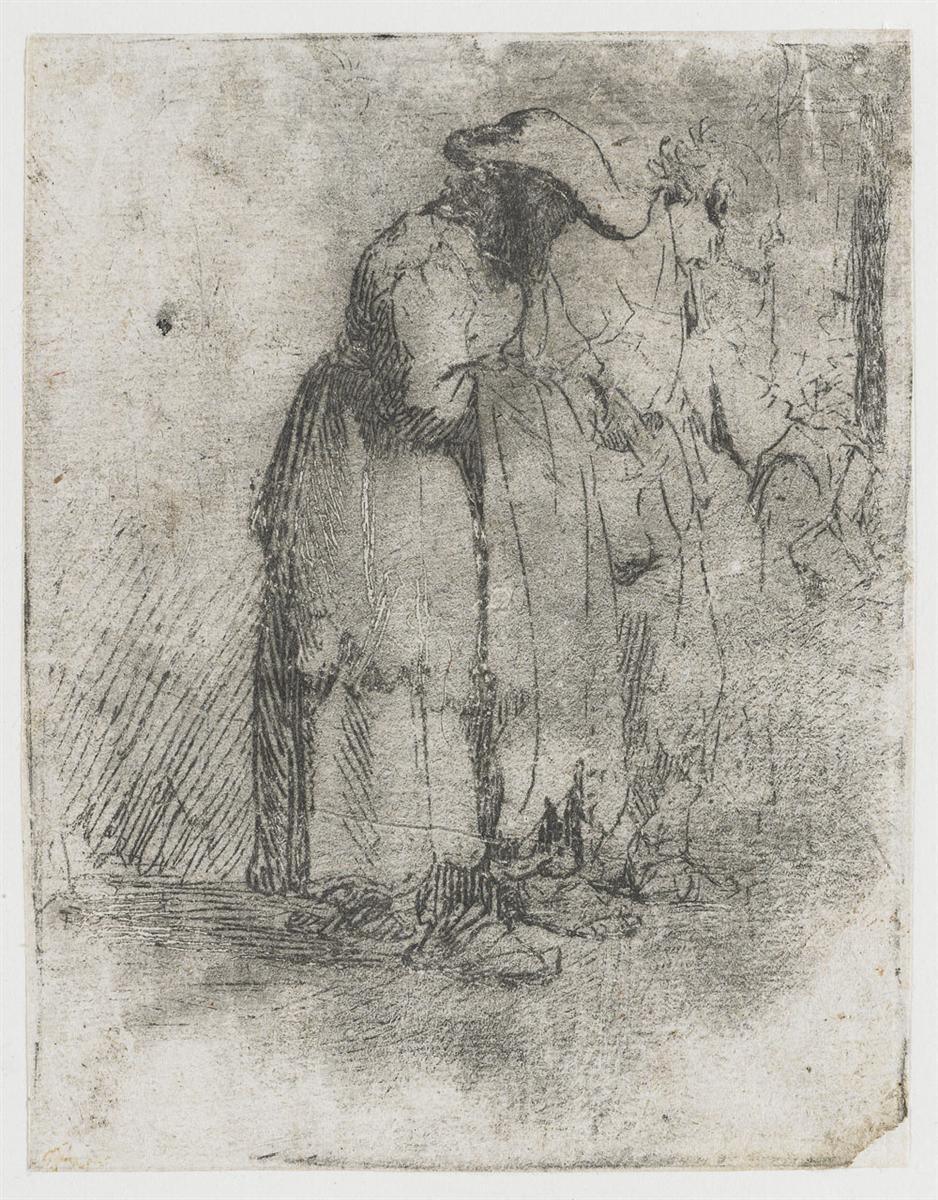
Rembrandt’s “Beggar Man and Woman,” created in 1628, is a tiny etching that carries the gravity of a much larger work. Two figures stand close together, rendered with an economy that heightens their presence: the woman leans, the man turns toward her, and their bodies meet in a hush of weariness and companionship. The plate’s surface is not polished to decorative fineness; instead, dry hatching, rubbed tones, and wavering contours build an atmosphere as tactile as worn cloth. Within a few inches of paper Rembrandt compresses a world of fragile dignity, social exposure, and mutual care.
Leiden, Early Experiments, And The Ethics Of Looking
By 1628 Rembrandt was still in Leiden, working with youthful intensity across media—oil, pen, and the comparatively new technology of etching. Etching allowed speed and revision: a copper plate covered in waxy ground could be drawn into with a needle, the exposed lines bitten by acid, and the result printed repeatedly. Rembrandt seized on the medium’s responsiveness to pressure, its ability to hold burr and accident, and its tolerance for tonal scum. In subjects like beggars, he also tested an ethic that would mark his career: the decision to look long at people whom polite society preferred to ignore, and to grant them the same artistic seriousness he gave to scholars and saints.
Composition As An Embrace
The print’s composition is compact and intimate. The woman’s broad hat and rounded cloak form a sheltering arc. The man’s head tilts toward her, compressing space between faces into a private zone of speech or shared breath. Vertical hatching rises behind their figures like a makeshift wall, while a horizontal ground line sets their feet in uncertain earth. The paired stance reads as an embrace without arms: two lives aligned against weather and want. The closeness is not sentimental; it is pragmatic, the way bodies conserve warmth and courage.
Line That Carries Texture And Feeling
Rembrandt’s etched line is varied and alive. He presses harder where the shadow under the woman’s brim must deepen, lets the needle nearly skate where a hem lightens into air, and cross-hatches only in tight pockets to suggest the rough pile of fabric. The lines never become a mere inventory of folds; they model the fatigue of cloth that has been slept in, rained on, and mended. The plate tone—those gray films left intentionally on the copper before printing—adds a soft veil across the open areas, deepening the mood. Through such means the artist turns technique into compassion; the very roughness of the mark honors the roughness of their days.
Faces On The Edge Of Visibility
Neither face is described with portrait clarity. The woman’s features withdraw under the brim; the man’s beard, nose, and cheek appear in a few flicks, more felt than seen. This partialness is deliberate. It preserves the privacy of people too often looked at without consent, and it enlists the viewer’s imagination to complete them. The effect is paradoxically intimate: by refusing to fix the faces in crisp outline, Rembrandt gives them movement and life. They could be any two people met at the edge of a market, a churchyard, or a quay, and therefore they become all such people.
Clothing As Narrative
The woman’s layered skirts hang in heavy, vertical strokes; the man’s cloak breaks into angular folds that hint at stitched patches. Hats, belts, and the suggestion of a bag or bundle are the only possessions visible. The garments do more than identify poverty; they tell a story about endurance. Their mass anchors the figures, making them feel solid and present rather than weightless clichés. You sense rain absorbed and dried again, hems frayed by cobbles, and seams reworked by hands that know needle and thread better than they know leisure. The clothes are biographies in cloth.
Space, Ground, And Exposure
There is no sheltering doorway or deep background in the print. The setting is a shallow wedge of space, the kind experienced by people who live publicly because they lack private rooms. A few vertical strokes suggest a wall or paling; scuffed horizontal marks indicate beaten earth. The figures stand in a zone of exposure, one step away from passersby who may stop or avert their eyes. Rembrandt positions us at that passing distance. We are close enough to be responsible for our gaze, yet far enough to recognize their vulnerability.
Gesture As Conversation
The man seems to incline and speak; the woman leans and listens. That reading arises from minute marks: a tuck of shoulder, a slight forward bend at the neck, a hint of clasped hand. The exchange might be a whispered plan—where to sleep, which corner to try, whether to seek the parish almoner—or a personal consolation. Rembrandt gives no prop to explain them; the silence is eloquent. By treating gesture as conversation, he restores agency to figures that art and society often arrested as mute symbols.
The Tradition Of Beggar Imagery And Rembrandt’s Turn
Images of beggars were common in the Low Countries, fueled by new urban poverty and artists’ fascination with low-life types. Many prints served as moralizing genre, warning against idleness or drink. Rembrandt neither prettifies nor condemns. He strips away allegorical props and puts us before two people whose existence is not a cautionary tale but a fact. The difference is not an absence of meaning; it is a change of ground. Meaning now arises in us as we decide what to do with our attention: to turn, to linger, to judge, or to recognize.
Scale And The Ethics Of Intimacy
The etching is small—palm-sized. That scale demands close looking. You cannot take it in from across a room; you must lean, the way you would lean to hear someone in a crowd. The proximity forges a bond between viewer and subject. The print becomes a kind of handheld meeting, a moral encounter disguised as a study in line. Rembrandt understood how scale can shape conscience. In a large painting, beggars might become part of a bustling city scene; here, they are the whole world.
The Quiet Radicalism Of Equal Attention
Rembrandt used the same habits of mind here that he applied to apostles and merchants: careful observation of weight and balance, respect for the intelligence of hands and posture, and a refusal to falsify surfaces. This equal attention is quietly radical. It asserts that the poor are worth an artist’s best sight, not just his quick glance. That assertion would echo across his career, culminating in late drawings whose tenderness toward the aged and marginal remains a standard of humane art.
Plate Tone As Weather
The gray veil left on the plate serves as more than mood; it is weather. Where Rembrandt wipes more cleanly, highlights emerge—edges of skirts, the turn of a hat, a strip of ground catching light. Where he leaves tone thick, the figures sink into a humid air that feels like drizzle or a shadowed alley. The distribution of tone is a kind of meteorology that joins body and environment. The beggars do not stand against an abstract backdrop; they inhabit air that presses and chills, which is why their closeness matters.
Roughness As Truth
Viewers used to the finished polish of engraved line might mistake the etched fuzz and tonal smears for haste. In fact, Rembrandt is choosing roughness as truth-telling. Poverty is not crisp. It blurs edges—of ownership, of address, of the line between public and private. The print’s surfaces mirror that uncertainty. This decision also makes the image more modern than many of its contemporaries. By privileging effect over finish, Rembrandt opens a path that later artists—from Goya to Daumier and beyond—would walk when depicting social reality.
The Rhythm Of Vertical And Diagonal Marks
Formally, the print’s beauty lies in the rhythm of its marks. Vertical strokes at the left balance the soft diagonals that shape the woman’s cloak; darker verticals near her arm stabilize the composition like a post. The man’s lower robe is drawn with downward lines that reiterate hunger’s pull, while his upper body bends in a counter-curve that delivers tenderness. These rhythms produce a visual music that contradicts the subject’s hardship. The eye enjoys the coordination of marks even as the mind considers the people they describe—a complexity that makes the print linger.
Poverty Seen Without Voyeurism
How does an artist show poverty without turning it into spectacle? Here are three choices this print models. First, the figures keep their faces partly private; we are guests, not intruders. Second, no theatrical gesture invites pity; the pathos is in fact, not pose. Third, the couple is not isolated as types; they are together, their togetherness a resource. These choices keep the viewer from the easy emotions of pity or the colder satisfactions of judgment. What remains is recognition and the possibility of respect.
Time Traced In Clothes And Stance
Even without a narrative, time runs through the image. The frayed hem implies months of walking; the hat’s sag tells of weather; the slight stoop of backs records years of carrying. Time also lives in the print’s making: the repeated passes of the needle, the stopped-out areas, the wiping of plate tone for each impression. By layering time in both subject and technique, Rembrandt doubles the image’s density. You do not glance and move on; you return to notice another small decision—an extra bite of acid creating a darker pocket, or a hesitant line suggesting a change of mind mid-stroke.
The Viewer’s Moral Geography
Where do we stand in relation to the beggar man and woman? The print offers a neutral pavement and a blank wall, the way an actual street offers no commentary. Our position is the space of passerby. We choose whether to look away or meet the gaze we cannot fully see. The image therefore maps a moral geography without prescribing a route. It knows the city, knows the church door, knows the marketplace. It leaves us to decide which door we are walking toward with our coins and our attention.
Echoes Across Rembrandt’s Oeuvre
This etching lays groundwork for later masterpieces of empathy. The softened anonymity of the faces anticipates the “tronies” of old age whose individuality shines through minimal description. The robust, almost sculptural treatment of cloth preludes the heavy draperies of the 1630s. The tonal veil becomes a constant tool, culminating in late prints where plate tone functions like atmosphere. The subject—human vulnerability met with observant kindness—continues to guide choices even in biblical scenes, where ordinary bodies carry sacred meaning.
How To Look Slowly
Draw close. Let your eye follow the brim of the woman’s hat and feel the shadow it throws over her brow. Trace the dark sleeve down to the ragged hem, noticing how Rembrandt thickens lines where cloth overlaps itself. Step across the small gulf to the man: watch how a few strokes articulate beard and mouth; read the slight angle of his shoulder as a question softened by care. Drift down to the ground, where a few horizontal strokes steady their feet, and then back up the vertical hatching that stands like a fence against the wind. Repeat this circuit until the pair’s shared temperature—bodily and emotional—becomes palpable.
Enduring Relevance
“Beggar Man and Woman” endures because it delivers a looking lesson our own streets still require. It refuses caricature, manipulative sentiment, and moralizing distance. Instead it produces a modest miracle: two nearly anonymous people receive the gift of patient attention, and that attention remakes them in our eyes from “case” to neighbor. The print is small, the means few, the subject unsung. Yet within those limits Rembrandt extracts something resembling justice—the justice of being seen well.