Image source: wikiart.org
Introduction
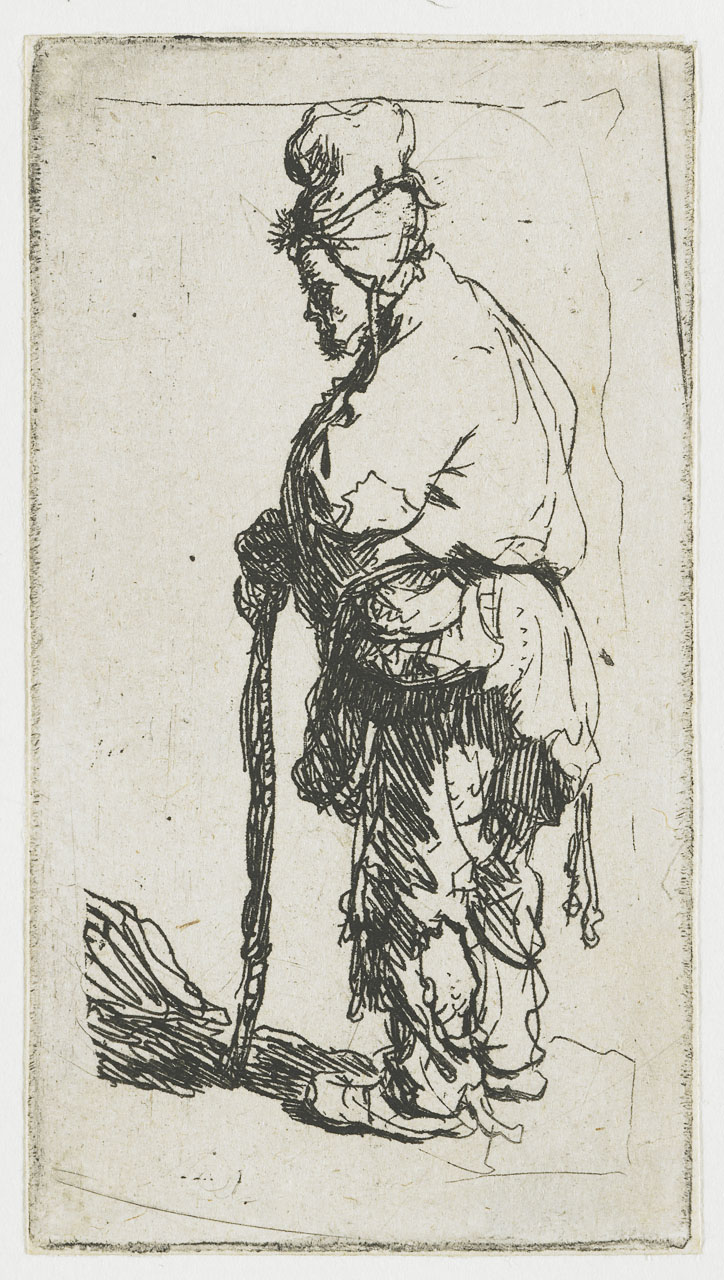
Rembrandt’s “Beggar Leaning on a Stick, Facing Left” (1630) condenses a life of endurance into a few charged lines. The small figure stands in profile, body bent forward, weight resting on a long staff that sinks into a patch of hatched ground. A wrapped cap bunches above the brow; the beard bristles; patched garments hang in torn tiers around hips and legs. The background remains almost entirely untouched, a pale field that functions as air and light. Within this deliberate spareness, Rembrandt orchestrates a powerful encounter: a single human being calibrating balance, breath, and motion at the edge of fatigue. The young artist, still working in Leiden, shows how etching can transform bare essentials—contour, hatch, reserve—into a complete world of feeling.
The Etching Medium and the Velocity of Gesture
Etching, unlike engraving, preserves the immediacy of drawing. A copperplate is coated in a wax ground; the artist scratches through with a needle, exposing metal that acid later bites to create grooves for ink. The tool glides easily, recording minute changes in speed and pressure. Rembrandt treats the medium as a seismograph of perception. The cap is drawn with supple, rounded strokes that echo the softness of cloth; the beard bristles in uneven, quick strokes; the torso is mapped in long, sagging curves that mirror the weight of a coat; the stick descends in a firm, unwavering line that declares its structural role. The hand’s tempo, translated into line, becomes the graphic analogue to touch, making surface and weight legible without descriptive excess.
Composition and the Architecture of Balance
The print is a lesson in how composition can embody physical truth. The figure occupies the left half of the vertical rectangle, advancing from right to left while leaning backward into the support of the staff. The ground is indicated by a small wedge of dense, flat hatching at the bottom left—enough to anchor the stick and the forward foot. The upper right remains open, a counterweight of blankness that prevents the composition from tipping. This distribution of mass and air mirrors the beggar’s own precarious equilibrium. The eye feels the body’s negotiation with gravity, and that felt balance becomes the image’s drama.
The Staff as Axis and Biography
The staff is both compositional spine and biographical shorthand. It is etched with unwavering conviction, thicker near the hand and lighter toward the ground, as if worn smooth by long usage. Its near-verticality contrasts with the oblique slant of the torso and legs, creating a triangular geometry—staff, back, ground—that stabilizes the figure. In Rembrandt’s beggar suite, sticks recur as instruments of survival. Here the staff is not a theatrical prop; it is a daily technology, a mobile railing that turns precarious steps into possible ones. By drawing it so simply and decisively, Rembrandt grants it the dignity of a protagonist.
Clothing as the Grammar of Wear
The garments are patched, frayed, and layered, and each condition receives its own syntax of line. Jagged short strokes at the elbows and knees indicate stress points; longer, drooping lines along the coat’s hem suggest heavy cloth pulling toward earth; irregular, scalloped contours mark rents and repairs. The pouch or bundle at the hip is sketched with overlapping ellipses that read as a tied satchel, a small repository of the man’s world. The sum is not caricature; it is documentary. Poverty is written here not as moral emblem but as the steady accumulation of frictions against fabric over years.
Face, Profile, and the Ethics of Reserve
Rembrandt draws the head in profile, and that choice matters. The profile avoids the confrontational gaze that could turn the figure into spectacle. The nose, brow, and jaw are crisply notated; the eye sinks into a small pocket of shade; the beard erupts in wiry touches. Expression is underplayed so that mood resides in posture rather than in grimace. The figure becomes someone we might pass on a narrow street rather than an actor performing for us. This ethic of reserve—closeness without intrusion—pervades Rembrandt’s finest prints of ordinary people.
Light, Paper White, and the Breath of Space
Because etching constructs darkness with ink and preserves light by leaving the paper untouched, the white field around the beggar is not empty; it is active. It is the air that the figure displaces, the blankness into which he leans his stick, the bright edge that sharpens his silhouette. Rembrandt allows the paper to glow through breaks in the coat’s line and along the upper contour of the cap, giving the drawing a quiet luminosity. The balance between inked stroke and reserved white is so carefully judged that the small sheet seems to breathe.
The Psychology of Posture
Body attitude does the emotional work. The head tilts forward slightly; the shoulders round; the pelvis rotates so that the back leg lags and the front foot flattens. This choreography suggests fatigue, but also persistence. The staff is planted, the next step implied. We are not watching collapse; we are witnessing management—a person calibrating weight and will in real time. The line’s quickness keeps the posture from feeling static. It is the instant before motion, a pause within motion, the way a pendulum lingers at its far arc before returning.
Relation to the 1630 Beggar Suite
“Beggar Leaning on a Stick, Facing Left” belongs to a compact constellation of etchings Rembrandt made around 1629–1630, featuring beggars warming hands, conversing, seated in chairs, or moving on crutches or wooden legs. Seen together, these works form a thesis about ordinary acts as worthy subjects. Each plate isolates a fundamental human negotiation: how to keep warm, how to rest, how to speak, how to walk with impaired means. The current print offers the purest instance of locomotion adjusted by tool. Its elegance lies in paring away everything except the minimum necessary for that story: a figure, a stick, a patch of ground, and light.
A Street Without Anecdote
Seventeenth-century Dutch prints often populate beggar scenes with passing citizens, architecture, or signage that tilt the image toward satire or moral commentary. Rembrandt prunes the street to its bones. The absence of context refuses to fix the figure within a narrative of blame or pity. We are left with presence. The viewer’s imagination may supply a city edge or canal path, but the plate insists that the essential encounter happens at the scale of a body and a tool.
The Music of Line
Read the sheet as if it were a score. The hat and cap sing in slow legato curves; the beard flickers in staccato notes; the coat descends in long, mezzo-forte phrases; the staff sounds a single unwavering tone that the eye returns to as a drone. The few dense hatchings at the ground act as percussion, a soft thud under the stick and foot. This musicality is not metaphor for its own sake; it is a way to describe how Rembrandt regulates our time in the image. He alters line quality to control tempo, and by controlling tempo he guides feeling.
Printing Variants and Atmospheric Mood
As with most early Rembrandt etchings, impressions can vary depending on inking and wiping. A plate tone left on the surface can veil the white field with a gray haze, suggesting damp or overcast weather; a clean wipe makes the paper brilliant, sharpening the silhouette and turning the scene crisp as winter sun. Heavier inking deepens the coat and ground, lending the figure gravitas; a lighter pull lets the cap’s highlights and the beard’s flickers glow. These options mean the same copper can tell a subtly different atmospheric story in each impression while preserving the essential posture.
Social Vision Without Sentimentality
The print acknowledges poverty without sensationalizing it. There is no imploring gesture toward an unseen passerby, no theatrical grimace. The man does not ask; he goes on. Rembrandt’s respect lies in attention: in giving the staff the authority of a column, in letting the cap’s wrap be carefully built, in recording the weight distribution with accuracy. This insistence that the lowly be drawn with the same rigor as princes and scholars was radical in its modest way and remains one source of the image’s modernity.
Comparisons with Painted Tronies
In 1630 Rembrandt also painted character heads—youths in berets, old soldiers in gorgets—using costume and light to construct persona. The beggar etchings share that fascination with type, but in reverse. Instead of historical dress, we have the dress of necessity; instead of studio props, a stick; instead of glowing armor, dismantled cloth. Yet the goal is similar: to see how light writes itself on a human surface and to coax psychology from posture. The austerity of the etching sharpens that project.
Technique Lessons for Artists
The sheet doubles as a compact manual. Model heavy cloth by letting long, directional strokes sag with gravity. Differentiate materials through stroke character: wiry for beard, soft looping for wrapped cloth, decisive straight for wood. Anchor a figure with a small plane of flat hatching rather than full background. Build profile with minimal interior detail, reserving emphasis for the nose–brow break and the lip–beard junction. Above all, trust omission; let the paper provide the light that paint would otherwise have to describe.
The Viewer’s Distance and the Ethics of Scale
The print’s intimate size enforces closeness. You must hold it near, at the same distance you would stand from a person in conversation. That nearness, coupled with the profile pose that denies eye contact, creates a particular ethical space: we are close enough to notice every patch yet not licensed to judge. The sheet trains a kind of looking that is both careful and kind, a balance Rembrandt will continue to pursue throughout his career.
Time Suspended in a Step
Although the figure is standing, the print feels full of time. The slant of the body, the planted staff, the forward foot, the trailing heel: these are notes in a phrase that implies the next step. The viewer senses the moment immediately before movement resumes. That poised interval is where the print lives. By choosing it, Rembrandt finds the human in the mechanical—motion as a sequence of calculated balances—and gives dignity to the mathematics of walking.
The Universality of the Image
“Beggar Leaning on a Stick, Facing Left” is local to Dutch streets and universal to human experience. The need to enlist tools—canes, sticks, rails, even companions—to manage the body is common across eras. The print’s power lies in its refusal to periodize that need with narrative trappings. We meet a person coordinating limb and wood; we recognize ourselves in miniature acts of balance we perform daily. The copperplate becomes a mirror for our own calibrations.
Conclusion
In this 1630 etching, Rembrandt demonstrates how little is required to say much: a figure, a staff, a patch of ground, and a field of light. The staff is an axis of survival; the patched clothes are a grammar of years; the profile safeguards dignity; the blank background preserves air. Everything serves the central insight that presence can be monumental without scale and that attention, when given wholly to an ordinary subject, becomes a form of respect. The beggar leans on his stick, facing left, and the world—our world—feels a degree quieter, more exact, and more humane for having looked.