Image source: wikiart.org
A Quiet Portrait with a Larger Story Behind It
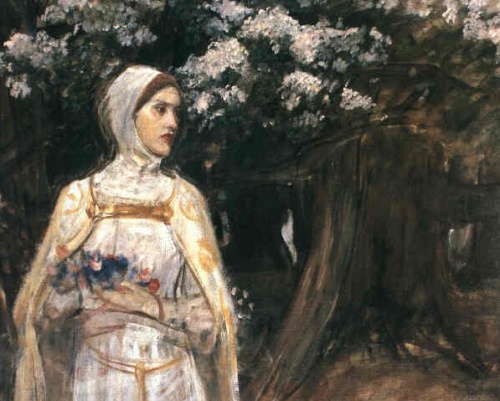
John William Waterhouse’s Beatrice (1915) feels like a pause held in paint. The scene is simple at first glance: a solitary young woman shown from the waist up, turned slightly to the left, her gaze set beyond the frame as if listening for something that will not quite arrive. Yet the simplicity is deceptive. Waterhouse gives Beatrice the stillness of an icon and the uncertainty of a living person, balancing reverence with intimacy. This is not a triumphant narrative moment, not a dramatic climax. Instead, it is a hush, a portrait of attention.
What makes the painting especially compelling is how it sits between modes. It reads as a character study, but it also behaves like a memory fragment, with forms that dissolve into atmosphere and a background that feels more suggested than described. Waterhouse, working late in his career, often moved toward a freer handling of paint, and here that looseness becomes part of the meaning. Beatrice is rendered clearly enough to anchor the image, while the surrounding world becomes a soft, dark, flowering blur, like a recollection that cannot be fully retrieved.
Even if a viewer does not immediately connect Beatrice to Dante, the painting conveys a specific emotional register: an ideal held at a distance, admired with longing, and framed as something both earthly and otherworldly. Waterhouse invites you to linger on that distance and to feel how it shapes the mood of the whole picture.
Beatrice as an Idea and a Presence
The name Beatrice carries a powerful cultural echo, most famously tied to Dante Alighieri’s muse and guiding figure. In the tradition that grows from Dante’s writings, Beatrice is not only a beloved woman but also a symbol of moral clarity, spiritual aspiration, and the kind of love that refines the soul. Waterhouse was drawn repeatedly to subjects that blend romance with reverie, and Beatrice fits neatly into his world of mythic women and lyrical longing.
What is striking here is that Waterhouse does not present Beatrice as a distant allegory alone. He gives her the physical reality of a young woman: the pale skin, the soft contours of the face, the subtle tension in the mouth, the firm line of the nose. Her expression is calm, but not blank. There is thought in it, and perhaps restraint. She looks like someone holding herself together in the presence of feeling.
In this sense, Beatrice becomes two things at once. She is the literary figure, elevated by centuries of interpretation, and she is a person caught in a private moment. Waterhouse does not force the painting into a single reading. You can approach it as a Pre-Raphaelite meditation on a famous name, or you can approach it simply as an image of inwardness. The best works allow both.
Composition and the Power of the Cropped Moment
The composition is built on a strong left-weighted placement. Beatrice occupies the left side of the frame, leaving a large portion of space to the right filled by darkness, foliage, and the suggestion of a tree trunk. This imbalance is not accidental. It produces a feeling of anticipation, as if the “rest of the story” could enter from the right, or as if Beatrice’s attention is directed toward something absent.
Her body is turned slightly, her head angled, and her gaze sent outward. That outward gaze becomes the painting’s main directional force. It pushes the viewer beyond the picture’s boundaries, which is a subtle way of creating narrative without depicting action. We do not see the cause of her focus, but we feel it.
The cropping contributes to the immediacy. Rather than a full figure in a fully described setting, we get a closer view that reads like a captured glimpse. It resembles the way memory edits reality, keeping what matters and letting the rest dissolve. Waterhouse uses that edited feeling to turn the portrait into an emotional snapshot.
The Figure, the Veil, and the Language of Modesty
Beatrice’s clothing appears medieval or medieval-inspired, with a white veil framing her hair and a pale dress that catches warm highlights. The veil is important because it immediately signals purity, restraint, and a kind of ceremonial distance. It creates a boundary between her and the world, much like her pose and expression do.
Waterhouse emphasizes the structure of the garment with warm, golden lines that describe seams, edges, and folds. These linear accents act almost like a quiet halo effect, not around her head, but across her body, giving her presence a gentle radiance. The white fabric is not a flat white. It carries shadow, warmth, and subtle discolorations that make it feel lived-in rather than decorative.
Her arms are held close, hands gathered in front of her torso. This closed posture suggests self-containment, as if she is guarding something inward. In a painting that depends on mood, posture is as expressive as facial features. Waterhouse does not need dramatic gestures. The slight tightening of the pose is enough.
Expression and Psychology in a Nearly Still Face
The face is painted with more definition than the background, and that contrast makes her expression the emotional anchor. She appears thoughtful, perhaps wary, perhaps resigned. The lips are set, not softened into a smile. The eyes do not meet the viewer; they travel past us. This refusal of direct engagement heightens the feeling that we are witnessing something private.
There is also a sense of listening in her profile. The angle of the head and the alertness of the gaze imply attention, as if she has noticed something beyond the frame. Yet the stillness keeps it ambiguous. Is she waiting? Remembering? Deciding? Waterhouse keeps the narrative suspended, and that suspension is the painting’s drama.
In late Waterhouse, faces often carry a quieter kind of intensity than the theatrical expressions of earlier Victorian storytelling. Here, the intensity is internal. It is the kind of emotion that does not spill over but remains held, like a breath not yet released.
The Dark Garden and the Blossoms Above
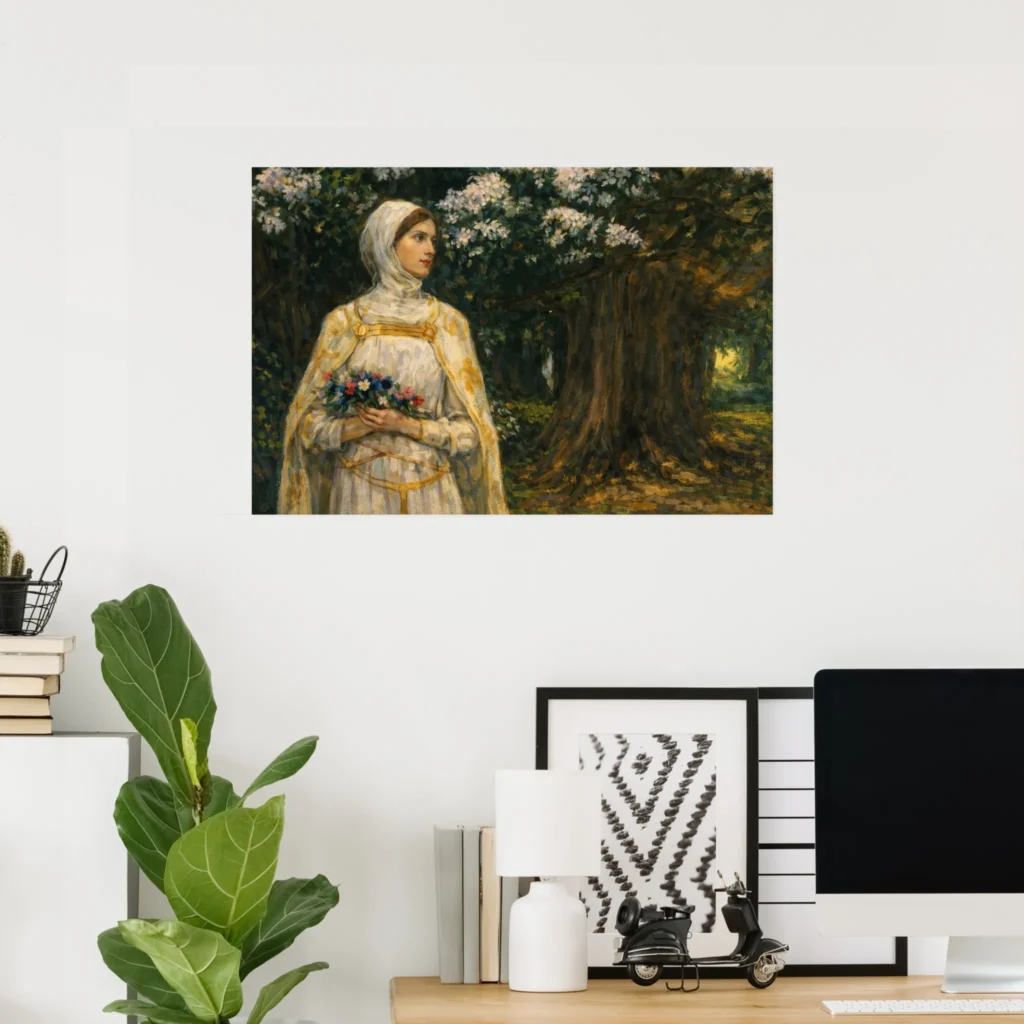
The background is dominated by dark greens and browns, with a mass of blossoms clustered near the top. The flowers appear white, but they are painted in broken touches, more like impressions than botanical specifics. They read as bloom, as fragrance, as season, rather than as identifiable species.
This floral canopy creates a gentle arch over Beatrice’s head, framing her without enclosing her. It suggests a garden space, a place associated with romance and contemplation, but the darkness complicates that association. The garden is not bright and welcoming. It is shadowed, private, and slightly mysterious.
The tree trunk or heavy vertical form on the right feels like a counterweight to Beatrice’s pale figure. It also contributes to a sense of enclosure, as if she stands near the edge of a hidden path. The environment becomes psychological: the darkness is not only night or shade, but mood.
Color, Light, and the Subtle Warmth of White
One of the painting’s most refined features is its palette. Waterhouse sets the pale dress and veil against deep, earthy tones, creating a strong value contrast. But the contrast is not harsh. The edges blur, and the whites are warmed with creamy yellows and faint pinks, preventing them from looking cold or clinical.
The warm linear accents on the dress add structure and glow, implying light even when the surrounding space is dim. It is as though Beatrice carries her own illumination. This effect aligns perfectly with the symbolic tradition around her name, but it is achieved through painterly means rather than obvious iconography.
The background greens are subdued and smoky. They do not compete with the figure. They provide atmosphere, like a stage of shadow from which the pale presence emerges. The blossoms near the top echo the whites of the clothing, tying figure and environment together and preventing the portrait from feeling cut out or pasted onto the scene.
Brushwork and the Beauty of the Unfinished
The painting’s handling feels loose and suggestive, especially in the background and even in parts of the dress. Waterhouse allows strokes to show, lets transitions remain open, and uses blur as a poetic tool. This approach can make the image feel like a study, but that “study-like” quality is not a weakness. It is part of the work’s emotional authenticity.
Looser brushwork can create a sense of immediacy, as if the image was seen quickly and recorded before it faded. That feeling suits Beatrice, who is often understood as an ideal glimpsed and carried in the mind. The paint itself behaves like memory: clear in the center of focus, dissolving at the edges.
This is also a late-career sensibility. Waterhouse, like many artists, did not remain fixed in a single style. Here he seems less interested in jewel-like detail and more interested in mood, tone, and the psychological weight of a single figure. The softness becomes a form of tenderness.
Symbolism Without Props
Unlike many narrative paintings filled with objects that explain the story, Beatrice is restrained. There are no elaborate attributes, no overt signs pointing to a specific episode. The symbolism is carried by pose, palette, and setting.
The whiteness of the clothing suggests purity, but it also suggests distance, like something untouchable. The veil implies modesty and separation, and the shadowed garden implies secrecy and inwardness. The blossoms overhead can be read as beauty and transience, a reminder that what blooms will pass. Together, these elements create a symbolic field that remains open rather than fixed.
Because the painting is not overloaded with explanation, viewers can bring their own emotional associations to it. For someone thinking of Dante, Beatrice may appear as the beloved whose presence reshapes a life. For someone approaching without literary context, she may feel like a woman caught in a threshold moment, poised between speaking and staying silent.
Waterhouse’s Late Romanticism and the Pre-Raphaelite Echo
Waterhouse is often associated with the Pre-Raphaelite orbit, even though his style and period are more complex than a simple label. In Beatrice, you can still sense the Pre-Raphaelite love of literary subject matter and the emphasis on the expressive female figure. Yet the execution here is not the sharply detailed, jewel-toned method many people expect when they hear “Pre-Raphaelite.” Instead, the painting feels softened, atmospheric, and intimate.
This blend is part of Waterhouse’s appeal. He takes the Victorian appetite for story and ideal beauty, but he frequently filters it through a more painterly mood. In 1915, with the world changed and the artist near the end of his life, the mood of romance can no longer be purely decorative. It becomes elegiac.
That elegiac note is important. Beatrice, as an idea, often belongs to longing and to the hope of guidance. Waterhouse paints her not as a triumph but as a quiet emblem of yearning. The romance is still present, but it is subdued, shaded, and introspective.
The Space of Waiting and the Emotional Temperature
What does the painting feel like, moment to moment? It feels like waiting. Not the impatient waiting of plot-driven suspense, but the slower waiting of the heart and mind. The pose suggests restraint, the gaze suggests attention, the dark garden suggests privacy, and the blossoms suggest a season that will not last.
This emotional temperature is neither joyful nor tragic in an obvious way. It sits in between, which is often where the most human feelings live. Waterhouse captures the ambiguity of desire that is also reverence, and admiration that is also loneliness. Beatrice is near, yet she is not available to us. We can see her, but we cannot reach her.
The painting’s softness contributes to this. Hard edges would make the scene more declarative. Soft edges make it tender and unresolved. The viewer is not told what to think. The viewer is invited to feel.
Connections to Waterhouse’s Larger World of Women
Waterhouse returned repeatedly to women drawn from myth, legend, and literature, often painting them at moments of heightened inwardness. Whether depicting sorceresses, tragic heroines, or muses, he tended to treat the female figure as the center of emotional gravity. Beatrice fits that pattern, but it does so with notable restraint.
Many Waterhouse heroines are shown amid drama, water, magic, or symbolic objects. Here, the drama is reduced to expression and atmosphere. That reduction makes the painting feel like a distilled statement: one figure, one mood, one quiet world.
It also invites comparison to the way Waterhouse paints attention itself. His women often look away. They see something we cannot. That gap between their awareness and ours creates tension, and it is one of his most effective narrative tools. In Beatrice, that tension becomes the entire painting.
Why This Beatrice Endures
A portrait like this can endure because it does not depend on a single interpretation. It can be read as literary, symbolic, psychological, or purely aesthetic. It rewards close looking, especially at how the pale figure is built from warm notes and gentle lines, and how the environment is kept deliberately unresolved.
It also endures because it understands that idealization is not always loud. Beatrice, in cultural memory, is often an ideal. Waterhouse does not destroy that idealization, but he humanizes it. He makes the ideal look like a person with a real face and a real silence. That choice keeps the painting from becoming merely decorative.
Above all, the painting endures because it captures a recognizable feeling: the presence of someone who matters, held just beyond reach, bright against a darker world, and remembered with a tenderness that cannot quite be translated into words.