Image source: wikiart.org
Introduction
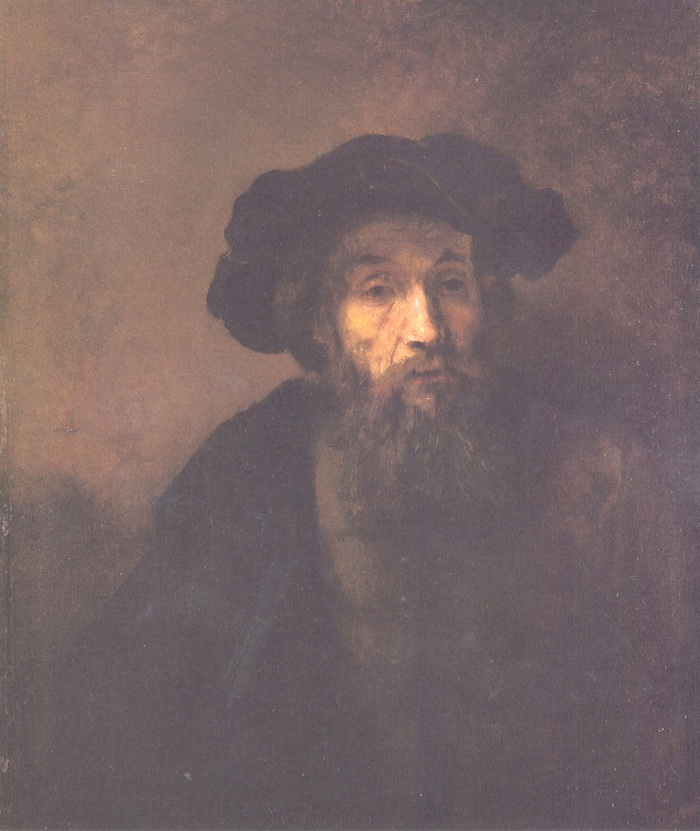
Rembrandt’s “Bearded Man with a Beret” (1655) is the kind of late portrait that seems to materialize from darkness as you watch. A warm, directional light grazes the sitter’s forehead, cheek, and the upper swells of his beard; everything else—hat, shoulders, background—dissolves into a living dusk. The result is not merely a likeness but a presence. The face feels breathed into rather than drawn around, and the painting’s apparent simplicity hides a sophisticated orchestration of tone, texture, and temperature. It is a demonstration of Rembrandt’s late style at full maturity: economical in detail, lavish in sensation, and relentless in its attention to the truth of a human head held in good light.
Late Rembrandt and the Art of Radical Omission
By 1655 Rembrandt had largely abandoned the crisp finish and narrative costume of his younger years. What interested him most was what could be said with the least. In this painting he omits paraphernalia, jewelry, and descriptive interiors. The sitter is granted no emblem of profession and no theatrical setting. Instead, the artist concentrates the viewer’s attention on the geography of the face and on the beret that shadows it. Omission is not austerity for its own sake; it is a strategy for depth. By withholding everything nonessential, Rembrandt leaves room for the subtleties of breath, age, and thought to register unimpeded.
Composition and the Poise of the Head
The head is set slightly off center, turned just enough to let one eye sit in fuller light while the other retreats toward shadow. That asymmetric illumination creates a subtle psychological torque: the sitter seems to be in the act of thinking rather than posing. The large, soft triangle of the beret frames the forehead like a canopy and completes a pyramidal silhouette with the beard as its base. This triangular stability is balanced by the softly drifting edges of cloak and background, so the portrait feels grounded without becoming static. The shoulders remain low and unobtrusive, letting the head carry the full weight of the composition.
Chiaroscuro as Human Weather
Rembrandt’s chiaroscuro in this picture is less a spotlight than a system of weather. Light behaves like a considerate hand that touches what it wants us to know and leaves the rest to privacy. Across the forehead and cheek the paint thins to a glowing veil; around the nose and philtrum it gains a little body to catch low highlights; under the beard it darkens to a cool, aerated shadow. The background’s tonal shifts—warmer near the face, cooler toward the margins—quietly stage space without resorting to theatrics. Darkness here is not emptiness; it is a medium that protects interior life.
Palette, Temperature, and the Sound of the Image
The painting’s economy of color is remarkable. Earth umbers, deep browns, soft charcoal blacks, and small pulses of reddish lake and honeyed ochre compose a low, resonant chord. Within that limited range Rembrandt orchestrates temperature so deftly that the head seems to breathe. Warmth gathers on the cheek and lower lip; cooler notes rim the eye socket and sink into the beard’s recesses; the beret swallows light into matte black. The whole image “sounds” like a baritone voice sung piano—modest in volume, rich in timbre, endlessly nuanced.
The Beret as Crown and Aperture
The beret is a structural and psychological device. Structurally, it serves as a broad dark wing that unifies the top of the composition and keeps the head from floating. Psychologically, it grants the sitter a democratic dignity—no plume, no metal, just felt and shadow. Its underside catches a breath of reflected light near the temple, which prevents the silhouette from turning into a flat cutout. Because the hat shades the brow, the eyes read from within a cave of depth; the gaze is protected from glare, and therefore from superficiality. In Rembrandt, hats often do the work that halos once did: they frame attention and create space for thought.
Flesh Made of Time
One hallmark of the late portraits is how they render age without cruelty or sentimentality. The skin in “Bearded Man with a Beret” reads as time made visible. Thin glazes and scumbles build a living translucency; furrows in the brow are not cut lines but soft, riverbed depressions where light thins and pools; the nose’s bridge carries a small ridge of light that suggests both bone and the memory of sun. The lips avoid the easy trick of wet highlights; instead, they are warmed just enough to register as living. This is the painter’s empathy at work: he reports what is there, but always in a key that honors the sitter’s dignity.
The Beard as Luminous Architecture
The beard is the painting’s second landscape. Rembrandt lays bristled paint so that tiny ridges catch light, while softer drags of the brush weave the mass into coherent volume. Silvery half-lights mingle with warmer honey tones, giving the hair the optical richness of real fibers. The triangular base of the beard anchors the portrait and sends reflected warmth back to the flesh above, acting like a natural lamp. Its edges alternate between crisp and dissolved, preventing the head from feeling cut out against the ground and suggesting breath moving through the hair.
Edge, Blur, and the Poetics of Focus
Rembrandt plays a game of focus that guides the eye without ever feeling manipulative. He states the contour of the cheek and nose decisively, then lets the rim of the beret blur into darkness. The nearer shoulder is little more than a shadowy plane; the far one disappears almost entirely. This hierarchy of edges establishes an inner and outer life for the sitter: the seen and the withheld. It also creates a depth of field more familiar from photography—a sense that the head itself is coming into focus as we look, the way people do when conversation gets real.
Brushwork and the Truth of Process
There are passages where the paint stands proud of the surface, catching actual room light, and others where it is rubbed thin so the ground participates in the mid-tones. Instead of hiding those traces of making, Rembrandt lets them remain. The face we meet is aged and particular; the surface we see is the record of choices made by a thinking hand. That doubleness—person and process—keeps the portrait alive. It is not a polished image delivered by a distant artisan; it is an encounter with the painter’s attention, still palpable centuries later.
The Psychology of the Gaze
The sitter’s gaze is direct but unaggressive. One eye reflects a small, low flame of light; the other settles into protective shade. The mouth is relaxed, the lower lip gently weighted by age. The expression is neither posed nor performative; it seems caught between thoughts. That in-betweenness is precisely what gives the portrait its magnetic draw. We read the face not as a mask but as a moving surface where attention, memory, and present company mingle. Rembrandt refuses the easy satisfactions of a smile or scowl. He gives us a person who can keep us company.
Background as Breathing Room
The surrounding darkness is softly graded rather than flat. Warmer browns near the left cheek create a halo that is too humble to be symbolic and too effective to be accidental. Cooler, more olive notes drift toward the right, deepening the sense of enclosure. Sparse, atmospheric brushwork suggests a space that is close but not claustrophobic—a quiet room rather than a void. This breathing room lets small shifts of tone around the face register as meaning. It is the acoustic in which the portrait’s low music resonates.
The Democratic Dignity of Rembrandt’s Sitters
Rembrandt is often celebrated for painting princes and burghers, but his truest genius emerges in faces like this—men without obvious rank or emblem whose dignity is conferred by attention. The “Bearded Man with a Beret” could be a scholar, a tradesman, a neighbor. What matters is not his social position but the intensity and tenderness with which the painter sees him. That democratic gaze is a moral stance as well as an aesthetic one. It says that a human head, lit well and looked at patiently, is sufficient subject for great art.
Comparisons Within the 1650s Portraits
The picture belongs to a family of heads Rembrandt painted and etched in the mid-1650s: old men in caps, rabbis with furrowed brows, women with white scarves, and anonymous faces caught in the threshold between light and dark. Compared with the more elaborately costumed “Jan Six” of 1654, this work is more austere, more monastic in mood; compared with the “Portrait of an Old Jew,” it is gentler in contrast and warmer in color. Together these works map the range of the late manner: from sumptuous reds and golds to mute browns and breathed shadows, always with the same commitment to truth.
The Viewer’s Vantage and Social Contract of Looking
We stand close—closer than we might in polite conversation. That intimacy comes with responsibility. The portrait invites a slow gaze, the kind that returns dignity to the sitter rather than consuming him as an image. There is no anecdote to finish, no attribute to decode, only the companionship of a face. Rembrandt’s late portraits often feel like conversations in which silence is as eloquent as speech. This canvas trains us to be the sort of viewers who can keep that silence well.
Material Poetics: Pigment, Oil, and Air
Lead white mixed with oil lays the beard’s lights; red lakes bloom, thinly, in cheek and lip; earth pigments pool into the darkness of the beret and coat. Glazes are pulled back with a rag, revealing underlayers the way time reveals earlier selves in a person. The specific chemistry matters because it becomes sensation: coolness at the temples, warmth over bone, the nap of cloth at the cut edge of shadow. The materials are never flashy. They are worked until they feel inevitable—paint turned into air and skin.
The Ethics of Age
Age in this painting is not a theme exploited for pathos; it is a condition observed with respect. The wrinkles suggest labor and weather; the thinning skin shows the cost of years; the beard’s wildness hints that mastery and letting-go now coexist. Yet nothing is emphasized for effect. Even the most worn features are bathed in a gentle light, as if the painter believed that attention itself is a kind of blessing. The face becomes a testament to endurance without bitterness.
Modern Resonance
To modern eyes, the portrait reads as astonishingly contemporary. Its loose edges, visible process, restrained palette, and concentration on the head anticipates later painters who privileged presence over polish. But its deeper modernity lies in how it understands identity: not as role or costume, but as the slow accumulation of lived time visible in flesh. In a culture saturated with high-definition surfaces, the soft, humane focus of this painting feels more truthful than perfect clarity.
Why the Painting Endures
What keeps “Bearded Man with a Beret” vital is the way it fuses craft and compassion. Every formal choice—the beret’s sheltering darkness, the small flame of light in the eye, the beard’s reflective warmth, the lost-and-found edges—supports the ethical aim of portraiture: to meet another. The canvas does not perform; it keeps company. Stand before it and your own breathing slows to the tempo of its light. That is not just art-historical achievement; it is a human one.
Conclusion
“Bearded Man with a Beret” is proof that Rembrandt’s most radical invention was not a technique but a way of paying attention. With a restricted palette and a handful of values he renders a head as a complete world. The beret dignifies without proclaiming; the light tells the truth without cruelty; the darkness protects what must remain private. The painting asks for time and rewards it with presence. In the end, you do not remember the brushstrokes, though they are beautiful, nor the structure, though it is masterful. You remember the man—seen, honored, and, for a moment, astonishingly near.