Image source: wikiart.org
Introduction to “Battle between Christians and Muslims at El Sotillo”
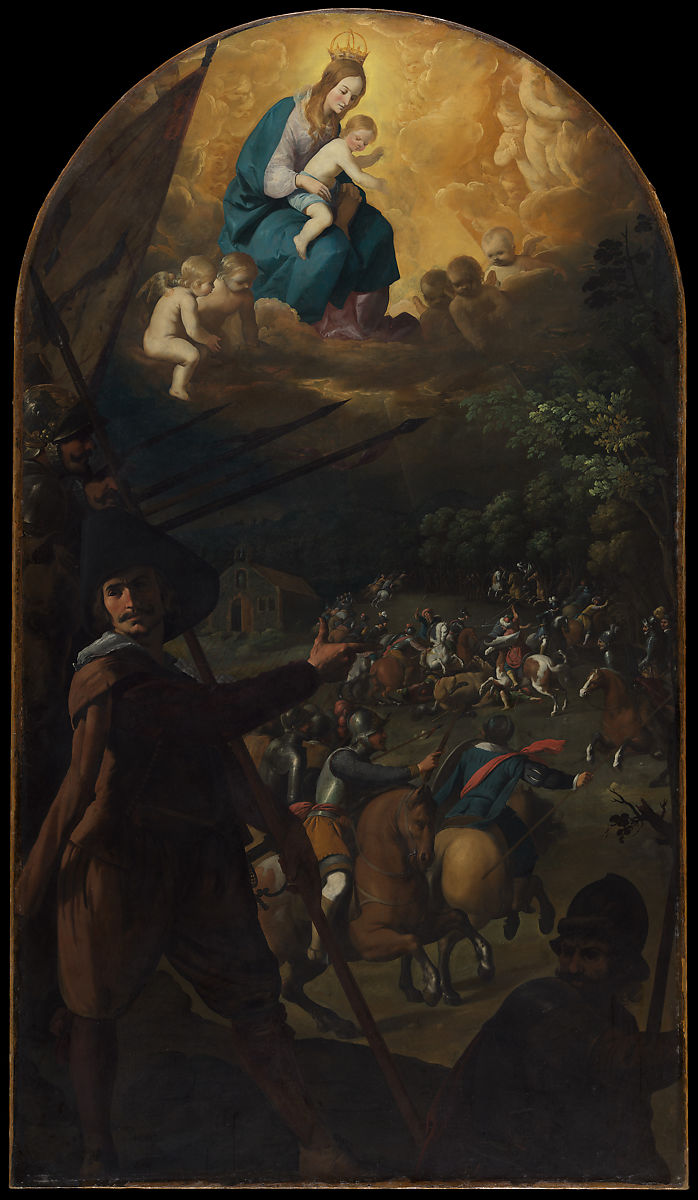
Francisco de Zurbaran’s “Battle between Christians and Muslims at El Sotillo,” painted in 1639, fuses celestial vision and earthly conflict into a single, dramatic statement of faith and power. The large, arched canvas is divided vertically between a luminous apparition of the crowned Virgin and Child surrounded by cherubs and, below, a dark, chaotic battlefield where Christian and Muslim cavalry clash in a swirl of lances, rearing horses and gun smoke.
In the very foreground a Spanish soldier turns toward us, flagstaff in hand, as if inviting the viewer to witness the miracle that hovers above the carnage. This painting goes beyond a simple war scene. It is a visual manifesto of Marian protection, national identity and providential victory, created in a Spain that constantly looked back to its long wars against Islam as proof of divine favor.
Historical and Political Context
By the time Zurbaran painted this work in 1639, the medieval Reconquista was long finished, but its memory still shaped Spanish consciousness. Images of battles between Christians and Muslims continued to be popular, reinforcing the idea that Spain’s Catholic monarchy had been chosen by heaven to defend the faith.
The battle of El Sotillo, though not among the most famous engagements, became a local emblem of Christian triumph. Paintings like this one turned historical episodes into sacred history, suggesting that the Virgin Mary herself intervened on the side of Christian warriors. The crowned Madonna seated in clouds above the battlefield makes this message explicit. She is not a distant observer but an active, protective presence, the heavenly queen who oversees and blesses the conflict.
Commissioned most likely for a religious institution or a civic chapel, the painting would have functioned as both memorial and devotional image. Viewers who passed before it could recall a specific victory while also entrusting their current struggles, whether military or spiritual, to the Virgin’s care.
Overall Composition and Dramatic Structure
Zurbaran structures the composition in two main zones. At the top of the arched canvas the Virgin Mary, crowned and robed in blue and white, sits on a glowing bed of clouds holding the Christ Child. Cherubs crowd around her, some looking down toward the battle, others playing or hovering in the golden light. This upper zone forms a radiant dome of warmth and serenity.
The lower two thirds of the painting are much darker, filled with overlapping diagonals of lances, flags and galloping horses. A church stands in the middle distance, and beyond it the battle spills across the landscape. The sky darkens near the horizon, contrasting with the luminous cloud that carries the Virgin above.
Between these two worlds stands the large figure of the foreground soldier, almost life size compared to the tiny horsemen in the distance. Placed on the left side, he turns in three quarter view, one hand pointing toward the battlefield, the other grasping his long standard. His figure cuts diagonally across the lower part of the canvas, visually linking the realm of the viewer with the armies and with the vision above.
This composition creates a strong narrative arc. Our eye moves from the soldier’s pointing hand to the clash of horsemen, then upward along the shafts of the lances to the glowing apparition of Mary and Jesus. At the same time, the golden radiance above sends implied rays back down over the battle, suggesting that victory flows from heaven to earth.
The Heavenly Apparition of the Virgin and Child
In the upper half of the painting, Zurbaran presents a tender, intimate image of the Virgin Mary and the Christ Child, set within a grand, baroque cloudscape. Mary sits slightly turned, her body forming a pyramidal shape that stabilizes the composition. She wears a deep blue mantle over a soft, pale garment, and a golden crown rests upon her head, signaling her as Queen of Heaven.
The Child rests comfortably on her lap, one arm encircling her neck in a gesture of affection. His body is rendered with Zurbaran’s characteristic naturalism, chubby limbs and small feet exposed. He tilts his head toward his mother in a relaxed, almost playful manner, which contrasts sharply with the violent scene unfolding below. This contrast emphasizes the idea that the source of Christian victory lies not in brute force but in the gentle, incarnate love represented by the Madonna and Child.
Surrounding them are numerous putti and cherubs, some clinging to the clouds, others drifting freely in the golden light. Their presence creates a sense of heavenly fullness, a choir of spiritual witnesses to the earthly battle. At the very edges of the cloudscape faint angelic forms appear, further extending the celestial court. The whole upper section glows with warm yellows and oranges, a visual sign of divine glory breaking into the gloom of war.
The Battlefield: Chaos and Heroism
The lower zone of the painting plunges the viewer into the turmoil of combat. Knights in armor, soldiers with arquebuses and lancers on horseback surge toward one another. Horses rear and twist, their bodies foreshortened to convey the speed and confusion of the fight. The Christian and Muslim forces are distinguished by details of costume and banners, but individual faces are mostly obscured; the battle is seen as a collective struggle more than a set of personal dramas.
Zurbaran does not revel in gore. There is little overt bloodshed. Instead he focuses on movement, noise and tension. Spears point in multiple directions, creating a visual tangle that captures the unpredictability of battle. The churned-up ground and scattered bodies of fallen riders hint at the cost in human life without dwelling on gruesome detail.
In the middle distance a small church stands among trees, its presence a quiet but powerful reminder of Christianity’s stake in the conflict. The battle appears to be taking place just outside this sanctuary. It suggests that the fight is not merely for territory but for the protection of faith and worship.
The landscape itself is somber. Dark greens and browns dominate, with the sky near the horizon clouded and heavy. This gloom sets off the beams of light descending from the Virgin’s cloud. Even when not explicitly painted, these rays are implied, visually connecting the heavenly glow with the darker lower half.
The Foreground Soldier as Mediator
One of the most original features of this painting is the large soldier in the foreground, who appears almost detached from the immediate fray. He turns toward the viewer, his face half shadowed but clearly individualized. His clothing suggests a Spanish infantryman or militia leader rather than a noble knight. The wide hat, buff jerkin and sturdy boots give him a grounded, earthly presence.
He holds a tall standard or pike diagonally in front of his body. With his other hand he gestures toward the battlefield, as if explaining the scene to us or inviting us to share his perspective. This gesture makes him a mediator between viewer and narrative. We, standing outside the frame, occupy a similar space of relative safety, looking on as the battle unfolds and as the Virgin appears.
The soldier’s gaze also seems directed upward, toward the vision of Mary and Jesus. His posture suggests that he has seen the miracle and now bears witness to it. In this sense he functions almost like an eyewitness narrator, analogous to a chronicler or the author of a victory account. Zurbaran thereby weaves together three layers of testimony: heaven testifying through the apparition, the soldier testifying through his gesture, and the viewer silently receiving and perhaps retelling the story.
Light, Color and Atmospheric Effects
Zurbaran’s manipulation of light is central to the painting’s message. The upper part is suffused with warm, almost golden luminosity. The Virgin and Child are bathed in this light, which gives their forms softness and depth. The surrounding clouds are painted in creamy yellows fading into pale oranges, creating the sense of a sunlit heaven beyond ordinary sight.
The battlefield below, by contrast, is enveloped in cooler, darker tones. Deep greens of the trees, browns of the earth, and muted grays of armor and horses predominate. Light catches on helmets, breastplates and horse flanks in small flashes, suggesting glints of steel amid the murk. This low-key palette enhances the perception of a world overshadowed by danger and uncertainty.
The meeting point between these two zones occurs roughly at mid-height, where the golden glow begins to fade and duskier tones take over. The effect is almost like a spiritual chiaroscuro: heaven radiant, earth shadowed. Yet the light from above leaks subtly into the lower half, especially around the central area of the battle, implying that divine favor is already penetrating the conflict.
Color contrasts also serve symbolic purposes. The Virgin’s blue mantle stands out sharply against the gold cloud, a traditional color combination that underscores her purity and royal dignity. The earthy browns and dark reds worn by the soldiers and horses speak of physical struggle and mortality.
Symbolism of the Crowned Virgin and the Battle Below
The crowned Virgin at the top of the composition is not only the mother of Christ but also a royal patroness. Her crown signals her role as Queen of Heaven and, more specifically in the Spanish context, as patroness of Christian armies. Her serene demeanor, combined with the tender embrace of the Child, transforms the chaos below into something seen and measured by divine love.
The juxtaposition of mother and child with armored warriors on charging horses creates a powerful symbolic contrast. The origins of Christian power lie not in weapons but in the infant who will one day sacrifice himself for peace. At the same time, the painting acknowledges that history unfolds through conflict, and that believers often perceive their struggles in light of spiritual warfare.
For seventeenth century viewers, the Muslim troops were not simply generic enemies; they represented a religious and cultural otherness against which Spanish identity had defined itself for centuries. By placing the battle directly under the Virgin’s watchful presence, Zurbaran reinforces the idea that victory over such enemies is ultimately a gift from God through Mary’s intercession.
The church building in the distance, modest yet clearly visible, may also symbolize the Christian community preserved by this heavenly protection. Its presence on the edge of the battlefield echoes the traditional belief that Mary guards not only individuals but also cities, kingdoms and churches.
Zurbaran’s Baroque Storytelling
While Zurbaran is often celebrated for his quiet monastic scenes and still lifes, this painting demonstrates his ability to handle complex, multi-figure narratives. He uses Baroque devices such as strongly contrasted light, dynamic diagonals and foreshortened horses to convey movement and emotion. Yet he avoids the extreme theatricality seen in some Italian contemporaries.
The overall tone remains contemplative. Even in the midst of action, there is a certain measured clarity. Figures are arranged so that the viewer can read the scene without getting lost in confusion. The foreground soldier’s gesture acts like a visual guide, directing attention where it is needed.
Zurbaran’s training as a painter of altarpieces is evident. The arched top, the central Madonna and Child, and the hierarchical ordering of space all recall the structure of a religious retable. The battle becomes, in effect, an extended predella or narrative zone beneath the sacred central image. This integration of devotional icon and historical scene is one of the painting’s most interesting achievements.
Emotional Atmosphere and Viewer Experience
Standing before this work, a viewer experiences a layered emotional response. The lower half evokes tension, danger and the thrill of conflict. The viewer’s eye follows the charging horses, the clash of lances, the pressing ranks of troops. Yet almost immediately the gaze is drawn upward to the calm, radiant Virgin. Her presence tempers the fear and excitement with a sense of reassurance.
The painting thus offers both drama and consolation. It acknowledges the reality of violence and the uncertainty of war, while at the same time affirming that history is not abandoned to blind fate. The soldier in the foreground, turning to involve us in the scene, suggests that we too can look up and interpret our own conflicts within a larger framework of faith.
For a seventeenth century audience living in a world of frequent military campaigns, religious tensions and political instability, such a message would have been deeply comforting. For modern viewers, the painting still challenges us to consider how we understand conflict and protection, whether in literal wars or in metaphorical battles of daily life.
Conclusion
“Battle between Christians and Muslims at El Sotillo” is a powerful synthesis of historical narrative, Marian devotion and Baroque visual drama. Francisco de Zurbaran crafts a composition that moves seamlessly from the tumult of cavalry charges to the serene heights of the crowned Virgin and her child. The monumental foreground soldier, the dark, swirling battlefield and the golden cloud of cherubs all work together to proclaim a single idea: Christian victory, whether military or spiritual, is ultimately grounded in divine grace rather than in human might alone.
Through careful control of light and color, through symbolic juxtapositions and through the mediation of the soldier who turns toward us, Zurbaran invites viewers into a contemplative engagement with history. The painting does not simply record a past battle; it transforms that event into a visual parable of faith under heavenly protection.
Even centuries later, the work retains its ability to arrest the viewer, to draw the eye from the shadows of conflict to the gentle yet commanding presence of the Virgin and Child seated above, and to suggest that in every struggle there remains a higher light to which we may look.