Image source: wikiart.org
Introduction
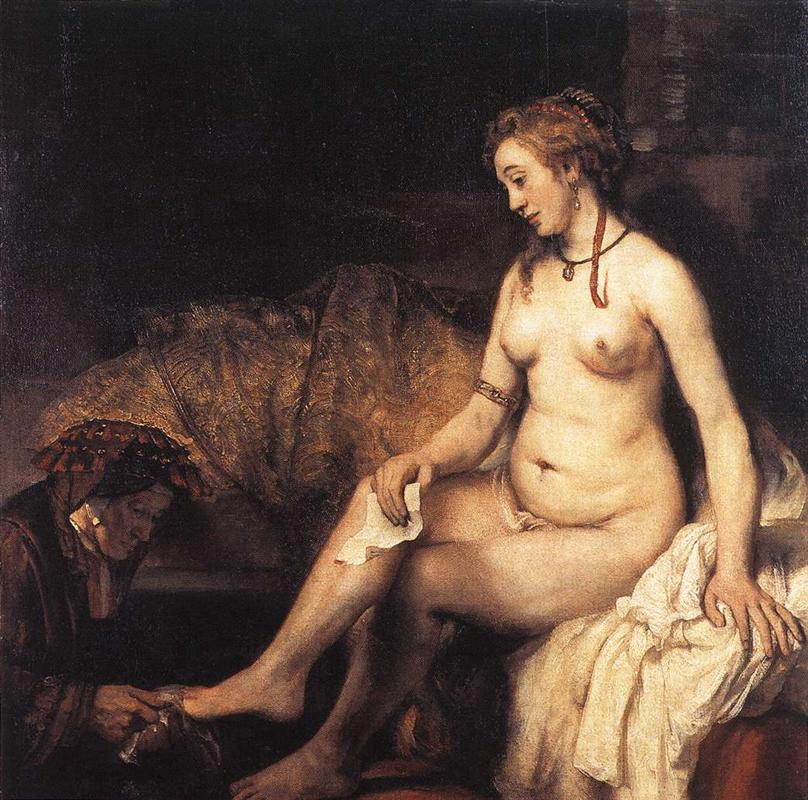
“Bathsheba at Her Bath (Bathsheba Holding King David’s Letter)” of 1654 is one of Rembrandt’s most searching meditations on desire, power, and conscience. The painting has the intimacy of a private moment and the gravity of an ethical drama. Rembrandt stages Bathsheba as a full, palpable presence who is neither an allegory nor an ornament but a woman caught at the hinge between invitation and command. The letter—barely a scrap of paper in her right hand—carries the weight of a king’s gaze, a summons that will change her life. Around that small rectangle Rembrandt builds a universe of light and shadow, of warm flesh and heavy cloth, of hesitant thought and insistent time. The result is a painting that refuses easy certainties: it is erotic and tragic, tender and inexorable, as much a portrait of deliberation as of the body.
The Biblical Episode and Rembrandt’s Choice of Moment
The story, from the Second Book of Samuel, is one of the Bible’s most unsettling tales of power. King David sees Bathsheba bathing, desires her, and sets in motion a chain of events that leads to adultery, conspiracy, and the death of her husband Uriah. Painters before Rembrandt often favored the voyeuristic moment on the rooftop, placing David at a window and Bathsheba as an unwitting spectacle. Rembrandt rejects that formulation. He brings us inside the scene after the king’s message has arrived. Bathsheba sits on a low seat, her body still glistening from the bath, an attendant drying her foot, the letter paused in her hand. We face not a passive beauty but a sentient person pressed by the force of command and the undertow of circumstance.
Composition and the Architecture of the Body
The composition is a shallow, darkened chamber shaped by cloth. A large gold-brown curtain billows behind Bathsheba, its brocade pattern catching light like a low-burning fire. To the left, shadow deepens around the old servant’s head and hands. The right margin is filled with pale linens—a crumpled mass that both supports and frames Bathsheba’s torso and thighs. Within this hushed amphitheater, the woman’s body performs as the central architecture. Her left leg extends toward the viewer, foot flexed, knee rising to form a diagonal that meets the tilt of her torso. The curve of her abdomen and the sweep of her right thigh compose an arabesque that draws the eye back toward the letter and then up to her thoughtful face. The composition continually returns the gaze to the site of decision.
Light, Shadow, and Moral Focus
Rembrandt orchestrates the lighting with theatrical precision and devotional restraint. A warm illumination enters from the right, striking Bathsheba’s shoulder, breast, belly, and near leg, leaving other passages in penumbral half-tones. Her skin holds the light rather than reflecting it sharply; it seems to drink illumination and then give it back slowly, as if the body itself were thinking. The face is not the brightest area, yet Rembrandt ensures it is the locus of feeling by thinning the paint, softening the transitions around the eyes and mouth, and setting a small cast shadow from the head against the curtain to articulate the profile. The servant remains largely in darkness, a moving frame that emphasizes Bathsheba’s isolation. The letter, caught between her fingers, becomes a pale flare—small but potent, a piece of paper that functions like a lighthouse or a blade.
Flesh as Paint and Truth
Few paintings handle the material of flesh with such empathy. Rembrandt’s brushwork is a tactile grammar: thin glazes on the cheek, granular impasto along the lit shoulder, crumbly touches where the linen meets the thigh, and softer scumbles over the abdomen where life leaves its natural traces. The flesh is not porcelain; it is inhabited. We sense weight, warmth, and pulse. Slight undulations at the stomach, a relaxed breast, the knotted tendons of the foot, the compression of skin where the hand grips the sheet—these are not insults to beauty but its human grounds. In the seventeenth century, when many artists idealized the nude, Rembrandt offers a truth that is both specific and dignified, asserting that a real body can carry serious meaning without corseting itself into myth.
The Letter and Narrative Ambiguity
The letter has been called the painting’s smallest protagonist. Rembrandt refuses to display its words; the paper is folded, its content implied by the story and by Bathsheba’s expression. She does not tear it, nor does she clutch it to her chest. Her grip is loose, almost absent-minded, as if the message weighs more within her mind than in her hand. This ambiguity nourishes the painting’s power. We stand at the interval between receipt and response. The half-second before action is often the most revealing moment in moral life. By painting that interval, Rembrandt transforms a story of royal desire into a study of conscience. The letter is both object and pressure, at once invitation, order, and omen.
The Gaze, the Viewer, and Ethical Complicity
Rembrandt engineers the encounter so that viewers become implicated in the act of looking. Bathsheba’s gaze is not turned outward toward the spectator; it drifts downward and inward, lidded and reflective, neither flirtatious nor accusatory. She does not perform for us. Yet our eyes travel across her body, summoned by the painter’s light and placement. That movement feels tender rather than predatory because the pictorial energy returns us repeatedly to her face and to the letter. We are allowed to see without consuming, and we are asked to see what she is considering. The painting thus trains the gaze: not a spectacle for desire alone but a rehearsal for attention that includes pity, unease, and respect.
The Attendant and the Labor of Care
At the lower left, the older woman bends to dry Bathsheba’s foot. She is painted in earth tones, her cap a lattice of reds and browns, her face weathered and absorbed in the task. Her presence reminds us that the scene is both intimate and ordinary. Bathing takes labor, and even privilege requires care. She also acts as a moral counterweight: while power manipulates from afar through a letter, a human being serves nearby with hands and cloth. The proximity of these two forms of touch—coercive distance and immediate care—sharpens the painting’s ethical edge. It is the servant who physically enables Bathsheba’s modesty and comfort, even as the message urges her toward exposure on another stage.
Drapery, Texture, and the Stage of Decision
The great curtain behind Bathsheba is more than scenery. Its heavy brocade, worked with thick paint and translucent glazes, displays a vocabulary of golds, browns, and olive greens that shift subtly as the surface catches light. The curtain functions as a dark sun against which the figure glows. It also acts like a set piece—an emblem of luxury and court proximity. Without ever showing David, Rembrandt conjures his world in fabric. The white linens around Bathsheba carry an opposite symbolism: domestic purity, the recent act of washing, the ordinary labor of maintaining a body. The two textiles—courtly and domestic—press against each other as visibly as the two choices in her mind.
Ornament, Identity, and the Body as History
Bathsheba wears a few pieces of jewelry: a bracelet circling her right arm, a necklace, a hair ornament, perhaps a small pendant. Rembrandt paints them without gemlike glitter; they merge with the skin rather than dominating it. The effect is to mark the body not as a blank ideal but as a life with attachments, gifts, and promises. The bracelet quietly echoes the encirclement of power suggested by the letter. The ornaments are neither moral accusations nor mere decorations; they are the record of who she is today, the self that must make the decision. The body becomes a kind of history book read by light and shadow.
Face, Gesture, and the Psychology of Delay
Bathsheba’s face is the painting’s soft engine. The head tips slightly forward; the mouth relaxes; the eyes almost close. Rembrandt is careful not to over-describe this expression. A fraction more smile would tip it toward seduction; a fraction more frown would turn it into resentment. He holds her on the edge of reverie where feelings mix: curiosity, fear, duty, and the memory of how power works. Her left hand drops toward the linens, fingers spread, as if seeking a foothold. Her right hand holds the letter but not tightly. These two gestures, open and uncertain, keep the drama alive without freezing it into verdict.
The Model and the Intimacy of Painting
Many scholars have associated the figure with Hendrickje Stoffels, Rembrandt’s companion, whose face and presence animate several works from this period. Whether or not the likeness is precise, the painting radiates a specific intimacy. It feels painted in conversation with a real body in a real studio, under light that sought not to flatter but to understand. The breastbone, the soft hollow above the hip, the almost imperceptible shadow of down on the upper thigh, the tendons in the ankle—these are the kinds of particulars one discovers only by loving study. The intimacy is not merely erotic; it is the intimacy of attention that painters give when they are trying to tell the truth about a person.
Color and the Weather of the Room
Rembrandt restricts the palette to a few families: warm ochres and siennas in flesh and curtain, deep umbers and blacks in the chamber, muted reds in the servant’s cap and garments, chalky whites in the linens. The limited range creates an enveloping atmosphere like late evening. Color operates as temperature rather than spectacle. Warmth adheres to the body; coolness inhabits shadow; the whites are not icy but cream-toned, as if the cloths themselves held onto bath heat. The picture feels like a climate into which the letter intrudes like a gust from another world.
Brushwork and the Evidence of Making
The paint surface is highly worked yet never fussy. In the linens Rembrandt uses loaded strokes that catch on the canvas weave and leave little ridges—a fitting texture for creased fabric. The curtain’s pattern emerges from layers of glaze broken by thicker highlights, so the viewer senses both textile richness and the painter’s hand. Flesh passages combine delicate blending with sudden decisiveness: a single pulled stroke along the shin, a dab catching the clavicle, a faint, roughened edge around the nipple where light meets shadow. These moves keep the body alive under our eyes. The painting owns its making; the viewer can follow decisions, corrections, and the pleasure of paint.
Morality, Power, and the Cost of Consent
Because Rembrandt paints the moment of decision rather than the voyeurism of discovery, the picture asks difficult questions about consent under pressure. A royal letter can hardly be refused without consequence. Bathsheba’s hesitation is therefore not coyness; it is the measured pause of someone who understands the way power consumes private life. The attendant’s focused service contrasts with David’s distant claim, suggesting two competing models of relation: one that fosters dignity and one that endangers it. The painting does not moralize Bathsheba; it sympathizes with her. The tragedy in the biblical narrative will largely be borne by her body and future. Rembrandt gives that body the dignity of thought.
Comparison with Earlier and Contemporary Treatments
Compared with the smooth, decorative nudes of many contemporaries, Rembrandt’s Bathsheba is startlingly frank and modern. Earlier versions by artists in Italy and the Netherlands often stage the woman as a gleaming ideal, draped with sparkling jewels, surrounded by maids and fountains, while a tiny David peers from a balcony. The viewer’s role in those pictures is to admire a pretexted Venus. Here the woman is adequate to herself. The fountain is gone, the garden replaced by a shadowed interior, the voyeur erased. The scene is not a feast for the eye alone but a test for the mind. Rembrandt seems less interested in mythic beauty than in the gravity that beauty bears when history presses upon it.
The Painting’s Place in Rembrandt’s Late Style
Painted in the year after “The Three Crosses” and alongside works of intense introspection, Bathsheba belongs to the period when Rembrandt’s finances were failing and his studio was reorganizing. The stress did not blunt his invention; it sharpened it. The late style is marked by a new tenderness for the ordinary body and by a confidence that meaning can be carried by texture, light, and hesitation. The painting breathes with that late energy: a readiness to let paint speak for flesh, to let doubt speak for drama, and to let small objects—a letter, a towel—hold monumental importance.
The Viewer’s Path and the Afterimage
To follow the painting is to share a path. The eye lights first on the gleaming shoulder, travels down the arm to the letter, slides across the abdomen to the knee, then descends to the servant’s hands, and finally circles back to the face. Each circuit deepens the story. We begin as observers of a nude and end as witnesses to a conscience at work. Long after leaving the picture, one remembers not only the body’s glow but the softness of the mouth and the almost-falling weight of the right hand. The afterimage is not titillation but compassion.
Conclusion
“Bathsheba at Her Bath” is among the rare paintings that honor a difficult choice without grand gestures or easy answers. Rembrandt locates the drama where it so often lives—in the pause between reading a message and rising to respond. The scene is saturated with care: a servant’s touch, fabrics that carry warmth, paint that loves the truth of skin. The light is both beautiful and stern, revealing a woman whose dignity lies not in averting the world but in facing it with awareness. The letter, a small brightness, is the axis around which a life will turn. Rembrandt asks us to imagine what it means to be summoned by power and to absorb the summons into one’s own conscience. That invitation to imagine—to practice empathy through looking—is why the painting continues to speak with undiminished urgency.