Image source: wikiart.org
Introduction
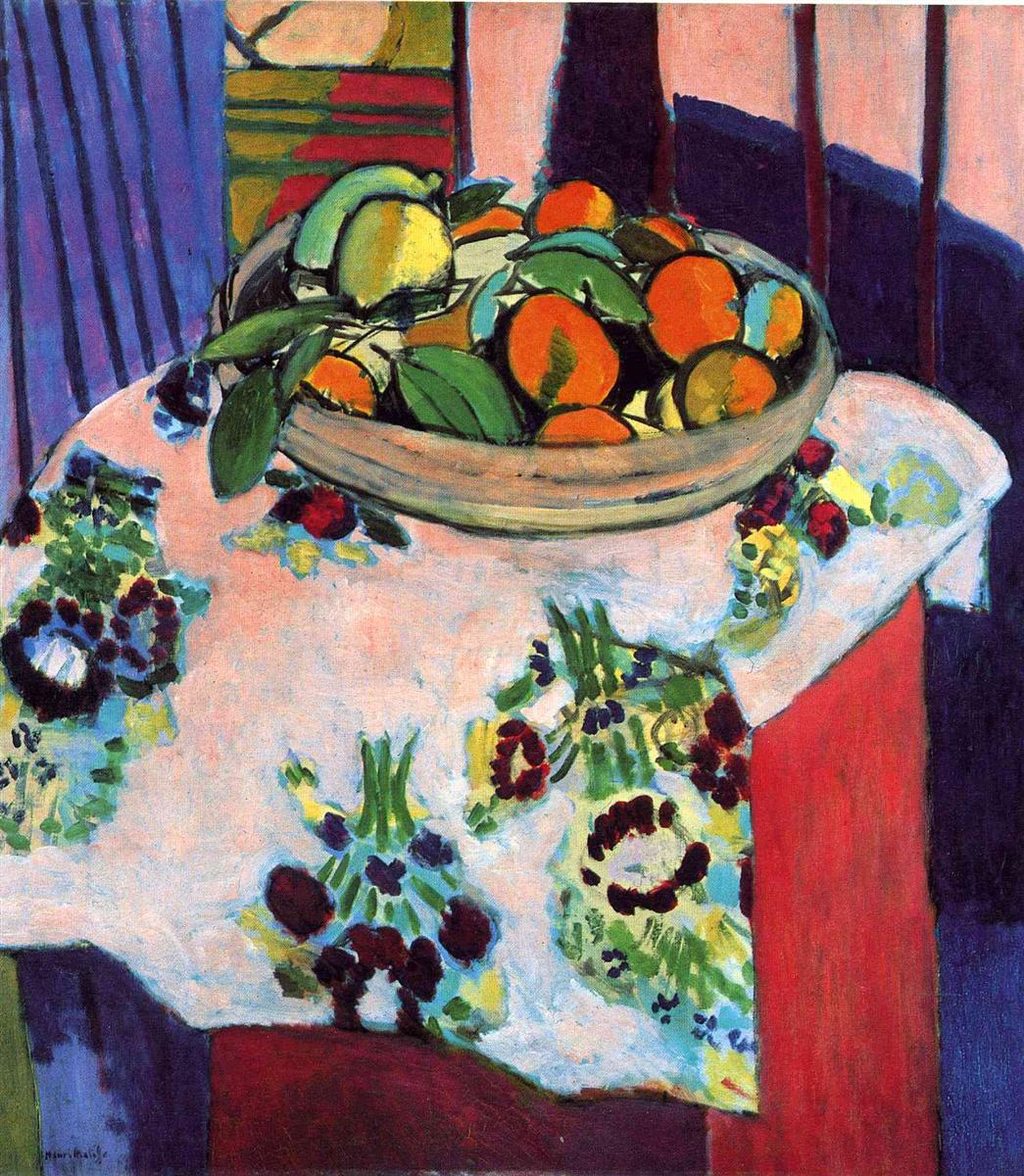
Henri Matisse’s “Basket with Oranges” (1913) is a still life that turns ordinary fruit and a tablecloth into an arena of color, rhythm, and decorative invention. A low, earthenware basket brims with oranges, a lemon, and glossy leaves; it sits on a pale cloth whose floral print unfurls in green, blue, and clove-dark reds. Around this compact stage rise bands of pink, violet, and crimson that hint at curtains, furniture, and walls without describing them. The subject is small, even domestic, yet the painting feels expansive because Matisse builds it from large, confident shapes, black-bounded contours, and color intervals tuned like music. Everyday things are transformed into a complete pictorial world.
Historical Context
By 1913 Matisse had returned from his Moroccan journeys and was consolidating the lessons of intense light, simplified planes, and decorative unity. He had moved beyond the eruptive Fauvism of 1905–06 to a calmer, more architectural handling of color. In these years he repeatedly tested how far he could reduce modeling and perspective while keeping objects legible and emotionally potent. The still life was his laboratory. In “Basket with Oranges” he accepts the genre’s intimacy but refuses its old conventions of shadowed realism. Instead he treats fruit, cloth, and table as actors in a chromatic drama, proof that modern painting could be both clear and sumptuous.
Composition and Geometry
The design is anchored by a circular bowl placed slightly high on the picture plane. Its roundness organizes the traffic of forms around it: a halo of leaves points outward, the curved lip echoes in the swags of floral print, and the table’s corner drives a diagonal wedge that cuts upward from the lower right. The cloth’s edge breaks the rectangle with emphatic angles, while vertical bands at left and right suggest curtains or supports that keep the composition upright. This interlocking of circle, diagonal, and vertical produces tension and repose at once. The eye cycles from the fruit to the patterned cloth to the surrounding fields and back again, never stranded, always moving along designed pathways.
Color Architecture
Color carries structure as surely as line. The oranges blaze in saturated cadmium and tangerine notes, some brushed thinly enough to let a warm underpaint glow, others laid dense and matte like rind. Against them Matisse sets a range of cools: the tablecloth’s mint and turquoise, the indigo-violet shadows, and the lilac-pink panels behind. The complementary clash of orange and blue provides the painting’s electrical charge; the pinks and greens modulate that voltage so it never turns garish. Black is used sparingly but decisively at contours and in the tablecloth’s floral hearts, sharpening forms while deepening the overall harmony. Rather than describe subtle shifts of light, Matisse organizes large, clear color fields so that hue does the work of volume, space, and mood.
Pattern and the Intelligence of Fabric
The tablecloth is more than a support for fruit. It is the painting’s decorative engine. Sprays of green stems topped by dark, pomegranate-like blossoms repeat across the white ground, tilting and overlapping as the cloth bends over the table’s edge. Matisse simplifies each bouquet into a few strokes, but their rhythm is precise: they thicken near the front edge, thin toward the upper right, and reappear as faint echoes near the bowl. This pattern knits the objects into the surface, so the still life reads as a unified fabric rather than a scattering of things in space. The floral print also introduces a human scale, the touch of textile design that Matisse loved and collected, linking the private sphere of the home to the formal ambitions of painting.
Drawing and Contour
Line in this painting is not a cage but a current. Black contours loop around the bowl, travel along the leaves, and catch the fruit’s edges with a supple energy that feels drawn and painted at once. Inside the bowl, quick seams of dark divide oranges and lemon where colors meet, letting drawing arise from adjacency rather than from separate outline. The tablecloth’s bouquets have edges that flicker, sometimes defined by a darker rim, sometimes by a halo of unpainted ground. This varied handling keeps the surface alive. It also clarifies Matisse’s approach to draftsmanship: contour is an expressive device, a way to set tempo and emphasis, not a neutral recorder of facts.
Space Without Conventional Perspective
The tabletop tilts steeply toward us, the bowl sits slightly above the geometric center, and the background panels rise like curtains. Depth is created by stacking zones and overlapping shapes rather than by vanishing points or cast shadows. The result is a shallow, stage-like space in which objects exist primarily as color forms pressed close to the picture plane. Yet the still life never collapses into flatness because the color intervals are so well judged: cool cloth recedes behind warm fruit; the dark table edge thrusts forward; the pink wall floats behind. The space we experience is a mental one, negotiated by hue and position, not by measured distance.
Light and Materiality
Nothing in “Basket with Oranges” looks modeled by a directional lamp, but everything glows. Light is an outcome of color choices. The whites of the cloth are not pure; they’re tinged with blue and rose, which makes them read as airy. Oranges carry small, pale crescents where the brush eased off, delivering a highlight without resorting to realism. The earthenware bowl is declared by a cool inner rim and a warm outer lip, enough to conjure weight. Even the leaves, painted in flat, varied greens, feel waxy because their contours and overlaps imply sheen. Matisse’s method is economical: a painting can suggest the tactile with minimal means if its color relations are true.
Rhythm and Movement
Still life often promises rest; Matisse adds motion. The fruit pile forms an outward push; leaves flick like hands; the cloth’s bouquets march in diagonal bands. The large verticals in the background slow this movement, acting as rests between phrases. This musicality is a hallmark of Matisse’s mature style. Even when nothing obviously happens, the eye dances. “Basket with Oranges” achieves this through repeated curves and carefully stepped diagonals, allowing viewers to feel the composition as a score played at a bright, moderate tempo.
The Tabletop as Theater
Matisse repeatedly turned tables into stages. Here the trestle is barely seen, but its presence is implied by the angled red block at right and the purple-green band at lower left. Over this platform he sets a domestic performance: fruit freshly picked, leaves left on to emphasize abundance, cloth flung casually yet artfully. The painting honors household rituals—arranging, serving, decorating—by giving them monumental clarity. Without sentimentality, it insists that the table is a site of culture, a place where color and pattern, appetite and vision, meet.
Symbolic and Sensory Associations
Oranges and lemons carry symbolic weight without literary insistence. They suggest Mediterranean climates, winter brightness, and the mingled tang of zest and foliage. In Matisse’s hands their warmth stands for vivid sensation itself—pleasure that is direct, wholesome, and present tense. The patterned cloth hints at human craft; the bowl suggests storage and offering. Together they create a secular altar to everyday abundance, a microcosm where cultivated nature, design, and nourishment coexist. The painting’s symbolic mode is pictorial rather than narrative: meaning emerges through chromatic relationships rather than through anecdote.
Dialogues Within Matisse’s Oeuvre
“Basket with Oranges” converses with earlier and later works. Its close cousin is “Still Life with Oranges II” and the earlier “Fruit and Bronze” or “Apples on a Table,” where tables tip and patterns compete with objects. The floral wave across the cloth anticipates the tapestries of pattern in the Nice interiors of the 1920s. The strong complementary chord of orange and blue recalls Fauvist canvases, but here the register is tempered and orchestral rather than explosive. The black contour, learned from Gauguin and reinforced in Matisse’s line drawings, now operates as part of color logic, not as a separate graphic layer. This painting represents a mature synthesis: Fauvist intensity balanced by decorative structure.
Process and Surface
Traces of revision give the picture its vitality. Around the bowl’s rim one can see thin adjustments where the contour was corrected to settle the ellipse. In the cloth, pale patches and over-brushings show where Matisse tuned the pattern until it flowed with the diagonal of the table. Leaves are repainted in places, dark accents added to separate them from neighboring greens. None of this reads as fussiness; it reads as practiced listening to color. The surface retains the sensation of quick, confident work, yet its balance could only have been achieved by testing and response.
The Role of Black
Black has a special job in Matisse’s palette. Here it outlines forms, anchors the floral centers, and creeps into shadows at the base of the bowl. Rather than swallow light, it intensifies adjacent hues, making oranges hotter and blues cleaner. By choosing where to deploy black and where to avoid it, Matisse calibrates the painting’s clarity. The cloth’s white remains luminous because its edges often meet colored planes rather than heavy lines. Meanwhile, the fruit’s weight is assured by slim dark rims. Black becomes a structural spice, not a dominant flavor.
Balance Between Decoration and Realism
A longstanding critique of modern still life was that it drifted toward mere decoration. Matisse answers by letting decoration become the means of realism. The cloth’s repeating bouquets do not distract from the fruit; they explain the tabletop’s tilt and the fabric’s fall. The background’s colored panels are not arbitrary; they stage the basket so it reads fully. The bowl and fruit remain convincing because the painting’s decorative unity persuades the eye that everything belongs. In this way Matisse refuses the false choice between truth and pattern. His truth is rhythmic.
The Experience of Looking
Standing before the canvas, viewers sense their eyes adjusting to a new kind of depth and light. You do not peer into a world; you let a world of color settle upon you. The oranges ping first, then the coolness of cloth arrives, then the low warmth of the bowl, then the vertical fields that wrap the scene like theater curtains. That layered arrival is the painting’s true subject: how looking itself can be paced and organized by hue. The fruit may be the motif, but vision is the theme.
Why the Painting Matters
“Basket with Oranges” matters because it proves that a still life can be monumental without scale and profound without allegory. It demonstrates that color relationships, handled with conviction, can communicate fullness, weight, atmosphere, and emotion. It shows an artist translating household objects into a language of planes and contours so lucid that viewers feel both the freshness of fruit and the rightness of form. The painting also crystallizes a broader modern insight: that the decorative, far from being superficial, can be the vehicle for deep order and lasting pleasure.
Conclusion
Matisse gathers a bowl, some fruit with leaves still attached, a patterned cloth, and a few surrounding color panels, and from them builds an image that feels inevitable. The oranges blaze, the greens breathe, the cloth’s bouquets advance and recede like waves, and the whole scene holds together as firmly as a woven fabric. There is no laborious illusion, no heavy shadow—only the calibrated chords of color that make objects live on a flat surface. “Basket with Oranges” is a celebration of the ordinary and a lesson in pictorial clarity, an image that continues to refresh the eye like the burst of citrus it depicts.