Image source: wikiart.org
Introduction
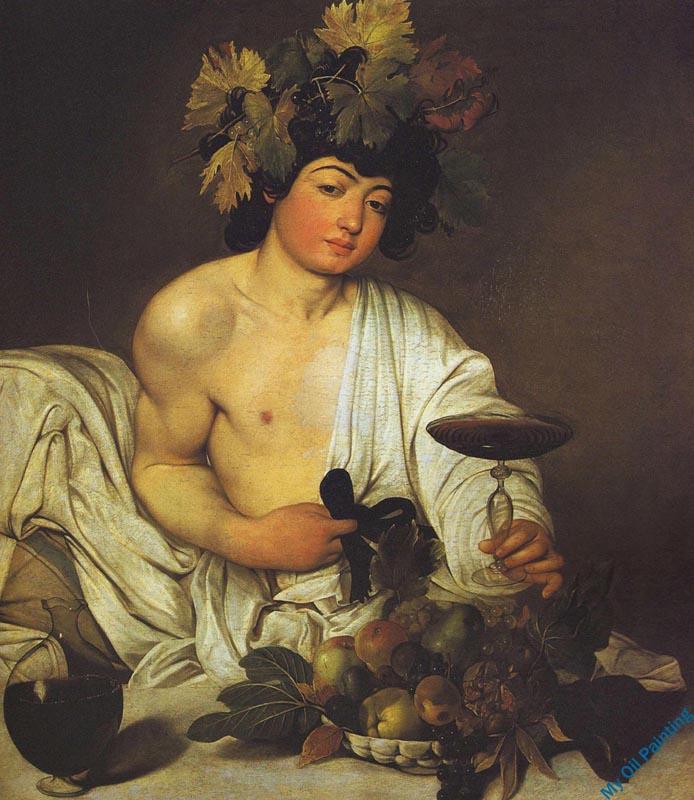
Caravaggio’s “Bacchus” (1596) stages a startling proposition: the ancient god of wine appears not as a distant marble ideal but as a flesh-and-blood youth who leans toward us with a proffered goblet and a table crowded with fruit and leaves. The figure’s wreath of ivy and grape clusters crowns a face that is cool, watchful, and faintly amused. A decanter sits to one side, its glass dark and heavy, while a basket of apples, figs, pears, grapes, and curling leaves spills across a stone slab whose chill is almost palpable. Against a warm, unornamented background, the young god’s body glows, every contour modeled by a steady light that reveals both seduction and the limits of pleasure. In this painting Caravaggio consolidates the radical naturalism of his Roman debut: antiquity is remade in the language of the present, and classical myth becomes a vehicle for psychological immediacy and tactile truth.
Caravaggio In Rome And The Challenge Of Antiquity
By 1596 Caravaggio had been in Rome for several years, working through small commissions and building the reputation that would launch his meteoric career. The city was saturated with classical ruins, learned collectors, and mannerist ideals of beauty. “Bacchus” responds to that environment with audacity. Rather than paraphrasing antique sculpture or composing a learned allegory, the painter recruits a contemporary model—likely a studio youth—and lets light, skin, and fruit carry the meaning. The result is both a challenge and an homage to Rome: a pagan deity rendered with the uncompromising observation of the street, yet dignified by the calm of proportional design and the gravity of a restrained palette. Antiquity is not rejected but reinterpreted through the lens of experience.
Composition And The Invitation Across The Table
The composition is built around a forward lean. Bacchus sits behind a stone table, torso turned slightly, left hand cradling a shallow glass of red wine as his right hand gathers a ribbon tied around a bag of grapes. The figure occupies the left half of the canvas, while the still life of fruit and leaves spreads to the right. This asymmetry creates a gentle tension that the outstretched goblet resolves: the god meets us halfway. The table’s flat edge forms a threshold between our space and his. Caravaggio keeps depth shallow and the background unarticulated so that every ounce of drama resides in the body, the goblet, and the harvest. Nothing distracts from the offer being made.
Light, Chiaroscuro, And The Temperature Of Flesh
A single, cool light falls from the upper left, describing flesh, glass, and fruit with exactitude. This is Caravaggio’s early chiaroscuro at full strength: shadows are deep but breathable, half-tones transition slowly, and highlights are placed with merciless economy. The shoulder blooms with a pearly coolness; the chest warms toward the sternum; the knuckles catch crisp gleams; the wine goblet holds a slate-colored reflection that registers the room beyond the picture. Light here is not theatrical thunder but a lucid, impartial measure that treats god and grape with the same attention. By equalizing subject and object, the lighting asserts the painting’s ethic: truth is democratic.
The Still Life As Co-Protagonist
Caravaggio refuses to treat the fruit as décor. The basket at lower right is a separate actor in the drama—heaped, heavy, and minutely observed. Grapes vary from frosted green to deep purple, some berries shriveled, others translucent with juice; figs open at the seam; apples bear harmless blemishes; pear skins model from sallow yellow to olive; leaves curl and brown at the edges. These details are not antiquarian fussiness. They stage a meditation on season and time: feast adjacent to decay, sweetness edged by mortality. The god of wine presides over ripeness, but the ripeness is already moving toward change. That low hum of temporality lends the image its gravity.
Glass, Carafes, And The Science Of Seeing
Few painters handle glass with Caravaggio’s sobriety. The shallow, Venetian-style tazza captures not only the wine’s color but the distortion of the liquid’s meniscus and the inverted world glimmering within. The decanter at left, dark and heavy, absorbs more than it reflects, yet along its curve a pale ribbon of light insists on the vessel’s thickness. These optical truths are not virtuoso tricks; they anchor the myth in physical law. If glass refracts and wine darkens under certain conditions, the god who offers them must belong to the same world of causes. The sacred and the ordinary meet at the edge of a rim.
Flesh Without Flattery
The youth’s body is believably human: a compact torso, faint tan lines at the shoulder, a soft abdomen rather than athletic ideal, and a hand whose nails are clean but not manicured. The white drapery that slips from his shoulder is not marble-like; it creases and folds with the weight of linen. Such candor is decisive. Caravaggio is not parodying antiquity; he is correcting it. The beauty here lies in precision of light and in the dignity of an unidealized person under that light. The painting argues, implicitly, that authenticity is more persuasive than polish—and that a god who can inhabit a real body can also touch real desire.
The Psychology In The Gaze
Bacchus’ expression avoids the grin of tavern pictures and the blank nobility of statues. His mouth is relaxed, his eyelids lowered, and his gaze slightly sidelong, as if weighing our answer to his offer. There is a hint of self-awareness, even mischief, but also a steadiness that prevents the scene from slipping into caricature. The invitation is not coercive; it is an urban ritual. We recognize the look from social life: a host who has poured, a friend who waits, a stranger whose confidence relies on our curiosity. The face’s restraint balances the lushness of the table, keeping the picture poised between appetite and composure.
Costume, Ivy, And Classical Signals
The wreath of ivy leaves and grape clusters declares identity without overwriting individuality. Caravaggio paints the crown with the same brisk observation he gives to fruit: veins, curls, insect bites, and a slightly drooping sprig. The white drapery across the lap and shoulder functions like a Roman toga translated into studio cloth—its folds designed to catch light rather than to proclaim status. These classical signals are legible, but they never harden into pageant. Myth is a language, not a cage.
Gesture, Offer, And Ritual
In the world of the painting, time is held at the instant before acceptance. The goblet is steady but not yet moving toward us; the hand on the ribbon subtly tightens, keeping the grape bag from spilling. The ritual quality of this pause makes the scene ceremonial. We feel the breath-space before a toast, the social hush before a first sip. Caravaggio has discovered that suspense can exist without narrative shocks; it can live in the moment when someone waits for our decision. That moral/elegiac suspense will become central in later religious works.
Color Harmony And Controlled Heat
The palette balances warm and cool with exquisite control. Flesh holds ochres cooled by olive half-tones; the background leans toward earth; the fruit basket orchestrates a spectrum from acid greens through bruised purples to russet reds; the drapery moves from chalk to pearl where shadow thickens. Small accents keep the harmony alive: the burgundy wine, the bluish bloom on grapes, the deep green of leaves, the flushed lip. Nothing screams; everything resonates. The painter composes with temperature and value rather than with saturated hue, a strategy that clothes the sensual subject in seriousness.
The Ethics Of Imperfection
One of the painting’s most consequential choices is its celebration of imperfection. Leaves are torn, fruit spotted, glass slightly smudged; the model’s skin shows minute irregularities. Caravaggio makes the lived texture of things visible and thereby dignifies them. This is not a moralism against luxury; it is a claim that beauty is a form of truthfulness. The authority of the picture depends on our trust that the painter never lies about surfaces. When later altarpieces ask us to believe in events of spiritual magnitude, that trust—earned here with the humble evidence of a grape’s bloom—will carry over.
Dialogues With Earlier Works
“Bacchus” converses with the earlier “Young Sick Bacchus” and with “Boy with a Basket of Fruit.” Compared with the convalescent self-portrait, this god is healthier, more deliberate, the palette warmer and richer. Compared with the boy who offers a harvest, this figure adds a transactional ritual: not only are we given fruit and wine, we are invited to drink. The three together chart the early program of Caravaggio’s naturalism: the human body under the clear weight of light, the still life elevated to co-star, and the viewer drawn into a compact drama staged at a table’s edge.
Devotion To The Ordinary In A Sacred City
In Counter-Reformation Rome, sacred art was charged with moving ordinary believers. Caravaggio’s insistence on everyday truth—dirty soles, worn edges, chipped crockery—was not a rejection of the sacred but a method for reaching it. “Bacchus,” although pagan, rehearses that method. The painting treats hospitality as a sacramental gesture and the table as an altar of the everyday. The decanter and cup echo liturgical vessels; the offering of wine recalls rites that conjoin celebration and memory. Without sermonizing, Caravaggio builds a bridge between classical myth and the religious psychology of his age.
The Viewer’s Complicity And Choice
Because the figure leans forward, the painting obliges us to reply. We can accept the goblet and enter the social contract the god proposes; we can refuse and remain apart. That interactivity is crucial to the picture’s staying power. The invitation arrives without ultimatum; it is soft power delivered through light and attentiveness. Caravaggio thus discovers a mode of address he will refine in scenes like “The Calling of Saint Matthew,” where a pointed hand or a thrown light asks for our response without dictating it.
Technique And The Authority Of Decisions
Look closely and the surface reveals the painter’s decisive economy. Flesh is built from thin, warm layers that let ground tones breathe through; drapery folds are established with assertive strokes dragged across wet paint; grape highlights are single touches that refuse fuss; the wicker of the fruit basket is suggested by interlaced bands rather than counted strand by strand. Everywhere the brushwork reads as choice rather than habit. That sense of chosen exactness is the painting’s secret rhetoric. It convinces without flourish by sounding like truth.
Sensuality Balanced By Reserve
“Bacchus” is sensuous without being lurid. The exposed torso carries weight and warmth; the wine glows; the fruit tempts. Yet the overall mood is one of composed presentation rather than abandon. The youth’s posture is poised, the eyes observant, the mouth calm. The scene models a tempered pleasure, the kind compatible with conversation and courtesy. In an age soon to revel in baroque excess, Caravaggio’s restraint establishes a distinctive tone: intensity secured by measure.
Time, Ripeness, And The Shadow Of Change
Under its surface elegance the picture hums with awareness of time. Grapes sugar and sour; figs open and collapse; wine deepens; bodies age. The ivy crown—emblem of constancy—sits atop a face young enough to believe in perpetuity, even as the tabletop harvest insists otherwise. The god of cyclical renewal offers a drink in the present tense, which is the only tense in which flavor exists. Caravaggio’s wisdom is to let that paradox breathe without comment. We meet the truth of transience through appetite itself.
Legacy And Influence
The clarity and immediacy of “Bacchus” helped confirm Caravaggio’s reputation among Roman collectors enamored of both antiquity and novelty. The work seeded a lineage of still-life-rich figure paintings across Europe—French, Spanish, and Dutch artists borrowed its cool light, its half-length format, and its democratic love of objects. Yet imitations often lacked the psychological poise that makes Caravaggio’s god more than a handsome prop. What endures is the balance of candor and ceremony, an equilibrium that few followers could sustain.
Why This Image Feels Contemporary
Four centuries later the painting still reads as modern. It treats a viewer like a guest, not a spectator; it trusts observation over dogma; it locates meaning in the exact meeting of light and matter. The mythic subject never hardens into illustration because the painter’s devotion to particularity keeps the scene alive: a specific wrist turning a specific glass over a particular table on a day when peaches were perfectly ripe. That is the kind of truth the eye remembers.
Conclusion
“Bacchus” is Caravaggio’s most persuasive argument that the ancient and the modern can share a single table. A young god, fully human, offers wine; a basket of fruit murmurs of season and time; glass holds the world’s reflections; light explains everything without speech. The picture dignifies appetite while honoring restraint, and it does so with a candor that would revolutionize European painting. In the end, the greatest seduction here is not the wine but the attention—the intense, impartial attention that makes the world trustworthy and invites us to enter it more fully.