Image source: wikiart.org
First Impressions: A Field Held by Air
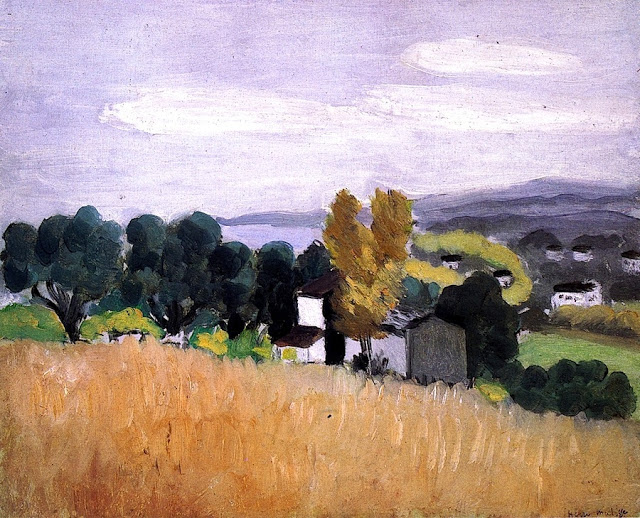
“Autumn in Cagnes” opens with a wide, honey-colored field pressed up against the picture plane. Beyond it, a cluster of dark-green trees shelters a few white buildings; two ocher-gold trees flare in the center like torches; and a ladder of soft blue-gray hills recedes under a pale, lavender sky. The whole scene feels at once spacious and intimate. Matisse builds the landscape from large, legible shapes and tuned temperatures, so the sensation of season—dry grass, cool air, distant haze—arrives before any thought of place names or topography.
1918: A New Key in the South
The year 1918 marks Matisse’s transition into the light and discipline of the Nice period. After the carved, high-contrast experiments of the mid-1910s, he turned to a steadier palette, shallow space, and color that persuades by temperature rather than by shock. Cagnes-sur-Mer, west of Nice, offered him sloping fields, orchard belts, and a clean Mediterranean horizon. In this canvas he refines that new grammar outdoors: a few structural darks, a measured spectrum of greens and golds, and a sky handled as climate rather than spectacle.
The Site and the Idea of Cagnes
Cagnes was a place Matisse knew from travel and from the artistic orbit of the Midi. Its fields terraced gently; houses sat low and white; and autumn arrived not with northern blaze but with a straw-yellow drift as grasses dried and light cooled. The painting retains local truth—olive clumps, orchard hedges, chalky sky—yet it speaks in universal terms. The field could be any field at the edge of town; the houses any houses held in trees. By abstracting toward essentials, Matisse makes season and structure the true subject.
Composition: Band, Cluster, and Ladder
The design is a conversation among three big moves. The foreground wheat forms a horizontal band of warm texture that grounds the canvas. Behind it, a compact cluster—trees, house walls, shed roofs—creates a central knot of forms and a stage for the two golden trees. Beyond that knot, a ladder of bluish hills rises in soft steps until it meets the calm roof of sky. Because each zone is simpler than the one before, the painting reads cleanly from front to back. The field invites, the cluster holds, and the hills release.
The Horizon and the Comfort of Height
Matisse places the horizon higher than a photographic view might, compressing sky into a narrow register. This choice nudges the eye downward into the field and middle distance, where his color relations are richest, while still giving the air room to breathe. The high horizon also recalls the way we actually look when standing at the edge of a field: more earth than sky, more near than far. It is a compositional courtesy that keeps the painting human-scaled.
Palette: Straw, Olive, Slate, and Pearl
Color sets the season. The wheat is not blazing cadmium but a moderated straw layered with ochre and diluted sienna, its warmth vibrating against the cooler greens behind. The orchards are deep bottle-green and bluish-olive, not spring-bright but autumn-dense. The two central trees flare with ocher and raw umber, a warm accent that anchors the key. The hills are lilac-gray and slate, stacked in cooling steps that announce distance without misty tricks. Over all floats a pearl sky—pale violet, off white, and a touch of cool gray—light enough to make the gold field glow.
Temperature Modeling Instead of Heavy Shadow
Matisse turns form with temperature rather than with thick chiaroscuro. In the wheat, warmer strokes ride the tops of stalks while slightly cooler passes sink into hollows. In the trees, blue-greens mark recesses and warmer greens lift the sun-facing bulges. The white house is never simply white: its planes tilt through cream, gray, and a pinkish light that ties it to field and sky. This method keeps the picture bright and planar while still delivering believable volume.
Black and Near-Black as Positive Color
Dark accents are deployed with economy. The deepest greens verge on black around the hedges; narrow strokes darken the undersides of tree masses; thin, almost black notes describe trunks and the tight seam where roof meets shade. These darks do not outline; they stabilize. Against the lightened sky they cool; pressed into the wheat they warm; nested among greens they sharpen. They are the quiet bass that lets the rest of the chord sing.
Brushwork: The Pace of Making Left Visible
The surface records its own construction. The wheat band is laid in with horizontal, lightly broken strokes that catch at the weave of the canvas, mimicking the crisp nap of dry stalks. Tree canopies are built from small, rounded touches packed into masses, their edges feathering where air begins. The walls and roofs of the houses are stated with broader, flatter passes that make architecture read as plane rather than detail. In the sky, long, dilute sweeps let undercolor breathe through, giving the clouds their chalk-and-pearl grain. Nothing is polished to anonymity. Each zone keeps its tempo, and the coexistence of tempos—field brisk, foliage pulsing, architecture steady, sky slow—creates the sense of a living day.
Sky as Climate Rather Than Event
There is no theatrical sunburst, no dutiful cloud portrait. The sky is a stable climate that governs the other colors. Its pale violet edge cools the hills; its slight warmth near the wheat lifts the field; its horizontality counterbalances the vertical pop of the two yellow trees. Because the sky is understated, it grants the earth permission to speak more fully.
Architecture as Measure
The house and shed function as measures of scale, tone, and human presence. Their whites are carefully tuned: not the cold of a hospital wall, but plaster warmed by day. The roof planes flicker between warm brown and charcoal; a dark slit reads as an eave shadow. Nestled in green, these simple volumes make the landscape believable without asking for narrative. They are pivots in the color chord rather than centers of a story.
The Two Ochers: A Seasonal Accent
At the heart of the cluster stand two ocher-yellow trees—the painting’s brightest warm note. They echo the wheat while rising above it, joining foreground to middle ground with a single chromatic gesture. Their placement is surgical: slightly off center, where they can ignite the composition without stiffening its symmetry. Around them, cooler greens and slate shadows gather, so the warmth feels earned rather than painted on.
Space Kept Close to the Plane
Depth is achieved through overlap and value steps, not through photographic perspective. The field pushes up and flattens, the trees sit against it in a crisp seam, the hills lighten and cool as they go. There is just enough atmospheric drift to suggest kilometers, but the surface never yields its integrity as a painted field. This closeness to the plane is what makes the picture restful: the eye travels without falling.
Rhythm and the Sense of a Mild Breeze
The painting’s rhythm lives in repeated, rounded canopy edges and the field’s horizontal ticks. The dark hedges make a scalloped line; the wheat makes a soft counterline; the long hills make a third, calmer wave. Together they move the eye left and right as much as in and out, like breathing. The rhythm suggests a mild breeze rather than wind, a day when grass rustles and the air clears slowly, which is to say a true autumn day in the Midi.
Autumn Without Melodrama
There are no blazing reds, no leaf piles. Autumn here is a change of key. The grasses turn to straw; shadows lengthen; distance cools to blue-gray; the sky whitens. Matisse captures the season as a mood shift rather than a costume change. The approach is consistent with his larger aesthetic: emotion conveyed by relation, not by rhetoric.
Dialogues with Tradition
The canvas speaks quietly with Cézanne’s Provence—stacked planes, orchards as masses, architecture as measured planes—but it resists Cézanne’s faceting rigor in favor of breathed edges and a more generous air. Impressionist precedent appears in the tuned color and outdoor light, yet Matisse refuses vibrating small strokes in favor of larger, declarative notes. Japanese print sensibility whispers in the flat horizon band and simplified shapes. The synthesis remains unmistakably his: decorative intelligence that never clutters, structure in the service of calm.
Sister Works and the 1918 Constellation
Seen alongside “Wheat Fields in Cagnes,” this painting feels like its quieter twin: same straw register, but with more air and clearer architecture. Compared with “Landscape around Nice,” it is more open and horizontally paced, trading dense woods for field-and-hill tiers. With “Landscape with Olive Trees,” it shares the authority of dark trunks and the lilac distance, but “Autumn in Cagnes” sets its drama lower in the field rather than in canopy swing. Together these works map the priorities of the moment: shallow, legible space; tuned temperature; blacks deployed as structure; and surfaces that show the time of their making.
A Guided Circuit for Close Looking
Enter through the wheat. Notice how short, parallel strokes ride across its top edge, and how a few cooler notes slip between warmer straws to keep the band from feeling pasted on. Step over the seam where field meets hedge; see how a darker, narrow stroke clarifies that join. Climb into the tree cluster, letting your eye rest on the two ocher trees and then fall onto the white house wall they partly veil. Drift right to the shed and the darker hedge that supports it. Now let your gaze step up the ladder of hills—green-gray, then lilac, then slate—until it reaches the pale sky. Follow a cloud band leftward and come back down through the round canopies to the wheat once more. With each loop, the painting’s cadence becomes clearer.
Material Evidence and the Courage to Stop
Pentimenti—decisions left visible—add life. A canopy enlarged over a cool underpass, a hill edge restated to adjust the distance, a strip of sky reclaimed above the trees, a brighter touch of ocher pressed into a leaf cluster at the end. Matisse does not buff these traces away. He halts when relations are inevitable, not when surfaces are cosmetically uniform. That earned inevitability is why the calm here feels convincing rather than bland.
What the Painting Offers Today
“Autumn in Cagnes” reads as contemporary because its clarity suits modern seeing. Big shapes register instantly; the palette is sophisticated but unstrained; process is visible and honest; space is shallow enough to sit comfortably alongside photography and design. Above all, the painting trusts a few exact relations—wheat to hedge, ocher trees to white walls, lilac hills to pearl sky—to carry feeling. That trust keeps the image fresh: it doesn’t perform for us; it composes for us.
Conclusion: Season Built from Relations
Matisse distills a hillside outside Cagnes into an architecture of season. A straw band holds the base; a green knot of trees and houses anchors the middle; a ladder of gray-blue hills and a pearl sky complete the chord. Blacks are sparing but decisive. Brushwork hums at different tempos that coexist like parts in a trio. Autumn arrives not as drama but as balance: warmth against cool, near against far, earth against air. The result is a picture that steadies the eye and describes a believable, breathable day with the least means necessary.