Image source: wikiart.org
Introduction
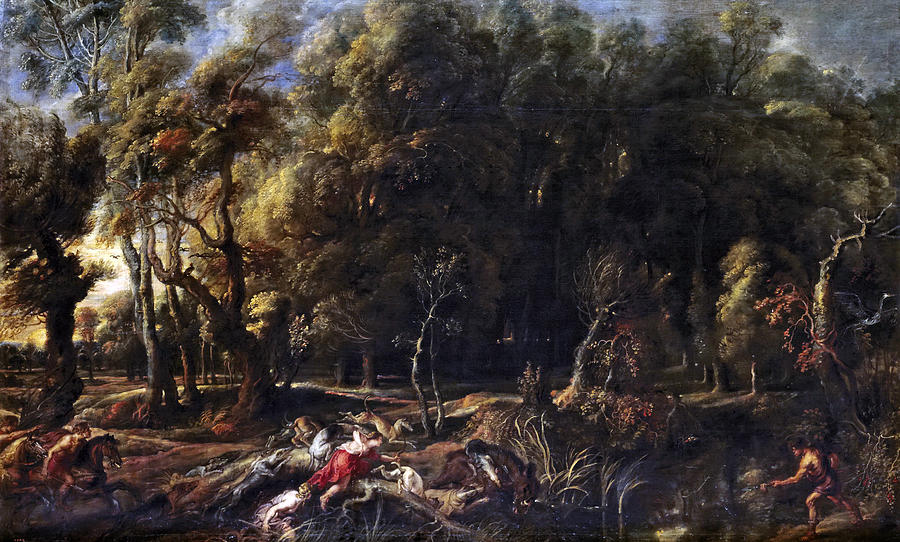
“Atalanta and Meleager Hunting the Calydonian Boar” by Peter Paul Rubens is a sweeping fusion of mythological drama and monumental landscape. At first glance the painting appears to be almost entirely about the forest: a vast, dark mass of trees stretches across the canvas, their foliage swollen with shadow and late light. Only gradually does the viewer notice the violent tangle of bodies in the lower foreground, where hunters, hounds, and the monstrous boar collide. Among them, Atalanta in a striking red garment and Meleager with spear in hand play out one of antiquity’s most celebrated hunting legends.
Rubens transforms this ancient story into an immersive visual experience. The painting is not simply an illustration of heroic exploits; it is an exploration of humanity’s confrontation with nature, of courage and chaos, and of the uneasy coexistence of beauty and brutality. The dominant forest setting, the swirling composition, and the small but intense cluster of figures together create a sense that the Calydonian hunt is both a specific event and a timeless drama unfolding in the heart of the wild.
Mythological Background
The myth of the Calydonian boar hunt originates in Greek literature, notably in Ovid’s “Metamorphoses.” King Oeneus of Calydon neglects to honor the goddess Artemis in his sacrifices, and in revenge she sends a monstrous boar to ravage the countryside. To defeat the creature, Oeneus summons the greatest heroes of Greece, including Meleager, prince of Calydon, and the swift-footed huntress Atalanta.
During the hunt, Atalanta is the first to wound the beast with an arrow, and Meleager ultimately delivers the killing blow. In gratitude and admiration, Meleager awards the boar’s hide and head to Atalanta, provoking rage among his uncles who resent seeing a woman so honored. The tale ends tragically with family conflict and Meleager’s death, but the hunt itself remains one of mythology’s archetypal scenes of collective heroism and gender inversion.
Rubens captures the climactic moment when the boar is beset by hounds and hunters. Atalanta and Meleager, though small amid the encompassing forest, are central to the action, embodying both the glory and the danger of challenging the divine beast.
A Landscape That Overwhelms
One of the striking features of Rubens’ interpretation is the prominence of the landscape. Unlike many earlier depictions that focus closely on the figures, here the dense forest occupies the majority of the canvas. Towering trees rise from the lower third to the very top edge, their trunks twisting and their crowns blending into a dark green canopy. Light filters unevenly through the foliage, creating patches of golden illumination and deep shadow that suggest the unpredictable mood of nature.
This forest is not a neutral backdrop. It feels ancient, vast, and almost sentient. The silhouetted trunks and thick undergrowth create a sense of claustrophobia: the hunters are deep in enemy territory, dwarfed by an environment that could swallow them. The boar is not just an animal; it is an expression of this wild landscape’s ferocity. By letting the trees dominate, Rubens emphasizes that human heroism takes place within a realm far larger and more powerful than the figures themselves.
At the same time, the forest is magnificent. Rubens revels in the textures of bark, leaves, and moss, using varied brushwork to suggest rustling branches and flickers of light. The result is a setting that is both threatening and beautiful—a quintessential Baroque combination of grandeur and unease.
Composition: Chaos Held Together
Although the painting’s surface is busy with detail, Rubens organizes it through a carefully worked-out composition. The horizon line sits low, and the main band of trees rises like a dark wall in the upper two-thirds. In contrast, the lower third is a zone of vigorous action. Here the diagonal sweep of the hunt drives from left to right: a rider on horseback enters from the left, the central melee of boar and hounds occupies the middle, and a figure at the right edge bends toward the water, perhaps drawing a spear or tending to a wounded dog.
At the center of the action, the boar is partially obscured by dogs and hunters, emphasizing the violence of the struggle. Atalanta, in her vivid red garment, kneels or leans forward as she aims or has just loosed her arrow, while Meleager appears poised to strike. Their red and white garments form a bright knot of color amid the surrounding earthy tones, pulling the eye to the mythic protagonists.
Diagonal lines created by fallen trees, running dogs, and leaning bodies carry the viewer’s gaze through the scene. The composition feels turbulent, but it never collapses into confusion. Rubens uses repetition of forms—curved backs of hounds, twisted tree trunks—to knit the chaos into a coherent rhythm. From the vantage point of the viewer, the hunt is both dizzyingly complex and graspable at a glance.
Atalanta: Heroine in a Male World
Although relatively small, Atalanta’s figure is crucial. Rubens dresses her in a red garment that contrasts sharply with the greens and browns around her. This choice makes her instantly identifiable and signals her exceptional status. She is not relegated to the sidelines; instead she is positioned at the center of action, physically closest to the boar.
Her posture indicates courage and engagement rather than fear. Whether she is in the act of loosing an arrow or aiding the hounds, her body leans forward rather than recoiling. Rubens thus acknowledges the mythic tradition that credits her with the first wound. Her presence is a challenge to conventional gender roles: a woman demonstrates martial skill equal to or surpassing that of male heroes.
Yet Rubens also preserves her femininity. The red garment drapes gracefully, and her pale skin glows amid the darker tones, giving her a certain softness. She is heroic but not masculinized. This tension between strength and beauty mirrors the classical fascination with Atalanta as a figure who disrupts yet also confirms the male gaze.
Meleager: Prince and Hunter
Near Atalanta is Meleager, identified not only by his proximity to the boar but also by his poised posture and commanding presence. He may be shown seated or half-fallen near the beast, spear or sword in hand, ready to deliver the fatal blow. His clothing, more subdued than Atalanta’s but still distinct, marks him as a leader among the hunters.
Rubens tends to depict Meleager as a strong, balanced figure amid the swirling chaos. While other hunters and dogs tumble and strain, Meleager’s pose often retains some composure, signaling his eventual success. However, he is not an aloof commander; he is embedded in the fray, his limbs entangled with hounds and the boar’s body. This duality—princely bearing combined with physical involvement—captures the hero’s role as both noble and vulnerable.
In the larger myth, Meleager’s valor leads to tragic conflict, but Rubens stops short of these later events. He focuses on the moment of heroism, leaving the complexities of pride and family loyalty as undercurrents embodied in the intense, almost desperate energy of the hunt.
The Calydonian Boar and the Hounds
The boar itself, though partially hidden, is rendered with ferocious vitality. Its bristling hide, gaping mouth, and powerful limbs convey menace. Rubens emphasizes its size by comparing it with the smaller, lithe bodies of the hounds. Even under attack from multiple dogs, the boar still appears capable of deadly force.
The dogs, by contrast, are painted with a mix of elegance and frantic motion. Some leap onto the boar’s back; others tumble to the ground or strain at leashes. Rubens uses them to express the raw energy of the hunt; their twisting bodies echo the convolutions of the surrounding foliage. The pack becomes a visual metaphor for collective effort against overwhelming odds.
The interaction between boar and hounds also reinforces the painting’s theme of struggle between civilization and wild nature. The boar is nature unleashed—punishment from Artemis for human hubris—while the trained hounds represent humanity’s attempt to harness animal energy for its own purposes. The battlefield between them is the forest floor, strewn with mud, water, and undergrowth.
Peripheral Hunters and Narrative Depth
Around the central melee Rubens scatters additional hunters, each contributing to the narrative and sense of space. On the far left, a rider on horseback appears to rein in his mount or turn back, perhaps startled by the ferocity of the fight. His pose creates a counter-diagonal to the movement of Atalanta and Meleager, enhancing the dynamism of the composition.
On the right, another hunter near the water’s edge seems to prepare his weapon or retrieve a fallen spear. His red garment provides a chromatic echo of Atalanta’s dress, guiding the eye across the lower edge of the canvas. These peripheral figures help situate the viewer within the broader action: the hunt extends beyond the immediate foreground, suggesting that dozens of heroes surround the boar even if only a few are visible.
Rubens thus gives a sense of narrative depth. We glimpse a single, critical moment within a larger story, much as a viewer might catch sight of the focal point of a great battle while knowing that many more events unfold just out of view.
Light, Color, and Atmosphere
The palette of “Atalanta and Meleager Hunting the Calydonian Boar” is rich and subtle, dominated by greens, browns, and golden tones. Light emanates from the left, perhaps suggesting late afternoon or early evening. It glances off the tops of leaves, gilds the edges of tree trunks, and highlights patches of grass and water. In the lower center, light falls more brightly on Atalanta’s red dress and on the pale bodies of the hunters and hounds, isolating the action against the darker forest.
This distribution of light creates mood as well as focus. The illuminated left side of the forest feels relatively open and inviting, while the right side deepens into a shadowy mass, hinting at the unknown dangers of wilderness. The sky above, partially visible through gaps in the canopy, features soft blues and greys with streaks of clouds, suggesting a changing weather—another reminder of nature’s restlessness.
Rubens’ color choices reinforce the emotional content. Earthy tones and deep greens create a serious, almost ominous atmosphere, while the vivid red of Atalanta’s clothing introduces a note of urgency and drama. The white of the dogs and scattered highlights on armor and flesh punctuate the canvas, providing visual rhythm and preventing the scene from sinking into gloom.
Brushwork and Textural Variety
Rubens’ brushwork contributes significantly to the painting’s vitality. In the foliage and sky he uses loose, energetic strokes, building up layers of color that suggest the flutter and shimmer of leaves in the wind. These passages sometimes verge on the impressionistic, particularly in areas where detail gives way to a general evocation of shimmering light.
By contrast, the figures in the foreground are painted with more precise modeling. Muscles, facial features, and clothing folds are carefully described, though still with a lively touch. This difference in handling helps maintain focus on the narrative while allowing the landscape to retain its atmospheric, almost enveloping quality.
The varied textures—rough bark, smooth dog fur, gleaming metal, soft fabric, and muddy ground—showcase Rubens’ ability to make paint mimic the physical world. This sensory richness draws the viewer closer, encouraging a kind of tactile empathy with the hunters and their environment.
Human Beings in the Theater of Nature
One of the most profound aspects of the painting is the way it situates human endeavor within the vast theater of nature. The hunters are brave, energetic, and determined, yet they are also small, fragile figures engulfed by towering trees and deep shadows. Even the heroic Atalanta and Meleager occupy only a narrow strip along the bottom of the canvas, dwarfed by the forest’s vertical reach.
This relationship between humans and nature reflects Baroque fascination with the sublime—experiences that surpass human control and evoke both awe and fear. The Calydonian boar, as instrument of divine vengeance, symbolizes nature turned against human arrogance. The heroes’ struggle to overcome it is both exhilarating and precarious; the outcome is not guaranteed.
Rubens’ painting thus invites reflection on the limits of human power. The moment of triumph, if it comes, will be hard-won and temporary. The forest remains, ancient and indifferent, long after the hunters have passed.
Gender, Honor, and Heroism
The myth of Atalanta and Meleager also raises questions of gender and honor that Rubens subtly incorporates. Atalanta’s conspicuous role challenges the idea that heroic action belongs solely to men. Her red costume and central position emphasize her importance; the viewer cannot mistake her for a secondary figure.
At the same time, the dense forest and the presence of many male hunters convey the social context in which her prowess will later be contested. Although Rubens does not depict the aftermath—the quarrel over the boar’s hide and Meleager’s death—the intensity of the hunt hints at the emotions that will surface. Honor, pride, and rivalry simmer beneath the surface of cooperation.
For early modern viewers, Atalanta might have symbolized both the allure and the perceived danger of strong women. Rubens navigates this ambivalence by presenting her as courageous and admirable yet still graceful and feminine. The painting neither resolves nor ignores the tension; it lets it vibrate within the swirling rhythm of the chase.
Rubens’ Synthesis of Myth and Landscape
“Atalanta and Meleager Hunting the Calydonian Boar” illustrates Rubens’ ability to synthesize mythological narrative with grand landscape, a combination he explored in several works. Rather than separating figure and setting, he interweaves them. The twisting forms of trees echo the contortions of human bodies; the flow of light and shadow parallels the ebb and flow of the hunt.
This integration allows the painting to function on multiple levels. It can be enjoyed as a dramatic story from classical literature, as a virtuosic study of forest scenery, or as an allegory of human struggle within a larger natural and divine order. The viewer is free to read it as a celebration of heroism, a warning about hubris, or a reflection on the beauty and danger of the wild.
Conclusion
Peter Paul Rubens’ “Atalanta and Meleager Hunting the Calydonian Boar” is a captivating masterpiece where myth, nature, and Baroque energy converge. The towering forest, painted with a mesmerizing mix of detail and atmospheric suggestion, dominates the canvas, reminding us that human exploits unfold within a vast, indifferent world. In the foreground, the heroic figures of Atalanta and Meleager lead a frenzied pack of hunters and hounds against the terrifying boar, embodying courage and cooperation but also hinting at the pride and conflict that will follow.
Through dynamic composition, rich color, and varied brushwork, Rubens transforms a classical hunting story into a meditation on humanity’s relationship to nature and to its own passions. The painting offers no simple moral; instead, it immerses us in the moment when bravery, beauty, danger, and the sublime intertwine. Even centuries later, standing before this swirling forest and its small, determined hunters, viewers can feel the thrill of the chase and the weight of the questions it raises about our place in the world.