Image source: wikiart.org
A Room, An Easel, And A Young Ambition
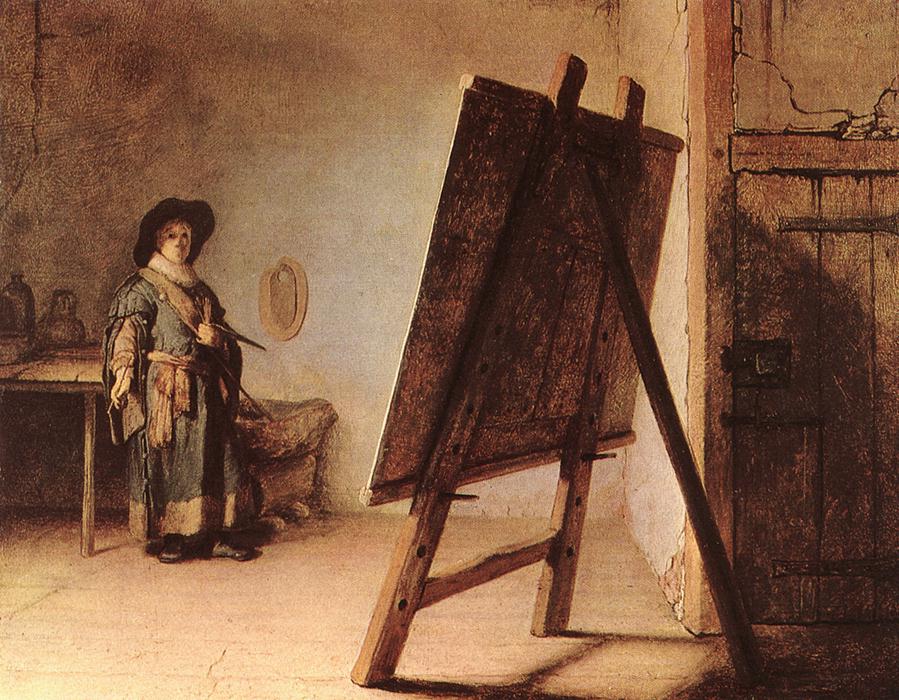
Rembrandt’s “Artist in his Studio,” painted in 1626 during his Leiden years, is a small picture with outsized resonance. The panel stages a quiet confrontation between a young painter and the instrument of his vocation. A monumental easel dominates the room like a piece of timbered architecture; behind it, near the left wall, a diminutive figure stands with brush and mahlstick poised, measuring his distance. The composition does not show the act of painting so much as the moment before commitment. It is a drama of gaze, scale, and readiness. The studio becomes a theater of concentration where the painter tests himself against the task ahead and the viewer joins him as a witness to that sober beginning.
Leiden And The Formation Of A Vision
In 1626 Rembrandt had recently returned to Leiden after studying with Pieter Lastman in Amsterdam. Lastman’s history paintings taught narrative clarity, costume, and gesture, but in Leiden Rembrandt turned inward to explore smaller rooms, single figures, and the grammar of light. The city’s scholarly atmosphere and modest interiors shaped his experiments. “Artist in his Studio” emerges from this milieu as a statement of method: art is not spectacle manufactured on a public stage; it is labor undertaken in a bare room, bound to the play of light across plain surfaces and to the artist’s judgement about when to begin.
Composition As A Negotiation With Scale
The easel occupies nearly half the picture, thrust diagonally from the lower right toward the center. Its legs plant like stilts; its board is a heavy plane, scarred and stained. The artist stands back, small against the left wall, framed by a simple table and a coil of drapery. This imbalance in scale is purposeful. The apparatus of art eclipses the artist, who seems to be measuring the distance he must cross not only physically but mentally. The diagonal of the easel creates a deep wedge that organizes the room while also blocking sight of the picture-in-progress. The viewer experiences the same frustration and anticipation as the painter: the work is hidden, potential rather than fact.
Light That Builds A World Out Of Bare Means
A single light source enters from the right, grazing the easel’s edge, warming the plaster wall, picking out the split planks of the door, and flattening into a pool on the floor. Shadows cast by the easel’s legs mark off space like sundial lines, while the artist’s figure stands partly in shadow, his face illuminated enough to make his intent legible. The light is ordinary yet theatrical, proof that a simple room can become a stage when attention is focused. This is an early demonstration of Rembrandt’s belief that light is not merely descriptive but moral and psychological, capable of assigning weight to objects and moments. The door’s rough wood and the wall’s abrasions register the history of touch and time through the way they return light.
Palette And The Humility Of Color
The painting’s color range is restricted to earthy browns, dusty creams, worn grays, and the soft blues and greens of the artist’s coat. The absence of bright accents keeps the eye attentive to texture and tone. The coat’s cooler hue separates the figure from the warm plaster, while the brown door and easel form a structural frame. A patch of pale wall behind the artist acts as a reflecting screen, gently haloing the figure without the formality of an aureole. The modest palette mirrors the modest space. This is not a gilded studio filled with showpiece props; it is a working room in which color keeps quiet so that vision and decision can speak.
The Easel As Architecture And Monument
Few paintings grant so much presence to an easel. Here it is not a neutral tool but a protagonist. Its board looms like a wall; its legs stake claims on the floor; its shadow divides the room into zones of accessibility and privacy. The oversized scale turns the easel into a monument to the task. It embodies resistance—the stubborn surface that the painter must persuade. The scuffs and stains echo a history of previous attempts, as if past images haunt the present undertaking. By monumentalizing the easel, Rembrandt dignifies the work of making art and insists on the materiality of the painter’s challenge.
The Figure And The Psychology Of Beginning
The young artist’s stance communicates preparation. He is not lunging toward the canvas; he is thinking with his body. One hand holds the mahlstick, the other a brush; his feet are planted, weight set back; his head tilts slightly as he triangulates distances. The posture belongs to the moment of assessment, when a painter decides where the next touch will land. That psychological interval—between seeing and doing—interested Rembrandt all his life. Here he isolates it and magnifies it. Viewers sense the breath before the stroke, the charged stillness in which the mind rehearses the hand’s path.
Space, Distance, And The Ethics Of Looking
The stretch of floor between painter and easel matters as much as any object. It is a field of intention. The diagonal shadows mark out steps from here to there, turning the distance into a visible problem to be solved. This space is also the viewer’s route into the picture. We are placed near the right edge, almost where the painter will soon stand. The arrangement produces a respectful etiquette of looking: we keep our distance as the artist keeps his, avoiding premature interference. Rembrandt thereby models an ethics of attention—stand back, study, move only when ready.
Doors, Walls, And The Truth Of Materials
The cracked plaster, the patched door, and the crude hinge invite the eye to read the studio as a body of work in itself. Every surface tells a story about use. The door is swollen, scored, and latched by a simple bolt. The wall shows tide lines of discoloration, holes, and a faint seam where plaster meets stone. These are not picturesque details; they authenticate the painter’s world as ordinary. By attending to the studio’s materials with the same care granted to faces and hands in other works, Rembrandt equates the dignity of labor with the dignity of subject. The studio is a tool shaped by time and effort, and painting is one of its traces.
The Invisible Picture And The Freedom Of Not Knowing
By hiding the picture on the easel, Rembrandt refuses to tell us what the artist paints. This absence liberates both painter and viewer. We are not asked to evaluate the success of an image but to inhabit the conditions of making. It also protects the sanctity of process. The unseen painting might be a grand history scene or a simple study; the logic of the room is the same. The blankness invites projection. Each viewer supplies a different imagined image, turning the panel into a generator of possibilities rather than a record of a single result.
Scale As Metaphor For Difficulty
The exaggeration of the easel’s size is not a naturalistic distortion; it is a metaphor. For a young painter, the task can feel outsized. The board becomes a cliff face to climb, the legs a scaffolding to negotiate. The man’s smallness is not belittlement but honesty about where ambition begins. Even as the figure appears dwarfed, his poise suggests capability. The picture thus holds two truths: the work is large, and the artist is equal to it. This tension animates the whole, lending the quiet scene a pulse of courage.
Time, Preparation, And The Discipline Of Delay
Painters know that much of the work happens before the brush touches ground: sharpening tools, checking proportions, mixing tones, choosing the right stance. The picture honors this prepwork. The table at left holds bottles and a bundle of cloth; shadows suggest more supplies beyond view. The coat’s sash and the strap across the chest speak of a habitual uniform, clothes that can absorb smears and survive long sessions. By fixing the moment before action, Rembrandt emphasizes that patience is a technique. The painter’s pause is as deliberate as any stroke.
The Studio As Self-Portrait Without A Face
Although the figure is not explicitly identified as Rembrandt, the painting reads as a self-portrait in the form of a room. In later years he will record his own face in a long series of self-studies; here he records his working environment and his relation to it. The cracked door could be the boundary between youthful ambition and the world; the massive easel, the obstacle and partner; the light, the judge. The panel proposes that an artist’s identity is housed less in likeness than in the arrangements of space, tools, and habits that structure his day. This oblique self-portrait is unusually candid, even humble, in how it values routine over bravura.
The Sound Of Silence And The Weight Of Air
The painting’s quiet is palpable. You can almost hear the dry rasp of the easel’s legs on the floor and the soft hiss of dust in side light. No other figures enter, no draperies ripple. The air is still, thickened by chalky light. This atmosphere carries psychological weight. Silence is not emptiness; it is the condition of focus. The young artist seems to draw concentration from the quiet the way he draws light from the window. The mood anticipates the gravity of Rembrandt’s later interiors, where silence often governs scenes of study, prayer, or decision.
Comparisons And Departures Within The Period
Other artists depicted studios as showcases of curiosity and abundance—tables piled with prints, plaster casts, musical instruments, maps, and skulls. Rembrandt’s room is bare by comparison. The restraint is not poverty of imagination but a choice that redirects attention from collection to commitment. The few props remain subordinate to the central triangle of painter, space, and easel. The picture thus departs from a bragging tradition that advertises a painter’s learning and instead argues for the primacy of looking and doing. The studio is not a cabinet of wonders; it is a workshop.
The Education Of The Eye
Everything in the room functions as a lesson in seeing. The oblique perspective of the easel tests the painter’s ability to translate angles into surface. The gradients on the wall demand sensitivity to tone. The mottled door forces attention to the difference between material textures under similar light. The long shadow cast by the easel’s leg asks the painter to calibrate darkness by distance from source. Even the floor’s divisions and stains provide a grid of measurement. The studio is therefore both subject and teacher, the place where the eye learns to weigh relationships rather than merely record outlines.
The Viewer’s Role And The Pact Of Respect
The composition positions the viewer almost where the artist will take his next step. We are invited to share his vantage and, by extension, his discipline. The painting makes a pact with us: stay back now, look carefully, respect the threshold. Later, when the work is ready, we may approach. This etiquette binds the viewer to the maker in a relationship of mutual regard. It is an unusual kind of narrative—no event occurs, yet a code of behavior is established. The picture teaches how to be present at the creation of art without polluting it with haste.
A Philosophy Of Making Encoded In Wood And Plaster
The panel can be read as a manifesto in plain language. The cracked door says that thresholds are real and need maintenance. The heavy board says that surfaces resist and hold memory. The long diagonal says that approach is angled rather than straight-on. The quiet light says that revelation is gradual. The small figure says that the self must be right-sized to the task—not small in worth, but proportioned to reality. Together these mute elements form a philosophy of making that Rembrandt will enact for decades: seriousness without pomposity, patience without paralysis, craft without vanity.
Anticipations Of The Mature Master
Seeds of the later Rembrandt abound. There is the way light sculpts a story without the help of emblem or inscription. There is the deep respect for workaday objects—the door, the table, the easel—as carriers of truth. There is the interest in people thinking rather than merely acting. There is, finally, the courage to let emptiness play a leading role. In later self-portraits he will hold our gaze with minimal props and maximal candor; in biblical scenes he will slow climaxes to the tempo of moral reflection. This small studio picture foreshadows such quiet authority.
Why This Modest Panel Endures
The painting endures because it captures a universal threshold: the moment before one begins a serious task. Whether the viewer is a painter, writer, carpenter, or student, the image recognizes the gulp of attention, the sizing-up of tools, the respectful distance, the first step forward. Its honesty about difficulty is bracing, and its confidence in method is consoling. The room contains no audience and no applause; the work will justify itself through care. In an age that often celebrates results over process, this seventeenth-century panel offers a corrective. It honors the invisible labor that precedes visible achievements.