Image source: wikiart.org
Introduction
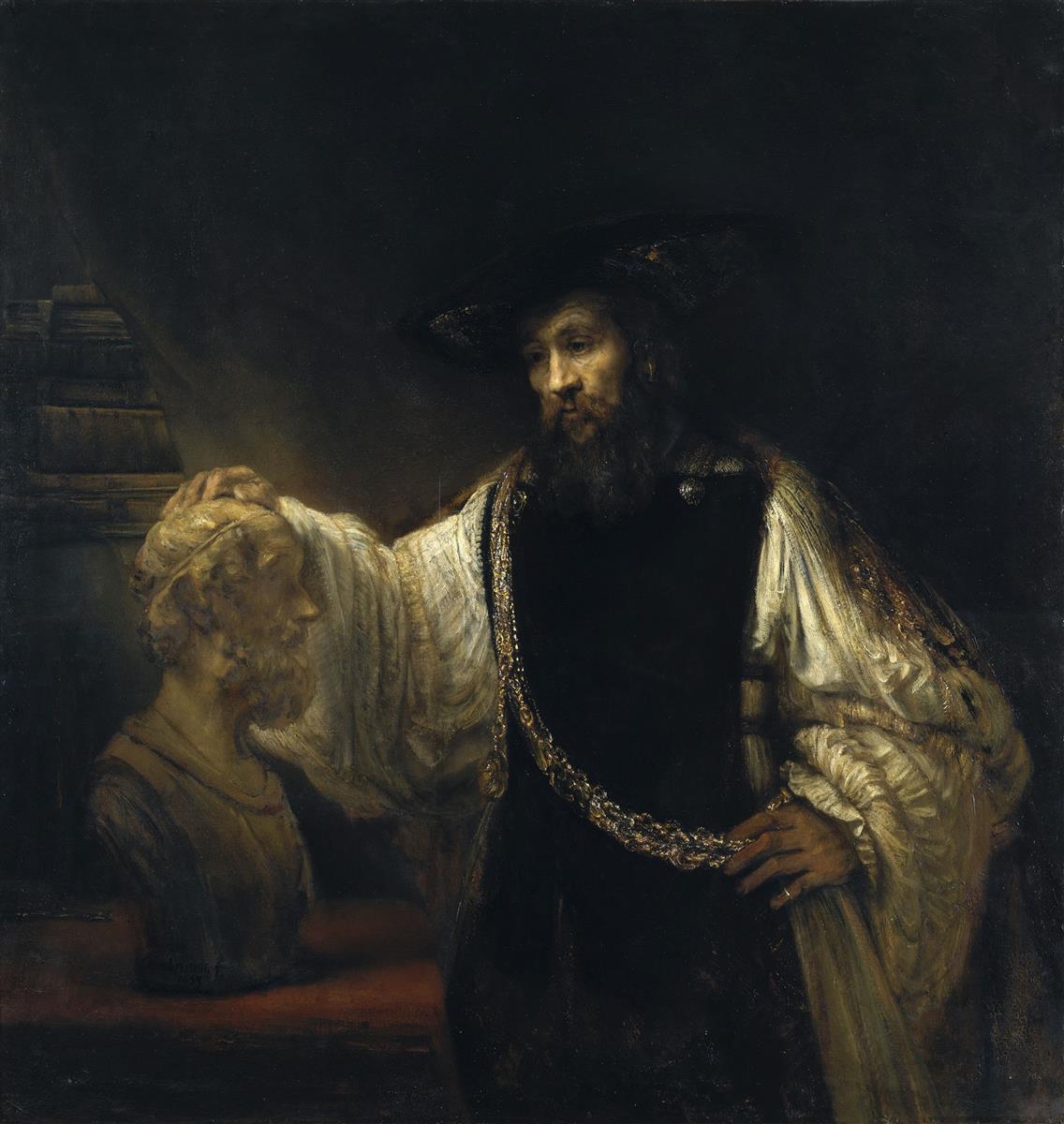
Rembrandt’s “Aristotle with a Bust of Homer” (1653) is one of the most searching meditations on knowledge, fame, and memory ever painted. A single figure looms from a brown, resonant darkness: the philosopher Aristotle, dressed in sumptuous black with swollen, light-struck sleeves and a massive gold chain that drapes across his chest. His right hand rests on the head of a stone bust—Homer, the blind poet whose verses underwrote Western imagination—while his left hand anchors his own body at the hip, as if to steady a thought that grows heavy. The scene is hushed, almost nocturnal; the light pools on silk, skin, metal, and marble, and then dies away into a deep silence. The picture is not about allegory staged for spectators. It is about one mind in conversation with another across centuries, the living flesh attending to a dead yet inexhaustible voice.
The Dramatic Triangle Of Mind, Matter, And Light
Rembrandt constructs the composition around a triangle that never announces itself and yet governs everything. One point is the bust of Homer, low and left, a compact mass of stone that catches light along nose, brow, and beard. The second point is Aristotle’s illuminated right sleeve and hand, the bridge between stone and man. The third point is the philosopher’s face under the shadow of his wide-brimmed hat. These three points triangulate the painting’s meaning: past achievement embodied in art, present attention embodied in touch, and living judgment embodied in a face that thinks. The background’s dark breadth is not emptiness; it is the interval across which memory travels.
Gesture As Philosophy
Unlike many history paintings, the message here is not carried by emblems or text but by a gesture. Aristotle does not point or declaim. He rests his palm on the crown of Homer like a blessing or a benediction, testing the cold authority of the past with the warmth of his hand. The contact is affectionate and interrogative, both loyalty and appraisal. Meanwhile the left hand, bearing a signet ring, grips his hip in a posture that reads as steadiness, even resistance. The philosopher is neither submissive to tradition nor rebellious against it; he is responsible for it. Rembrandt turns action into ethics, and ethics into portraiture.
The Chain Of Gold And The Weight Of Reward
The luminous chain, heavy and ornate, is painted with an almost sculptural relish. Every link swells and falls into shadow, an object of wealth earned or bestowed. Traditionally it is associated with Aristotle’s service in the court of Alexander the Great, a worldly reward for wisdom. Rembrandt sets the chain’s shine against the mute marble of Homer and the inwardness of the philosopher’s gaze. The question forms by itself: which honors matter—the prince’s metal or the poet’s memory? The chain, for all its dazzle, drags slightly on the dark garment, as if responsibility and reward share the same gravity. The painting refuses a simple answer and lets the philosopher think through the problem with his hand.
Chiaroscuro As Moral Atmosphere
Light in this painting is not a flood but a visiting intelligence. It seeks out the zones of significance—the hand on stone, the thoughtful face, the extravagant sleeve that testifies to status, the chain that testifies to patronage—and leaves the rest in a dignified obscurity. This chiaroscuro is Rembrandt’s language for moral depth. Darkness does not conceal a secret plot; it protects the privacy of a moment in which thought occurs. The viewer is granted exactly enough illumination to participate in the meditation and no more. The sense of air within the shadow is palpable, a soft pressure that helps us feel the room around the figures without distracting furniture or architecture.
Costume, Surface, And The Theater Of Touch
Aristotle’s costume is more than period dress. It is texture made eloquent. The sleeves billow with passages of thickly loaded paint, dragged and scumbled so that folds break under light like water over rocks. The black body garment swallows reflection, a velvety well that deepens the picture’s center. The hat is a dark corona that frames the head with an aperture of shadow. Against these fabrics the hard surfaces—the polished links of the chain and the stony, pitted cheek of Homer—stand out and invite comparison. Rembrandt’s brush makes thought tactile. You can feel the difference between a worldly gift, a carved inheritance, and a living mind that must weigh both.
Aristotle’s Face And The Psychology Of Attention
The face is the canvas’s intellectual engine. Aristotle’s gaze slides down and slightly away toward Homer, but not submissively; it is a gaze that measures, remembers, and decides. The mouth is soft, corners not set for pronouncement but relaxed toward meditation. The beard falls in shadow, a quiet conduit between thought and chest. Rembrandt never reduces expression to an emblem. The philosopher is not “thinking” in capital letters; he is simply caught at the moment when the past, the present, and the self arrive at a provisional arrangement. That near-speechless authority is why the picture continues to persuade.
Homer’s Bust As A Source Of Light And History
Homer, though stone, appears lively because he is given the picture’s warmest light. Highlights tick the brow and nose, and quick, staccato strokes energize the curls of beard. The bust is smaller than life but heavy from thought; it seems to radiate its own history, as if the poems themselves polished the marble. Rembrandt is too honest to make the ancient poet into a sentimental relic. The surface is worn, even rough in places. The past, in this vision, is not a smooth ideal; it is a weathered fact. The philosopher’s hand bridges the weathered and the living, the durable and the questioning.
A Room Without Props And The Discipline Of Restraint
Rembrandt strips the environment to essentials: a ledge, a few indistinct stacked volumes, and a darkness that functions as both space and silence. This restraint converts the picture from a lecture to a meditation. There is no window, no curtain, no distant view of Athens or Amsterdam, no classical column to flatter the eye. What matters is here and now, between the three actors of mind, stone, and light. The humility of the setting flatters neither the sitter nor the viewer; it honors the work of thinking.
The Painter’s Own Dialogue With Antiquity
It is impossible not to sense Rembrandt’s self-portrait by analogy. A painter midway through his career, working in Amsterdam with debts mounting and fashions shifting, paints an image of a man appointed to weigh fame, fortune, and the claims of the past. The connection is not biographical gossip; it is structural. The act of painting a living philosopher touching a dead poet is itself a dialogue between contemporary craft and classical authority. Rembrandt did not copy antiquity; he handled it. He placed his brush where Aristotle placed his hand, and by doing so claimed a share in the conversation.
The Scale Of Intimacy And The Viewer’s Role
Though the figure is nearly life-size, the painting feels private. The darkness closes ranks around us; we stand close enough to hear the brush whisper on the swollen sleeve. The scale grants the viewer the role of quiet witness. We are not asked to adjudicate the debate between poetry and power; we are asked to keep company with someone who must. The painting teaches a mode of looking that is not evaluative but companionable, a way of sharing space with thought.
Color As Breath
The palette, limited and warm, moves in browns, deep blacks, ochres, and soft whites warmed by amber glazes. The chain’s gilded notes puncture the quiet with soft suns. The bust’s pale stone leans toward honey rather than cold gray. Within these harmonies Rembrandt modulates temperature with extraordinary sensitivity: a vein of cooler tone around the eye, a faintly rosier note in the knuckles, a toasty sheen on the sleeve’s crest. The coherence of color contributes to the sense that everything in the room shares the same air.
The Slow Architecture Of Paint
Rembrandt built the surface over time, and that duration stays visible. Impasto stands on the highlight ridges of silk. Thin glazes pool in the dark, allowing previous layers to tint the present like memory tinting perception. On the chain a quick, loaded stroke describes an entire link; on the marble a scuffed brush suggests age in a fraction of a second. This chronicle of making parallels the subject: just as Aristotle considers what the past means for the present, the painting shows how earlier layers inform what we see now.
The Ethics Of Fame And The Question Of Value
The painting’s fame often centers on a single question: which deserves more honor, the glitter of patronage or the endurance of poetry? Rembrandt complicates the dilemma by making both gifts—chain and bust—converge in the philosopher’s present responsibility. The chain, for all its glitter, depends on a wearer to mean anything; the bust, for all its authority, needs a living hand to awaken it. Value, in this vision, occurs not in objects or names alone but in the intelligent regard that holds them together. The philosopher’s palm is the painting’s conscience.
Books In Shadow And The Continuum Of Learning
Behind Aristotle’s arm a few volumes stack into half-light. Their titles are unreadable, their bindings worn. It is tempting to call them Aristotle’s, but Rembrandt seems to resist pinning labels. These are books in the abstract—tools of a life, repositories of other people’s voices, weighted forms that crowd the edges of a working mind. Their presence confirms that the painting is not about singular genius isolated from the world but about the relay of learning across hands and generations.
The Hat As A Dark Halo
The wide, flat hat throws the upper face into soft shadow and works like a secular halo, isolating thought and giving the head an architectural canopy. It also brings a practical grace note: the hat’s darkness suppresses upward glare, deepening the philosopher’s inwardness. Rembrandt takes an ordinary accessory and turns it into a device for concentrating light on critical planes of the face, while leaving the hat itself a calligraphic silhouette.
Silence, Sound, And The Body’s Poise
Look long enough and the picture acquires sound: the faint rasp of chain on cloth, the soft thud of a resting palm on stone, the hush of a robe settling into stillness. Aristotle’s posture is deliberately slow; weight rests slightly on the left leg, the right elbow angles out, the shoulders slope into a tranquil curve. Thought here is not a fever; it is a bodily condition maintained by balance and calm. Rembrandt’s affection for this poise is palpable, and it transfers to the viewer, who unconsciously adjusts their own breathing to the painting’s tempo.
Close Looking At Key Passages
The chain where it crosses the breast is a masterclass in abbreviated description: a handful of thick, glinting strokes do the work of dozens, each link modeled by a highlight and a swallow of shadow. The sleeve’s brightest ridge is not white but a warm, creamy mixture that catches the room’s light rather than inventing its own. The knuckles of the resting hand are simple planes, yet the tiniest pinkish note at a joint turns anatomy into life. Homer’s beard is made of broken, square-ended touches that let the underlayer show, a technique that simulates the rough scatter of carved stone. The area around Aristotle’s eye is a network of minute tonal shifts that yields sympathy rather than glare. In each passage Rembrandt trusts the viewer to complete the form—a generosity that pulls us into participation.
Why The Painting Still Speaks
In an age crowded with information and honors, the painting’s question has not dimmed. What is worth touching, what is worth wearing, and how should one look at the past while standing in the present? The picture’s answer is a posture rather than a slogan: touch the inheritance with respect, weigh worldly gifts without surrender, keep the face open to thought, and let light find you where meaning gathers. The image survives not because it solves a philosophical dilemma but because it gives the body a way to inhabit it.
Conclusion
“Aristotle with a Bust of Homer” is Rembrandt’s quiet epic about wisdom. The drama flows through skin, metal, fabric, and stone; the plot is a palm meeting a brow; the resolution is a face that continues to think after paint has dried. In its generous darkness and exact light the painting grants the viewer a share in a conversation that began before Aristotle and will continue after us. It renders the past palpable without making it tyrannical and treats honor as a weight to be rightly carried. Few paintings allow looking to feel so much like understanding.