Image source: wikiart.org
Introduction
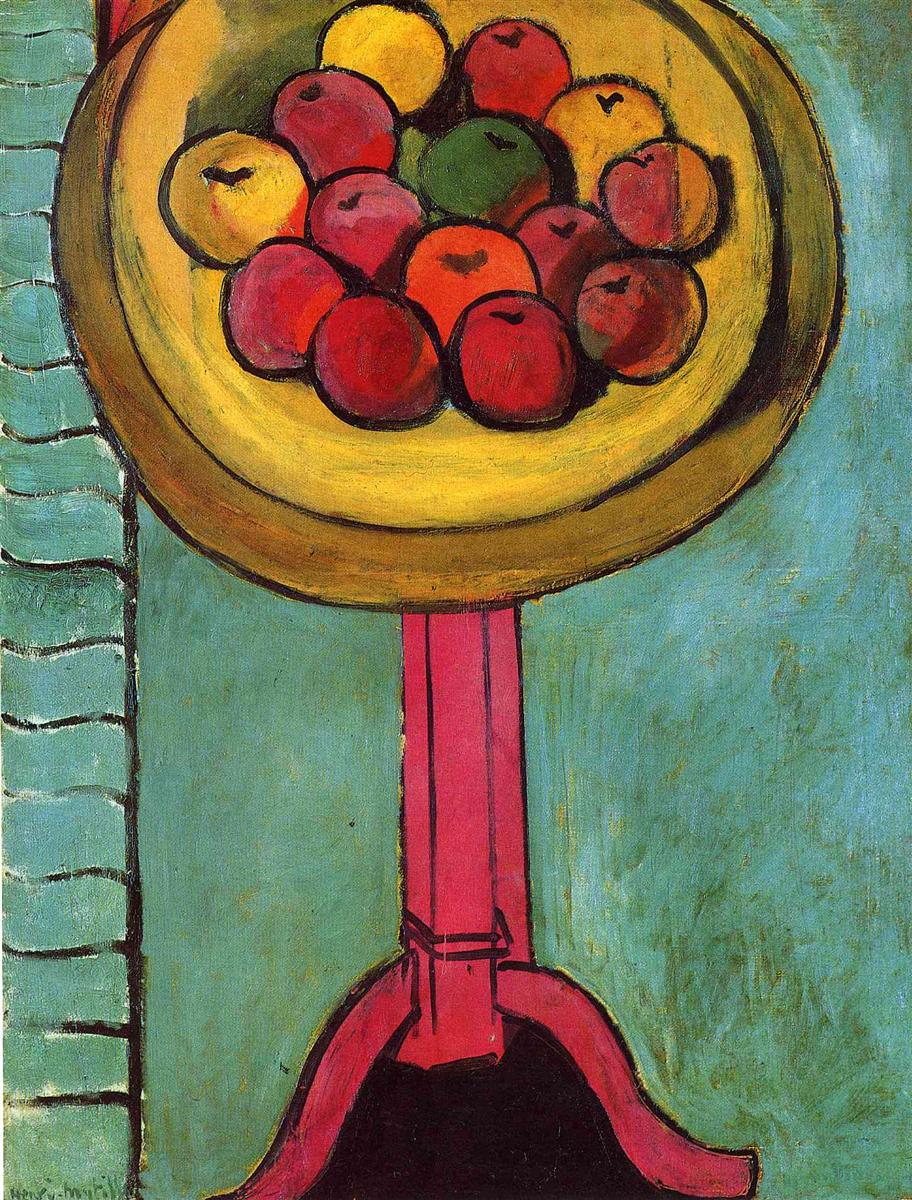
Henri Matisse’s “Apples on a Table, Green Background” (1916) is a brilliant demonstration of how a familiar still-life motif can become a complete visual architecture. A bowl brimming with fruit sits atop a tall pedestal table; the dish glows golden, the pedestal flares in hot pink, and the surrounding field is a velvety, mineral green. Thick, confident contours hold each shape in place, while the apples—red, orange, yellow, and a single green—gather like a chromatic chorus. The composition is both playful and monumental. Matisse pares away descriptive clutter so the painting can speak in clear relations: circle against column, warm fruit against cool ground, black line against radiant color. The result is a late-wartime image of measure and joy.
Historical Context
Painted in 1916, this canvas belongs to Matisse’s disciplined period from 1914 to 1917. After the blaze of Fauvism and the exotic intensities of his Moroccan journeys, he tightened his language to essentials—large planes, decisive drawing, restrained palettes, and a studio world where windows, tables, fruit, textiles, and simplified figures could be recomposed as living geometry. The war heightened his search for order and poise. “Apples on a Table, Green Background” sits alongside works such as “Apples,” “Still Life with Nutcracker,” and the two versions of “Sculpture and Vase of Ivy,” all of which test how still-life elements can carry the weight of structure, rhythm, and feeling. Here he chooses a compact, totemic setup and pushes color to the fore.
First Impressions
From across the room the painting resolves into three large chords: the golden circle of the dish, the fuchsia column of the pedestal, and the sea-green field that surrounds them. A narrow vertical band at left—striped and wavering—acts like a tiled wall or curtain edge, adding a syncopated counter-rhythm. Within the dish, the apples form a tight bouquet of spheres whose highlights are reduced to dark dimples and quick flashes of light. Despite the simplicity, the scene feels full: fruit press together, the dish almost spills the frame, and the pedestal swells at the base like a rooted trunk. The immediate effect is of buoyant abundance anchored by a strong architectural spine.
Composition and Viewpoint
Matisse chooses a high vantage point that looks slightly down into the dish yet still reads the pedestal’s front plane head-on. This hybrid vantage compresses space and lets the dish become a framed arena for color. The bowl is positioned in the upper half of the canvas rather than centered; that displacement increases the pedestal’s role as a visual column. The flare of the pedestal’s base lands near the bottom edge, where it meets a shadowy notch, stabilizing the whole. The narrow band at left keeps the composition from becoming too bilateral; its wavering wiggle line counters the heavy circular mass and introduces a conversational asymmetry.
The Circle as Generator
The golden dish behaves as the picture’s generator. Concentric rings of ocher, yellow, and cream, laid with broad, curving brushstrokes, pull the gaze inward and outward at once. A dark, calligraphic contour around the rim acts like a key signature: it sets the pitch and holds the movement. Inside, the apples are not scattered; they’re marshaled into a close-packed ring whose outer edge mirrors the dish’s rim. The device is old—circle within circle—but Matisse enlivens it by varying spacing, size, and color so the ring never closes mechanically. The circle here is a pulse, not a wheel.
Color Architecture
Color is the ruling principle. The background is a saturated, slightly granular green that sits between malachite and oxidized copper. This field is cool, steady, and matte, chosen to let the dish and pedestal blaze without shouting. The dish itself is a sun of yellows: lemon, straw, and honey, with exposed flashes of undercolor that keep the surface breathing. The pedestal’s shocking pink, tempered by touches of carmine and violet shadows, introduces a hot counterpoint that pushes the green toward depth and keeps the yellows lively. Within the bowl, Matisse deploys a rich fruit scale—crimson, brick, coral, orange, apricot, butter yellow, and a single deep green apple nestled at the center like a tonal anchor. The orchestration is precise: complements and near-complements flirt across small intervals so the surface vibrates.
The Role of the Green Background
The title singles out the “Green Background,” which is not mere backdrop but the painting’s climate. Green cools the heat of the pedestal and dish, expands space without perspective, and links to the natural world of orchards without describing a setting. Its slight variations—thinly brushed passages beside denser ones, darker seams near the edges—keep the field from dead flatness. Against this green, red and orange apples pop, yellow ones glow softly, and the single central green apple becomes a harmonic pivot rather than a camouflaged spot. The background’s power lies in its neutrality that is not neutral; it is color as atmosphere.
Apples as Chromatic Chorus
Matisse paints each apple as a compact, saturated sphere with just enough modeling to read volume. Dark dimples and short, curved strokes substitute for naturalistic detail. The apples do more than represent food; they operate as units of hue and weight. The reds carry the melody, the oranges add bridge tones, the yellows open light within the cluster, and the central green lowers the key so the ensemble does not become shrill. Close looking reveals small temperature shifts within a single fruit—cooler red on one side, a warmer glint on the other—that keep them from feeling stamped. Their packed arrangement creates pressure, a gentle convex bulge that presses against the dish’s inner wall and animates the circular composition.
The Pink Pedestal as Structural Spine
The pedestal is more than support; it is the painting’s spine and a crucial color statement. Composed of a tall central shaft with bevels and a flaring base, it reads like carpentry reduced to its essentials. The black outline thickens at corners as if to underline joints; a darker interior band suggests an inset panel. This structure makes the vessel and fruit feel elevated, ceremonial even, without becoming fussy. Its hot pink hue ventures beyond local color into expressive necessity. It anchors the warm range and keeps the painting from being top-heavy. By echoing the reds of the apples and the magenta undertones of the dish’s shadows, it ties the whole ensemble together.
Contour and Drawing
The black contour—elastic, emphatic, never pedantic—is Matisse’s grammar. It encircles the dish in a bold ring, firms up the apples with quick loops, articulates the pedestal with straightened strokes, and draws the left-hand band as an undulating chain. Edges occasionally sit slightly off the color fields, leaving haloes of underpaint that make the line shimmer. The variety of the contour’s pressure assigns character to materials: taut around ceramic, playful around fruit, carpenterly along the pedestal. This is drawing that sculpts without shading.
Brushwork and Surface
The painting remains tactile. In the dish’s yellow rings, brushstrokes follow the ellipse and leave ridges that catch real light; the effect is of gleam without illusionism. The apples are laid in with curved patches and then adjusted with dry strokes that introduce bloom and slight bruising. The pedestal’s pink is flatter, brushed down the length to emphasize verticality, with darker glazes in the recesses. The green background is scumbled and patchy, allowing small tonal variations to create quiet movement. Everywhere the hand is visible, a record of decisions rather than a polished finish.
Light and Value
Rather than representing a single light source, Matisse distributes value to serve structure. The highest values gleam along the dish’s inner ring and in tiny highlights on certain apples; the lowest values are held by the black contours and the pedestal’s shadowed base. The value spread is modest—no blinding whites, few deep blacks—so color can do the expressive work. This measured range keeps the painting legible from a distance and cohesive at close range.
Spatial Compression
Depth is intentionally shallow. The tabletop is absent; the dish seems to rest on air. Perspective appears only in the beveled facets of the pedestal and the slight tilt of the bowl. Overlap does the rest: apples in front of apples, bowl in front of background, pedestal in front of everything. The compression concentrates attention on shape relations and color intervals rather than on a realistic room. The faint, tiled band at left hints at an environment but refuses to open deep space, keeping the painting rooted on the plane.
Rhythm and Movement
Although nothing moves, the painting is rhythmic. The eye circles the dish along the black rim, dips into the cluster of fruit, and slides down the pink column to rest in the dark scallop at the base. It then climbs the green field, catches on the wavering left band, and returns to the glowing dish. This path stays fresh because Matisse inserts micro-accents: a two-toned apple, a heart-shaped highlight, a slightly flattened fruit that slows the ring, an asymmetry at the pedestal’s base that prompts a pause. Rhythm is built from these small deviations within order.
Symbolic Resonances
Matisse did not construct allegories, yet his objects carry meanings that grow from their treatment. The pedestal elevates everyday fruit into a kind of domestic offering. The green ground whispers of orchards and gardens without illustration. The color harmonies suggest an ethic: warmth and coolness, exuberance and calm, held in balance. In 1916, that balance might have felt like a wish as much as an observation. The painting meets anxiety with order but refuses austerity; it keeps pleasure in the picture.
Dialogues with Tradition
The bowl of fruit is a classic still-life subject from Caravaggio to Cézanne. Matisse acknowledges that lineage but bends it to his purposes. He keeps Cézanne’s insistence on formal construction—spheres and ellipses—but replaces the older painter’s patchwork geometry with planes of color locked by line. Where a Baroque still life might dazzle with reflective detail, Matisse lets a single black rim and a field of green carry the drama. Tradition supplies the motif; modernity supplies the method.
Evidence of Process
Traces of revision remain visible and enliven the picture. On the dish’s right edge, a faint echo of an earlier contour widens the rim just slightly. A red apple near the bottom shows a halo of dark underpaint, suggesting it was nudged to balance the cluster. The pink pedestal reveals pencil-straight underdrawing in places where the brush veered. These pentimenti are not corrected out; they keep the canvas human and prove that the final clarity was reached through testing.
Comparisons within the 1916 Series
Seen beside the related “Apples” of 1916, which stages a nearly top-down view on a dark-and-gold field, this work shifts the climate dramatically. The green surround opens the space and cools the high-keyed dish, while the pink pedestal injects architectural presence absent from the other version. Compared to “Still Life with Nutcracker” or “The Green Pumpkin,” this painting is more emblematic, less descriptive. It is a sign-like still life whose power lies in the precision of its planes.
How to Look
Begin by letting the green ground fill your peripheral vision. Feel how the golden dish floats against it. Move into the ring of apples and register the succession of temperatures—crimson to orange to yellow to the solitary green. Let the black rim carry you around and then drop to the pedestal, noticing the slight bevels that make the column stand. Step close to watch bristles trace the dish’s ellipse and to see the dry strokes on fruit that enliven their surfaces. Step back again so the painting snaps into its bold three-part chord of green, gold, and pink. The work rewards this pendulum between near and far.
Legacy and Relevance
“Apples on a Table, Green Background” continues to speak to artists, designers, and viewers because it demonstrates how much can be achieved with few means. It shows that color temperature can define space more persuasively than perspective, that contour can confer character without literal detail, and that a single large form—here, the bowl—can organize an entire composition. For anyone searching for clarity without chill, the canvas offers a model: reduce, tune, and let relations do the expressive work.
Conclusion
This painting distills Matisse’s wartime grammar into a compact, luminous statement. A golden dish, a pink column, a green field, and a chorus of apples are enough to create a world that feels both ceremonial and intimate. The pleasure it gives is not a matter of ornament but of calibrated relations—circle to column, warm to cool, bright to dark—held in a poised equilibrium. More than a century later, the fruit still glows, the pedestal still stands, and the green air around them still feels fresh.