Image source: wikiart.org
Introduction to Apparition of Jesus Child to St Anthony of Padua
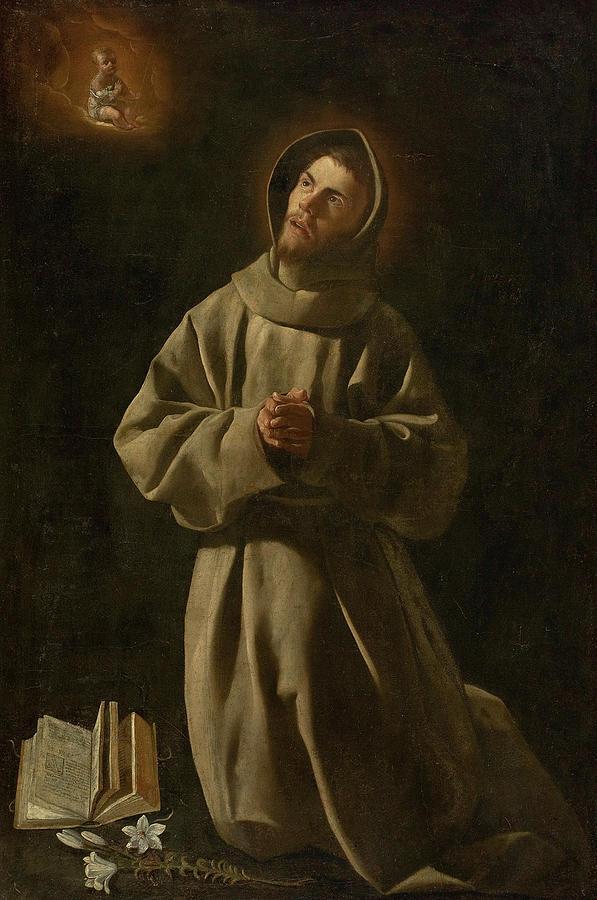
“Apparition of Jesus Child to St Anthony of Padua,” painted by Francisco de Zurbaran around 1630, is a contemplative vision in oil. The work shows the Franciscan saint kneeling in prayer, hands clasped and eyes lifted toward a glowing vision of the Christ Child that appears in the dark upper corner of the canvas. At St Anthony’s feet lie an open book, a lily, and a few sprigs of greenery, simple objects that acquire profound meaning in the quiet space of the painting.
Zurbaran is celebrated for his ability to combine intense spiritual feeling with stark, almost sculptural realism. In this painting he distills a famous episode from the life of St Anthony into a direct encounter between the praying friar and the radiant Child. There is no crowd, no architectural setting, and almost no landscape. Instead, the drama unfolds in an undefined darkness, as if the saint has stepped out of ordinary space and into a realm of pure contemplation. The result is a focused, intimate image that draws the viewer into the saint’s ecstatic gaze.
Historical and Religious Context
St Anthony of Padua, a Portuguese Franciscan who lived in the early thirteenth century, was one of the most beloved saints in Catholic Europe. Known as a powerful preacher, a defender of orthodoxy, and a worker of miracles, he was canonized shortly after his death. Over time many legends grew around him, one of the most charming being the story that the Christ Child appeared to him while he was reading Scripture. Artists in Italy, Spain, and beyond adopted this tale as a subject, showing Anthony kneeling before the Child or holding him lovingly in his arms.
Zurbaran’s painting belongs to the world of early seventeenth century Spain, a culture deeply shaped by the Counter Reformation. Religious art was expected to be clear, devout, and emotionally engaging. The story of Anthony’s vision offered an ideal opportunity to present the intimacy of mystical experience in a way that ordinary believers could understand. By showing Anthony alone with the Child, Zurbaran gives viewers a model of personal relationship with Christ, rooted in prayer, Scripture, and humble purity.
This subject also resonated with the Franciscan order, which emphasized poverty, simplicity, and heartfelt devotion. St Anthony appears in the brown habit characteristic of the order, with its ample folds and simple rope belt. The plainness of his clothing contrasts with the luminous Christ Child, reminding viewers that the wonder of divine grace can touch even the humblest of lives.
Composition and Space
Zurbaran organizes the composition around a diagonal movement that connects earth and heaven. St Anthony occupies the lower right portion of the canvas, kneeling in profile yet turned slightly toward the viewer. His gaze moves upward toward the left, where the Child appears within a small cloud of golden light. This diagonal line from Anthony’s clasped hands through his face and on toward the Child sets the visual rhythm of the painting.
The background is a deep, nearly impenetrable darkness. There are no architectural boundaries or landscape elements to define the scene. Instead, the saint and the vision seem to float in a spiritual space. This emptiness heightens the supernatural aspect of the event, as if everything worldly has faded away in the intensity of Anthony’s contemplation. The ground is barely indicated, just enough to support a few objects and to show that the saint is truly kneeling.
The simplicity of the setting allows the viewer’s eye to rest on the main elements without distraction. St Anthony occupies the majority of the canvas, his large habit creating powerful volumes of light and shade. The glowing apparition of the Child, although small, dominates the upper left by virtue of its brightness. The open book and lily at the bottom left balance the composition and act as visual stepping stones that lead toward the saint’s face.
The Figure of St Anthony
Zurbaran’s depiction of St Anthony is deeply human yet suffused with spiritual intensity. The saint kneels with his hands clasped tightly in front of his chest, fingers interlocked in a gesture of fervent prayer. His head tilts upward, and his eyes, wide and luminous, are fixed on the vision of the Child. The expression on his face brings together awe, tenderness, and a slight sense of surprise, as if he is overwhelmed by the grace suddenly granted to him.
The artist’s skillful use of light brings out the structure of Anthony’s face. A soft glow falls across his forehead, nose, and cheek, revealing a young but thoughtful countenance. Slight shadows under the eyes and around the mouth suggest a life of fasting and study. The saint’s beard is short and well kept, and his hair appears tousled within the hood of his habit, reinforcing the sense of authenticity and everyday humanity.
The habit itself is a major visual element. Its coarse brown fabric is rendered in broad, weighty folds that suggest both the body beneath and the rough texture of the cloth. Zurbaran delights in describing the way the light grazes the edges of the folds while leaving large areas in deep shadow. This treatment turns the garment into a kind of sculpted envelope around Anthony’s figure, emphasizing his kneeling posture and his humble identity as a friar. The simple rope belt, tied at the side, completes the image of Franciscan poverty.
The Vision of the Christ Child
In the upper left corner of the painting, Zurbaran depicts the Christ Child seated on a small cloud, bathed in warm light. Despite its limited size, this apparition becomes the spiritual center of the composition. The Child appears slightly turned toward Anthony, legs folded and one arm reaching outward in a gentle gesture. His small figure is wrapped in a light garment, but his upper torso and face are illuminated, revealing softness and serenity.
The glow surrounding the Child contrasts sharply with the darkness of the background. It functions as both halo and heavenly cloud, signifying that this is not a child of earth but the divine Son. Yet Zurbaran avoids flamboyant effects. The light is warm and gentle, not blinding. The Child is tender and approachable, not distant. This reflects the Catholic emphasis on the humanity of Christ, especially in relation to saints who seek an intimate, loving connection with him.
Anthony’s gaze is directed squarely at this apparition, and the line of sight is so strong that the viewer instinctively follows it. The distance between the saint and the Child is important. Unlike other depictions where Anthony physically holds the Child, here the relationship is entirely spiritual. It is a vision seen in prayer rather than a bodily embrace. This choice underscores the contemplative nature of the encounter and emphasizes the power of interior devotion.
Light, Shadow, and Color
The painting is a masterclass in the use of chiaroscuro, the contrast of light and shadow. The dark background envelops the scene, making the illuminated figures appear almost carved out of darkness. This technique, associated with the broader Baroque movement, allows Zurbaran to focus attention on the key elements and to heighten the sense of mystery.
The main light source seems to come from the direction of the apparition, bathing St Anthony’s face and upper body with a subtle glow. This suggests that the light of Christ is literally shining upon him, a visual metaphor for spiritual illumination. The folds of the habit catch this light in a variety of ways. Broad, softly lit areas flow into deep shadows, giving the garment a powerful three dimensional presence.
Color plays a restrained but significant role. The predominant tone of the habit is a muted brown, almost gray in some shadows, which emphasizes Franciscan humility. Against this neutral field, the warm flesh tones of face and hands stand out. The Christ Child is enveloped in warmer golden and rosy hues that differentiate his heavenly light from the cooler earthbound tones below.
At the bottom of the painting, the open book and lily add touches of pale cream and white. These lighter colors echo the brightness of the apparition and prevent the lower part of the canvas from sinking entirely into shadow. Together, the color choices create a harmonious, meditative palette that supports the spiritual character of the scene.
Symbolism of the Book, Lily, and Kneeling Posture
Although the composition is simple, each object carries symbolic meaning. The open book near St Anthony’s knees is most likely a Bible or a volume of theological writings. It implies that the vision of the Child comes in response to his meditative reading. The saint is presented as a man of study whose intellectual engagement with Scripture blossoms into mystical experience. The book also represents the Church’s teaching and the continuity of faith across generations.
The lily lying beside the book is a traditional symbol of purity and virtue. In the iconography of St Anthony it often stands for his chaste life and his dedication to God. The flower’s bright whiteness in the painting contrasts with the earthier tones around it, emphasizing its association with spiritual brightness and moral integrity. The combination of book and lily suggests that true holiness involves both doctrinal truth and a heart purified by grace.
The kneeling posture of St Anthony is itself a symbol. Kneeling expresses humility, submission, and adoration. In this painting, the saint’s entire body participates in the act of worship. His bent knees, clasped hands, and upward tilted head form a continuous movement of prayer. The posture reminds viewers that encounters with the divine are not casual affairs but demand reverence and surrender. In a devotional context, this encouragement to imitate the posture of the saint would have been very powerful.
Emotional Tone and Spiritual Atmosphere
The overall mood of the painting is quiet, intense, and deeply interior. There is no dramatic crowd, no swirling drapery, no theatrical gesture. Instead, the entire emotional energy is concentrated in the gaze that passes between St Anthony and the Christ Child. This focus creates a meditative atmosphere in which the viewer almost feels like an intruder on a private moment of prayer.
At the same time, the painting does not feel cold or distant. The softness of the light, the tenderness of the Child’s pose, and the gentle, slightly parted lips of the saint convey warmth and affection. St Anthony’s expression is a blend of amazement and love. He does not appear terrified or overwhelmed. Instead, he seems caught in a deep, joyful astonishment that something so holy would draw near to him.
The dark background amplifies the sense of silence. There is nothing to indicate time of day or specific location. We do not know whether Anthony is in a cell, a chapel, or a remote landscape. This deliberate vagueness suggests that the true setting is the inner chamber of the soul. The painting thus invites the viewer to consider that such visions are not limited to particular places but can occur wherever a heart is open in prayer.
Zurbaran and the Language of Spanish Baroque Devotion
This work exemplifies Francisco de Zurbaran’s contribution to Spanish Baroque painting. He specialized in religious themes that combined strong realism with intense spiritual focus. Many of his canvases feature solitary saints, monks, and martyrs presented against dark backgrounds. He often depicted them in moments of prayer or mystical experience, emphasizing personal devotion rather than narrative action.
In “Apparition of Jesus Child to St Anthony of Padua,” Zurbaran uses this approach to great effect. The plainness of the habit, the solidity of the kneeling pose, and the carefully rendered book and lily all reflect his commitment to truthful observation. At the same time, the apparition of the Child and the glow around the saint’s head show his ability to suggest supernatural light without resorting to overly decorative effects.
Within the context of Counter Reformation Spain, such images played an important role in encouraging interior piety. They provided viewers with models of how to pray, how to read Scripture, and how to cultivate a direct relationship with Christ. The clarity and restraint of Zurbaran’s style suited these aims perfectly, ensuring that the viewer’s attention was drawn to the spiritual message rather than distracted by worldly detail.
Legacy and Contemporary Relevance
For modern viewers, “Apparition of Jesus Child to St Anthony of Padua” offers more than a glimpse into seventeenth century devotion. It speaks to universal themes of longing, faith, and the desire for encounter with the divine. Even those who approach the painting from a secular perspective can appreciate the intensity of concentration and the emotional honesty in St Anthony’s face.
The painting also provides insight into how art can make invisible experiences visible. Mystical visions, by their nature, lie beyond ordinary perception. Yet through careful composition, expressive gesture, and the play of light and shadow, Zurbaran gives shape to something that would otherwise remain interior. In doing so, he shows how painting can act as a bridge between the inner life of the believer and the shared world of visual culture.
In museums or reproductions today, this canvas continues to communicate a sense of stillness and reverent wonder. Surrounded by modern noise and distraction, the kneeling figure of St Anthony invites viewers to pause, to look upward, and to imagine what it might mean to be addressed personally by a loving presence. The painting’s enduring appeal lies in this invitation to contemplation, a call that transcends time and place.
Conclusion A Vision of Humble Encounter
“Apparition of Jesus Child to St Anthony of Padua” stands as a luminous testament to Francisco de Zurbaran’s ability to capture the essence of spiritual experience in paint. Through a restrained composition and a limited set of elements, he creates a scene of profound intensity. The kneeling saint, wrapped in the heavy folds of his Franciscan habit, looks toward a radiant Christ Child who appears in the darkness like a small but brilliant sun.
The symbolism of the open book and lily deepens the meaning of the image, linking study, purity, and vision in a single act of prayer. The strong chiaroscuro and muted colors focus attention on the central relationship between Anthony and the Child, while the empty background suggests a space beyond the visible world. Everything in the painting serves the goal of drawing the viewer into that relationship, inviting a moment of shared contemplation.
In the end, the power of the work lies in its simplicity. There is no complexity of narrative, no elaborate setting. Instead, we witness a humble friar surprised by grace, his face lit by a light that comes from beyond himself. Through this image, Zurbaran offers a poetic statement about the possibility of divine encounter for anyone who kneels, listens, and opens heart and mind to the presence that calls.