Image source: wikiart.org
Introduction to Apotheosis of St Thomas Aquinas by Francisco de Zurbaran
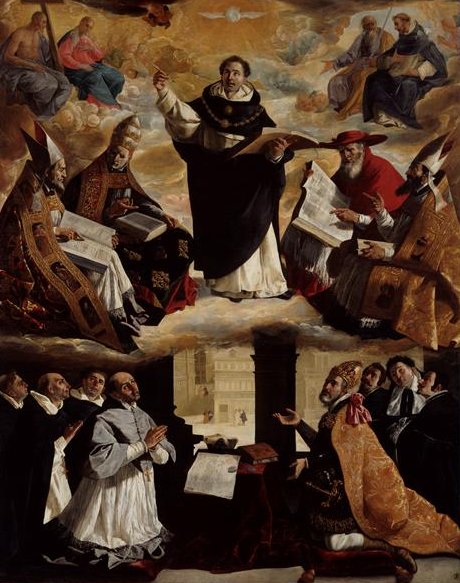
“Apotheosis of St Thomas Aquinas,” painted in 1631 by Francisco de Zurbaran, is one of the most ambitious and richly populated compositions in the artist’s career. The canvas presents a grand vision in two registers. Above, St Thomas Aquinas appears glorified in heaven, surrounded by clouds, saints, and theologians. Below, a group of clergy and dignitaries kneel and converse beneath monumental architecture, lifting their eyes toward the revelation unfolding in the sky.
Unlike Zurbaran’s more intimate single figure saints, this work functions like a visual summa, weaving together theology, history, and political symbolism. It celebrates Thomas Aquinas not only as a learned Dominican but as a doctor of the Church whose teachings unify heaven and earth. The painting is therefore a powerful testimony to Counter Reformation Catholicism, which prized clear doctrine, learned preaching, and the harmony between faith and reason.
Historical and Theological Context
St Thomas Aquinas, who lived in the thirteenth century, was a Dominican theologian whose writings shaped Catholic thought for centuries. By the early seventeenth century, his authority had become central to Catholic theology, especially in the universities and religious orders of Spain. He was recognized as a doctor of the Church, and his synthesis of Aristotelian philosophy and Christian doctrine was seen as a bulwark against heresy and confusion.
Zurbaran worked in Seville, a thriving port and intellectual center. The Dominicans were prominent in the city, and commissions glorifying their great theologian fit perfectly within the religious climate after the Council of Trent. The Council emphasized the need for solid teaching and clear articulation of doctrine. In this context, Thomas Aquinas appeared as an ideal patron for theologians, preachers, and scholars.
The term “apotheosis” refers to elevation to divine or heavenly status. By depicting an apotheosis of Thomas, Zurbaran shows the saint being publicly acknowledged in heaven as well as venerated on earth. The painting likely commemorated the saint’s role as patron of a college or church and proclaimed that his teachings were rewarded by divine approval. The work thus operates both as devotional image and as intellectual manifesto.
Composition and Structure in Two Registers
Zurbaran organizes the painting into an upper heavenly zone and a lower earthly zone, separated by a dense band of clouds. The division creates a vertical axis of meaning. Above the clouds, the glorified Thomas floats in a golden aura, flanked by seated Church Fathers and watched over by Christ, the Virgin, and apostles. Below the clouds, human figures kneel or stand within an architectural space that opens toward a distant city.
In the upper section, Thomas stands centrally, dressed in the black and white habit of the Dominicans, holding an open book and gesturing as if teaching. He is placed slightly forward from a semicircle of enthroned bishops and doctors, whose richly ornamented vestments and miters reinforce their authority. The clouds behind them are suffused with warm light, giving the impression of a heavenly council chamber.
The lower register shows clerics and noblemen gathered around a table or pedestal covered with cloth. Some hold documents, others clasp their hands in prayer, and a few look up intently toward the vision above. Behind them rise massive columns that frame a view onto a city square. This architectural setting anchors the event in a recognizable earthly space, perhaps alluding to a specific institution dedicated to Aquinas.
By layering these two realms and linking them through the figure of Thomas, Zurbaran conveys the idea that what happens in theology and liturgy on earth corresponds to an eternal reality in heaven. Human reflection, under the guidance of Aquinas, leads upward to divine truth.
The Glorified St Thomas Aquinas
At the center of the upper zone, St Thomas Aquinas commands attention. He is shown not seated but standing upon a glowing cloud, raised above the already exalted company of bishops and doctors. This placement underscores his exceptional status as the Angelic Doctor. His black cappa and white tunic stand out among the ornate reds and golds around him, giving his figure a striking clarity.
Thomas holds an open book in one hand, representing his Summa Theologiae and other writings. His other hand is raised in a teaching gesture, as though he is expounding doctrine even in heaven. The open book is turned outward toward the viewer and toward the congregation of saints, indicating that his teachings are addressed to both Church and faithful. Light falls strongly on the pages, making them a luminous focal point, symbolic of divine wisdom articulated through human words.
His face is serious yet serene, with eyes lifted slightly upward. He is not lost in private ecstasy but engaged in communication, linking the divine source of truth with the souls who receive it. A subtle halo encircles his head, marking his sanctity, while the glowing clouds behind him form an even larger radiance that extends his aura into the surrounding space.
By giving Thomas the posture and gesture of a teacher, Zurbaran emphasizes that his sanctity lies not only in personal holiness but also in his intellectual service to the Church. Knowledge and charity are united in this figure, making him a model for scholars and pastors alike.
The Heavenly Assembly of Saints and Doctors
Surrounding Thomas is a distinguished group of saints and Church Fathers seated like judges or advisers in a celestial council. Their presence affirms that the teachings of Thomas harmonize with the tradition of the Church.
On either side of him appear bishops in richly embroidered copes and miters, possibly representing St Augustine, St Ambrose, St Gregory the Great, and St Jerome, the classic Latin Fathers. Their garments are depicted with Zurbaran’s characteristic love of texture and detail. Gold threads shimmer in the light, and jewelled borders catch the eye. Each figure holds a book or scroll, signifying their own contributions to theology and scripture.
Behind and above this circle, at the very top of the composition, Christ appears enthroned in the clouds, often accompanied by the Virgin Mary and apostles such as St Peter and St Paul. Their presence places the entire scene under the authority of Christ the divine Teacher. It is from him that truth ultimately flows, and it is to him that Thomas’s teaching remains obedient.
The arrangement of these figures suggests a hierarchy of knowledge and glory. Christ presides at the summit, the apostles and Virgin form an inner council, the Fathers sit as judges, and Thomas stands as the mouthpiece who articulates their wisdom for later generations. All faces are turned toward him, or toward the book he holds, indicating their approval and the continuity of doctrine.
The Earthly Congregation and Architectural Space
In the lower register, Zurbaran shifts from celestial vision to a scene of earthly ceremony. Here we see a group of men, mostly clerics in white surplices or religious habits, along with richly dressed lay dignitaries. They gather around a central table where documents and perhaps an image or relic of Thomas are displayed.
One prominent figure in ornate vestments kneels or sits at the right, his profile sharply lit. He may represent a king, emperor, or high ranking nobleman showing devotion to Thomas. His luxurious golden cloak contrasts with the more austere garments of the clergy behind him, emphasizing the cooperation between temporal power and spiritual authority.
Several clerics on the left kneel in prayer, hands joined, while others stand reading or debating from texts. Their upward gazes connect visually with the saint above, but because the clouds intervene, it is ambiguous whether they actually see the vision or contemplate it inwardly. This ambiguity invites viewers to imagine themselves in a similar position, contemplating the heavenly glory through faith even if it is not physically visible.
The architectural setting is impressive. Massive dark columns frame the group, casting deep shadows and suggesting solidity and permanence. Between the columns we glimpse a bright exterior plaza with classical buildings. The contrast between shadowed interior and sunlit exterior enhances the sense of depth and also hints at the journey from the darkness of ignorance to the light of knowledge that Thomas helps to guide.
Light, Color, and Dramatic Atmosphere
Zurbaran uses light and color to weave together the two halves of the composition. In the heavenly zone, warm golden tones dominate. Clouds are suffused with a glowing light that comes from no single source but seems inherent to the divine realm. The garments of the saints shine with white, red, and gold, creating a joyful and radiant atmosphere.
In the lower zone, the palette shifts slightly toward cooler and darker hues. Blacks, deep reds, and rich browns dominate the interior space, while the distant city outside is painted in cooler beige and gray. Light falls from above, touching faces and fabrics, but large areas remain in shadow. This tenebrist effect heightens the drama and focuses attention on particular figures.
The boundary of clouds between the two zones is not a hard line but a rolling mass of vapor filled with light. This soft transition suggests that heaven is not an entirely separate world but one that overshadows and penetrates earthly reality. The glowing clouds function like a curtain partly drawn back to reveal the heavenly stage.
Zurbaran’s mastery of textile painting is evident in both registers. The shimmering brocades of the bishops, the velvet and lace of the nobleman’s robes, and the simple white linen of the surplices all exhibit different textures. These contrasts underline the diversity of vocations within the Church while uniting them in common devotion to Thomas.
Symbolism of Books, Documents, and Gesture
Books and documents are everywhere in this painting. In heaven, Thomas and the Fathers hold open volumes; on earth, clerics read from texts and laymen handle official papers. These objects symbolize the written tradition of the Church, the authority of councils and decrees, and the importance of study. They also underscore the role of Thomas Aquinas as writer and scholar.
The open book Thomas displays may be understood as the Summa, a comprehensive exposition of Christian doctrine. By turning the pages outward, Zurbaran suggests that this text is offered to the world as a reliable guide. The way Thomas’s hand gestures outward while the other holds the book indicates a dynamic of giving and teaching. He does not hoard knowledge but shares it.
On the earthly level, the documents on the table may refer to the official recognition of Thomas’s status, perhaps symbolizing papal bulls or university statutes that elevate him as patron and doctor. The act of reading and signing these documents becomes a participation in the heavenly acknowledgment already granted to him. In this way, calligraphed lines of ink on paper mirror the golden script of divine will.
Gestures also carry significant meaning. The kneeling posture of several figures indicates reverence and submission. Raised hands suggest appeal for intercession or acceptance of divine teaching. Faces turned upward show the orientation of the human intellect and will toward higher truth. Zurbaran arranges these gestures to create rhythmic movement that leads the eye from earth to heaven and back again.
Emotional Tone and Spiritual Message
Despite its crowd of figures and complex symbolism, “Apotheosis of St Thomas Aquinas” has a clear and unified emotional tone. It is a celebration of wisdom and harmony rather than a scene of conflict or martyrdom. The expressions of the heavenly figures are dignified and serene. On earth, even those engaged in discussion appear calm and focused.
The painting communicates a sense of confidence in the ability of human reason, guided by faith, to approach divine truth. The upward thrust of the composition, culminating in Thomas raised above the Fathers, suggests that the Catholic Church, through its theologians, is securely anchored in a tradition that is both rational and revealed. Viewers are invited to trust that this tradition is ratified in heaven.
At the same time, the painting has a meditative quality. The soft golden light, the rhythm of clouds, and the balanced grouping of figures encourage leisurely contemplation. Believers in front of the canvas could reflect on their own relationship to the saints and teachers of the Church. They might identify with the kneeling clerics or with the lay dignitary, recognizing that all vocations are called to listen to divine wisdom.
Zurbaran’s Style and Artistic Achievement
This work shows Zurbaran operating on a grand public scale. While many of his best known paintings feature solitary saints in quiet contemplation, here he orchestrates a large ensemble scene without losing focus or clarity. Each figure is individualized, yet all contribute to the overall structure.
The combination of strong tenebrism in the lower zone and luminous color in the upper zone reveals his skillful manipulation of Baroque drama. He uses light not just for realistic effect but as a symbol of grace and understanding. His textures are so carefully rendered that garments and objects gain almost tactile presence, grounding the visionary subject in material reality.
The painting also demonstrates Zurbaran’s sensitivity to composition. The diagonal lines of gaze and gesture, the vertical pillars, and the semicircular arrangement of seated saints create a dynamic yet stable structure. The work avoids overcrowding by creating clear clusters of figures with open spaces between them, allowing the eye to move comfortably.
As an apotheosis scene, the painting stands out in seventeenth century Spanish art. It rivals the large altarpieces of other masters in ambition while retaining the distinctive spirituality of Zurbaran. It testifies to his ability to translate theological abstraction into visual drama without sacrificing reverence or clarity.
Conclusion A Triumph of Doctrine and Vision
“Apotheosis of St Thomas Aquinas” by Francisco de Zurbaran is a monumental hymn to the power of sacred learning. By presenting Thomas glorified among the greatest doctors and saints, the painting affirms his role as a guiding light for the Church. The earthly congregation below, immersed in prayer and study, mirrors the heavenly council above, suggesting a profound unity between the Church militant and the Church triumphant.
Through careful composition, rich color, and expressive lighting, Zurbaran leads the viewer’s eye upward from the darkened architectural space of history to the radiant clouds of eternity. Books, documents, and gestures all work together to tell a story of knowledge received, pondered, and finally endorsed by heaven itself.
For modern viewers, the canvas offers not only a glimpse into the intellectual culture of seventeenth century Spain but also a meditation on the relationship between reason and faith. Thomas stands at the center as a reminder that rigorous thought and deep devotion can coexist. In celebrating his apotheosis, Zurbaran invites us to reconsider the nobility of the search for truth and to recognize how that search, when oriented toward the divine, can be a path to glory.