Image source: wikiart.org
Introduction
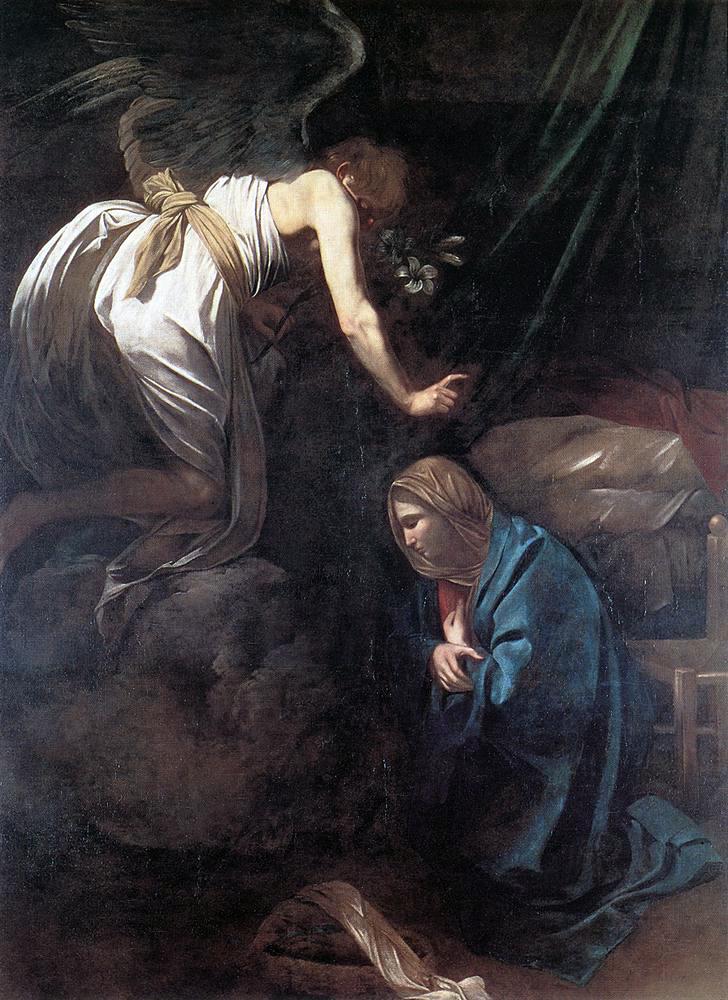
Caravaggio’s “Annunciation” (1608) belongs to the artist’s late period and distills his drama into hushed reverence. Painted during his Maltese sojourn, the work reduces a moment of cosmic consequence to a chamber of near darkness where an angel stoops and a young woman bows. Caravaggio avoids decorative flourish and lets light, gesture, and the atmosphere of silence carry the meaning. The result is an Annunciation unlike the courtly, ornamented versions of earlier centuries: intimate, earthbound, and yet charged with a gravity that feels almost audible.
A Late Caravaggio In Malta
By 1608 Caravaggio had left Rome amid scandal and was seeking rehabilitation in Malta. There he produced works anchored in sober simplicity, with flattened backgrounds and figures that seem cut from shadow by bands of light. The “Annunciation” reflects this aesthetic: the space is sparse, the props minimal, and the emotional temperature is contemplative rather than theatrical. That late style—less crowded, more monumental—suits the subject, because the Incarnation enters history not with spectacle but with consent and quiet.
Composition As A Theology Of Descent
The composition reads as a diagonal of grace. The angel occupies the upper left, knees bent as if still in flight, body wrapped in a white garment that catches the light. Opposite, Mary kneels low at the right, cloaked in deep blue, her head bowed and hands folded. Between them the darkness opens like a corridor through which the message travels. Nothing distracts the eye from this line of descent: not an elaborate interior, not a garden, not a window. Caravaggio compresses the scene so that the entire drama is the movement from God to human and the response from human to God.
Chiaroscuro As Messenger
Caravaggio’s light does the speaking. It falls across the angel’s garment, turning folds into waves, then spills toward Mary’s veil before dissolving in the shadows at her feet. The angel’s face is partially veiled by shade, emphasizing the emissary rather than the personality; Mary’s features are softly modeled, their clarity increasing as the viewer’s gaze descends. This is theological composition: revelation originates above and becomes legible as it meets human assent below. The darkness is not emptiness but mystery; the light is not decorative but declarative.
The Angel In Motion And In Humility
The angel’s posture is a marvel of restrained dynamism. One knee rests on the cloud, the other leg still airborne; the torso inclines forward in respectful address; the hand extends not in command but in offering. Caravaggio refuses the exuberant wings and garlands of earlier examples. These wings are dark and tangible, almost animal in their physicality, and the figure’s attitude is one of service. The angel’s presence is concrete but not intrusive, aligned with the painter’s preference for sacred figures who enter real rooms and cast real shadows.
Mary’s Human Consent
Mary is the axis of the painting’s serenity. Caravaggio shows her as a robust young woman wrapped in a mantle of blue that pools heavily around her knees. Her head tilts downward and slightly aside, the gesture of one listening more than speaking. Her hands are folded near the heart, reading as both prayer and self-possession. The artist avoids idealized beauty; instead he gives Mary the gravity of a person confronted with a task that will transform history and her own life. The painting turns the doctrine of the Incarnation into a human posture: a quiet yes.
The Language Of Fabrics
The textiles carry symbolic resonance. The angel’s white tunic suggests purity and the luminosity of the message; its fabric, thrown into crisp ridges by the light, makes spiritual content feel tactile. Mary’s mantle is a dense blue, almost black where the folds thicken. It holds and absorbs light rather than throwing it back, implying the mystery of grace received and kept. On the bed behind Mary lies a rumpled cover, and at the bottom edge of the picture a strip of cloth rests on the floor. These ordinary linens ground the miracle in domestic reality and hint at the future linens of the Nativity and Passion.
Symbols That Whisper
Caravaggio places a spray of white lilies in the angel’s left hand, a compact emblem of Mary’s purity. No reading lectern or open book dominates the scene, and no dove breaks in from above. The omission is deliberate: by stripping iconography to a minimum, he avoids allegorical clutter and holds the viewer in the present tense of the encounter. The lilies glow briefly, then fade back into shadow, mirroring how signs accompany revelation but never eclipse it.
Space, Scale, And Intimacy
The room is small enough that the figures nearly fill it, yet large enough to preserve a corridor of darkness between them. A simple chair and bed frame assert scale and plainness. Caravaggio’s perspective keeps the eye from “escaping” through a window or doorway; this is an enclosed space where grace concentrates. The intimacy of the setting confers dignity on the everyday: the Incarnation takes place among things we recognize, not in an abstract heaven.
Silence As Subject
This painting is quiet. Even the angel’s speech seems tactile rather than audible, carried by a hand gesture and a tilt of the head. The hush is intensified by the weight of the drapery and the muffled bedclothes. The viewer does not simply observe a scene; one enters a silence significant enough to be called prayer. Caravaggio’s genius lies in trusting such silence—he resists narrative embellishment, confident that light and stance can tell the story.
Gesture As Grammar
Hands are the painting’s verbs. The angel’s right hand extends, articulating the moment of announcement; the left holds lilies that gloss the spoken word. Mary’s interlocked hands answer with assent. The space between hands is the sentence’s predicate, the invisible word that changes the world. Later Annunciations often dramatize Mary’s surprise with a recoil; Caravaggio’s grammar is quieter: listening, consenting, and receiving.
Color As Doctrine
The palette is limited and precise. Warm whites, cool blues, and earthy browns comprise nearly the entire chromatic range. Blue for Mary anchors the human pole of the mystery; white for the angel articulates heaven entering history; brown and charcoal for the room assert the reality of matter. The few zones of saturated color—Mary’s underdress peeking at the neckline, a warm cushion on the bed—keep the picture human and embodied. The mood is contemplative rather than operatic, a decision that aligns the image with the spirituality of interior prayer.
The Bed, The Chair, And The Body
Two pieces of furniture bear theological weight. The bed behind Mary points to the Incarnation’s physicality—God will take on flesh, and human life happens among linens. The chair to the right is empty, an unobtrusive symbol of the place that will be filled by the child. Caravaggio never turns these into overt symbols; he lets their ordinary presence hint at meaning. The sacramental worldview of the painting is clear: grace inhabits simple things.
The Annunciation In Caravaggio’s Language
Compared with medieval or Renaissance prototypes—where Gabriel often stands upright, wings bright, and Mary holds a book—Caravaggio reinterprets the scene for a new age. His angel bends; Mary kneels; the book disappears; a cloud serves as the sole supernatural furniture. The shift reflects a Counter-Reformation preference for immediacy and devotion. The painting asks the viewer not to decode an allegory but to share a moment of contemplation and decision.
The Weight Of The Drapery
Caravaggio is famous for making fabric feel sculptural, and here the folds are heavy, almost geological. The mantle’s edges catch the light like cliffs; the angel’s garment ripples like water. The heaviness serves the theme: eternity has weight when it meets the world. The drapery stabilizes the composition and underscores the union of heaven and earth through material forms.
The Cloud As Threshold
Under the angel’s knee a compact cloud rises into the room, not as a theatrical puff but as a threshold between realms. It lifts the messenger over the floor without triumphalism. In Caravaggio’s visual theology, heaven does not shatter the room; it enters quietly by a soft, permeable boundary. The cloud’s subdued light keeps the eye on the drama of consent rather than spectacle.
Human Psychology Without Theatrics
Mary’s face registers no ecstatic rapture nor paralyzing fear. Her gaze is lowered, lids heavy with thought. The viewer senses a mind at work and a heart settling into courage. Caravaggio’s psychological realism refuses caricature. The holiness here is recognizable: it looks like attention, receptivity, and acceptance.
A Devotional Image For A Military Island
Made for Malta, a fortress island of the Knights of St. John, the “Annunciation” brings tenderness into a martial context. It complements the Order’s identity: defense and mercy, fortification and hospitality. The painting’s quiet strength suggests that true power is not the soldier’s arm but the saint’s yes. In a chapel ringed by stone, the canvas becomes a soft gateway through which grace enters the citadel.
Anticipations Of Passion And Nativity
The linens scattered in the room prophesy the cloths of Bethlehem and Calvary. Mary’s bowed head anticipates the Pietà; the angel’s descent prefigures the comfort offered to Christ in Gethsemane. These echoes are not overt but resonate through form and fabric. Caravaggio binds the Gospel’s arc into a single, hushed room.
The Viewer’s Participation
Caravaggio positions us low and near, almost at Mary’s level. We do not look down on a stage; we are permitted inside the chamber’s edge. That intimacy asks for a response. The painting’s power is not only to show a holy event but to model a human stance before it—attention, humility, and freedom. The question it poses is personal: what word is being offered to you, and will you permit it to become flesh in your life?
Conclusion
“Annunciation” (1608) is Caravaggio’s meditation on how revelation enters the ordinary. With a few figures, a sparse room, and a current of light, he stages the moment when eternity touches time and waits for a human answer. The work’s humility—its subdued color, its compressed space, its quiet gestures—magnifies rather than diminishes the drama. In the silence between angel and maiden, the world changes. Caravaggio, late in his life and in exile, knew how to paint that change without raising his voice.