Image source: wikiart.org
Introduction to Bartolomé Esteban Murillo’s “Annunciation”
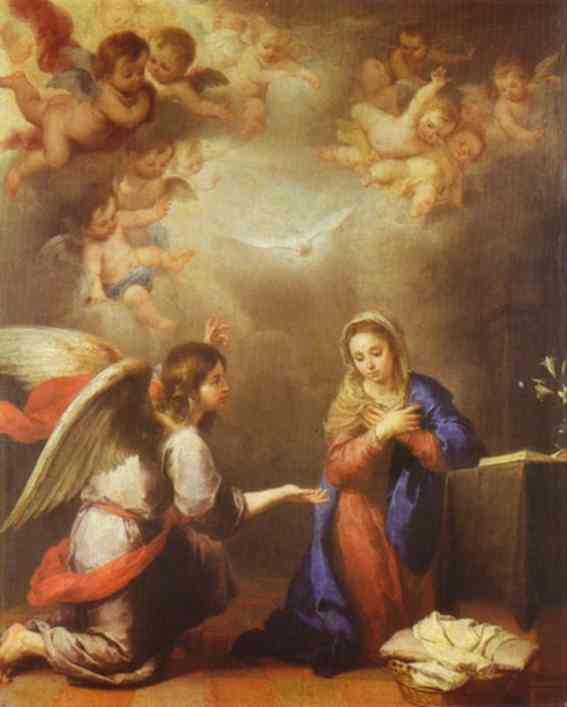
“Annunciation,” painted by Bartolomé Esteban Murillo around 1665, is a luminous vision of the moment when the archangel Gabriel announces to Mary that she will become the mother of Christ. The scene unfolds in a quiet interior, yet the space seems to open into heaven itself. Cherubs swirl in a golden cloud, a white dove glides downward, and a soft radiance surrounds the kneeling figures.
Murillo was one of the great painters of the Spanish Baroque, and this work shows him at the height of his devotional style. The composition is tender, the light almost glowing from within, and every detail is shaped to convey humility, grace, and divine presence. By blending the everyday with the miraculous, Murillo presents the Annunciation not as a distant, unreachable mystery, but as an intimate encounter between heaven and earth.
The Biblical Story Behind the Painting
The source of the subject is the Gospel of Luke, where the archangel Gabriel appears to Mary in Nazareth. He greets her as “full of grace” and tells her that she has been chosen to bear the Son of God. Mary is troubled at first, but then accepts this calling with the words, “Let it be done to me according to your word.”
Murillo captures the moment when Mary’s humble yes has already begun to form in her heart. She is not depicted as frightened or overwhelmed. Instead, she looks gentle and reflective, her hands crossed over her chest as if sealing the promise she is about to make. Gabriel, kneeling before her, gestures with one hand in a combination of greeting and reassurance, while with the other he points upward to the source of his message.
Above them the Holy Spirit, symbolized by a white dove, descends in a stream of light from the heart of a swirling cloud filled with angels. The composition makes clear that this event is not simply a conversation. It is an intervention from heaven that will change the course of history.
Composition and Spatial Arrangement
Murillo organizes the painting around a triangular structure. At the lower right, Mary kneels beside a small lectern or table. At the lower left, Gabriel kneels facing her. Above them, the dove of the Holy Spirit occupies the apex of the triangle, surrounded by a host of cherubs. This structure ties the earthly and heavenly elements together and visually expresses the connection between Mary, the messenger, and God.
Mary is slightly offset toward the right, which allows her blue mantle and red dress to stand out against the darker background. Gabriel’s wings open diagonally across the lower left, echoing the movement of the cloud above. This mirroring effect unites the earthly and heavenly realms and guides the viewer’s eye upward and back again.
The interior setting is simple. We see a small table with a book and a vase of lilies, a basket of sewing or linen at Mary’s feet, and shadowed walls behind them. There are no elaborate architectural perspectives or deep vistas. Instead, the space feels intimate and shallow, as if the viewer has stepped quietly into a private room and discovered a miracle taking place.
By keeping the setting modest, Murillo emphasizes that the extraordinary often enters ordinary spaces. Heaven bursts into a quiet domestic interior, transforming it without destroying its familiarity.
Mary as Model of Humility and Contemplation
Murillo’s Mary is very human and approachable. She is a young woman with soft features, downcast eyes, and a serene expression. Her head is slightly tilted in a gesture of both listening and modesty. Her hands cross over her chest as if she is both protecting her heart and offering it.
The colors of her garments carry rich symbolism. The deep blue mantle is traditionally associated with her purity and role as Queen of Heaven. The warm red dress beneath can be associated with charity and the flesh that Christ will take from her. Murillo softens these colors into velvety tones that glow in the warm light, reinforcing the painting’s gentle atmosphere.
Mary’s posture is still, almost sculptural. She kneels on the ground, emphasizing humility, but her upper body remains upright and poised. This combination of low position and dignified bearing tells us that she is fully aware of the greatness of what she is hearing, yet she accepts it with calm trust.
Beside her, the open book hints at her meditation on Scripture. The lilies on the table symbolize her purity and her openness to God. The basket of linen at her feet suggests her daily domestic tasks. Murillo thus unites Mary’s contemplative life with her everyday work, showing that holiness can grow in the midst of ordinary duties.
The Archangel Gabriel as Messenger of Light
Gabriel appears as a youthful, graceful figure with large wings that stretch behind him. He kneels before Mary, a gesture of respect that underscores her unique role in the divine plan. Although he is an archangel, he approaches her with humility.
His garment combines soft whites, blues, and rose tones. A red sash wraps around his waist, adding a dynamic accent that echoes the warm colors in Mary’s dress. The light falls across his face and shoulders, giving him a luminous quality. Yet he remains solid and tangible, not a vague apparition. Murillo makes him believable so that the encounter feels real.
Gabriel’s right hand is extended toward Mary, palm open, as if offering the message. His left hand is slightly raised, pointing upward toward the cloud and dove, indicating the origin of his words. This double gesture acts as a visual translation of his message: he carries news from heaven and offers it to Mary’s free acceptance.
His gaze is fixed on her face, not on the heavenly light. This focus underscores the importance of her response. The drama of the scene depends not on the arrival of the angel but on how Mary receives his message.
Cherubs and the Descent of the Holy Spirit
The upper part of the painting is crowded with cherubs and angelic heads drifting among soft, golden clouds. They form a circular movement around the central beam of light that carries the dove of the Holy Spirit downward. The cherubs appear joyful and curious, some looking toward Mary, others toward the dove, as if they too marvel at this moment.
The dove is pure white, wings spread, positioned directly above Mary’s head. From it radiates a soft halo of light that fades into the surrounding clouds. This visual path of light links heaven to Mary’s heart. It symbolizes the overshadowing of the Holy Spirit described in the Gospel and suggests that divine grace is pouring into her life.
Murillo’s cherubs are characteristic of his style. They are plump, rosy, and full of movement. Their playful forms add warmth and tenderness to the scene, preventing it from becoming too austere. At the same time, their presence enlarges the event to cosmic scale. The entire heavenly host seems to be watching and celebrating Mary’s consent.
Light, Color, and Atmosphere
Perhaps the most striking feature of Murillo’s Annunciation is its light. The painting seems suffused with a golden haze that softens edges and bathes the figures in radiance. The strongest light comes from the central heavenly area, spills over the cherubs and dove, then descends onto Gabriel and Mary.
This light is not harsh or dramatic. It is diffused and enveloping, creating a sense of gentle illumination rather than sharp spotlight. Mary’s face and hands, Gabriel’s wings, and the lilies on the table all catch this light, making them glow against the darker background.
The color palette centers on warm golden browns, deep blues, and soft reds. These tones blend harmoniously and contribute to a feeling of peace and intimacy. Even the shadows are warm and transparent rather than cold and opaque. Murillo’s color choices support the theme of grace quietly entering the world.
The hazy, soft focus at the edges of forms gives the work a dreamlike quality. It feels as if the viewer is seeing the scene through a veil of sacred light. This approach is typical of Murillo’s mature style, where the physical and spiritual seem to melt into one another.
Symbolic Objects and Domestic Details
Murillo enriches the scene with a few carefully chosen objects that deepen its meaning. The open book on Mary’s small table suggests that she has been reading Scripture when the angel arrives. It may refer specifically to prophecies about the Messiah, hinting that she is a woman attuned to God’s promises.
Next to the book stands a vase with white lilies. These flowers symbolize purity and are often associated with the Annunciation. Their placement near Mary and the book emphasizes her inner purity and her attentive listening to God’s word.
At Mary’s feet lies a woven basket filled with white cloths. This everyday object grounds the scene in the reality of domestic work. It suggests that Mary has been sewing or doing household tasks when the angel appears. Murillo thus portrays the divine encounter as happening in the midst of simple labor, reinforcing the idea that God enters everyday life.
The combination of sacred symbols and practical objects is one of the hallmarks of Murillo’s religious paintings. He invites viewers to see their own surroundings as potential sites of grace.
Emotional Tone and Spiritual Message
The emotional tone of Murillo’s Annunciation is remarkably gentle. There is awe, but not fear; reverence, but also warmth. Mary’s expression is thoughtful rather than overwhelmed. Gabriel’s demeanor is respectful and calm. The cherubs above are delighted, but not chaotic.
This calmness is significant. Murillo emphasizes the trust at the heart of the Annunciation. Mary listens, questions briefly, and then opens herself to God’s plan. The painting invites viewers to imagine themselves in a similar posture of openness.
The spiritual message is one of willingness and intimacy. God does not force his will upon Mary. Through Gabriel, he asks for her consent. Her crossed hands and bowed head express her free acceptance. The descending light expresses the response from heaven to her yes.
For viewers, this scene can serve as a model for responding to God’s call in their own lives, whether that call appears in dramatic form or in quiet invitations to charity, patience, or vocation. Murillo’s tender rendering suggests that saying yes leads not to terror, but to a deeper, gentler light.
Murillo’s Sevillian Context and Devotional Style
By 1665, Murillo was the leading painter in Seville, known especially for his religious works and his ability to capture tenderness and piety. The city at this time was marked by strong Marian devotion, with confraternities, churches, and processions honoring the Virgin. The Annunciation theme would have been especially cherished, since it marks the beginning of the mystery of the Incarnation.
Murillo’s style differed from the more dramatic, tenebrist approach of earlier Spanish painters. Where others favored stark contrasts and intense emotion, Murillo preferred softer transitions, luminous color, and an affectionate view of sacred figures. His Mary and Gabriel are approachable and compassionate, inviting devotional contemplation rather than distant awe.
This painting likely served as a focus for prayer, perhaps in a church or a private chapel. Its intimate scale and warm atmosphere encourage the viewer to kneel with Mary, listen with her, and allow the light of the Holy Spirit to descend in a spiritual sense.
The Annunciation as Intersection of Heaven and Home
One of the most powerful aspects of Murillo’s Annunciation is the way it brings together the heavenly and the domestic. Heaven is present in the radiant dove and the crowd of cherubs, in the golden clouds and the beam of light. Home is present in the simple table, the book, the lilies, and the basket of linen.
Mary is not removed from her ordinary environment when the angel arrives. She remains in her room, dressed simply, engaged in reading or work. The message of the painting is that God chooses to work through the ordinary. The divine plan unfolds not only in grand temples and palaces, but in quiet homes and hidden hearts.
Gabriel kneels on Mary’s floor as if entering sacred ground. The room becomes a sanctuary, yet it loses none of its familiar character. This subtle transformation mirrors the way grace can change a life from within without erasing its human texture.
Conclusion
Bartolomé Esteban Murillo’s “Annunciation” is a masterful portrayal of one of Christianity’s most important moments. Through careful composition, luminous color, and tender characterization, Murillo presents the encounter between Mary and Gabriel as an intimate dialogue suffused with divine light.
The painting conveys multiple layers of meaning: the unfolding of salvation history, the beauty of Mary’s humility, the descent of the Holy Spirit, and the surprising way heaven enters everyday life. Cherubs and clouds remind us of the cosmic significance of the event, while domestic details and gentle gestures keep the scene grounded and relatable.
More than three centuries after its creation, Murillo’s “Annunciation” continues to invite quiet contemplation. It asks viewers to step into Mary’s room, to feel the warmth of the light, and to consider how they too might respond when called to something greater than themselves.