Image source: wikiart.org
First Impression and the Power of a Small, Focused Portrait
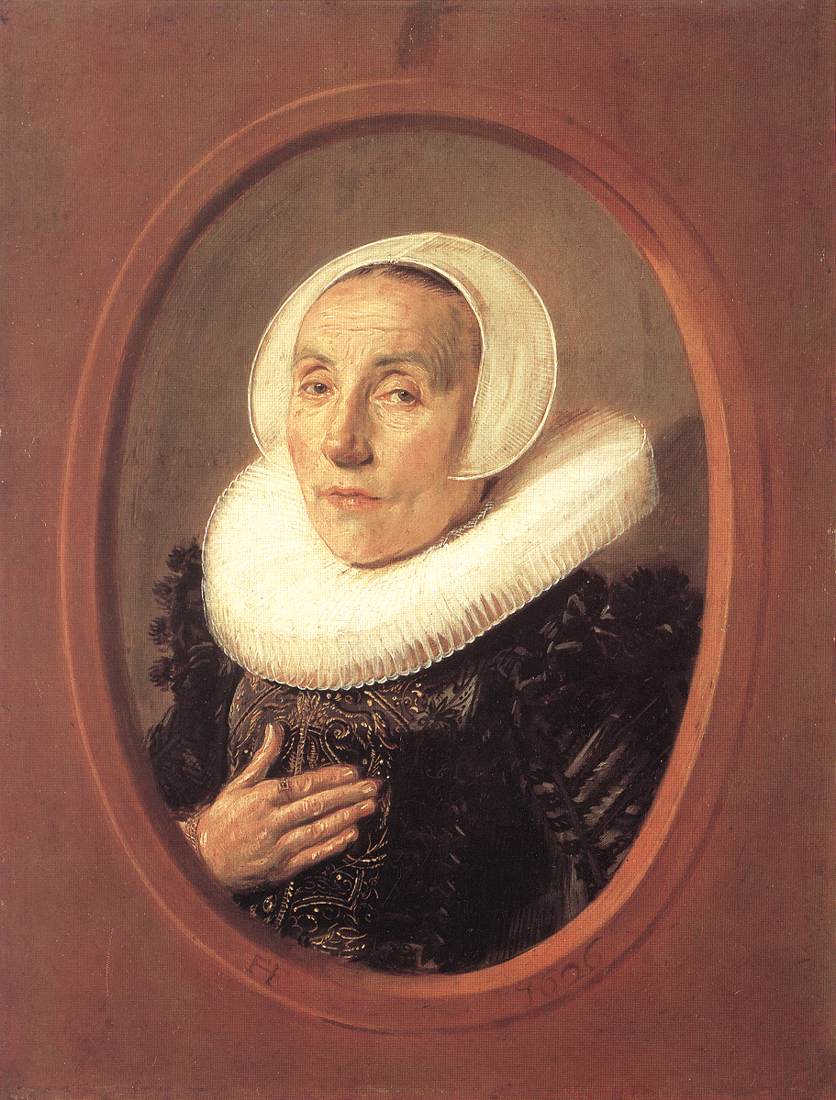
Frans Hals’s Anna van der Aar (1626) is quietly arresting. Unlike his full-length portraits that announce status through scale and theatrical space, this work concentrates everything into an oval frame, pulling the sitter close and asking the viewer to read her face, her gesture, and the subtle eloquence of her clothing. The oval format creates an immediate sense of intimacy, as if we are looking through a window into a private encounter. Yet the painting is not casual. It is formal in its restraint, and that combination of closeness and ceremony is where its emotional force lives.
Anna’s expression is calm but not blank. Hals paints a face shaped by experience: the skin is softly modeled, the features are precise, and the gaze meets us with a steady, slightly tired clarity. There is no overt smile, no theatrical flourish. Instead the portrait offers something rarer: a sense of presence that feels earned rather than performed. The effect is not sentimental. It is dignified, human, and quietly intense.
Even before we consider the details, the composition tells us that this is a portrait about character. Hals keeps the background plain, the color warm and muted, and the lighting gentle. The sitter becomes the entire event.
The Oval Frame as a Device of Intimacy and Control
The oval framing is more than a decorative choice. It shapes how the portrait functions. Ovals were often used to create a sense of refinement and focus, and they naturally compress space, bringing attention to the head and shoulders. Here, the oval acts like a soft boundary that contains Anna’s presence without trapping it. The curve echoes the circular forms of her white collar and cap, building a visual harmony that feels stable and composed.
This containment also produces psychological effect. A rectangular canvas allows the eye to wander into corners and background details. The oval keeps the viewer close, insisting that meaning be found in the sitter rather than in surrounding objects. Hals uses this format to amplify the portrait’s directness. We are not distracted by architecture, drapery, or landscape. We are asked to look at a person.
At the same time, the frame suggests social order. Portraiture in the Dutch Republic often balanced individuality with decorum, and the oval can feel like a gentle form of discipline, a way of presenting the sitter within an ideal boundary. Anna appears centered, steady, and deliberately presented. The portrait feels like a statement of identity that values clarity over spectacle.
Expression and Gaze: Quiet Authority Without Performance
Anna’s gaze is one of the painting’s most compelling elements. It is direct but not confrontational, attentive but not animated. Hals creates an impression of a woman who is accustomed to composure, someone who does not need expressive gestures to command attention. The eyes convey alertness, and the slight tension around the mouth suggests reserve, perhaps shaped by the expectations placed on a woman presenting herself in formal portraiture.
The face is painted with a remarkable balance of honesty and respect. Hals does not idealize Anna into youthful smoothness. He acknowledges age and experience through subtle modeling, gentle shadows, and the natural texture of skin. This is not cruel realism, but dignified realism. The sitter is shown as she is, with the kind of sympathetic clarity that makes the portrait feel alive rather than merely flattering.
What makes Hals special is his ability to imply interiority without drama. Anna’s expression suggests thought, memory, and a controlled social presence. It is the sort of face that invites the viewer to imagine a life behind it, precisely because it refuses to put everything on display.
The Hand on the Chest: Gesture as Meaning
Anna’s hand rests against her chest, a gesture that immediately reads as significant. In portraiture, hands are never neutral; they are symbolic instruments as much as physical ones. This gesture can suggest sincerity, piety, humility, or personal conviction. It can also simply indicate a respectful self-presentation, as if the sitter is acknowledging the viewer’s presence with a modest, contained motion.
Hals paints the hand with careful attention, making it one of the portrait’s visual anchors. The fingers are long and lightly curved, and the hand’s pale tone contrasts with the dark dress beneath it. This contrast ensures the gesture cannot be ignored. It becomes a second focal point after the face, creating a subtle narrative line: the viewer meets Anna’s eyes, then follows the gaze down to the hand, and then returns upward to her expression with a renewed sense that something is being communicated.
The gesture also warms the portrait emotionally. It introduces tenderness, not in a sentimental way, but in a human way. A hand on the chest is inherently personal. It implies the body beneath the clothes, the heart beneath the social surface, the private self within the public presentation.
Costume and Social Language: Black Fabric and White Architecture
Anna’s clothing speaks the language of respectability in the Dutch Golden Age. The black dress carries the weight of sobriety, wealth, and status. Black cloth was expensive and often associated with moral seriousness. Hals does not paint black as a flat darkness. He reveals its complexity through subtle highlights and hints of texture, suggesting rich fabric and careful construction.
The white collar, large and sculptural, functions like architecture around the neck and shoulders. It frames Anna’s face and reinforces the portrait’s sense of order. This collar is not only a fashion element; it is also a sign of discipline and social position. Maintaining such whiteness required care, laundering, and resources. Hals makes it luminous and tactile, with delicate gradations that suggest thickness and crispness at once.
The cap echoes the collar’s whiteness and adds to the impression of modesty and propriety. Its round form frames the forehead and temples, reinforcing the portrait’s circular rhythms. In combination, the black and white elements create a visual code: sobriety, dignity, social stability. Hals uses these codes, but he also ensures they do not overwhelm the sitter’s individuality. The costume supports the personality rather than replacing it.
Light and Tone: Warm Restraint and Gentle Clarity
The portrait’s light is carefully moderated. It does not create harsh drama, but it does build clarity. Hals illuminates Anna’s face and collar with soft directional light, allowing the features to appear fully present. Shadows are gentle, and the background remains warm and muted, offering contrast without distraction.
This warm restraint is essential to the painting’s atmosphere. A colder palette might make the sitter feel distant. Hals’s warm browns and creams keep the portrait human, even as the costume remains formal. The background seems to hold a quiet glow, like a wall catching ambient light, and that glow supports the sitter’s complexion and the collar’s brightness.
The collar itself becomes a kind of light source within the painting, reflecting brightness upward into the face. This is a subtle optical effect that Hals uses to make the features feel alive. The white fabric does not merely sit beneath the head; it actively participates in shaping the portrait’s illumination.
Hals’s Brushwork: Precision, Suggestion, and the Living Surface
Although Hals is often associated with energetic brushwork and lively spontaneity, this portrait shows his ability to adapt style to subject. The handling here is controlled, but still fresh. The face is modeled with delicate transitions, avoiding overblending so the surface retains life. The collar is painted with strokes that suggest its pleated structure without turning it into a mechanical pattern. Hals captures the impression of crisp fabric through selective emphasis, giving the viewer enough information to feel the collar’s texture.
In the black dress, Hals uses nuanced variations to suggest embroidered or patterned fabric. Black is never simply black. It carries reflections and shifts, and Hals paints those shifts just enough to imply richness. This is an important point: the portrait’s luxury is not expressed through bright colors or jewelry, but through the depth of materials. Hals uses paint to make those materials convincing.
The overall effect is that the painting feels both composed and alive. It has the polish required for formal portraiture, but it never loses the sense of a living encounter.
Psychological Portraiture and the Ethics of Looking
A portrait like this raises a subtle question: what does it mean to look at someone across centuries? Hals’s achievement is that he makes the act of looking feel respectful rather than invasive. Anna’s gaze meets ours with steadiness, and the painting does not invite gossip or spectacle. It invites attention.
The hand gesture reinforces this ethical feeling. It reads as sincerity, as a quiet assertion of self. Anna is not merely displayed. She participates in her representation. Even if the portrait follows conventions, Hals gives the sitter agency through the direct gaze and meaningful gesture.
There is also an emotional complexity in the expression. It is not cheerful, yet it is not bleak. It suggests a life with weight, a person who has experienced time. Hals does not reduce that to a message. He simply lets it exist. This is one reason the portrait feels modern: it respects ambiguity and treats the sitter as a full human presence rather than a symbol.
The Portrait’s Social Context: Respectability, Piety, and Domestic Authority
In the Dutch Republic, portraits of women often carried layered meanings. They could signal marital status, family position, piety, and the authority of the household. Even without showing a domestic interior, the costume and demeanor can imply a role within the social structure. Anna’s sober dress and controlled presence suggest a woman situated within respectable society, likely connected to family networks where reputation mattered.
The gesture and the lack of flamboyant jewelry strengthen the impression of modest virtue. This does not mean the sitter lacks wealth. On the contrary, the quality of fabric and lace implies resources. The portrait’s message is not poverty; it is disciplined prosperity. It communicates that wealth is present, but it is governed by values.
In this way, the portrait can be read as a statement of identity that merges spiritual and social ideals. Anna appears as someone whose public image is shaped by restraint, seriousness, and stability, qualities that would have been admired in many circles.
The Oval Portrait as a Concentrated Legacy
Because the painting is tightly framed, it feels like a distilled legacy. Full-length portraits can be about environment, power, and display. This one is about essence. The oval format and close cropping suggest that the sitter’s face and gesture are what mattered most to preserve.
That preservation is not only personal but familial. Portraits were often commissioned to mark lineage, to hold memory, to represent continuity. Anna’s calm gaze suggests not only her individuality but also a sense of permanence. She becomes a figure of stability, someone meant to be remembered in a controlled and dignified way.
The portrait’s simplicity makes it durable. It does not rely on temporary fashions of background decoration or elaborate symbolism. It relies on what lasts: a human face, a meaningful gesture, the quiet eloquence of light.
Why This Painting Still Resonates
Modern viewers often respond strongly to portraits that feel honest. Anna van der Aar resonates because it does not try to entertain. It tries to present. Hals’s genius is that presentation becomes compelling. The sitter’s presence is enough.
The painting also resonates because it balances distance and closeness. The formal costume and controlled expression create a boundary, reminding us we are looking at someone from another world. Yet the gaze and hand gesture bridge that distance. We feel an encounter, not just an image.
Finally, the portrait demonstrates how much can be done with restraint. Hals proves that psychological intensity does not require drama. It can be built from subtle modeling, thoughtful composition, and the quiet authority of a sitter who meets the viewer with steady composure.
Conclusion: A Study in Dignity, Interior Life, and Quiet Persuasion
Frans Hals’s Anna van der Aar (1626) is a portrait that persuades through understatement. Its oval format concentrates attention, its warm background eliminates distraction, and its careful contrasts of black fabric and white collar frame the sitter as a figure of composed authority. Anna’s gaze holds the viewer with a steady calm, while her hand on her chest introduces a gesture of sincerity that deepens the portrait’s emotional register.
The painting’s greatness lies in its balance. It is formal but intimate, restrained but psychologically rich, socially coded yet deeply personal. Hals gives us not a spectacle of status, but a human presence shaped by time and self-possession. In a small space, he achieves an extraordinary sense of life, making this portrait feel less like an artifact and more like an encounter.