Image source: wikiart.org
Introduction to “Anna of Habsburg Queen of France”
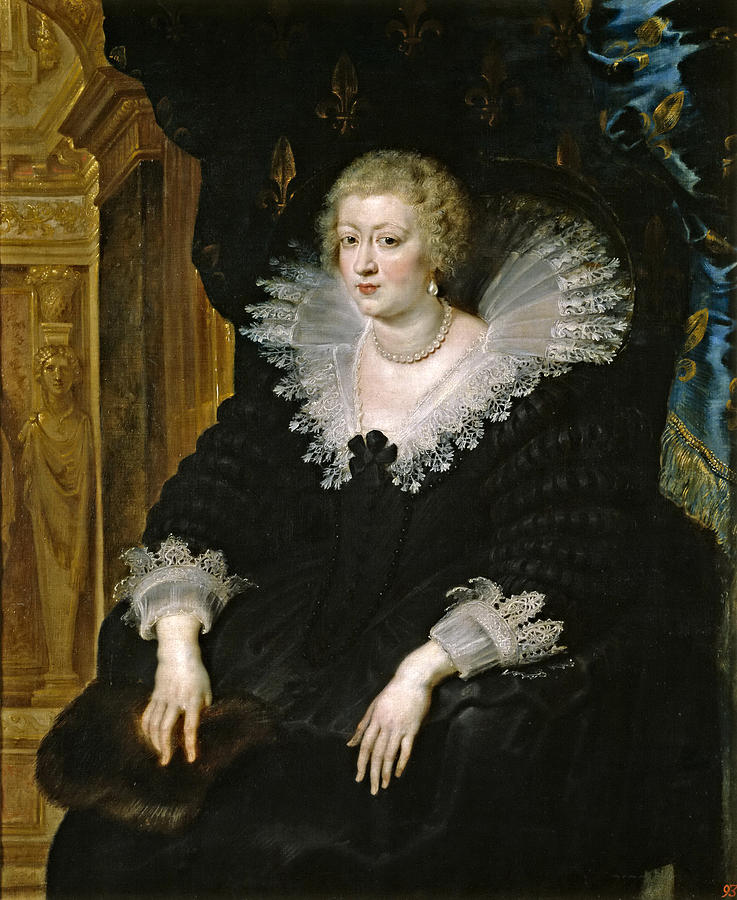
“Anna of Habsburg Queen of France” by Peter Paul Rubens is a commanding image of royal presence, political identity, and Baroque elegance. The queen sits frontally before us, dressed in a lavish black gown trimmed with lace, framed by golden architecture on one side and a rich blue curtain on the other. Rubens turns what might have been a conventional state portrait into a subtle psychological study, capturing both the majesty and the quiet introspection of a powerful woman navigating a complex court.
Although the exact date is unknown, stylistic clues place the work in Rubens’ mature period, when he was closely connected to the French and Spanish courts. The painting blends ceremonial splendor with the painter’s characteristic warmth and humanity, making it an essential work for understanding how early seventeenth-century queens chose to be seen.
Historical Context and Identity of the Sitter
Anna of Habsburg is better known today as Anne of Austria, the Spanish princess who became queen of France through her marriage to Louis XIII. As a Habsburg and a Catholic consort in a politically tense France, she stood at the intersection of dynastic diplomacy, religious conflict, and court intrigue. Portraits of her were not mere likenesses; they were instruments of dynastic propaganda, meant to affirm alliances and communicate stability to both domestic and foreign audiences.
Rubens, a diplomat as well as an artist, understood these stakes. He had already worked for Marie de’ Medici, Anne’s mother-in-law, painting the famous cycle of canvases celebrating Marie’s life. His familiarity with court protocol and his knowledge of how images functioned politically allowed him to paint Anne in a way that balanced personal individuality with dynastic symbolism.
In this portrait, Anne appears not only as an individual woman but also as a representative of two great houses: the Habsburgs and the Bourbons. Everything—from her costume to the background motifs—serves to underscore this layered identity.
Composition and Pose
Rubens composes the portrait with a strong vertical emphasis. Anne is seated squarely facing the viewer, but her body is turned slightly to one side, which softens the rigidity of the pose. Her hands rest calmly on her lap, one holding a dark fur muff, the other extended slightly forward, fingers relaxed. This carefully controlled posture projects decorum and self-possession rather than theatricality.
The queen’s head and shoulders are framed by a dark, high-backed chair or canopy decorated with fleur-de-lis, the lily emblem of the French monarchy. This framing device draws the eye to her face and ruff, making them the luminous center of the painting. The architectural elements on the left and the blue drapery on the right act almost like wings of a stage, directing attention inward toward the main figure.
The seated pose is telling. In royal portraiture, standing figures often signal active authority and martial power, while seated ones emphasize dignity, stability, and ceremonial rank. Anne’s full-length seated portrait aligns her with the tradition of queens and regents who rule through presence and counsel rather than direct command on the battlefield.
Costume and Court Fashion
Anne’s costume is a tour de force of Habsburg-Bourbon fashion and Rubens’ technical mastery. She wears a voluminous black gown whose dark surface is broken by intricate patterns of slashing and pleating. At the cuffs and neckline, cascades of fine white lace create striking contrast, transforming the dress into a statement of both sobriety and luxury.
Black was a favored color at the Spanish court, associated with elegance, piety, and high rank; it was costly to produce a deep, even black dye. By painting Anne in black, Rubens evokes her Spanish origins and her serious, devout reputation. At the same time, the lavish lace and jewelry prevent the outfit from appearing austere. This is a queen who can embody both modesty and magnificence.
Around her neck she wears a single strand of pearls and matching earrings. Pearls, long associated with purity and royalty, underscore her status as a Catholic queen and a legitimate consort destined for motherhood and dynastic continuity. Rather than overburden her with jewels, Rubens chooses a few key pieces, letting them sparkle against pale skin and dark fabric.
The fur muff resting under her left hand adds both textural richness and seasonal context. It suggests winter court life and echoes the sumptuousness of her gown while also providing a tactile counterpoint to the crisp lace and smooth pearls.
The Lace Ruff and Textural Detail
One of the most eye-catching features of the portrait is Anne’s lace ruff and collar. Rubens renders the delicate fabric with astonishing skill: tiny scallops, loops, and floral motifs emerge from the play of light across translucent layers. The ruff rises high behind her head and fans outward, framing her face like a halo while simultaneously acting as a fashion statement.
This elaborate neckpiece signals wealth and taste—fine lace was an extremely expensive commodity—and also enforces a certain physical discipline. The stiff structure requires the wearer to hold herself upright, reinforcing a sense of regal bearing. For the viewer, the ruff focuses attention on the face, emphasizing Anne’s status as the moral and dynastic center of the image.
Rubens differentiates textures across the painting with nuanced brushwork. The lace is built up with quick, light touches; the fur muff is treated with softer, feathery strokes; the heavy black fabric of the gown is modeled with broader, more opaque passages. These variations create a rich sensory experience, inviting the viewer to imagine not only the look but also the feel of these materials.
Color, Light, and Setting
The overall palette of the portrait is dominated by blacks, whites, golds, and deep blues. The black of the gown and the dark background create a visual field from which the luminous skin, white lace, and pearls emerge. Gold architectural details on the left echo the warm tones of Anne’s hair and the highlights on her jewelry, tying the composition together.
The blue drapery on the right, patterned with golden motifs, provides a counterbalance to the architectural column on the left. Draped fabrics were a staple of Baroque portrait backgrounds, suggesting luxury, stagecraft, and the malleable nature of political fortune. In this context, the blue cloth may also allude to the royal households with which Anne is associated, since blue and gold are dynastic colors in several European heraldic traditions.
Light is handled with Rubens’ characteristic subtlety. A soft, diffused illumination falls from the left, illuminating Anne’s face, neck, and hands, and catching delicately on pearls and lace. This light models her features gently, avoiding harsh shadows while still giving depth. The background remains relatively dark, ensuring that nothing distracts from the queen’s visage.
The architecture in the left background, with its gilded niches and statues, evokes a palace or chapel space. It hints at the grandeur of the royal environment without specifying a particular room, thereby elevating the portrait into a timeless, idealized setting rather than a specific moment in a specific location.
Facial Expression and Psychological Presence
Anne’s facial expression is restrained and dignified. She looks directly outward with a calm, slightly detached gaze. Her lips are closed, neither smiling nor frowning. This neutrality is typical of state portraits, where overt emotion could be seen as undermining the dignity of the sitter. Yet Rubens manages to imbue her features with a sense of interior life.
The faint flush in her cheeks, the slight tension around the eyes, and the relaxed but not slack mouth suggest a woman aware of being scrutinized, conscious of her role, yet perhaps carrying private burdens. Anne’s life at the French court was marked by political suspicion, struggles for influence, and difficulties in producing an heir; such biographical knowledge can color how viewers read her expression as thoughtful, even slightly melancholic.
Rubens avoids idealizing her features beyond recognition. She is presented as a real person with a particular bone structure, complexion, and age, not as an abstract symbol. This honesty enhances the painting’s power; we are not looking at an anonymous Queen figure, but at Anne herself, with all her cares and responsibilities.
Symbolism and Political Messaging
Every element in the painting contributes to a broader message about monarchy, legitimacy, and female power. The fleur-de-lis pattern behind Anne clearly identifies her as Queen of France, nested within Bourbon symbolism. The architectural richness and gilded statues link her to a long classical and Christian tradition of rulership, implying continuity and divine sanction.
Her costume’s black color can signal widowhood and piety, but here it more likely reflects fashionable Spanish court dress while also projecting seriousness suitable for a queen consort and future regent. The pearls and lace speak of wealth but also of refined taste and purity. The fur muff, while practical, hints at the queen’s physical presence and humanity; she is not a disembodied symbol, but a living woman who experiences climate, comfort, and touch.
The compositional centering of Anne, coupled with the encircling architectural and decorative elements, communicates stability. In a time of dynastic uncertainty and factional rivalries, such a portrait would reassure subjects and allies that France was anchored by a legitimate, dignified queen whose allegiance bridged Spanish and French interests.
Comparison within Rubens’ Portraiture
When compared to Rubens’ other portraits of high-ranking women—such as Marie de’ Medici, Isabella Brant, or various aristocratic sitters—this image of Anne stands out for its ceremonial gravity. His portraits of his wives and friends often show a more relaxed pose, open landscape, or playful details; here, every element is formal and tightly controlled.
Yet Rubens’ signature traits remain visible. The soft modeling of skin, the lively handling of textile textures, and the subtle interplay of warm and cool tones all point to his hand. The way the lace catches the light, the glint on the pearls, and the slight moisture in the eyes all testify to his observational acuity.
The portrait also participates in a broader European tradition of royal imagery. One can compare it to works by Velázquez, Van Dyck, and other court painters, who similarly balanced individualized likeness with dynastic iconography. Rubens’ Anne sits somewhere between the introspective realism of Spanish portraits and the elegant, elongated refinement that Van Dyck later developed in England.
Legacy and Modern Reception
Today, “Anna of Habsburg Queen of France” is valued not only as a masterful painting but also as a historical document. It offers insight into how a powerful queen wished—or was required—to be seen. For historians of costume, the painting is a rich source for studying early seventeenth-century fashion, particularly the transition from stiff ruffs to softer lace collars and the continued prominence of black gowns in high society.
Art historians appreciate the portrait as an example of Rubens’ ability to operate comfortably within the strict conventions of court art while still infusing his sitters with humanity. Viewers are drawn to the tension between the luxurious setting and the quiet, almost vulnerable presence of the queen. The painting invites questions about the pressures of monarchy, the role of women in power, and the ways images construct political identity.
In contemporary exhibitions, such a portrait can spark conversations about representation, gender, and authority. Anne’s controlled pose and rich costume may seem distant from modern informality, yet the subtle expression on her face remains relatable. She appears as someone who understands the weight of being constantly observed and the necessity of maintaining a carefully crafted public image.
Conclusion
Peter Paul Rubens’ “Anna of Habsburg Queen of France” is a brilliant synthesis of court protocol, dynastic symbolism, and personal portraiture. Through careful composition, sumptuous costume, and nuanced characterization, Rubens presents Anne as both a powerful queen and a reflective individual. The dark gown, radiant lace, pearls, and architectural setting all contribute to a visual narrative of dignity, piety, and political significance.
At the same time, the painting surpasses its propagandistic function. The gentle modeling of the queen’s face, the softness in her eyes, and the natural fall of her hands reveal the subtle empathy of an artist who saw beyond titles and regalia to the human being beneath. As a result, the portrait continues to captivate modern viewers, offering a vivid encounter with a historical figure whose life shaped the politics of seventeenth-century Europe.