Image source: wikiart.org
Introduction to Angel with Incense by Francisco de Zurbaran
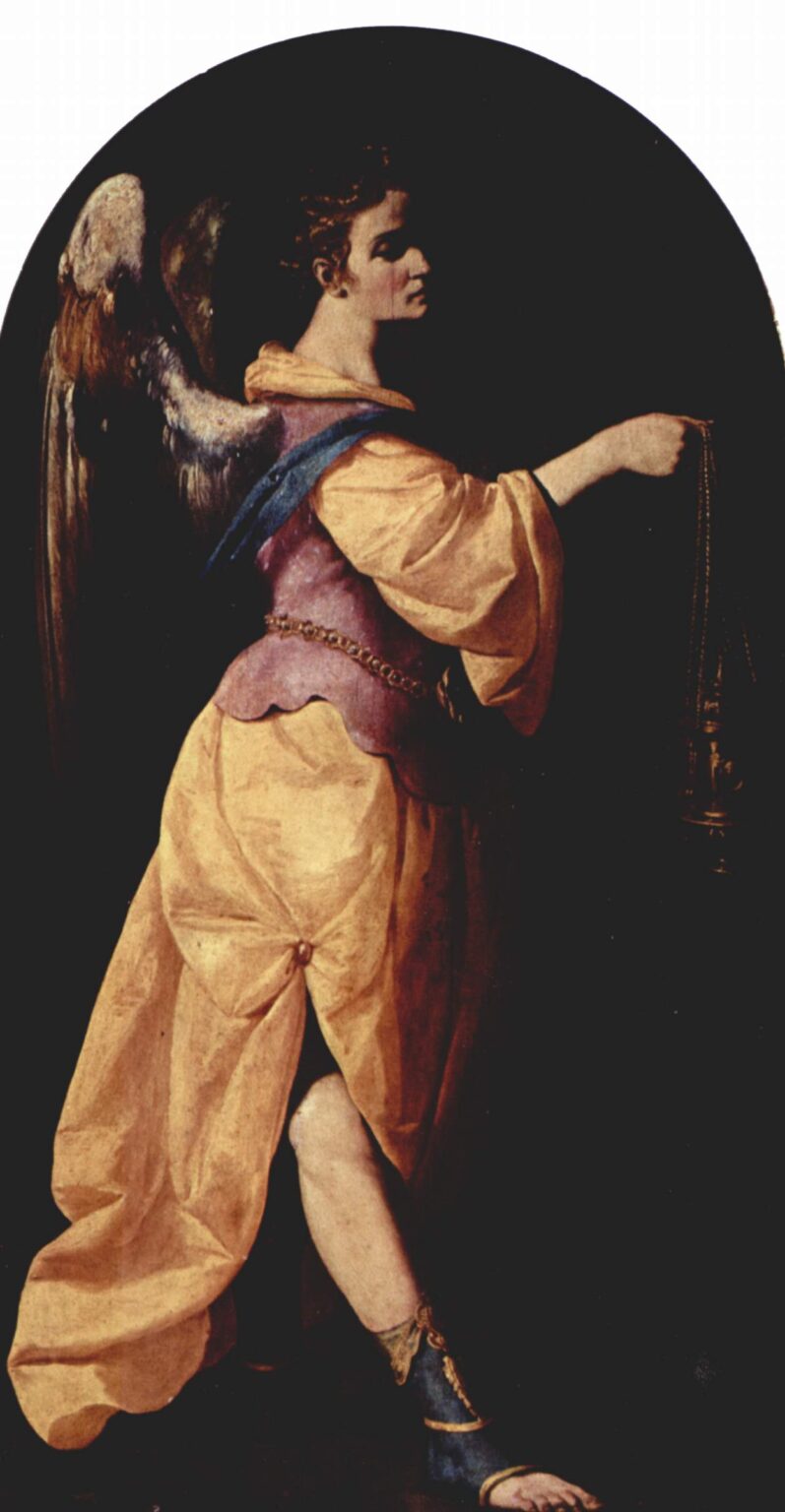
Francisco de Zurbaran’s “Angel with Incense,” painted in 1638, is a quietly spectacular image that fuses Baroque drama with meditative stillness. A single angelic figure fills the tall, arched format, stepping forward against a deep black background. Draped in voluminous yellow robes and a rose colored bodice, the angel turns in profile, one arm extended to swing a thurible that disappears into the darkness at the right edge.
At first glance, the painting seems simple. There is no narrative setting, no crowded composition, no explicit miracle. Yet the more a viewer studies the canvas, the more it reveals. The pose suggests movement, while the face remains tranquil. The darkness around the figure makes the golden fabric glow from within, as if the light of heaven itself were caught in cloth and skin. In this combination of motion and stillness, material richness and spiritual simplicity, Zurbaran achieves a powerful image of worship.
“Angel with Incense” is usually associated with liturgical imagery and may have formed part of a series of angels for an altarpiece or choir. Regardless of its original context, it now stands as one of the most refined examples of Zurbaran’s ability to turn a single figure into a complete world of devotion and beauty.
Historical and Religious Context
Seventeenth century Spain was a culture deeply marked by the liturgy of the Catholic Church. Processions, Masses, and hours of the Divine Office shaped daily life, especially in monasteries and convents, which provided many of Zurbaran’s patrons. Incense played a central role in these rites. It symbolized prayer rising to God, honor offered to the altar and the Gospel, and the sweet fragrance of sanctity.
Angels, too, occupied a vivid place in Spanish devotion. They were seen as heavenly courtiers, guardians of individuals and cities, and liturgical ministers who accompanied earthly worship with their own invisible praise. Religious art of the time often showed angels holding candles, musical instruments, or censers, visually linking the ceremonies in church to a larger cosmic liturgy.
Zurbaran responded to this atmosphere by producing several paintings of angels that seem designed for altars or choir stalls. “Angel with Incense” reflects that environment. Instead of portraying a biblical episode, he offers a timeless servant of God, perpetually engaged in offering incense. The painting would have resonated strongly with viewers who regularly saw incense smoke in church and who believed that angels moved unseen among the clouds of fragrance.
Composition and the Arched Format
The first striking feature of “Angel with Incense” is the tall, narrow, arched format. This shape echoes the architecture of church niches and altarpieces, making the painting feel as if it is part of the building itself. The arch encloses the figure like a halo of stone, focusing attention entirely on the angel.
Zurbaran positions the angel diagonally within this vertical space. The figure steps forward with the right leg, while the left leg remains behind, creating a sense of movement from left to right. The torso twists slightly as the arm extends outward to the right, holding the chain of the thurible. The face turns in profile, oriented toward the gesture. This dynamic pose keeps the eye traveling along the length of the figure and across the canvas.
Despite the sense of motion, the composition remains balanced. The fullness of the garments at the lower left counterweights the extended arm at the upper right. The wings, though subdued in color, provide a secondary mass at the upper left, preventing the figure from appearing top heavy. Because the background is almost entirely black, there is no distraction from the angel’s silhouette. The result is a composition at once simple and sophisticated, perfect for contemplation.
The Angelic Figure Gesture and Expression
Zurbaran’s angel is youthful, serene, and focused. The face, turned in profile, has calm classical features, with a straight nose, full lips, and a smooth jawline. The hair is arranged in soft curls, suggesting a certain courtly elegance. There is no crown or halo, yet the angel’s expression and bearing clearly mark it as a being from another realm.
The gesture of the right arm is essential to the painting’s meaning. The hand lightly holds the chain of the censor, which disappears into the shadows. The arm is neither tense nor limp. It suggests a controlled, habitual motion, as if the angel has swung the thurible countless times in endless praise. The left arm is bent close to the body, adding to the sense of collected poise.
The legs show a similar combination of energy and grace. The right foot, wearing a dark blue sandal adorned with golden decoration, steps forward, toes pointing slightly outward as if in mid stride. The left leg is partly hidden by the drapery but can be seen pushing off behind. This creates an impression of walking without actually moving. The angel is captured in an eternal procession, suspended between one step and the next.
Costume and Drapery A Meeting of Earth and Heaven
One of the most captivating elements of “Angel with Incense” is the clothing. Zurbaran dresses the angel not in a purely ethereal robe but in garments that evoke both liturgical vestments and court fashion. The lower garment is a wide, golden yellow tunic gathered in voluminous folds. A shorter, rose colored bodice fits snugly over the tunic, cinched at the waist with a chain belt that glints in the light. Over one shoulder lies a blue sash or mantle, and the legs are partly visible beneath the raised hem.
The yellow fabric is painted with extraordinary attention to texture. Broad planes of warm color are modulated by shadows into deep folds, suggesting a heavy, slightly stiff material. The way the garment gathers at the back, fastened by a button or tie to create a puffed volume, reveals Zurbaran’s delight in the fashion of his time. He translates the contemporary taste for elaborate folds into a sacred context, making the angel look both timeless and very much of the Baroque world.
The rose bodice and blue sash provide chromatic contrast. These cooler, darker tones prevent the yellow from overwhelming the composition and introduce a triad of colors often associated with divine and Marian imagery. The chain belt adds a subtle note of preciousness, hinting at angelic nobility without turning the figure into a glittering courtier.
Through these garments, Zurbaran bridges earth and heaven. The clothes are real enough to imagine touching them, yet their color and arrangement make them feel like vestments for a celestial liturgy.
Wings and the Subtle Signs of the Divine
Zurbaran’s depiction of the wings is restrained. Painted in soft browns and grays with hints of white, they avoid the bright colors seen in some angelic images. The feathers appear slightly worn, as if this angel has long been engaged in service rather than posing for display. The wings rise behind the shoulders and curve outward, partly lost in shadow.
This subdued treatment of the wings has several effects. It prevents them from competing with the face and garments for attention, thereby keeping the viewer’s focus on the act of offering incense. It also contributes to the painting’s overall seriousness. The angel is not a decorative accessory but a laborer in the heavenly liturgy.
At the same time, the presence of the wings transforms what might otherwise be seen as a young acolyte into a being of another order. They signal that the act of incense offering is not only a human ritual but something that crosses the boundary between visible and invisible worlds.
Chiaroscuro and the Mystery of Light
The dark background of “Angel with Incense” is a hallmark of Zurbaran’s style. By setting the figure against almost complete darkness, he heightens the dramatic contrast between light and shadow. The light source appears to come from the upper left, bathing the angel’s face, upper torso, and front leg in a warm glow. The back of the figure and the space behind fade into deep shadow.
This chiaroscuro has both visual and symbolic significance. Visually, it creates a sense of three dimensionality, making the angel appear as if it is emerging from the darkness into the viewer’s space. The strong highlights on the garments and skin give the figure a sculptural presence, almost as if it were carved marble touched by candlelight.
Symbolically, the light suggests divine illumination. The darkness can be read as the obscurity of the earthly world, while the brightly lit angel embodies grace breaking into that obscurity. The fact that the light seems to emanate from no visible candle or window reinforces its spiritual character. It is as though the radiance comes from the very act of worship, from the incense rising in unseen clouds.
The Thurible and the Idea of Prayer
Although the thurible itself is largely hidden in shadow, its presence is central. The chain hangs from the angel’s hand, disappearing off the lower right edge where we catch just a hint of the metal censer. This partial visibility invites the viewer to imagine the rest, including the glowing coals and fragrant smoke.
In Christian symbolism, incense represents the prayers of the faithful ascending to God. In the Book of Revelation and in many liturgical texts, angels are described as presenting these prayers before the divine throne. By giving the angel a thurible, Zurbaran visualizes this role. The painting becomes an image of intercession. The angel does not worship in isolation but carries the hopes and petitions of others.
For a viewer in a church, this imagery would be especially powerful. The sight of the painting could coincide with the actual smell and sight of incense during Mass or Vespers. The painting thus serves as a visual echo of a sensory experience, reminding worshipers that their earthly ritual is accompanied and perfected by heavenly assistance.
Possible Series and Liturgical Setting
Scholars often suggest that “Angel with Incense” was originally part of a pair or series of angel images designed for an altar or choir. Other paintings by Zurbaran show angels with candles, musical instruments, or different liturgical objects. A set of such figures arranged symmetrically around a central image would create a visual choir of heavenly attendants.
If this painting was indeed part of such a group, it would have participated in a larger visual narrative. Together, the angels would surround Christ, Mary, or a major saint with a ring of praise, just as the Eucharistic liturgy is surrounded by chants and ceremonial gestures.
Even when viewed in isolation today, however, “Angel with Incense” retains a strong sense of context. The arched top, vertical orientation, and liturgical object all suggest its original function. Looking at it, one can easily imagine organ music, chanted psalms, and the murmur of prayer echoing through a church.
Emotional Tone and Spiritual Invitation
The emotional tone of the painting is both solemn and gentle. There is no trace of fear, sorrow, or ecstatic upheaval. The angel’s expression is calm, the movement restrained, the colors warm and harmonious. This mood reflects the nature of the action being depicted. Offering incense is not a dramatic crisis but a regular, rhythmic act of worship.
For viewers, this calmness can have a soothing effect. The painting invites quiet contemplation rather than intense emotional reaction. It encourages a steady, ongoing orientation toward praise, much like the regular swinging of a thurible during the Divine Office.
At the same time, the solitary figure and deep darkness evoke a sense of mystery. The viewer may feel that the angel moves in a sacred space beyond ordinary human sight, yet the simplicity of the pose makes it easy to identify with the act of worship. In this way, the painting invites the viewer to join in a kind of silent liturgy, to imagine personal prayers mingling with that unseen incense.
Zurbaran’s Artistic Achievement in Angel with Incense
“Angel with Incense” showcases many of Zurbaran’s strengths as a painter. His mastery of drapery, developed through countless depictions of monastic habits, is here applied to luxurious yet controlled garments. His understanding of light, honed in stark images of saints against darkness, gives the angel an almost tangible presence.
What makes the painting particularly impressive is the balance he achieves between naturalism and idealization. The anatomy of the legs and arms is convincing, the folds of fabric behave plausibly, and the wings have a modest realism. Yet the overall pose and serenity of the face push the figure beyond the everyday. The angel looks both human and more than human, rooted in the real world yet belonging to another.
In this work, Zurbaran also demonstrates his ability to handle color with refinement. The yellow, rose, and blue garments create a rich yet harmonious palette. Against the black background, these colors glow like stained glass lit from within. The careful distribution of color over the figure guides the eye from head to feet and back again, making the painting endlessly rewarding to study.
Conclusion A Silent Liturgy on Canvas
Francisco de Zurbaran’s “Angel with Incense,” painted in 1638, is a radiant example of how a single figure can embody a whole vision of worship. With no elaborate setting or dramatic narrative, the painting communicates the essence of liturgical praise. A young angel steps forward in quiet motion, swinging a thurible that symbolizes the prayers of the faithful.
Through controlled composition, masterful chiaroscuro, and rich yet balanced color, Zurbaran turns this action into a timeless ritual, forever unfolding within the frame. The angel’s serene expression and poised gesture invite viewers to consider their own participation in divine worship. Whether displayed in a church or a museum, the painting remains a visual reminder that prayer rises continuously, carried by hands both human and angelic.
In “Angel with Incense,” Zurbaran unites the grandeur of Baroque art with the intimacy of personal devotion. The result is a silent liturgy on canvas, a perpetual offering of fragrance and light before the unseen presence of God.