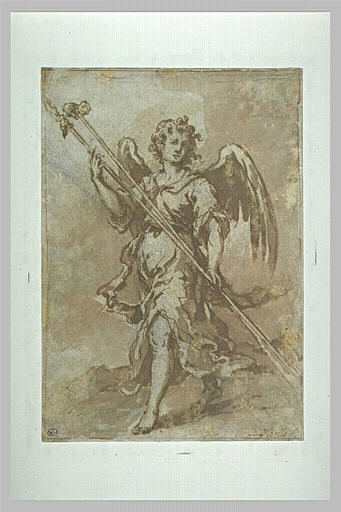
Image source: wikiart.org
Introduction to “Angel holding the spear and sponge holder”
“Angel holding the spear and sponge holder,” created around 1660 by Bartolomé Esteban Murillo, belongs to a remarkable group of small devotional drawings in which the artist explores angels bearing the instruments of Christ’s Passion. Executed in brown ink and wash on paper rather than in oil, this work has an intimate and contemplative character. The monochrome palette strips away distraction so that line, gesture, and symbol carry the spiritual message.
At the center of the image stands a youthful angel, advancing toward the viewer with quiet determination. In its hands the angel carries a long diagonal staff that combines two crucial objects from the Crucifixion narrative. At the upper end we see the spear that pierced Christ’s side and also the holder for the sponge dipped in vinegar and offered to him on the cross. Instead of showing these instruments in the hands of Roman soldiers, Murillo entrusts them to a heavenly messenger. This transformation signals that the story of suffering has been taken up into the life of heaven and turned into a source of redemption.
Although modest in size, the drawing condenses theology, Baroque movement, and Murillo’s personal sense of tenderness. It rewards sustained looking, revealing layer after layer of meaning in the angel’s posture, the flow of drapery, and the subtle play of light and shade.
Composition and Visual Structure
Murillo organizes the composition around a strong diagonal. The spear and sponge holder runs from the lower left corner toward the upper right, almost touching the edge of the sheet. This diagonal line introduces dynamic energy, immediately conveying the idea of movement and purposeful action. It also divides the space into two unequal zones that keep the composition from feeling static or symmetrical.
The angel stands with one foot slightly forward and the other trailing behind, following the direction suggested by the spear. The figure occupies nearly the full height of the drawing and is positioned just off center, which enhances the sense of forward motion. Murillo balances this movement by allowing the wings to unfold in the opposite direction, so that the right wing reaches outward while the left wing drops more vertically.
The background remains deliberately vague. Soft washes of brown ink suggest clouds or an undefined spatial environment, but there are no architectural elements or landscape details. The absence of specific setting allows the viewer to imagine the scene as taking place in a spiritual realm, not tied to a particular earthly location. The empty space around the angel also accentuates the clarity of the figure and the Passion instruments that it carries.
The Angelic Figure and Gesture
The angel’s pose is crucial to the emotional tone of the drawing. Murillo chooses a walking stance, not a theatrical leap or rigid posture. One bare foot steps forward, toes visible, pressing gently into the ground. The other foot lags slightly behind, establishing balance and continuity. This slow, measured step gives the impression of a solemn procession. The angel is not running into battle, but advancing calmly, as if participating in a liturgical ritual.
The left arm reaches upward to grasp the spear near its midpoint, while the right arm extends diagonally downward, holding the staff closer to its base. This double grip conveys both control and effort. The instrument is long and heavy, yet the angel bears it with grace. The hands do not clutch in desperation, they hold firmly in service.
The head tilts slightly, with the face turned outward toward the viewer. This gentle rotation of the neck softens the strict alignment of body and staff, giving the figure a human and approachable quality. The gaze appears steady and thoughtful. The angel becomes not only a bearer of objects, but also a conscious witness to the events that these objects recall.
Drapery, Movement, and Baroque Rhythm
Murillo’s treatment of drapery animates the entire drawing. The angel’s robe wraps around the body in flowing folds that catch the light and plunge into shadow. At the waist a simple sash gathers the fabric, and from that knot the cloth cascades downward, breaking into diagonal ridges that echo the line of the spear. This repetition of diagonals creates a rhythmic harmony throughout the composition.
The edges of the garment flutter outward around the legs and ankles, suggesting that air is moving around the angel as it walks. These fluttering hems also convey the spiritual lightness of the figure. Even though the angel carries a heavy instrument, it appears unburdened, as if the weight is transformed by divine strength.
Murillo uses diluted washes and varied line density to suggest the volume of cloth. Darker strokes accentuate the deepest folds and areas under the arms, while the tops of folds are left lighter, allowing the whiteness of the paper to serve as highlight. This interplay of tone mimics the shimmer of fabric in real light and gives the drawing a sculptural presence.
Wings, Face, and Emotional Tone
The wings, folded partly behind the angel, confirm its celestial identity and contribute significantly to the overall composition. The right wing arcs outward and downward, its feathers rendered in simple, repeated strokes. The left wing is more vertical, falling closer to the body. Together they frame the figure like a living mantle. Their substantial size adds visual weight to the upper half of the sheet and balances the long spear.
Murillo’s angels often display youthful, almost childlike faces, yet here the features carry a more serious expression. The hair curls softly around the forehead in loose ringlets. The eyes are large and open, the mouth slightly parted. Rather than smiling, the angel seems absorbed in its task. The expression conveys a quiet awareness of the gravity of what the spear and sponge represent, yet without sadness that overwhelms. It is the look of a being who knows that suffering has been transformed into salvation.
This controlled emotional tone reflects the devotional function of the drawing. It is meant to lead the viewer into contemplation, not overwhelm with dramatic grief. The angel becomes a guide into the mystery of the Passion, inviting those who gaze upon it to ponder rather than to recoil.
Instruments of the Passion: Spear and Sponge Holder
The long staff that the angel carries combines two of the most poignant instruments associated with the Crucifixion. At its upper end we can discern the spear related to the centurion Longinus, who according to tradition pierced Christ’s side after his death on the cross. Attached near the top is also the holder for the sponge, which was soaked in sour wine and lifted to Christ’s mouth as he hung on the cross.
In conventional Passion scenes these objects appear in the hands of Roman soldiers or hostile figures. Murillo’s decision to place them in the grasp of an angel radically changes their meaning. The instruments of cruelty are now carefully preserved as precious relics. They are no longer tools of humiliation but signs of the sacrifice by which redemption is accomplished.
The diagonal position of the spear suggests both historical memory and present proclamation. It is as if the angel is carrying these objects from the scene of the Crucifixion into the realm of the viewer, so that the events of Calvary remain alive in memory and devotion. The presence of the sponge holder, often overlooked in larger compositions, emphasizes the physical reality of Christ’s suffering, the thirst of the crucified one, and the small gestures of human interaction that accompanied his final moments.
Technique, Medium, and Drawing Style
Executed in brown ink and wash, “Angel holding the spear and sponge holder” showcases Murillo’s mastery of drawing as a medium distinct from painting. Without the full resources of color, he relies on the expressive potential of line and tone. The contours of the figure and spear are defined with confident strokes, sometimes dark and assertive, sometimes light and suggestive.
Wash is used to model volume and to create a soft atmospheric background. Murillo allows the wash to pool in certain areas and fade in others, producing a mottled surface that contributes to the antique charm of the work. The texture of the paper remains visible in places, engaging the eye with subtle variations.
Unlike a finished oil painting, this drawing retains traces of spontaneity and process. Small corrections and overlapping lines reveal the artist’s search for the right pose. Yet the overall impression is one of clarity and control. The composition feels fully resolved, suggesting that Murillo intended the sheet to stand on its own as a devotional image or a modello for a more elaborate project.
Spiritual and Devotional Context in Seville
To fully appreciate the drawing, it is helpful to consider the spiritual atmosphere of seventeenth century Seville, Murillo’s home city. Devotion to the Passion of Christ was central to religious life. Processions during Holy Week, confraternities dedicated to specific aspects of the Passion, and churches filled with images of suffering and redemption shaped the imagination of artists and worshippers alike.
In this context a drawing of an angel carrying Passion instruments would have been immediately meaningful. Viewers would recognize the spear and sponge holder and recall the corresponding moments in the Gospel story. The angel’s presence would reassure them that the events of Good Friday are not lost in the past, but cherished in heaven and made present in liturgy and prayer.
Such drawings could serve many functions. They might prepare designs for altarpieces, be translated into prints for widespread devotion, or be treasured as unique works in private collections. Whatever the exact purpose, they share a single aim, to deepen meditation on Christ’s sacrifice and to encourage imitation of the virtues associated with it, such as humility, patience, and love.
Relationship to Murillo’s Other Angel Drawings
“Angel holding the spear and sponge holder” is part of a small series in which Murillo represented angels bearing different instruments of the Passion. Other sheets show an angel carrying the cross, another bearing the inscription board with “INRI,” and others with additional symbols. Seen together, these drawings form a kind of angelic cortege, each figure carrying one aspect of the Passion as if in a solemn procession.
Comparing them highlights Murillo’s inventiveness within a limited theme. Each angel is distinct in pose and character. The angel with the cross embraces the instrument with both arms, emphasizing loving acceptance. The angel with the inscription presents a small tablet, stressing the proclamation of Christ’s identity. The present drawing, with the spear and sponge holder, focuses on movement and the physical reality of Christ’s wounds and thirst.
All these works share the same monochrome technique and delicate modeling. They reveal Murillo’s fascination with angels as intermediaries between divine mysteries and human devotion. Through them he could explore graceful movement and subtle emotion, while also expressing central truths of his faith.
Contemporary Appeal and Lasting Significance
Although created for a seventeenth century Catholic context, “Angel holding the spear and sponge holder” retains strong appeal for modern viewers. Its restrained beauty and intimate scale invite close contemplation. The drawing offers an alternative to the more dramatic and sometimes overpowering Baroque canvases that dominate church interiors. Here the mystery of the Passion is distilled into one quiet figure and a single diagonal gesture.
Beyond specific religious meanings, the work speaks more broadly about how human beings remember suffering. The spear and sponge symbolize pain and thirst, yet in the hands of an angel they also suggest care, memory, and transformation. The image can thus be read as a meditation on how painful experiences are carried forward and given meaning, rather than erased or forgotten.
The drawing also provides insight into the artistic process of a major Baroque painter. It shows how Murillo constructed figures, how he balanced movement and stability, and how he used the simplest means to achieve depth and presence. For artists and art lovers alike, the sheet illustrates the enduring power of drawing as a vehicle for both technical skill and spiritual reflection.
Conclusion
“Angel holding the spear and sponge holder” by Bartolomé Esteban Murillo is a finely crafted union of Baroque style and devotional content. Through a single youthful angel striding forward with the instruments of Christ’s suffering, the artist gives visual form to the memory of the Passion and its transformation in the light of faith.
The strong diagonal of the spear, the flowing drapery, the balanced wings, and the gentle yet serious expression of the angel all work together to create a scene of quiet solemnity. Murillo’s mastery of ink and wash allows him to evoke atmosphere and movement with minimal means. The drawing stands as a testimony to his ability to blend elegance and emotion, and to communicate complex theological ideas through simple, clear imagery.
Even centuries after its creation, the work continues to invite viewers into contemplation. It speaks of suffering endured, love remembered, and the enduring hope that transforms instruments of pain into signs of grace.