Image source: wikiart.org
Introduction to Angel holding a hammer and nails
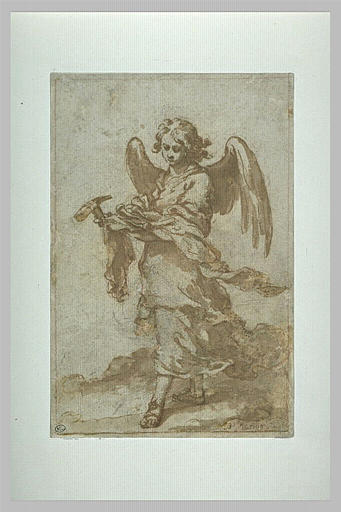
“Angel holding a hammer and nails,” created by Bartolome Esteban Murillo around 1660, offers a delicate and contemplative vision of a celestial messenger. Unlike Murillo’s large oil paintings filled with color and drama, this work is a small, monochrome drawing in which line and wash carry all the emotional weight. An angel moves lightly across a cloudlike ground, holding the humble tools of the Crucifixion.
The subject belongs to the iconographic group known as the Instruments of the Passion. These are the simple objects associated with Christ’s suffering, transformed into symbols of redemption. Murillo presents them not in the hands of a soldier or tormentor, but entrusted to a gentle angel. The result is an image which blends sorrow with consolation and invites quiet meditation on the mystery of the Cross.
Medium, Technique and First Impression
The drawing is executed in a restricted palette, probably pen and brown ink with brown wash over a light ground. Murillo uses fine, economical lines to define the contours of the figure, then builds volume with transparent layers of wash. The limited tonal range forces the viewer to pay attention to rhythm, proportion and gesture rather than to color.
At first glance the image feels airy and light. The angel’s robes flutter around the body, and the ground beneath the feet dissolves into indistinct clouds. The figure does not appear weighed down by the tools it carries. Instead, there is a sense of graceful movement, as though the angel is walking slowly while absorbed in thought.
The small format, surrounded by a generous margin, enhances the precious quality of the work. It resembles a devotional image meant for close inspection, possibly a preparatory study for a larger composition, yet fully satisfying as an independent meditation on the Passion.
Composition and Spatial Organization
Murillo places the angel slightly to the right of center, striding diagonally from left to right. This diagonal movement animates the composition and prevents it from feeling static. The figure is seen three quarter length and slightly from below, which gives a hint of monumentality despite the modest size of the sheet.
The wings extend outward in an elegant arc that echoes the curve of the drapery. They frame the head and shoulders, reinforcing the vertical axis of the body. The left wing is fully revealed, while the right is partially hidden behind the figure, creating a subtle sense of depth.
The tools, a small hammer and several nails, are held in both hands at the level of the chest. Murillo arranges them so that they are clearly visible, yet integrated with the folds of the cloth that cradles them. The diagonal formed by the hammer handle intersects the diagonal of the figure’s stride, weaving the instruments firmly into the overall design.
The lower part of the drawing is occupied by a soft, irregular mass of cloud. It supports the angel’s bare feet and blurs the boundary between earth and heaven. No architectural background or landscape is included, which focuses attention entirely on the figure and the symbolic objects it bears.
The Angel’s Gesture and Expression
The most striking element of the drawing is the angel’s gesture. The head tilts gently downward, the gaze directed toward the tools in its hands. This introspective posture suggests reverence and sorrow touched by acceptance. The angel does not look out toward the viewer, which invites us to join in its contemplation rather than to meet its eyes in direct communication.
The hands are drawn with particular delicacy. Fingers curve softly around the cloth that holds the hammer and nails, neither gripping them tightly nor letting them slip. The gesture recalls the way one might carry something both precious and dangerous. These objects have inflicted terrible pain, yet in Christian belief they also opened the path to salvation.
The face is youthful and slightly androgynous, with gentle features framed by curling hair. A faint smile plays around the lips, though it is more a smile of tenderness than of happiness. Murillo avoids dramatic anguish, choosing instead a mood of quiet melancholy and trust. The angel is aware of the suffering associated with these instruments, yet accepts its role in presenting them to the viewer.
Drapery, Line and the Sense of Movement
Murillo’s handling of drapery reveals his mastery of Baroque rhythm even in a small drawing. The garment wraps around the angel’s body in a series of sweeping folds that convey both form and motion. Long diagonal lines in the robe echo the direction of the stride, while shorter, curved folds create lively accents around the waist and sleeves.
The hem of the robe lifts slightly as if caught by a soft breeze. This movement, combined with the lifted back foot and the forward placement of the other, suggests that the angel is in mid step. The figure is not merely posing but traveling toward an unseen destination.
Murillo uses line sparingly, allowing the wash to do much of the modeling. Contours are firm but not rigid. In some areas, such as the wings and the edges of the clouds, he allows the ink to fade and break, which gives a sense of softness and light. The alternation of defined line and blurred wash keeps the surface visually interesting and supports the theme of a being who belongs partly to another world.
The Instruments of the Passion and Their Symbolism
The hammer and nails are simple objects, yet in Christian art they carry immense symbolic weight. They are the tools that attached Christ’s hands and feet to the cross. Murillo’s choice to place them in the hands of an angel transforms instruments of cruelty into emblems of love.
By wrapping them in a cloth, the angel treats them almost like relics. The cloth may recall the veil of Veronica, the burial shroud, or the linens associated with liturgical rituals. It protects the bearer from direct contact and also elevates the objects, presenting them with a sense of ceremony.
The number of nails, traditionally three, often symbolizes the three wounds of Christ’s limbs or the three theological virtues. The hammer can be read as the human force that drove the nails, yet when carried by an angel it also becomes a reminder that even human violence is ultimately encompassed within divine providence.
Murillo’s drawing thus invites meditation on the paradox of the Passion. These tools caused physical agony, yet through them God’s redeeming love was made manifest. The angel’s reverent handling suggests that believers are called to gaze on the cross not morbidly, but with grateful wonder.
Devotional Context and Murillo’s Spiritual Sensibility
Seventeenth century Spain cultivated an intense devotion to the Passion of Christ. Confraternities organized processions with sculpted images of the suffering Christ. Monasteries and churches encouraged meditative prayer on each stage of the Passion. Works like Murillo’s drawing would have served that spiritual culture by providing a focused image for contemplation.
Murillo is often associated with gentle, lyrical interpretations of religious themes. Even when he depicted scenes of sorrow, he was inclined to soften harsh details and emphasize consolation. In “Angel holding a hammer and nails,” this sensibility is evident. The mood is quiet and prayerful rather than tragic. The angel acts as a mediator who helps the viewer approach the mystery of the cross with trust.
The drawing could also have functioned as a study for a larger painting in which multiple angels carry different instruments of the Passion. Whether preparatory or independent, it reflects Murillo’s ability to express complex theology with a single figure and a few well chosen symbols.
Artistic Context within Murillo’s Oeuvre
While Murillo is best known for his oil paintings of the Immaculate Conception, the Holy Family and scenes of everyday life in Seville, he was also an accomplished draftsman. His drawings often served as experiments in composition or as meditations he made for his own use.
This angel belongs to a broader tradition of Spanish Baroque drawings that combine functional purpose with artistic refinement. Compared with some of his more detailed studies, this sheet is relatively free and spontaneous. The light touch of the pen and the transparent wash suggest that Murillo was confident in his understanding of anatomy and drapery. He could evoke a convincingly moving figure with minimal means.
Art historians often note the influence of Italian and Flemish models on Murillo. Angels bearing instruments of the Passion appear in works by artists such as Rubens and Van Dyck. Yet Murillo’s version is more restrained and introspective. The small scale and delicate technique reflect a specifically Spanish taste for intimate devotional images that encourage individual reflection.
Emotional Resonance and Viewer Experience
Standing before this drawing, the viewer is likely to feel drawn into a quiet dialogue. The angel does not confront us directly but instead seems absorbed in its own contemplation. That inward focus encourages us to join the angel’s meditation, to imagine ourselves present at the unfolding drama of the Passion.
Because the tools are small and modest, we must look closely to discern their shapes. This act of close looking parallels the spiritual practice of slowly pondering each detail of Christ’s suffering. The more one studies the drawing, the more eloquent the small gestures become. The cloth that wraps the hammer and nails, the tilt of the head, the trailing folds of the robe, all speak of a love that treats even painful memories with tenderness.
The monochrome technique also contributes to the emotion. Without the distraction of vivid color, the viewer experiences the image in terms of light and shadow, presence and absence. The brown tones resemble dried blood or aged parchment, subtly reinforcing the sense that this is a memory preserved, a story that has already taken place yet continues to shape the present.
Conclusion
“Angel holding a hammer and nails” by Bartolome Esteban Murillo is a small yet profound work that encapsulates the heart of Christian meditation on the Passion. Through a single, gracefully moving figure and a few simple objects, Murillo evokes themes of sorrow, reverence and redemption.
The angel’s gentle stride across the clouds, the careful way it cradles the tools of crucifixion, and the soft glow of line and wash combine to create an image that is at once humble and exalted. Here the instruments of pain have become instruments of grace, carried not by executioners but by a messenger of heaven.
In this drawing Murillo demonstrates how powerful drawing can be as a vehicle for theological and emotional depth. Stripped of color and grand architectural settings, the scene relies on gesture, rhythm and symbol. The viewer who lingers over it enters into the angel’s contemplative movement, joining in a quiet act of remembrance that bridges earth and heaven.