Image source: wikiart.org
Introduction to “Angel holding a banner”
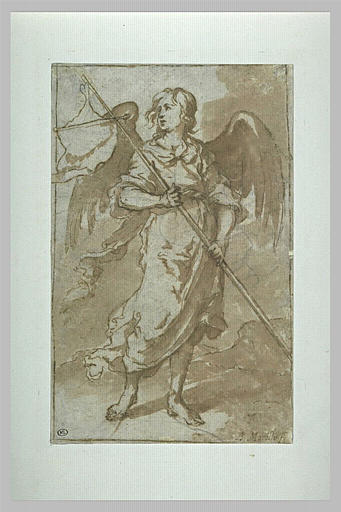
“Angel holding a banner,” created by Bartolome Esteban Murillo around 1660, is a small but eloquent image that shows how powerful a simple drawing can be. Unlike his large oil paintings filled with color and dramatic light, this work relies on a limited palette of ink and wash. In this restrained medium Murillo evokes an angelic figure who seems to hover between earth and heaven, poised in gentle motion with a long banner staff.
The sheet offers a rare glimpse into Murillo’s creative process. Here he is not yet working for an altar or a chapel. Instead he explores pose, gesture, and mood with a freedom that is sometimes harder to see in his finished canvases. The angel is at once a preparatory study and a complete image in its own right, a meditation on grace embodied in line and tone.
Murillo’s context and the role of angelic studies
By the 1660s Murillo was one of Seville’s most sought after painters. Many of his major commissions included angels. They appeared in altarpieces, Immaculate Conception scenes, and large narrative works that required celestial attendants. To populate these compositions convincingly, Murillo prepared studies of individual angels in various poses and attitudes.
“Angel holding a banner” belongs to that world of preparatory exploration. The figure holds a long staff topped with a fluttering cloth, a familiar attribute in processions and triumphal religious imagery. Such a figure could easily be adapted for an altarpiece, perhaps accompanying a saint, announcing the Resurrection, or appearing in a Marian vision. The drawing demonstrates how Murillo considered balance, silhouette, and rhythm before translating the figure into oil.
At the same time, Spanish collectors of the period valued finished drawings as devotional images. An angel with a banner could serve to decorate a private oratory, reminding the owner of divine presence and celestial worship. The sheet therefore stands at the intersection of studio tool and spiritual image.
Composition and the poised stance of the angel
Murillo arranges the angel within a vertical rectangle that echoes the length of the banner staff. The figure stands slightly off center, turned diagonally toward the viewer’s left. One foot steps forward while the other remains further back. This contrapposto stance gives the body a dynamic twist, suggesting that the angel is either about to walk or has just come to a stop.
The staff runs from the lower right corner to the upper left, cutting across the body in a bold diagonal. Its long line stabilizes the composition while enhancing the sense of movement. The banner at the top introduces a lighter, curving form that balances the solid vertical of the angel’s body and the broad shape of the wings.
The figure’s head tilts in the opposite direction of the staff, slightly upward and to the right. This counter motion creates a graceful S curve through the torso and neck, a classic device inherited from Renaissance art. Even within the limited space of the drawing, Murillo orchestrates a subtle dance of lines that keeps the eye moving.
The banner and its symbolic significance
The banner carried by the angel has rich associations. In Christian art, angels often appear as messengers, bearing scrolls or banners that proclaim the glory of God, victory over sin, or specific phrases from Scripture. Sometimes a banner indicates the Resurrection, as in images of Christ emerging from the tomb with a white flag marked with a cross. At other times it is associated with triumphal processions on feast days.
Murillo does not inscribe any text on this particular banner, leaving it visually open. The cloth curves outward as if caught by wind, its edges fluttering. The emptiness of the banner allows viewers to project their own meanings. It can stand for the unspoken word of God, the song of praise that angels offer unceasingly, or announce a yet to be revealed message.
By giving the angel such an attribute, Murillo emphasizes the figure’s active role. This is not a static guardian watching silently. It is a herald, prepared to move forward and display its standard. The long staff that almost exceeds the boundaries of the sheet reinforces the idea that the angel’s mission extends beyond the small space of the drawing into the viewer’s world.
Drapery, rhythm, and the suggestion of motion
One of the pleasures of this drawing lies in Murillo’s treatment of the garment. The angel wears a simple, long robe that wraps around the body in fluid folds. The lines of the drapery follow the contours of the figure yet respond to an invisible breeze. The cloth swirls slightly around the legs, lifts near the hem, and bunches at the waist where the hands hold the staff.
Murillo uses swift, confident strokes to indicate these folds. He does not describe every crease. Instead he chooses key lines that suggest how the fabric falls and moves. Areas of wash deepen the shadows where the cloth overlaps or turns inward, giving volume to the robe.
The result is a sense of continuous movement. The robe appears to ripple gently as the angel shifts weight from one foot to the other or turns in space. This rhythmic treatment of drapery is typical of Murillo and reveals his study of Italian models, where garments often serve as visual expressions of spiritual energy.
Wings, anatomy, and the angel’s spiritual presence
The angel’s wings dominate the upper part of the figure, stretching outward in two dark shapes. Murillo defines them with broad strokes and patches of wash, suggesting layered feathers without painstaking detail. The contrast between the dark wings and the lighter robe emphasizes the supernatural quality of the figure. The wings serve as both anatomical appendages and symbolic signs of the heavenly realm.
Anatomically, the angel stands with believable weight. The knees bend according to the turn of the hips, the arms wrap around the staff in a natural way, and the shoulders rotate to support the diagonal movement. Murillo’s training in life drawing, rare but present in Spanish workshops, is evident here. Even though the figure is clothed and winged, the underlying structure of the body feels convincing.
Spiritually, the wings transform this otherwise human figure into a mediator between worlds. The face shows no exaggerated ecstasy or sternness. Instead, the angel appears composed, almost introspective, as it looks into the distance. This balance between physical solidity and quiet interiority gives the figure a strong spiritual presence.
Light, shadow, and the economy of wash
“Angel holding a banner” is executed in pen and brown ink with brown wash. Murillo uses the wash to create areas of shadow and to suggest atmospheric depth. The darkest tones appear in the wings, along the side of the robe, and beneath the feet, indicating where light is blocked or where forms turn away from the light source.
The ground beneath the angel consists of a few horizontal strokes and a darker wash where the shadow falls. This device anchors the figure and prevents it from floating aimlessly. At the same time, Murillo leaves large portions of the paper untouched. The white of the support becomes the highlight on the robe and banner, giving the image brightness without heavy labor.
This economy of means shows Murillo’s confidence as a draughtsman. With relatively few marks he evokes a complex scene. The viewer’s eye fills in the gaps, sensing clouds, air, or distant space where only a vague wash exists. The interplay of line and wash creates a dynamic texture that would be lost in a more polished oil painting, making this drawing particularly vital.
Spiritual themes and emotional tone
Although the drawing lacks the color and elaborate iconography of Murillo’s large religious works, it expresses several key spiritual themes. The angel’s forward stance and raised banner call to mind ideas of proclamation and guidance. Angels in Catholic tradition were believed to lead believers, protect them, and announce God’s will. This figure, ready to move, suggests a moment of readiness just before speech or action.
The emotional tone is calm yet energetic. The angel’s features are not detailed enough to show a specific expression, but the tilt of the head and the open stance convey quiet alertness. There is no sign of struggle, terror, or exuberant ecstasy. Instead Murillo offers a sense of steady, watchful presence. It is the kind of spiritual attitude that many seventeenth century viewers would have associated with faithful service.
The simplicity of the medium reinforces this atmosphere. Without brilliant colors or dramatic contrasts, the viewer is invited to contemplate the essence of the figure. The monochrome scheme echoes the contemplative practices of the period, where believers meditated on images not to be dazzled but to be guided toward prayer.
Relationship to Murillo’s larger body of work
When compared with Murillo’s better known canvases, such as his Immaculate Conceptions or scenes of the Holy Family, “Angel holding a banner” appears modest. Yet it reveals fundamental aspects of his style. The gentle movement, soft modeling, and humane spirituality that characterize his paintings are all present here in embryonic form.
In many of his altarpieces angels flank central figures, carry attributes, or hover in the heavens. The pose of this angel could easily be incorporated into such a composition, perhaps mirrored or adjusted. Thus the drawing may have served as a reference sheet to be consulted when arranging groups of angels around a saint or the Virgin.
The work also underlines Murillo’s role as a master draughtsman, something that can be overlooked when focusing only on his finished oils. In Spain, drawing often remained within the workshop, rarely signed or displayed. The survival of this sheet allows us to appreciate the skill that undergirded Murillo’s more public works. It shows that his grace in paint was supported by disciplined study in ink.
Legacy and contemporary appreciation
Today, “Angel holding a banner” speaks to viewers who are drawn to quieter, more intimate works. The drawing’s small scale invites close inspection. Looking at it feels like peeking into the artist’s notebook, catching a moment when inspiration took quick form on paper. For art historians, such sheets are invaluable evidence of process and technique. For general viewers, they offer a more personal connection to the artist.
The subject of an angel also continues to resonate across cultures and beliefs. Even outside specific religious contexts, angels are often associated with protection, guidance, and messages from beyond. Murillo’s figure, with its gentle motion and unspecific banner, can be appreciated as a symbol of hope and direction in uncertain times.
Collectors and museums value such drawings not only for their authorship but for their ability to condense the essence of Baroque style into a few lines and washes. They showcase how seventeenth century artists thought in terms of gesture and silhouette before adding color and detail. In this sense, “Angel holding a banner” is both a historical document and a timeless example of the beauty of drawing.
Conclusion
“Angel holding a banner” by Bartolome Esteban Murillo is a small masterpiece of Baroque draftsmanship. Through a limited palette of ink and wash, the artist creates a figure full of life, movement, and quiet spiritual power. The composition balances diagonals and curves, the drapery ripples with subtle rhythm, and the wings frame a body that stands firmly yet seems ready to move forward into the viewer’s space.
As a study, the drawing hints at larger works to come. As a finished image, it invites meditation on the role of angels as heralds and protectors. Murillo’s careful yet economical strokes capture not only the form of an angel but the attitude of attentive service and readiness to proclaim.
Viewed today, the drawing continues to delight by its elegance and restraint. It reminds us that sometimes the most profound expressions of faith and beauty can be found not in grand altarpieces but in the quiet language of line on paper.