Image source: wikiart.org
Introduction
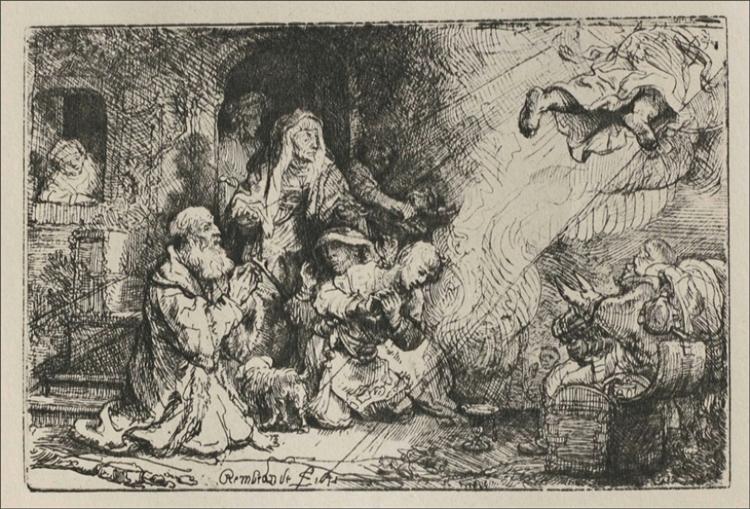
Rembrandt’s “Angel Departing from the Family of Tobias” (1641) is a compact etching that distills an entire chapter of the Book of Tobit into a chamber-sized miracle. Within a few inches of copper, the artist stages a farewell that is at once domestic and cosmic: a humble interior filled with baskets, stools, and pets becomes the threshold where an archangel reveals his identity and rises in a blaze of light. The print’s energy is focused, its emotion layered, and its craft unmistakable. Figures kneel, embrace, and shield their eyes; a river of radiance pours diagonally across the plate; and the angel, already airborne, turns in a last gesture of blessing. The scene’s power lies not in spectacle alone but in how Rembrandt choreographs sight, touch, and astonishment, letting the miracle land inside a household the viewer could almost step into.
The Biblical Moment and Its Human Stakes
The source is the deuterocanonical Book of Tobit, a narrative beloved in the seventeenth century for its blend of piety and adventure. Elderly Tobit, blinded by misfortune, sends his son Tobias on a journey; the guide who accompanies the young man is the archangel Raphael in human disguise. After many trials—including the healing of Sarah from a demon and the curing of Tobit’s blindness with a fish’s gall—the angel at last reveals who he is and departs. Rembrandt chooses this pivotal instant not as a courtly tableau but as a cramped, lived-in space. His decision focuses attention on the family’s recognition: the miracle presses into daily life. Raphael’s ascent confirms what the characters have recently learned about providence and companionship, turning gratitude into vision.
Composition: A Diagonal of Revelation
The composition is governed by a single, commanding diagonal that runs from the lower right, where a small brazier glows, toward the upper right, where Raphael bursts away in a blaze of radiating lines. This diagonal of light carries the narrative: illumination begins in the hearth of the home and expands into the heavens, as if faith itself has ignited the air. Around this beam Rembrandt clusters a semicircle of figures. Tobit kneels at the left foreground, hands clasped and head lifted with trembling reverence. Behind him Anna leans forward, one hand outstretched in farewell, the other guiding the newly healed Tobias, who bends low with the awkward mix of devotion and disbelief. The family’s dog—famous from earlier scenes in the story—lurks near their knees like a pulse of ordinary life, a reminder that this is a real household meeting a real angel.
Etched Line as Narrative Voice
The print is a study in how an etched line can speak. Rembrandt varies the density, direction, and pressure of his hatching to separate the world into kinds of substance: the stone and timber of the interior are written in dense, crisscrossed nets; the clothing of the kneeling figures loosens into cascading contours; and the angel’s light is described with long, curving arcs that grow thinner as they streak across the copper. The closer one looks, the more intentional the drawing feels. Where he needs a figure to turn in space, Rembrandt bends his hatchings around the form; where he wants light to flare, he reserves the paper and adds only a few filaments of ink to suggest brilliance. The plate becomes a living voice that can whisper or shout depending on how the needle moves.
The Angel’s Gesture and the Grammar of Departure
Raphael’s body angles upward, torso twisting back toward the family in a last acknowledgment. One hand points gently downward, as if both to bless and to ground them in the memory of what has occurred. The wings open into two dark planes that briefly interrupt the torrent of light, giving the eye a foothold amid the brightness. Face and features are abbreviated—this is not a portrait of a spiritual being but the idea of an angel exiting, a figure more motion than anatomy. By suppressing finicky detail and emphasizing the long sweep of the ascent, Rembrandt makes the gesture legible even at a glance: revelation has happened; now the messenger withdraws, leaving gratitude behind.
Domestic Texture and the Touch of Reality
On the opposite side of the plate, Rembrandt piles up the textures of ordinary life: a low stool, a chest with woven sides, a basket, a rough wall, and a niche where another figure peers out, startled. These familiar things do not dilute the miracle; they invest it with credibility. The brazier at the lower right refuses to become a symbolic censer; it is a household flame that simply happens to be the source from which the beam of radiance seems to launch. Tobias’s mother is bundled in practical layers; Tobit’s robe is an old man’s garment with a hem that drags; even the dog, insensitive to theology, reacts to commotion rather than to sanctity. This insistence on the tactile convinces the viewer that the angel has visited people like us.
Light as Theological Argument
Chiaroscuro is not merely visual drama; here it is doctrine. The entire right half of the print is a spray of light that dissolves architecture and makes a path through the air, while the left half remains architecturally solid, carved by cross-hatching. The family kneels at the fault line where the two worlds meet. In the logic of the print, grace does not abolish the domestic sphere; it floods it. The tiny luminance of the brazier’s bowl—hardly more than a few reserves of paper—grows into a cataract of glory, picturing how small acts of piety are answered by abundance. Rembrandt has found a way to make light itself the subject: the angel is the vehicle, illumination the message.
Emotion in the Hands and Faces
Rembrandt’s figures are never mannequins. In this etching, hands articulate the inner life of each character. Tobit’s clasped fingers knot with fervor; Tobias’s hands, halfway to a gesture of prayer, instead clutch at his chest with overwhelmed awkwardness; Anna’s hand extends in an unstudied mix of farewell and desire to touch. Their faces, minimally incised yet eloquent, carry distinct responses: Tobit’s upward yearning, Tobias’s dawning comprehension, Anna’s relieved astonishment. None of them looks directly at the angel; their sight seems diffused by the very light that reveals him. This deliberate choice stresses that recognition is not a clean gaze but an inward registering, a light that reorients the heart before the eye adjusts.
The Small Scale and the Intimacy of Miracle
The plate’s dimensions are modest, and that smallness is decisive. Large religious paintings often project authority through size; this print instead invites the viewer to lean in, to occupy the family’s intimate radius. The closeness changes the terms of belief: rather than watching a public ceremony, we are present at a household event. The miracle has the scale of a conversation—angel and family within the same few feet. Rembrandt uses the etching medium’s portability to let the image travel into collectors’ albums and private cabinets, where it could be studied like a devotional miniature. The result is a theology delivered in whispers rather than trumpets.
Movement Without Confusion
The scene brims with activity: figures kneel and bend, garments billow, light arcs, and the angel rises. Yet the design remains readable because Rembrandt distributes darks and lights with architectural clarity. The left edge is a block of darkness that organizes the interior; the lower center is a bright ground that hosts the kneeling group; the right edge is a basket of shadowed lines that counterweigh the radiant diagonal. Each pocket of activity locks into a broader geometry, so the viewer’s eye moves along a planned path—entering at the kneeling Tobit, climbing through the embracing pair, skimming the beam, and exiting with Raphael’s wing. This is the discipline beneath the spontaneity.
The Artist’s Signature and the Social Life of the Print
At the lower center Rembrandt signs and dates his work, the small flourish of authorship grounding the miracle in the labor of a human hand. Etchings like this circulated widely and at prices accessible to a growing class of collectors. Their owners arranged them in albums by subject or artist, studied them by candlelight, and compared impressions printed with heavier or lighter plate tone. In many impressions of this print, Rembrandt leaves a faint mist of ink on the upper field, deepening the contrast between common interior and celestial blaze. The print’s social life—handled, traded, and shown—meant that the angel’s departure could be witnessed in many rooms, a multiplication that echoes the very content of the image: a miracle that meets people where they live.
Dialogue with Earlier Tobias Images
Rembrandt returned to episodes from Tobit throughout his career—in drawings of the journey, paintings of the return, and prints of the healing. By the time of this 1641 plate, he had honed a visual vocabulary for the story: the family dog as a homely anchor, the close-knit domestic architecture, and the use of strong diagonal light to signal divine action. Yet each iteration feels specific. In this version, the angel’s motion is more urgent, the light more concentrated, and the figures’ gestures more layered. The plate reads as a culmination: not only a narrative ending but also an artistic summation of what the story means—gratitude, healing, and the sense that what seems like chance companionship was grace in disguise.
The Ethics of Representation
Rembrandt resists triumphalism. There is no theatrical prostration, no swoon of pious ecstasy, no sharp division between sacred and profane. His people are robust and busy even in their reverence. The dog scrambles; the old man kneels with the stubbornness of age; the mother manages emotion and household; the son is awkwardly ardent. This humane refusal to flatten characters into devotional types is an ethical stance: the holy is not extracted from life; it enters it. The print’s invitation is to practice a similar attention—to look for the diagonal of light that sometimes cuts across our own ordinary rooms.
Visual Echoes and Rhythms
Rembrandt knits the plate with echoes. The arch of the angel’s wing rhymes with the arch of the doorway at left; the curved lines of radiance repeat in softer form in the folds of clothing; even the round brazier anticipates the small halo-like curve around Raphael’s head, a barely suggested nimbus born from the movement of lines. Such repetitions generate rhythm, and rhythm produces plausibility: the miracle feels embedded in a pattern we already sense, the way music prepares us for a modulation by first planting its motif.
The Role of Negative Space
Between the kneeling group and the angel’s ascending torso, there is a crescent of relatively bare paper—an airy gap that the light must cross. That negative space is crucial. It keeps the figures from tangling with the angel and stages the separation that the narrative demands. We witness not only reunion and gratitude but also loss. The beam draws apart what love would prefer to keep, reminding us that revelation often arrives with an ache: the guide goes, the family remains, and faith must now work without the visible companion.
Why the Image Feels Contemporary
Despite its biblical subject, the print reads with striking modernity. The close crop, the off-center blaze of light, the visible scratch of the hand, and the interplay of domestic detail and spiritual event anticipate the cinematic and documentary instincts of later centuries. The faces are not masks but persons. The miracle is not distant; it breaks the frame. What keeps the sheet alive for contemporary viewers is this combination of authenticity and daring: a household suddenly full of light, recorded with lines that still look fresh.
Conclusion
“Angel Departing from the Family of Tobias” compresses doctrine and drama into a small, urgent theater. Rembrandt’s needle imagines light as motion, motion as grace, and grace as the most truthful description of a family’s astonished gratitude. The etched line becomes a language that can carve wood, drape cloth, wrinkle hands, and set an angel into flight without a single brush of color. The print’s intelligence lies in its balance: a miracle large enough to split a room, tender enough to touch each person differently, and crafted with the control that keeps chaos legible. In this farewell, Rembrandt gives the viewer a manual for looking—attend to the diagonal that begins in the smallest hearth and ends in heaven, and you will find the story the picture tells everywhere life is lived.