Image source: wikiart.org
Introduction to “Angel Carrying the Cross”
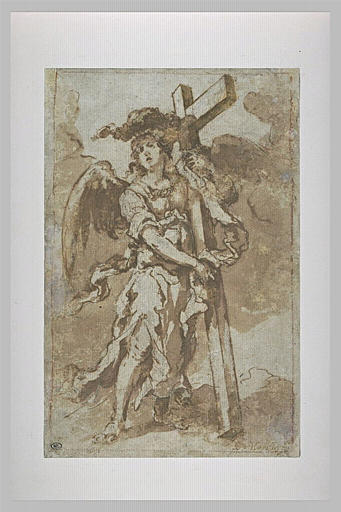
“Angel Carrying the Cross,” created around 1660 by Bartolomé Esteban Murillo, is a small but powerful meditation on faith, sacrifice, and consolation. Unlike Murillo’s colorful altarpieces and genre scenes, this work is executed in a restrained monochrome palette, probably using pen, ink, and wash. The limited color heightens the spiritual atmosphere. The viewer’s attention is drawn to line, gesture, and symbol rather than to decorative detail.
At the center of the composition stands an angelic figure, youthful and graceful, carrying a large cross that nearly equals the height of the figure itself. While Christ is not present, the cross unmistakably evokes the Passion. Murillo invites the viewer to contemplate the instrument of suffering through the presence of a celestial messenger, a being who inhabits a realm where the meaning of the cross is fully understood.
The drawing reveals Murillo’s ability to convey emotion with a few carefully judged strokes. The angel’s flowing garments, the tilt of the head, and the firm grip on the cross all contribute to an image that is at once delicate and resolute. This work offers insight into Murillo’s devotional imagination and his working process as a draftsman during the mature phase of his career.
Composition and Overall Structure
Murillo organizes the composition around a strong vertical axis formed by the cross. The angel stands slightly off center, leaning toward the right, but the weight of the cross and the swirl of drapery bring the eye back to the middle of the sheet. The figure’s legs are planted on the ground, yet the lightness of the clothing and the suggestion of clouds behind the angel give the impression of hovering or gentle motion.
The cross is placed diagonally, rising from the lower right toward the upper left. This diagonal line introduces dynamic tension and suggests that the angel is in the act of bearing or presenting the cross rather than posing statically. The figure’s arms wrap around the vertical beam and the slanting crossbar, creating a visual embrace that expresses both responsibility and affection.
Around the main figure, Murillo keeps the space relatively open. There are hints of clouds and atmospheric strokes, but no heavy architectural framing. This open background suggests a heavenly environment without specifying a precise setting. The whiteness of the paper becomes a field of light in which the angel moves. The understated context ensures that the viewer’s focus never strays far from the relationship between the angel and the cross.
The Angelic Figure and its Gesture
The angel is portrayed with a youthful, almost androgynous beauty typical of Murillo’s angels. The face is softly modeled, with rounded cheeks, full lips, and large eyes. The expression seems both serious and tender, as if the angel is aware of the gravity of the symbol it bears yet approaches it with loving reverence.
The head is slightly tilted, a gesture that conveys humility and contemplation. This inclination breaks the strict symmetry of the vertical axis and introduces a gentle rhythm in the figure’s pose. The hair is rendered with quick, flowing strokes that echo the movement of the garments and contribute to the sense of lightness.
The arms play a crucial role in communicating meaning. One hand grasps the upright of the cross, providing stability, while the other appears to support the crossbar or to draw a fluttering ribbon or banderole closer to the wood. This ribbon may originally have been intended to bear an inscription, perhaps a short phrase related to Christ’s sacrifice. Whether or not any text is visible, the curving ribbon adds an element of grace and indicates that the cross is not merely an object, but a sign that can be read and contemplated.
The legs and feet are sketched with confident economy. The angel’s stance suggests forward movement, as if walking slowly while bearing the cross. The slightly bent knee and outstretched foot imply that this is a living, moving messenger, not an immobile statue.
Garments, Drapery, and the Sense of Movement
Murillo demonstrates his mastery of drapery in this work. The angel’s robe cascades in long, broken folds that follow the contours of the body while also swirling around it. With diluted ink and quick strokes, he creates folds that are at once descriptive and expressive. The garment seems to respond to an unseen breeze, reinforcing the impression that this is a celestial figure moving through airy space.
The belt or sash at the waist gathers the fabric and creates a focal point of structural tension. From there, the folds radiate downward, revealing the direction of movement. The edges of the cloth flutter outward, particularly near the feet, suggesting that the angel is advancing rather than standing still.
Using a limited range of tones, Murillo manages to indicate different textures. Some areas of drapery are treated with denser, darker wash to indicate shadow and weight, while other zones are left almost untouched, allowing the white of the paper to represent highlights. This play of light and shade gives the robe a sculptural quality and enhances the sense of a three dimensional body beneath the cloth.
The Cross as Central Symbol
The cross is the defining attribute of this angel and the central symbol of the composition. It is drawn in simple, solid lines, with minimal detail. The lack of ornament emphasizes its function as an emblem of Christ’s Passion rather than as a decorative prop. Its large size relative to the figure underscores its spiritual weight.
Carrying the cross is traditionally associated with Christ’s own journey to Golgotha. By assigning this role to an angel, Murillo shifts the scene from historical narrative to symbolic meditation. The angel carrying the cross can be interpreted as a heavenly being that contemplates, safeguards, or presents the mystery of redemption. It may also hint at the role of angels as companions of believers, helping them carry their own spiritual crosses.
The diagonal orientation of the cross can be read as a bridge between earth and heaven. Anchored near the angel’s feet yet reaching toward the sky, it visually connects the lower and upper parts of the sheet. The angel’s close physical contact with the cross, wrapping arms and perhaps even part of the garment around it, symbolizes the intimate link between divine love and salvific suffering.
Technique and the Language of Drawing
“Angel Carrying the Cross” is particularly valuable for understanding Murillo’s technique as a draftsman. The monochrome execution allows us to see his thought process without the distractions of full color. He uses pen or brush to lay down firm outlines, then enriches the forms with washes of diluted pigment. The resulting effect is both graphic and painterly.
The outlines of the figure and cross are clear but not rigid. Murillo varies line thickness to suggest depth and emphasis. Thicker lines accentuate the foreground contours, such as the nearest leg or edge of the cross, while lighter lines are reserved for distant or secondary elements.
The wash is applied with versatility. Broad areas of tone indicate large cast shadows, particularly on the robe and around the base of the cross. Smaller touches and hatching strokes define the folds, facial features, and feathers of the wings. By leaving certain areas of the paper nearly untouched, Murillo creates highlights that give the figure a luminous quality.
This technique suggests that the work may have served as a study or modello, perhaps for a larger painting or print that depicted an angel with an instrument of the Passion. Even if it was not directly transferred to another medium, the drawing showcases the preparatory discipline behind Murillo’s more finished works.
Light, Space, and the Sense of the Heavenly
Although executed with limited tonal means, the drawing conveys a convincing sense of light and space. The main light source appears to come from the upper left, creating shadows along the right side of the angel’s body and the cross. This directional light helps orient the figure in a three dimensional environment.
The background is treated with loose, cloudlike washes. There are no hard edges or strong contrasts in this zone, which suggests the indefinite atmosphere of the sky rather than a solid architectural space. The soft background contrasts with the crisp outlines of the figure, making the angel appear to emerge forward out of a hazy, spiritual realm.
Murillo carefully balances areas of high detail with zones of relative emptiness. The face, hands, and intersection of cross and ribbon receive the most attention, drawing the viewer’s gaze. The outer edges of the composition are more sparsely treated, permitting the eye to rest and reinforcing the impression of open air. This approach mirrors the artist’s work in oils, where he often surrounds principal figures with softly lit clouds, allowing them to stand out as focal points of devotion.
Baroque Spirituality and Murillo’s Angels
Murillo’s art is deeply rooted in the religious climate of seventeenth century Spain. Devotion to the Passion of Christ and veneration of angels were central aspects of Catholic spirituality at the time. Angels were seen not only as remote celestial beings, but as active guardians and messengers engaged in human salvation.
In “Angel Carrying the Cross,” Murillo combines two key motifs: angelic presence and the instrument of Christ’s suffering. The result is a visual embodiment of consolation. Instead of showing Christ bowed under the cross in agony, he presents an angel bearing it with quiet strength. This suggests that, in the realm of grace, the cross is no longer simply a burden, but a sign of victory and love.
Murillo’s angels often display childlike innocence or soft beauty, inviting viewers to approach the divine with trust rather than fear. Here, however, the angel has a slightly more solemn and elongated figure. The expression is not playful but contemplative. This tonal shift is appropriate for the subject, which concerns the weighty mystery of redemption. Yet the gentleness of the features and the graceful pose prevent the image from becoming harsh or austere.
Emotional Tone and Devotional Impact
The emotional tone of the drawing is one of quiet reverence. There are no dramatic gestures or violent contrasts. Instead, the viewer encounters a calm figure who holds the cross with both respect and familiarity. This calmness invites contemplation rather than shock.
The angel’s proximity to the cross can have a consoling effect on the believer. It suggests that the instruments of suffering are not abandoned or forgotten, but held in loving remembrance by heaven itself. For someone engaged in prayer, such an image could serve as a reminder that personal trials too are watched over, supported, and given meaning within a larger divine plan.
The monochrome medium also encourages meditative viewing. Without the distraction of rich colors, the viewer can focus on the lines and forms that communicate spiritual content. The restrained palette echoes the simplicity of pen and ink devotional drawings circulated in prayer books and small prints, yet Murillo infuses this simplicity with considerable grace and refinement.
Place within Murillo’s Oeuvre
While Murillo is best known for his large religious canvases and scenes of street children, his drawings reveal the foundation of his visual thinking. Works like “Angel Carrying the Cross” show how he developed compositions, explored gestures, and distilled theological themes into clear visual statements.
This drawing belongs to a broader group of images that depict angels holding objects associated with the Passion, such as the crown of thorns, the nails, or the chalice. Such images served both as studies for larger projects and as independent devotional works for collectors. They express Murillo’s interest in the interplay between heavenly beings and the instruments of salvation.
The date around 1660 places the drawing in Murillo’s mature period, when his style had reached a high degree of confidence and softness. Comparing this work with his painted altarpieces from the same decade, one can observe similar compositional strategies. In both media he favors flowing drapery, gentle diagonals, and luminous atmospheres that draw viewers into a world of interior devotion.
Conclusion
“Angel Carrying the Cross” by Bartolomé Esteban Murillo stands as a subtle yet profound reflection on the mystery of the Passion as seen through the eyes of heaven. Using limited means pen, ink, and wash the artist creates a graceful angelic figure whose intimate embrace of the cross expresses both reverence and love.
The composition, centered on the diagonal of the cross and animated by the angel’s gentle movement, leads the viewer into a quiet contemplation of sacrifice and consolation. Murillo’s sensitive rendering of drapery, careful modulation of light and shadow, and delicate facial expression reveal his mastery as a draftsman and his ability to invest even small works with theological and emotional depth.
Within the context of Spanish Baroque spirituality, this drawing invites believers to see the cross not only as a burden but as a treasured sign of redemption, cherished by the angels themselves. For modern viewers, the work continues to offer a moment of stillness, where line and symbol combine to speak of faith, hope, and the enduring presence of grace.