Image source: wikiart.org
Introduction
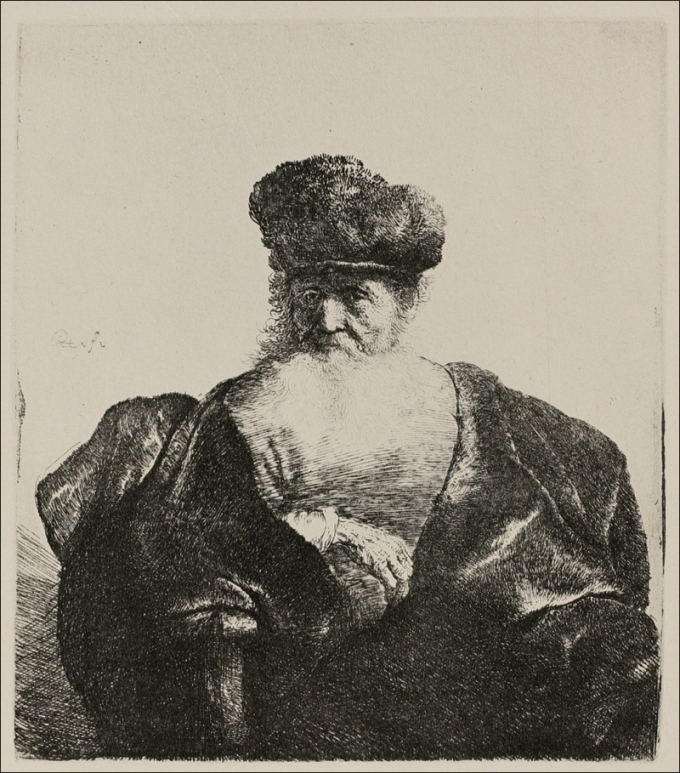
Rembrandt’s “An Old Man with a Beard, Fur Cap and a Velvet Cloak” (1632) is a compact masterwork of presence forged entirely from ink, copper, and air. Within the square of the plate an elderly sitter advances toward us, his head capped by a dense pelt of fur, his shoulders engulfed in velvet that drinks light, his beard flowing like a pale river across the chest. Nothing distracts: no architectural frame, no emblem, no anecdotal prop. The likeness is constructed from contrasts—blacks that seem cut from night; a white, breathing beard; mid-tones that feather into skin. It is as if Rembrandt asked how few elements are needed to build authority and then answered with a gaze, a garment, and the tense quiet of a hand.
A Moment Of Arrival In Amsterdam
The year 1632 marks Rembrandt’s early Amsterdam ascent. Fresh from Leiden, he was conquering the city with portraits and biblical dramas while experimenting relentlessly in etching. This print belongs to the cluster of mature, suddenly confident works where he elevates the single head into a public event. While the subject is anonymous, the image carries the weight of civic portraiture: the fur cap signals winter and rank; the velvet cloak suggests prosperity; the assertive scale places the figure close, the way a patron might lean across a table to speak. It is the face of Amsterdam’s new elite rendered with the empathy and daring that became Rembrandt’s signature.
Composition As Compressed Architecture
The composition is built from three blocks of value. At the bottom and sides, the velvet cloak forms a dark mass—broad, asymmetrical, and richly textured. Above it, the beard opens a luminous clearing that pushes the head forward like a pedestal of light. The fur cap caps the structure with another dark slab whose rounded top echoes the curve of the skull. These stacked zones make a simple, powerful architecture, a temple for a face. The shoulders spread beyond the frame’s midline, giving the old man a commanding breadth. The left hand, partly hidden, presses the cloak into place and quietly completes the pyramid. Nothing feels accidental; everything contributes to stability and poise.
Chiaroscuro That Thinks
Rembrandt’s chiaroscuro is not a special effect; it is the picture’s intelligence. Light comes from the upper left and scuds across surface like thought. It grazes the cap’s ridge, wicks into the beard’s curls, and skids across velvet only where pile catches the ray. Shadows are not holes; they are breathable densities varied by cross-hatching and plate tone. Look at the cheeks where shadow meets stubble: the transitions are slow, almost moral in their restraint. Light offers clarity without cruelty. Darkness protects the sitter’s dignity while making the visible passages blaze. The balance gives us not a theatrical apparition but a human being in air.
The Language Of Etched Line
Etching records touch with forensic fidelity. Rembrandt’s needle defines form with a vocabulary that ranges from wiry, hair-thin tracings to meaty, gouged strokes that hold thick ink. The beard is the triumph: hundreds of tiny arcs interlock but never tangle, letting light enter between strands. The fur cap exchanges curls for pelt; its marks are shorter, stippled, and directionless, imitating the way light scatters on fur. The velvet cloak receives broad, sloped hatchings broken by flashes of bare paper that read as crushed highlights on pile. The hand emerges from a burst of cross-lines and a few confident contours; it is more suggestion than anatomy, yet it convinces because the pressure and angle are right. Everywhere, the line serves the physics of materials.
Textures And The Morality Of Surface
Rembrandt’s realism is never inventory but ethics. Fur and velvet are shown as heavy, costly, tactile—yet neither steals attention from the face. The richest passages of texture live in the borderlands where cloth meets skin or beard meets collar. There, the print testifies to time: the beard grows long because years have passed; the velvet sits well because the wearer has earned comfort. Luxurious surfaces are subordinated to experience. The old man does not wear the garments; he inhabits them. The viewer senses warmth under the cap, weight on the shoulders, the slight tickle of beard against cloth. Texture becomes a form of sympathy.
The Face And Its Quiet Force
The sitter’s gaze is steady but not hostile, shaded by the cap’s brim and framed by wisps of hair. The eyes are merely pockets of tone with small catches of light, yet they command the space because all other vectors aim toward them: the beard’s flow, the shoulder slopes, the inward fold of the cloak. The mouth descends into a wry line softened by mustache; the nose, modeled with a sparing wedge of light, is assertive without dominance. Nothing is idealized. Pores, wrinkles, and the slight sag of aging muscles are rendered not as pathology but as evidence. The result is a paradox: the man’s authority stems precisely from his vulnerability to time.
Gesture, Hands, And The Psychology Of Weight
Hands in Rembrandt often carry unspoken biography. Here, the right hand clutches the cloak’s lapel, a small act that both arranges garment and composes dignity. The gesture reads like a reflex learned over many winters: pull fur into warmth, brace against weather, secure one’s place before speaking. Because the hand is partly engulfed by shadow, it feels tentative, a private habit caught in public space. This intimacy offsets the image’s grandeur, reminding us that strength and self-care coexist.
The Stage Of Negative Space
The upper half of the sheet is largely unworked paper. This void is not laziness; it is the acoustics of the print. Against that expanse, the head and garments acquire sculptural relief, as if pressed forward by the emptiness behind. The left margin shows a sliver of softly hatched wall, a nearly invisible cue that locates the body in a room rather than a vacuum. By refusing background anecdote, Rembrandt invites the viewer to supply setting and story. The figure becomes exemplary without becoming abstract.
Plate Tone, Wiping, And The Image’s Weather
Impressions of this print can vary widely. When the plate is wiped clean, the whites ring with icy clarity and the cloak’s hatchings read like crisp topography. When Rembrandt or a later printer leaves a film of ink—plate tone—the air around the figure deepens into a soft haze that feels like indoor dusk. The difference is dramatic: one version presents an almost sculptural presence; another wraps the sitter in warmth and time. This plasticity is not incidental. Rembrandt considered printing a second stage of composition, using ink and cloth as atmospheric instruments.
Dress, Status, And Dutch Civic Identity
Fur cap and velvet cloak are not merely stylish; they broadcast status in the Dutch Republic. In a mercantile culture that favored sober display, texture and cut mattered more than heraldic blazon. Rembrandt exploits this code while keeping the picture humane. The garments confer rank, but the face confers personhood. Even if the sitter is anonymous, he reads as a representative of Amsterdam’s citizen rulers—wealthy, experienced, deliberate—whose power derived not from aristocratic birth but from trade and governance. The print therefore operates at two registers: a specific portrait of an aging man and a symbolic portrait of civic authority.
Kinship With Contemporary Heads And Studies
This old man belongs to the company of Rembrandt’s “tronies,” character heads used as studies for paintings and as collectible prints in their own right. Compared with the theatrical tronies of soldiers and orientals from the same period, this plate is more severe, more northern in its restraint. It shares with painted works like “Old Man with a Black Hat and Gorget” the love of large forms and solemn light. Yet the etching adds a quickness that oil cannot match: the beard’s scribble breathes, the cloak’s hatchings vibrate, and the eyes catch light with the sharpness of a needle mark.
A Close Reading Of The Beard
The beard is the picture’s most audacious device: a blazing wedge of paper shaped only by surrounding darks and the subtlest web of line. It functions as lamp and pedestal, a luminous buffer that separates garments of status from the thinking head. Study the lower edges where shadow feathers into light; the boundary is rarely a single stroke. Instead, Rembrandt uses soft cross-hatching that thins gradually, letting the paper’s whiteness do the final modeling. By refusing to overdraw, he preserves the beard’s airy volume. Its brightness becomes a kind of moral light, earned rather than imposed.
How To Look, Slowly
Begin at the cap’s crown and feel how the stippled marks splinter light like frost on fur. Slide down to the eyes, noticing how a few dark pools and two tiny highlights establish scrutiny and thought. Let your gaze fall to the beard’s upper shelf, where faint hatches lay a path of shadow across the cheek and mouth; here the face softens from authority into fatigue. Cross to the right hand and watch the contour kink at the knuckle, a minute admission of grip. Now roam the cloak’s valleys and ridges, where broad diagonals and broken highlights make velvet read as matter you could press with a palm. Step back and the architecture reasserts itself: cap, beard, cloak—three simple chords sustaining a human presence.
Sound And Silence In A Silent Medium
Even in a print, Rembrandt suggests an acoustic. The compact shape of the figure against the void generates a hush, like a room waiting for speech. The fur and velvet, heavy and absorptive, seem to deaden noise; the beard could whisper if stirred. The etched surface, with its fields of closely knit lines, carries a visual buzz that the mind translates into the faint rustle of cloth. This sonic imagination deepens the viewer’s sense of being there.
Why The Image Still Feels Modern
The print’s modernity lies in its economy and its faith in large shapes. Designers today speak of positive and negative space, of brand marks built from value blocks; Rembrandt does the same at human scale. He trusts a triad of forms to shoulder meaning and lets detail serve, never lead. He also refuses sentimental narrative. Age is presented as fact, dignity as posture, wealth as texture. The result is a portrait that feels honest enough for our century’s eyes.
Meaning Without Allegory
There is no explicit emblem here, no Latin motto, no allegorical attribute. Yet the image carries meanings that centuries recognize: the gravity of experience, the warmth of winter garments against northern cold, the proximity of power and vulnerability. The old man’s cloak becomes a reminder that civilization is a fabric we continually pull around ourselves, while the beard’s light suggests inner life that persists despite time. It is a secular sacrament of attention.
Legacy And Collecting
Rembrandt’s etched heads were prized by collectors even during his lifetime because they offered mastery at a domestic scale. They could be held, studied by lamplight, and compared impression to impression. This plate’s play between radiant beard and swallowing velvet became a touchstone for later printmakers exploring how to make white paper blaze without pigment. It also influenced painters who sought to knit costume and psychology into a single, legible silhouette.
Conclusion
“An Old Man with a Beard, Fur Cap and a Velvet Cloak” is a lesson in how presence can be summoned from the simplest means. A dark garment, a bright beard, a fur cap, and a face that refuses exaggeration—these are the instruments. Rembrandt arranges them with architectural clarity and then animates them with light that behaves like understanding. The print holds together grandeur and humility, surface luxury and inner patience, public authority and private fatigue. Four centuries on, the old man still advances out of the white field toward us, asking nothing more than that we meet his gaze and acknowledge the life the lines contain.